10 Channel Strategy Examples for B2B SaaS in 2026
Parth Jasrapuria
Founder
The channel plan looked great on paper. A B2B SaaS team had a polished video, a carefully designed landing page, and a paid campaign ready to launch. Three months later, the team had published one video, checked the view count once, and blamed the algorithm. The algorithm, naturally, had no lawyer.
That pattern is common because channel strategy sounds strategic even when it's only a list of platforms. LinkedIn gets a budget. YouTube gets a login. Search gets a few articles. Nobody decides how the pieces should work together.
The channel strategy examples below use the same practical lens every time: format, publishing cadence, target ICP, KPIs, and business outcomes. Each example also includes a first move a B2B SaaS team can copy next week and a trap worth avoiding. The focus stays on useful systems, not a parade of famous logos with suspiciously perfect results.
For broader planning, teams can also review this guide to sequencing outbound content and paid ads.
1. YouTube Long-Form and Short-Form Clip Repurposing
One strong long-form video can become the raw material for an entire content run. A B2B SaaS team might publish an SEO-focused YouTube lesson on reducing customer churn, then cut practical moments into Shorts, LinkedIn clips, TikTok videos, and Reels.
A useful format is an 8 to 15 minute educational video with a clear problem, a few useful sections, and a direct next step. The publishing cadence can be weekly or fortnightly, depending on production capacity. The ICP might be a Head of Growth, CMO, or founder who wants tactical guidance rather than another product tour.
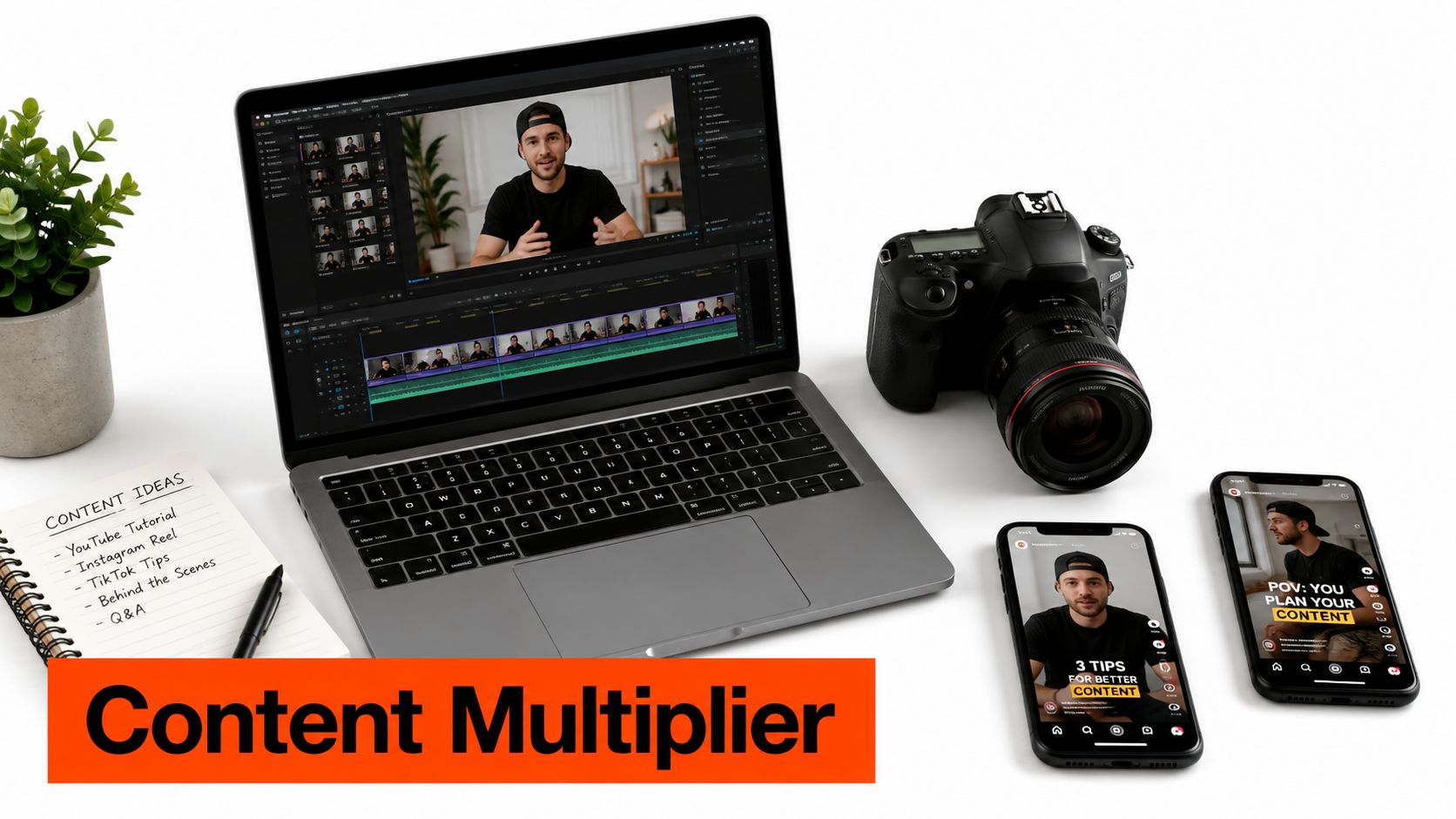
The KPI set should connect attention to demand. Track qualified views, average percentage viewed, search traffic, clicks to the site, engaged target accounts, and enquiries. A UK professional-services firm using YouTube grew from 6 videos in month 1 to 28 by month 6, while monthly views rose from 180 to 3,200. YouTube search traffic increased from 34% to 71%, and six month-six enquiries cited a specific video, according to the reported YouTube case study.
The operating model
Shoot with vertical repurposing in mind. Leave room for captions, use cutaways, and record clean sections that can stand alone. Short clips need an immediate hook, because a slow introduction is a polite invitation to scroll.
A practical distribution system should also separate discovery from depth. The long-form video answers the full question. The clips highlight one useful point and send interested viewers toward the longer asset. Guidance on distributing video content can help teams connect those formats without turning every platform into a copy-paste bin.
First move next week: choose one buyer-intent question, record one useful long-form answer, and mark five moments during editing that can become short clips.
Common trap: publishing clips with no relationship to the main video. Random snippets may earn views, but they won't necessarily attract the right ICP or create a useful path to conversion. Teams can study approaches to scaling short-form video workflows while keeping the buyer question at the centre.
2. Animated Explainer and Paid Ad Creative Workflow
Complex software often loses buyers before the product gets a fair hearing. An animated explainer can translate a technical workflow into a simple story, then supply the base creative for paid campaigns across YouTube, LinkedIn, and Meta.
The core format is a 60 to 90 second animation. It should start with the customer's problem, not a logo performing a dramatic entrance. One idea every few seconds keeps the narrative moving. The same script can be rendered in horizontal, vertical, square, and feed-friendly formats.
A workflow automation company, for example, might explain how disconnected approval steps create delays. The first version can introduce the problem, show the workflow, explain the product's role, and finish with a demo invitation. Paid variants can then change only the opening hook, such as speed, visibility, or reduced manual work.
Where the economics improve
The KPI isn't merely completed views. Track qualified click-through rate, landing-page conversion, cost per qualified lead, lead quality, and sales-accepted pipeline. One B2B paid-video campaign started at approximately $120 cost per lead for personalized video, compared with about $115 for a standard control. After testing introductions, calls to action, thumbnail behaviour, watch time, and demo-request cost per lead, the personalized variant reached approximately $72 CPL, a 40% reduction from its $120 baseline, while the control stayed near $115, as described in the campaign report.
The lesson isn't “add personalization and wait for miracles.” The improvement came from testing the opening, CTA, and conversion path together. A polished animation with a weak landing page is still a polished way to waste attention.
First move next week: write three openings for the same explainer, keeping the audience, offer, and landing page stable.
Common trap: making one expensive master video and refusing to adapt it. Paid channels reward learning, not artistic attachment.
3. LinkedIn Thought-Leadership Video Series
A founder or senior operator can build authority faster by explaining how the market works than by repeating product features. A native LinkedIn series works well when the speaker shares a clear opinion, a useful process, or a hard-earned lesson without turning every post into a sales pitch.
The format is a 3 to 5 minute video, filmed vertically or square for mobile feeds. A weekly cadence gives the audience a reason to return. The ICP could include revenue leaders, operations executives, or technical buyers who want to understand the category before speaking to sales.
A founder of a data platform might publish a weekly answer to questions such as, “Why dashboards fail after implementation,” or, “What procurement teams need from security documentation.” The speaker doesn't need a television studio. A clear point, clean audio, captions, and a relaxed delivery beat corporate wallpaper.
Make authority measurable
Track qualified video views, saves, comments from target accounts, profile visits, branded search, newsletter sign-ups, inbound conversations, and speaking invitations. LinkedIn's B2B research reports that video objectives are distributed across brand awareness at 35%, trust and credibility at 29%, and conversions or sales at 23% in its cited research on video's role in B2B marketing.
That split matters. An opinion video shouldn't be judged like a demo ad. A useful thought-leadership asset may create familiarity and retargeting audiences before a later conversion asset does the selling.
Practical rule: let the speaker sound like a knowledgeable colleague, not a press release with a pulse.
First move next week: record three short answers to questions sales reps hear repeatedly, then publish the strongest one with captions.
Common trap: over-polishing the content until nobody sounds human. B2B buyers already have enough videos where every sentence passed through six approval meetings.
4. Product Demo and Customer Testimonial Mashup
A demo shows what the product does. A testimonial shows why anyone should care. Combining both creates a stronger decision-stage asset than either one alone.
The format can run for 2 to 3 minutes, with a short customer soundbite inside the product story. A useful structure is problem, demo, customer evidence, and CTA. The ICP might be a buying committee evaluating implementation risk, time savings, integration complexity, or internal adoption.
A scheduling platform could show a meeting request moving through the workflow, then let a customer explain how the change affected the team's day. The product footage supplies proof of functionality. The customer supplies context that a product marketer can't manufacture.
Keep the proof specific
Choose customers who can explain a real outcome, not just say the product is “easy to use.” Sales teams should help identify stories involving faster onboarding, fewer manual steps, improved visibility, or a simpler tool stack. If the customer's environment can appear on screen, the story usually feels more credible than a studio interview beside a decorative plant.
Track qualified views, demo-page visits, assisted conversions, sales usage, opportunity progression, and questions raised during calls. The video should answer objections, not create a new mystery about whether the customer uses the product.
The testimonial video production guide offers a useful framework for connecting customer evidence with product footage.
A product-and-proof narrative can also live inside a wider sales or campaign flow:
First move next week: ask one customer to describe the old process, the product change, and the clearest business consequence in separate answers.
Common trap: using vague praise as evidence. “Great platform” is pleasant, but it doesn't help a nervous buying committee make a decision.
5. SEO-Backed Pillar Video and Blog Cluster
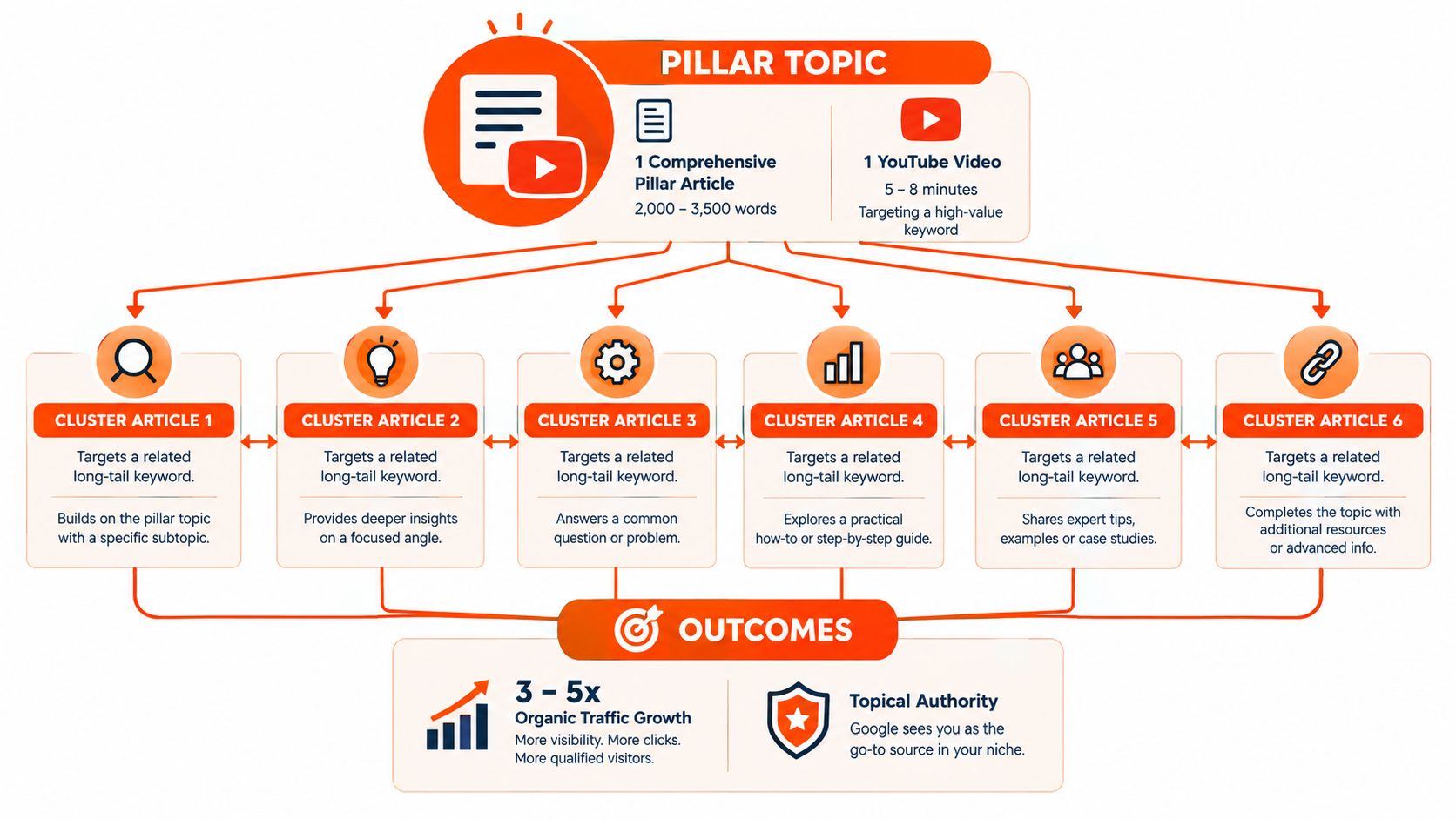
Search and YouTube often belong in the same channel strategy. Among surveyed B2B buyers who searched online for a product, 94% used Google Search, while 60% watched a product or service tutorial on YouTube and 63% visited the brand website, according to the Google B2B buyer journey research.
A SaaS company selling warehouse software could build a pillar article around warehouse management software, produce a five-to-eight-minute explanatory video, and publish supporting articles on inventory visibility, barcode workflows, reporting, and implementation planning. The article catches research intent. The video demonstrates understanding. The website gives the buyer a place to evaluate the offer.
The format works best as a connected system. One substantial pillar page supports related cluster articles, while the video answers the same question in a more visual way. Internal links should guide readers between the assets rather than leave each page stranded like a lonely airport suitcase.
Measure the whole stack
Track non-branded organic impressions, rankings, qualified organic sessions, video engagement, assisted conversions, demo requests, and sales conversations influenced by the cluster. The outcome isn't traffic. A large audience with no relationship to the ICP can make a dashboard look festive while revenue remains unimpressed.
Use FAQ or How-To structured data only when the page genuinely contains that information. Refresh the pillar and supporting pages when the product, search intent, or market language changes.
First move next week: choose one high-value buyer question, outline the pillar page, and record the video outline from the same research.
Common trap: writing disconnected articles that all target the same broad phrase. A cluster needs distinct jobs, not six versions of the same paragraph wearing different hats.
6. Ad Creative Testing and Rapid Refresh
Paid channel performance rarely improves because a team discovers one perfect ad and frames it forever. Creative fatigue, audience differences, and changing objections require a testing rhythm.
A practical workflow introduces 2 to 4 new variations every two weeks, with one meaningful variable changed per test. The variable might be the opening hook, visual, headline, CTA, or proof point. The ICP stays stable while the creative question changes.
A cybersecurity company could compare a risk-led opening with a product-screen opening and a customer-story opening. A productivity platform might test time saved against fewer manual steps. The point isn't to make the ads look different for decoration. The point is to learn which message attracts qualified demand.
Test for pipeline, not applause
Track click-through rate, watch time, landing-page conversion, qualified cost per lead, sales acceptance, opportunity creation, and pipeline progression. LinkedIn reports that videos showing a brand logo within the opening two seconds achieved an average 17% lift in click-through rate, based on its B2B video advertising research. That result is a testable idea, not a universal commandment. A logo-led opening can win clicks and still attract weaker leads.
Keep a creative playbook with winning hooks, objections, proof types, and audience notes. Sales feedback belongs in that document because the ad platform doesn't attend discovery calls.
The ad creative testing framework can help teams turn refreshes into a repeatable process.
First move next week: write one hypothesis, create two versions that differ in one place, and define the downstream KPI before launch.
Common trap: changing the hook, audience, budget, landing page, and offer at once. That produces a result, not a lesson.
7. Podcast Repurposing Into Ten or More Assets
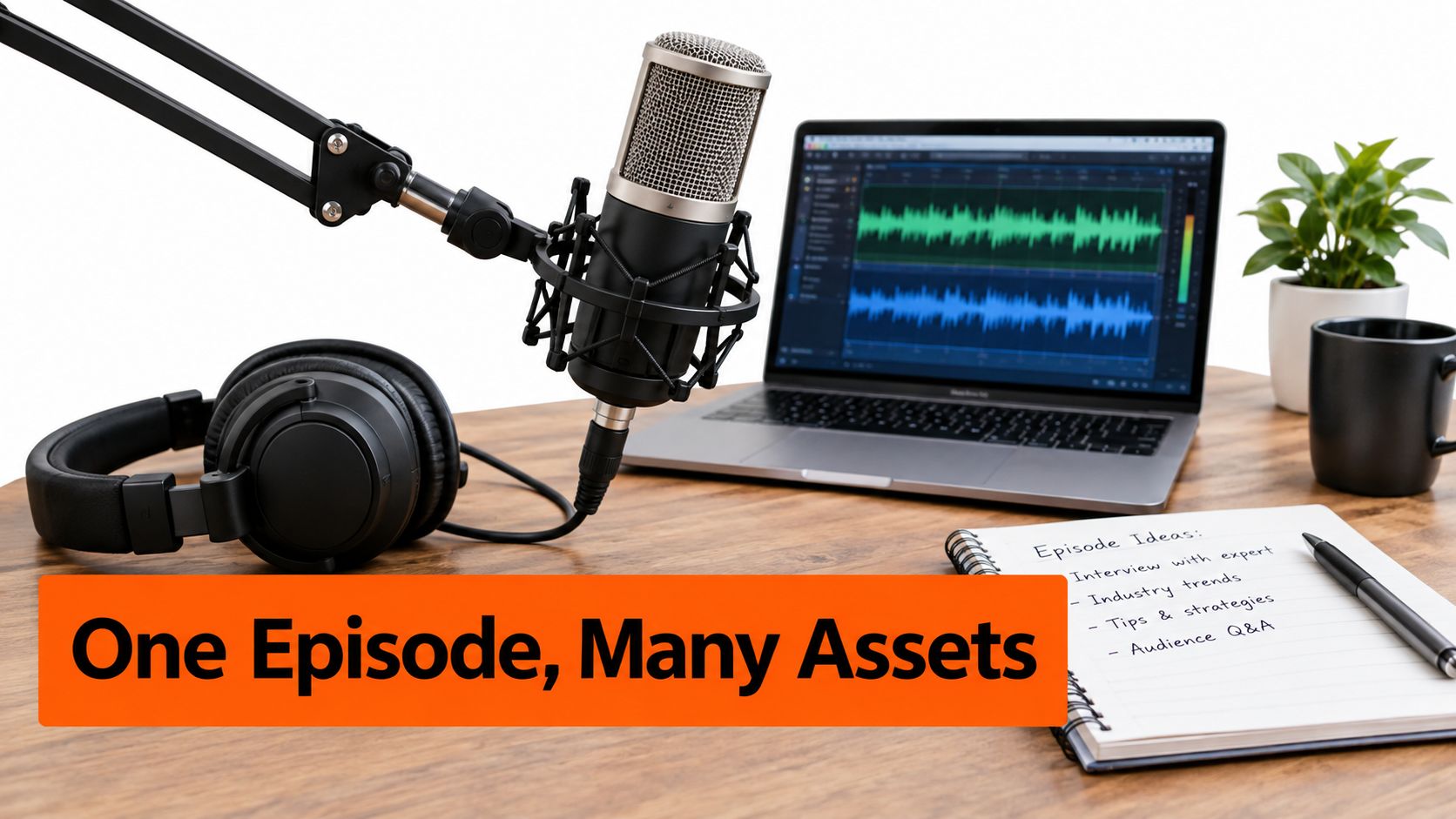
A podcast can become a content engine when the recording is planned for extraction. The useful unit isn't the episode alone. It's the collection of stories, answers, examples, and disagreements hiding inside the conversation.
The core format is a 45 to 90 minute interview or roundtable. A B2B SaaS team can turn it into a full YouTube episode, short clips, a transcript-led article, an email sequence, LinkedIn carousels, quote graphics, and sales snippets. The ICP might include technical leaders and operators who prefer learning from practitioners rather than product pages.
A customer operations podcast could ask one guest how the team handles onboarding handoffs. During recording, the producer marks a story about the old process, a useful framework, and a surprising failure. Those moments become separate assets with different openings and calls to action.
Give every asset a job
The full episode can build depth. Short clips can create discovery. The article can capture search intent. Email can bring existing subscribers back into the conversation. Guest distribution can introduce the episode to a relevant professional network. A B2B podcast marketing strategy becomes much more useful when the team designs those handoffs before recording.
Track qualified listeners, video completion, clip engagement, email clicks, target-account visits, enquiries, and guest-driven traffic. Captions matter because many viewers encounter video in quiet places, often while pretending to work during a meeting.
First move next week: book one expert conversation and prepare three questions designed to produce a story, a process, and a strong opinion.
Common trap: recording a long conversation with no extraction plan. A two-hour audio file isn't automatically a strategy. Sometimes it's just a very large editing bill.
8. Sales Enablement Video Library
Sales teams repeatedly answer the same questions. A short video library can give prospects a consistent explanation while helping reps spend more time on complex conversations.
The format is a collection of 90 to 180 second videos. Topics might include an integration walkthrough, a migration explanation, a security answer, a feature comparison, or a common implementation objection. The ICP changes by asset. A technical evaluator needs different evidence from a finance leader or a day-to-day user.
A CRM company might create one video on lead scoring, another on enterprise setup, and another on migrating from a competing system. Sales reps can send the relevant asset after a call, and marketing can update the video when the product changes.
Build from real conversations
Interview top sales reps and collect the objections that appear most often. Use the actual product interface rather than actors pretending to click invisible buttons. Give every file a searchable name and store the library in one location.
Useful KPIs include rep usage, prospect engagement, follow-up response, opportunity progression, sales-cycle movement, and outdated-content rate. The outcome is consistency and speed, not a public view count. A library can be private and still generate substantial value.
The best sales video answers the next question before the prospect has to type it.
First move next week: list the ten objections that appear most often in recorded calls, then script the shortest answer for each.
Common trap: producing a giant library before testing demand. A small set of frequently used videos beats a cinematic archive nobody can find.
9. Competitor Comparison and Differentiation Video
Buyers compare products whether a company participates or not. A clear comparison video can help them understand trade-offs before a sales call, provided the presentation is fair.
The format is a 3 to 5 minute comparison involving two or three named competitors. A project-management SaaS company might compare workflow flexibility, reporting, integrations, onboarding, and best-fit team size. The video should explain what to look for, show evidence, and acknowledge where other products may be a better fit.
That honesty is a feature. A comparison that pretends every competitor is useless sounds like a salesperson trapped inside a browser tab. Neutral framing also helps the content serve buyers who are still defining their requirements.
Protect credibility
Use current feature information, real screenshots where permitted, and clear caveats. Avoid claims that cannot be supported. If pricing is shown, add a date and explain what the comparison includes. The video should help a buying committee reach a shared shortlist, not merely win an argument in the comments.
Track comparison-page visits, qualified views, demo requests, sales usage, objections during calls, opportunity progression, and sales-cycle effects. Search demand may bring the asset to the right audience, while sales teams can use it when a prospect says, “The shortlist is down to you and one other vendor.”
First move next week: ask sales for the three comparisons buyers mention most, then define five neutral criteria before naming a winner.
Common trap: building a straw-man competitor. Buyers notice selective evidence quickly, and trust is harder to recover than a missed click.
10. Customer Success Story and Case Study Video
A strong case study follows a customer through a business problem, a decision, an implementation, and a result. It doesn't stop at a smiling interview and a sentence about loving the platform.
The format is a 5 to 8 minute documentary-style video. It can include customer interviews, footage of the customer's environment, product walkthroughs, before-and-after context, and outcome title cards. The ICP is usually in the decision stage, when proof from a similar company can reduce perceived risk.
A professional-services customer might explain how work was previously tracked across disconnected tools, show the new workflow inside the product, and describe what changed for managers and users. The product appears as part of the operating story rather than as a floating feature list.
Match proof to the buying committee
One viewer may care about adoption. Another may care about implementation effort. A finance stakeholder may need a clear business case. The edit should include enough evidence for those different roles without turning the video into a twelve-person panel discussion.
Track target-account views, sales-page engagement, influenced opportunities, stakeholder participation, demo conversion, and customer-story usage by sales. Nielsen's 2024 survey of nearly 2,000 global marketers found that companies planned to allocate more than 63% of media budgets to digital channels, while only 38% said they measured traditional and digital marketing together for ROI, according to the Nielsen Annual Marketing Report. A case study should therefore be measured across the journey, not treated as a digital asset in isolation.
First move next week: choose one customer with a clear before-and-after story and schedule a structured interview around problem, change, evidence, and lesson.
Common trap: asking the customer only, “What do you like about the product?” That question produces compliments. A case study needs consequences.
10 Channel Strategy Comparison
Strategy | Implementation complexity | Resource requirements | Expected outcomes | Ideal use cases | Key advantages & key risks
YouTube Long-Form + Short-Form Clip Repurposing (The Content Multiplier) | Medium–High: planning + strategic multi-format editing | One high-quality long shoot, skilled editors, repurposing tools, captions | Multiply content pieces, boost reach, improve YouTube authority and consideration | SaaS, professional services, B2B tech seeking discovery + awareness | Advantage: 5x content from one production, SEO + short-form awareness; Risk: complex editing, algorithm volatility, upfront production cost
Animated Explainer + Paid Ad Creative Workflow (The Conversion Engine) | High: script lock, animation pipeline, revision cycles | Animation artists, VO, motion designers, multiple aspect-ratios | Clear product understanding, scalable ad variants, improved conversion and recall | SaaS with complex value props, fintech, healthcare tech | Advantage: Simplifies complexity, reduces creative fatigue in ads; Risk: long lead time, high cost if low-quality, not ideal for live UI demos
LinkedIn Thought-Leadership Video Series (The Authority Play) | Medium: ongoing cadence and modest production | Leadership time, basic filming setup, editor, captions | Growing personal/company authority, inbound meetings, speaking opportunities | Founders, CMOs, VPs in SaaS and professional services | Advantage: Organic, trust-building momentum; Risk: requires strict consistency, slow results, personality-dependent
Product Demo + Customer Testimonial Mashup (The Social Proof Engine) | Medium–High: multi-speaker editing and narrative stitching | Demo recording, customer interviews, editors, possible multi-site shoots | Higher conversion through combined demo + social proof; reusable testimonial clips | Enterprise SaaS and platforms needing ROI proof | Advantage: Converts better than demo alone; Risk: recruiting customers, higher production and coordination effort, potential credibility loss if customer relationship changes
SEO-Backed Pillar Video + Blog Cluster (The Organic Growth Stack) | High: keyword research, long-form writing, cross-format production | SEO research, writers, video production, technical SEO setup, periodic updates | Compounding organic traffic, topical authority, lower long-term CAC | SaaS with long sales cycles, professional services seeking scalable inbound | Advantage: Long-term, compounding organic growth; Risk: slow to rank, requires maintenance and strong upfront research
Ad Creative Testing & Rapid Refresh (The Performance Optimizer) | Medium: disciplined, repeatable testing process | Ongoing creative production, testing budget, analytics, fast iteration team | Lower CPL, faster learning, library of proven creative | Performance marketers on Meta, LinkedIn, YouTube where CPL matters | Advantage: Prevents ad fatigue and speeds optimization; Risk: requires testing budget, statistical volume, and process discipline
Podcast Repurposing: One Episode = 10+ Assets (The Multiplier Effect) | Medium–High: heavy editing to produce many formats | Recording environment, editors, transcript service, repurposing workflow/tools | Many assets per episode, authority, multi-platform reach | B2B podcasters, founders, thought-leaders maximizing content ROI | Advantage: Extreme efficiency and library growth; Risk: high editing complexity, audio quality dependencies, not every episode clips well
Sales Enablement Video Library (The Conversation Shortcut) | Medium: large initial build with structured content | Production of 30–50 short videos, hosting/library, CRM/tracking integration | Shorter sales cycles, consistent messaging, measurable engagement signals | Enterprise sales teams, SaaS with complex sales motions | Advantage: Scales sales efficiency and onboarding; Risk: high upfront cost/time, adoption risk, needs frequent updates
Competitor Comparison + Differentiation Video (The Positioning Weapon) | Medium: research-heavy and fact-checked production | Product & competitor research, video production, legal/PR review | Addresses decision-stage objections, captures high-intent traffic, shortens sales cycle | Competitive SaaS categories where buyers compare vendors | Advantage: Builds trust via honest comparison; Risk: legal/PR issues, needs regular updates, can appear defensive if poorly executed
Customer Success Story + Case Study Video (The Proof Builder) | High: documentary-style shoots and in-depth interviews | On-site filming, customer access, skilled editors, metrics validation | Strong decision-stage asset, higher conversions, trusted proof for buyers and CFOs | Enterprise B2B where ROI proof is critical to purchase | Advantage: High-converting, credible storytelling with metrics; Risk: significant customer time, logistics and production complexity
Pick One Strategy and Ship It by Friday
The best channel strategy isn't the one with the most platforms. It's the one a team can publish consistently for a buyer who has a real reason to care. A lean SaaS team may get more from one searchable YouTube series and a sales library than from trying to maintain every social feed known to humanity.
Channel selection should follow purchase context. McKinsey found that B2B buyers used approximately five sales channels in 2016, rising to about ten by 2022, in research covering more than 3,800 B2B decision-makers and sellers across 13 countries. The channels included face-to-face sales, inside sales, ecommerce, mobile applications, social media, texting, and remote or self-service interactions, as described in McKinsey's B2B growth research. The practical lesson is coordination. A buyer should be able to move from search to video to sales without losing the thread.
That doesn't mean every SaaS company needs ten channels. It means a website, sales team, video library, email programme, and paid campaigns should not behave like separate departments sharing one confused calendar.
Match the channel to buyer familiarity
McKinsey's research also found that 76% of buyers said speaking with a salesperson was helpful when researching a new product or service. That preference fell to about 50% for repeat purchases with new or different specifications and to 15% when repurchasing exactly the same product or service. The same research found that 46% would be willing to purchase through a supplier website if the option were available and efficient, while only 10% were making online B2B purchases at the time, according to McKinsey's buyer-channel research.
For a new, risky purchase, educational video, technical documentation, webinars, and expert sales conversations may work together. For a familiar, standardised purchase, search, product pages, email, and self-service ordering may carry more of the journey.
Measure influence without pretending certainty
Attribution will never make a messy buying committee perfectly tidy. A 2025 benchmark discussion describes an average B2B journey lasting 211 days, involving 76 touchpoints, 6.8 stakeholders, and 3.7 channels, as reported in the Dreamdata benchmark discussion. That makes last-click reporting useful for some decisions but weak as a complete explanation.
Measurement confidence also suffers from fragmented data. One cited survey found that 49.5% of marketers identified fragmented data as a reason to distrust measurement, 48% cited cross-channel deduplication problems, and 40.8% pointed to walled-garden reporting limitations. Platform attribution was used by 65.8%, while 52.0% also used incrementality tests and 49.5% used marketing mix modelling, according to the marketing measurement report.
A practical measurement ladder starts with platform metrics for rapid creative decisions, CRM touchpoints for account progression, controlled tests for causal lift, and broader modelling for budget allocation. Track qualified pipeline, engaged target accounts, branded search, sales-cycle progression, stakeholder participation, and revenue. A channel that starts demand may look modest beside the final click, but it can still move the buying group forward.
The next move is simple. Choose the strategy that fits the buyer and the team's actual capacity, write down the one KPI it must move in the next 90 days, and publish the first asset before polishing the brand animation for the seventeenth time. Review results weekly. Keep the winning parts. Retire the theatre.
ContentBuck can support B2B teams with scripting, editing, YouTube production, animated explainers, ad creative, SEO content, and distribution under one operating system.
ContentBuck plans, produces, edits, and distributes video-led channel systems for B2B SaaS and professional-services teams, from YouTube series and explainers to ad variants, case studies, and repurposed podcast assets. Visit ContentBuck to turn one practical channel strategy into a publishing workflow the team can run.
Parth Jasrapuria
Founder at ContentBuck
Building video systems for B2B businesses. Obsessed with YouTube growth, creative strategy, and organic SEO.