Ad Creative Testing That Actually Works
Parth Jasrapuria
Founder
Most ad accounts do not need another targeting tweak. They need better creative, tested with discipline instead of hope and caffeine. When a team keeps swapping audiences while the core message stays mushy, it's usually just repainting the same leaky bucket.
Modern paid media has made that painfully clear. Creative quality explained 47% of performance variance across 2.4 million ad impressions in aggregated 2026 analysis, ahead of targeting and placement optimization, while 2025 to 2026 trend reporting also shows AI is changing production workflows fast, with 86% of DTC advertisers planning to increase AI use for research and ideation in 2025 and 79% expecting broader AI use in production (Motion). In other words, the winning question is less “which audience should see this?” and more “why would anyone stop for this in the first place?”
Why Your Targeting Tweaks Are Not Saving Your Ads
The old habit is comforting. Change the audience, change the lookalike, blame placement, then blame the algorithm when the same weak offer keeps limping along. That approach feels active, but it often ignores the part of the ad that persuades a human being to stop scrolling.

Creative is the lever, not the garnish
Ad creative testing has been around longer than anyone's favorite dashboard. Experimental ad campaigns were already being used in the early 20th century, Claude Hopkins later described coupon-based ad tests in Scientific Advertising in 1923, and Ronald Fisher's 1925 work on statistical methods helped make randomized experimentation and significance central to modern testing (Wikipedia overview of A/B testing). That history matters because the method was never about vibes. It was about isolating what changes response.
The same idea still applies in B2B and SaaS today. If the headline is clean but the value prop is vague, a new audience won't rescue it. If the video opens with a generic stock clip and the buyer can't tell what problem is being solved, more precise targeting just delivers the same flop to a slightly different room.
Practical rule: if the message doesn't work cold, it usually won't magically work warm. Retargeting can help, but it can't turn a bland idea into a convincing one.
The best teams treat ad creative testing like a permanent operating system, not a quarterly science fair. That mindset fits reality, because winning ads are rare. Independent 2026 benchmark coverage reports only about 4% to 8% of Meta ads become true winners, with one summary at 5% to 8% and another at 5% to 7% across audited accounts, while many advertisers ship 6 to 7 creatives per week and top-spend accounts produce 12 to 19 or more weekly (Opascope).
The ugly truth about over-focusing on audience
A better audience can help. A better creative compounds it. But a bad ad still looks bad in front of the right person, just faster. That's why seasoned teams stop treating targeting as the hero and start treating creative as the bottleneck.
For B2B buyers, the first proof point is rarely a clever targeting trick. It's whether the hook makes the problem feel immediate, whether the visual proves the claim, and whether the offer sounds like something a serious team would click. That's the part worth testing relentlessly.
Designing a Clean Test Without the Chaos
A clean test is boring in the best possible way. One change, one result, one decision. The second a campaign mixes three hooks, four visual styles, and a different CTA into one pot, the result becomes creative soup, and nobody can tell what made it taste weird.
Build the test around one variable
A good B2B video ad test isolates a single thing, like the opening three seconds, the core promise, or the proof frame that appears after the hook. Selzee's framework recommends separating the test from the core campaign structure, placing each creative test in its own ad group, and changing only one element at a time so the result can be attributed to a single variable rather than a compound effect (Selzee). That is the difference between learning and guessing.
Google Ads says the same thing in plainer language. Keep tests organized, document start and end times, set a clear testing threshold, wait for enough impressions before judging results, and limit how many elements change at once so the test stays learnable and doesn't turn into ad-confetti chaos (Google Ads testing guidance).
A practical setup looks like this:
Hook test: keep the body and CTA fixed, change only the opening line or first visual.
Proof test: keep the hook fixed, swap testimonial, demo, or customer logo treatment.
Offer test: keep message and format fixed, change the call to action or incentive framing.
Format test: keep the script fixed, compare talking-head, screen-record, or motion-led delivery.
Separate the variable, or the account will lie to you with great confidence.
For ad structure, Google Ads ad variations let marketers test one change across an account, campaign, or custom scope, and the setup includes an end date and a traffic split. Older setup guidance shows traffic splits can be set at 10%, 20%, 30%, 40%, or 50%, which makes the test design concrete instead of vibes-based (Google Ads ad variations). Google Ads custom experiments also let advertisers control duration and how much of the original campaign's traffic and budget is used, and if the split is cookie-based with audience lists, the list should have at least 10,000 users (Google Ads custom experiments).
A simple matrix for clean variable isolation
Element to Isolate | Primary Metric Impacted | Example B2B Variation
Opening hook | Thumb-stop or hold rate | “Stop paying for vague leads” vs “Your pipeline is leaking in the first 5 seconds”
Proof frame | Retention and click-through | Customer dashboard demo vs founder testimonial
Offer framing | Click-through and lead quality | Free audit vs strategy call vs product walkthrough
Visual style | Attention and watch time | Screen recording vs talking head vs animated explainer
If useful ad examples are needed for reference, MerchLoom's ad creative examples show how different formats can be structured without turning the whole test into a circus.
For planning how many variations to run, the answer belongs in this practical breakdown on how many ad creatives to test, because the central issue is not “more” or “less.” It's whether the test can still teach something by the time it's done.
Measuring the Right Metrics at the Right Time
A top-of-funnel video should not be judged like a closing-stage sales asset. That mistake kills good ideas early, usually right when the hook is starting to prove itself. The right way to measure is staged, because buyers move through stages, not through one giant conversion tunnel with a magic button at the bottom.
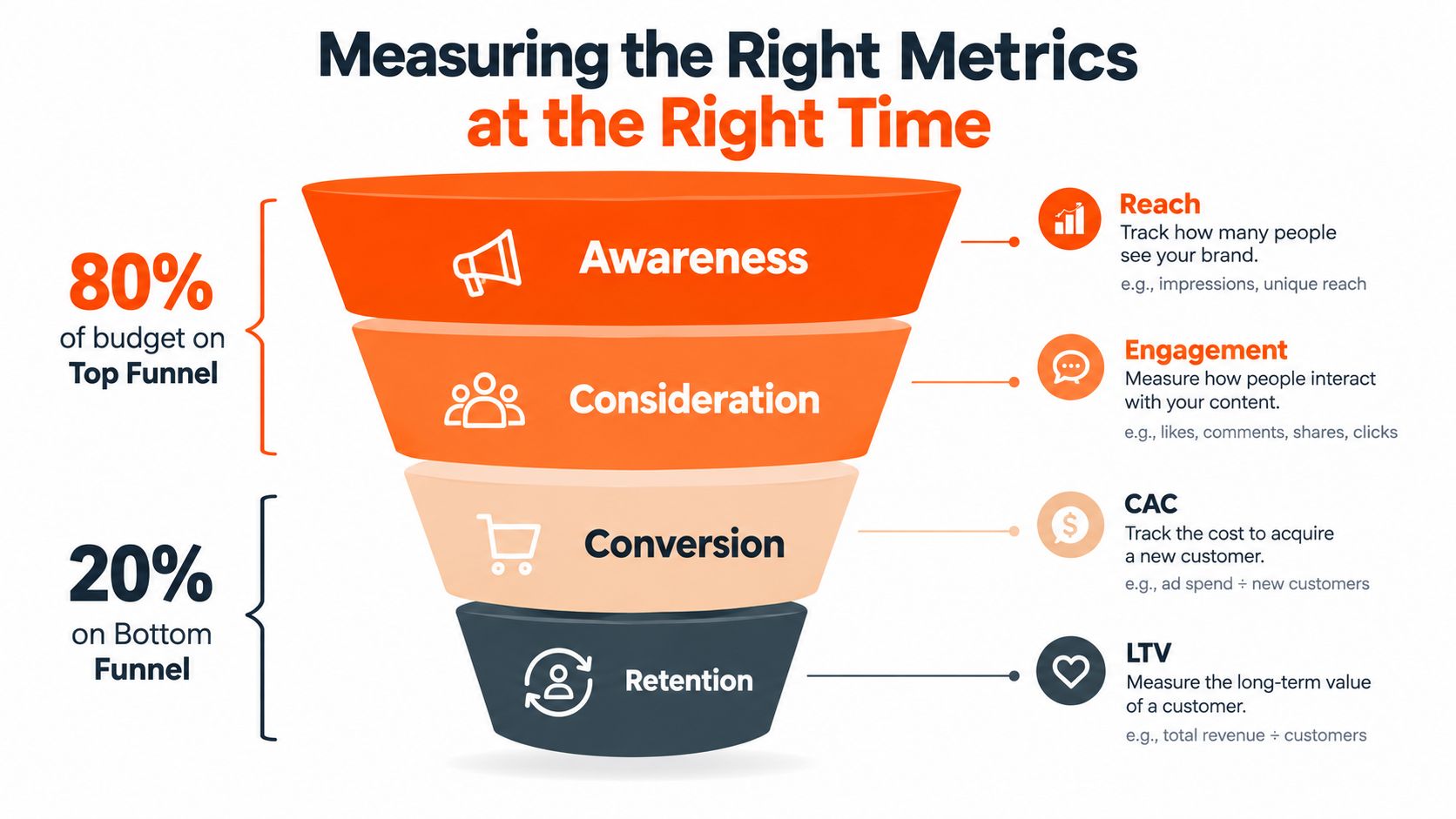
Measure the funnel in order
The cleanest approach is to move from attention to retention to intent to business outcome. That means the first question is whether the ad stopped the thumb. The second is whether people stayed with it long enough to understand the point. Only after that does click behavior matter, and only after that does lead quality or revenue matter.
This staged view is especially important in B2B software, where the buyer journey is long, committee-driven, and easy to misread. A video can generate a modest click rate and still be the strongest concept because it holds attention, explains the pain clearly, and attracts the right sort of account. A flashy ad can pull clicks and still be useless if the post-click audience has no intent.
CodeWords' automated A/B test analysis is worth a look for teams that want a more structured way to interpret results without staring at charts until midnight (CodeWords). Automation won't invent a better idea, but it can reduce the ritual of second-guessing weak tests.
Match the KPI to the job
Google Ads recommends building repeatable testing habits by staying organized, documenting timing, setting a threshold, waiting for enough impressions, and avoiding too many simultaneous changes (Google Ads testing guidance). That advice works because each metric should answer a specific question, not all questions at once.
Use this sequence:
Attention: track whether the opening frame earns a stop.
Retention: check whether the message holds through the middle.
Intent: watch clicks or site actions once the creative has earned interest.
Business outcome: evaluate lead quality, pipeline fit, or downstream conversion.
A common mistake is chasing click-through rate as if it were the prize. It isn't. It's a clue. If CTR rises but qualified leads drop, the creative may be attracting curious people instead of the right buyers, which is how a polished win becomes a sales-team complaint.
For teams building video systems, this guide to video ad services fits naturally with a measurement stack that starts with hooks and ends with revenue, not applause.
Building a Weekly Testing Cadence That Scales
A quarterly testing plan is just a calendar event wearing a strategy costume. Creative testing needs a weekly rhythm, because spend keeps flowing while the team waits for the next bright idea to show up.
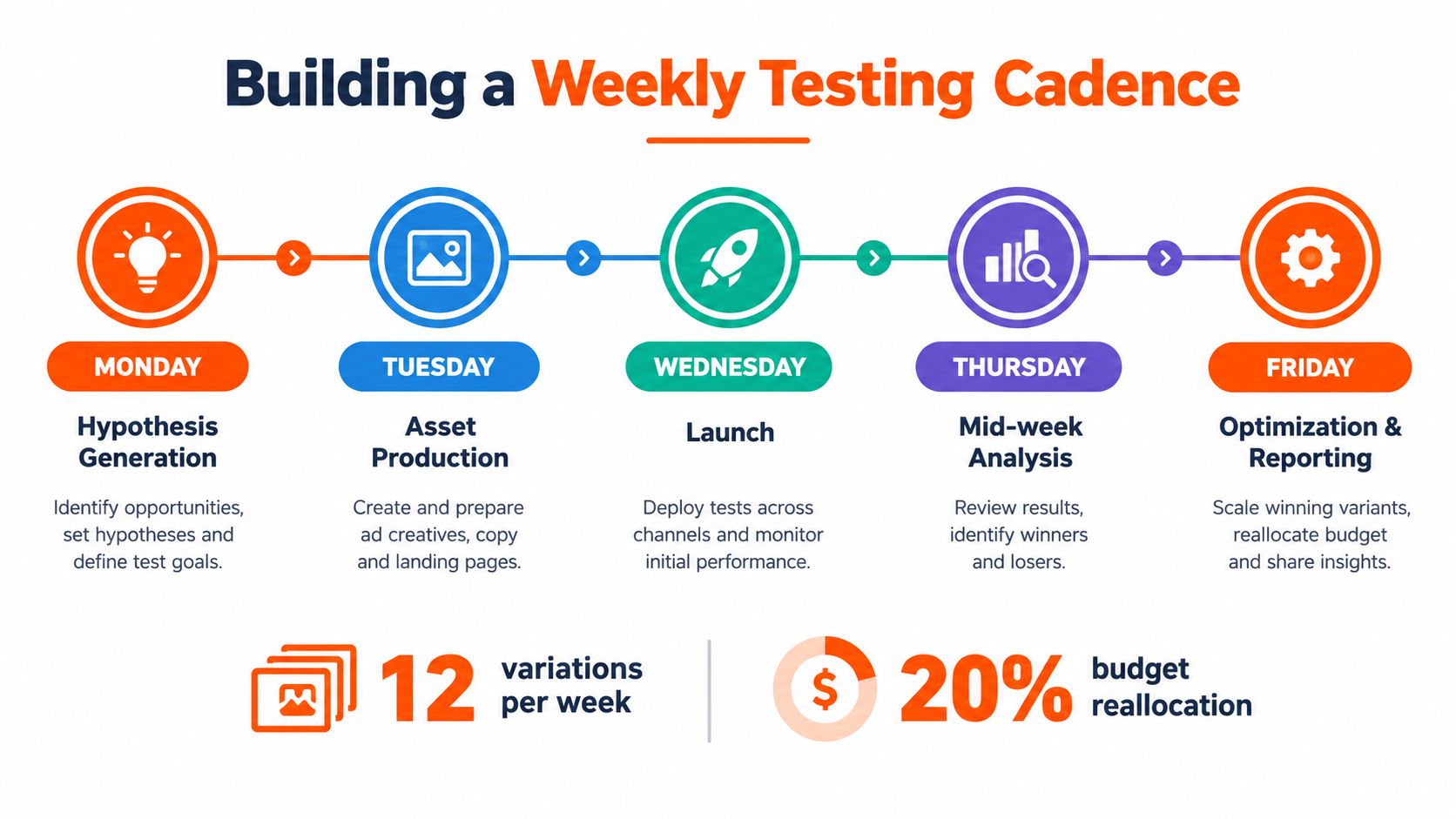
What a realistic week looks like
Monday is for hypotheses, Tuesday for production, Wednesday for launch, Thursday for review, and Friday for decisions. That rhythm keeps media buying and editing in the same conversation instead of letting them drift into separate little kingdoms.
For B2B teams, the weekly target usually looks different from a fast-moving DTC account. A long sales cycle means you are not chasing a single flashy winner, you are building a stream of usable video assets that can survive a longer evaluation window. That makes the production mix more important than raw volume alone. If one week's output is three decent hooks, one proof-heavy cut, and one teardown-style explainer, that is better than seven slightly different versions of the same ad with new thumbnails and old thinking.
Creative fatigue also changes the pace. One benchmark summary points to 23% of ad impressions wasted because of fatigue, and the same source advises refreshing Meta creative every 2 to 4 weeks and TikTok creative weekly to avoid decay (AdLiftr). That is the part people skip until performance starts looking like a used battery.
A practical weekly operating rhythm looks like this:
Monday, hypothesis: the media buyer writes one clear test question.
Tuesday, production: editors cut only the variants needed for that question.
Wednesday, launch: tests go live with fixed settings.
Thursday, review: weak assets are tagged, not defended in a group chat.
Friday, reallocation: budget shifts toward the assets that earned more runway.
Keep the output tied to the production reality. B2B teams often work from webinars, product demos, founder Q&As, and customer stories, then slice them into hook tests, proof clips, and format variations. That is a better weekly system than trying to invent a brand-new concept every Friday afternoon, which is how teams end up with ten “new” ads that all feel like the same tired pitch in different outfits.
The goal is steady options before the current winner goes stale. A weekly cadence works only if the team treats it as an operating system, not a one-off experiment with a prettier spreadsheet.
Solving the Production Bottleneck for B2B Teams
The biggest lie in performance marketing is that the answer is always “test more.” For lean B2B teams, the constraint is often production. A small in-house team cannot casually spin up polished video variations all week unless someone has invented a clone, and that clone is already booked solid.

Why volume breaks teams
The problem is not just workload. It is quality drift. When a team rushes to hit a testing target, hooks get weaker, edits get sloppier, and ideas start sounding like the same LinkedIn post in different outfits. The account ends up full of variants that are technically new but strategically dead on arrival.
Reusable source material is the cleaner answer. Long-form webinars, product demos, founder Q&As, and customer stories can be cut into hook variations, proof clips, and format tests. The production team then focuses on the first three seconds, the claim, and the visual proof, instead of rebuilding the whole ad from scratch every time.
For the full production workflow behind this loop, see the ad creative production process. ContentBuck is one example of a partner that runs ongoing unlimited ad editing with hooks and scripts included, so one core idea can become several testable variants.
A practical way to keep the engine fed
A solid production workflow does not need theater. It needs repetition.
Start from one core concept: one pain point, one promise, one proof point.
Cut three hook options: each opening should earn attention in a different way.
Keep the body stable: avoid changing too many moving parts at once.
Reuse proof assets: testimonials, screen captures, and customer logos travel well.
Retire weak ideas fast: do not keep feeding the account with stale concepts just because the edit looked expensive.
A common failure mode is treating editing like a one-off project. That leaves teams with a polished “hero video” and no second act. A testing system needs a bench, not a trophy shelf.
If production cannot keep pace with testing, the account will start recycling old winners long after they have gone soft.
The fix is a tighter loop between media buyers and editors. Buyers should brief the problem, not just the deliverable. Editors should know which hook failed, which proof angle held attention, and which format deserves another round. That feedback loop is where the volume comes from.
Common Testing Traps and How to Avoid Them
Most bad test results are self-inflicted. The ad wasn't cursed, the setup was messy. Someone changed the landing page, peeked too early, or declared victory after a handful of clicks because the dashboard looked flattering for one afternoon.
The usual ways tests go off the rails
The first trap is impatience. A test can look weak in the first stretch and still settle into a clear pattern later. That's why Google Ads recommends waiting for enough impressions, documenting timing, and setting a clear threshold before judging the outcome (Google Ads testing guidance). Without that discipline, every slight wobble becomes a dramatic theory.
The second trap is pretending small samples are meaningful. A few conversions can be enough to start a conversation, but not enough to crown a creative king. A test that barely got delivery may be a routing issue, not a creative issue.
The third trap is changing the landing page while the ad test is live. That muddies the waters instantly. The ad gets blamed for a page problem, and the page gets blamed for a message problem. Everyone loses, except the confusion.
For a useful comparison framework, AdStellar AI's guide to testing ads effectively is a practical companion when teams need a tighter checklist for interpretation and cleanup.
FAQ
How many creative variants should be tested at once? Enough to compare ideas without starving delivery. The exact number depends on budget and volume, but the test still needs enough room to learn.
Should AI-generated variations replace manual concepts? No. AI can help with volume and ideation, but weak strategy still produces weak ads faster. That's useful only if the team wants to fail efficiently.
Do platform algorithms choose the winner automatically? They distribute delivery, not strategic judgment. A platform can find the cheapest click today and still miss the better long-term concept.
When should a winning ad rest? When its performance starts decaying, when frequency climbs, or when the next challenger is ready. Winners are tools, not family heirlooms.
What's the cleanest sign a test is broken? If one major variable changed without anyone logging it, the result is contaminated. The account can't teach a clean lesson from a dirty experiment.
ContentBuck helps B2B teams turn one strong idea into a steady stream of video-led ad variants, from hook testing to editing and repurposing. If the current ad account needs a tighter creative system instead of more random targeting tweaks, visit ContentBuck and see how that workflow can fit into a real testing cadence.
Parth Jasrapuria
Founder at ContentBuck
Building video systems for B2B businesses. Obsessed with YouTube growth, creative strategy, and organic SEO.