SEO Content Writing: A Practical B2B Workflow for 2026
Parth Jasrapuria
Founder
A marketing lead opens the blog dashboard on Monday morning. Twelve articles went live last quarter. Total demo requests from those articles: zero. There's a familiar pain in that moment, because everyone did the work. Writers wrote. Designers designed. Someone even put a brave little traffic chart in the quarterly deck. The problem usually isn't effort. It's that the articles answered questions nobody with a budget was asking.
SEO content writing fixes that order. Start with what buyers search, give them a clear answer, prove it, then show a sensible next step. It sounds simple. Doing it well, week after week, is the actual craft.
What SEO Content Writing Actually Means
Think of a good SEO article as a shop sign on the busiest street in town. People walk past every day already looking for exactly what's sold inside. A weak article is a beautiful sign in an empty field. Lovely. Useless. Very peaceful, though.
In plain words, SEO content writing means writing pages that answer the questions people type into search engines, so the right buyers find a company before they ever talk to sales.

The Three Parts a Reader Must See
Every useful page shows three things fast:
The search question: The exact problem the reader typed, said back in normal language.
A direct answer: No warm-up act. No history of the internet since 1998.
A reason to trust it: A number, an example, a source, or an expert who has done the work.
Say a finance software firm writes a guide titled How to Close the Books Faster. A controller searches that phrase at 4 pm on a Tuesday, tired and a bit grumpy. The guide opens with a clear process, shows a real close calendar, and explains where delays hide. That's useful at 4 pm. A demo booking from that visit isn't magic. It's timing plus relevance.
The scale of the channel explains why teams bother. BrightEdge's Channel Share research, summarized in Elite Content Marketer's SEO statistics roundup, found that organic search generated 53.3% of all trackable website traffic in its 2019 dataset, compared with approximately 15% from paid search and 5% from social media. Treat that as a historical benchmark across a broad set of websites, not a promise for every industry or country.
For teams learning the mechanics, a plain-English walkthrough of optimizing articles for organic visibility helps separate writing choices from technical ones.
Start here: Write down two questions buyers ask on sales calls this week. Those questions are raw material for the next two articles.
SEO Content Compared With Other Content Types
Each content type has a different job, and mixing them up wastes budget. It's like asking a birthday cake to do the work of a weekly grocery shop. Both involve food. Only one feeds anyone on Tuesday.
Content type | Main goal | How long it keeps working | Typical format
SEO article | Earn search clicks from buyers researching a problem | Months to years | Problem guide or comparison page
Social post | Spark conversation and shares | Hours to days | Short text or video
Paid ad landing page | Convert clicks you have paid for | While the budget runs | Single-offer page
Thought-leadership essay | Build a point of view for existing readers | Short bursts among followers, rarely searched | Opinion article
A LinkedIn post about a product launch can do well on launch day, then fade by dinner. That's fine. Its job is a moment, not a library.
An SEO article on how to forecast customer churn works differently. A subscription business searches that problem every month, so a strong guide keeps pulling in readers long after publication. It continues to earn its keep, like a good dishwasher.
A paid landing page is rented attention. While money flows, visitors arrive. When spending stops, so does the traffic. A thought-leadership essay serves people who already know the author. It can sharpen a reputation, but strangers rarely search for someone's opinion by accident.
The Common Mix-Up
Say a company publishes a thoughtful essay about the future of work, then wonders why it doesn't rank for project management software pricing. The essay wasn't built for that search. The searcher wants prices, plans, and limits, not philosophy with a stock photo.
Ask two questions about any idea this week. Who is searching for this, and what will they do after reading it?
If nobody is searching, it may still be worth publishing. Just don't call it SEO content and then blame SEO when the phone stays silent.
Planning Buyer-Intent Topics Before You Write
Search intent is a simple idea with a fancy name. People searching are learning, comparing, or deciding, and each stage needs a different article. Giving a pricing page to someone who wants a basic explainer is like proposing marriage during a first coffee. Technically bold. Practically alarming.
The diagram below shows the three stages side by side.
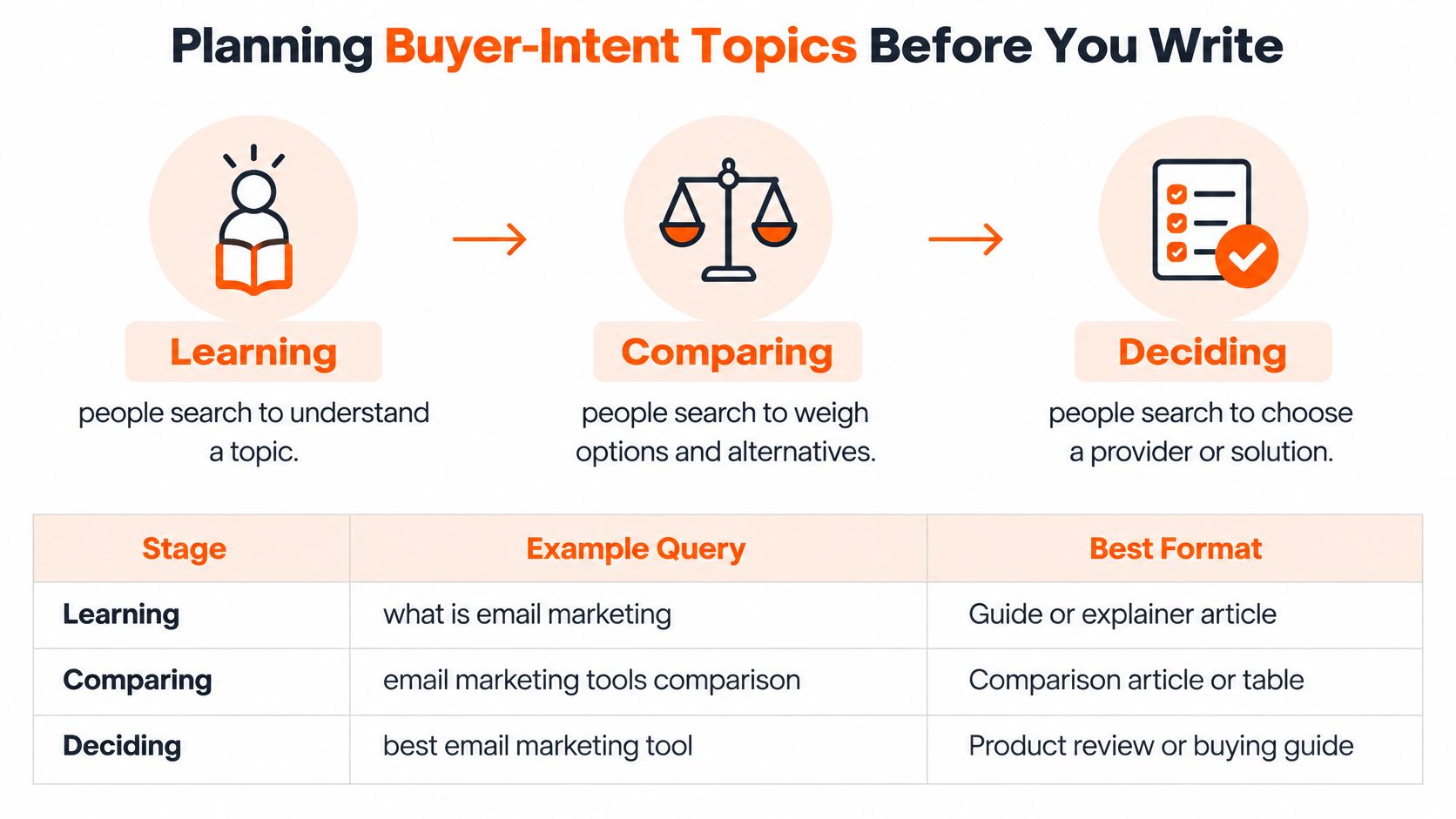
Intent stage | Example query | Best format | Next step for reader
Learning | how to run exit interviews | Explainer guide | Checklist download
Comparing | best HR software for 50 employees | Comparison article | Free trial or demo request
Deciding | Acme HR pricing or Acme vs Rival | Pricing page or case study | Sales call booking
An HR buyer searching how to run exit interviews wants steps and good questions. A buyer searching best HR software for 50 employees wants options weighed. A buyer typing a vendor name beside a rival wants help choosing, and probably wants it before Friday's budget meeting.
This short video shows how topic choices connect to a wider search plan.
Four Planning Steps
Pull seed queries: Collect 20 to 30 phrases from sales call notes and support tickets. Real buyer language beats brainstormed jargon every time.
Check the intent: Read the top results for each query. If Google shows comparisons, don't write a poem about feelings.
Group the topics: Build one pillar page with five to eight cluster articles linking back to it. A solid SEO content marketing strategy keeps those clusters tied to revenue topics, not random ideas.
Write a one-page brief: List the audience, decision stage, primary query, unique evidence, expert reviewer, and conversion action.
Google's SEO Starter Guide recommends placing the words searchers use in prominent locations such as the title, main heading, alt text, and link text, while keeping content helpful and people-first. In practice, that means mapping one primary commercial question to the title and introduction, then using headings for evaluation criteria, implementation, risks, and next steps.
Teams that want context for those choices can browse current marketing and SEO statistics before locking a topic list. The finished output is simple to hold: ten topics, each tagged with its stage.
Where Humans Must Stay in the Loop
AI can draft an article in minutes. So can a microwave produce a meal in minutes. Speed is real. Dinner quality is a separate question.
The numbers keep expectations honest. A study reported by Semrush on whether AI content ranks examined 42,000 blog posts ranking for 20,000 keywords and found that purely AI-generated content appeared in the top position only 9% of the time, while human-written content held the top position 80% of the time.

What AI Handles Well
Query expansion: Turning ten seed phrases into a longer list for review.
Brief drafting: Organizing headings, sources, and questions into a first pass.
Document summaries: Condensing long reports so an expert can judge what matters.
Proofreading: Catching typos and clumsy sentences before a human editor steps in.
What Humans Must Own
Customer interviews, product nuance, technical checks, point of view, source selection, and final sign-off stay human. Those are the parts a buyer can smell from three paragraphs away.
Say a SaaS draft on churn reduction claims a neat benchmark with no source behind it. During review, the subject-matter expert spots the problem and swaps in the team's own retention data. The article gets slower by one afternoon and better by a mile.
If a sentence could sit unchanged on any competitor's site, it needs firsthand evidence before publishing.
A copy-ready review check asks three questions. Who observed this? Where is the source? What would a customer say about it? Weak answers mean the draft goes back, however tidy the formatting looks.
How to Write and Optimize Each Article
Good SEO content writing follows a repeatable order. The order matters because fixing structure after drafting is like moving walls after painting. Possible, dusty, and nobody thanks anyone.
The flow below shows the core writing sequence at a glance.
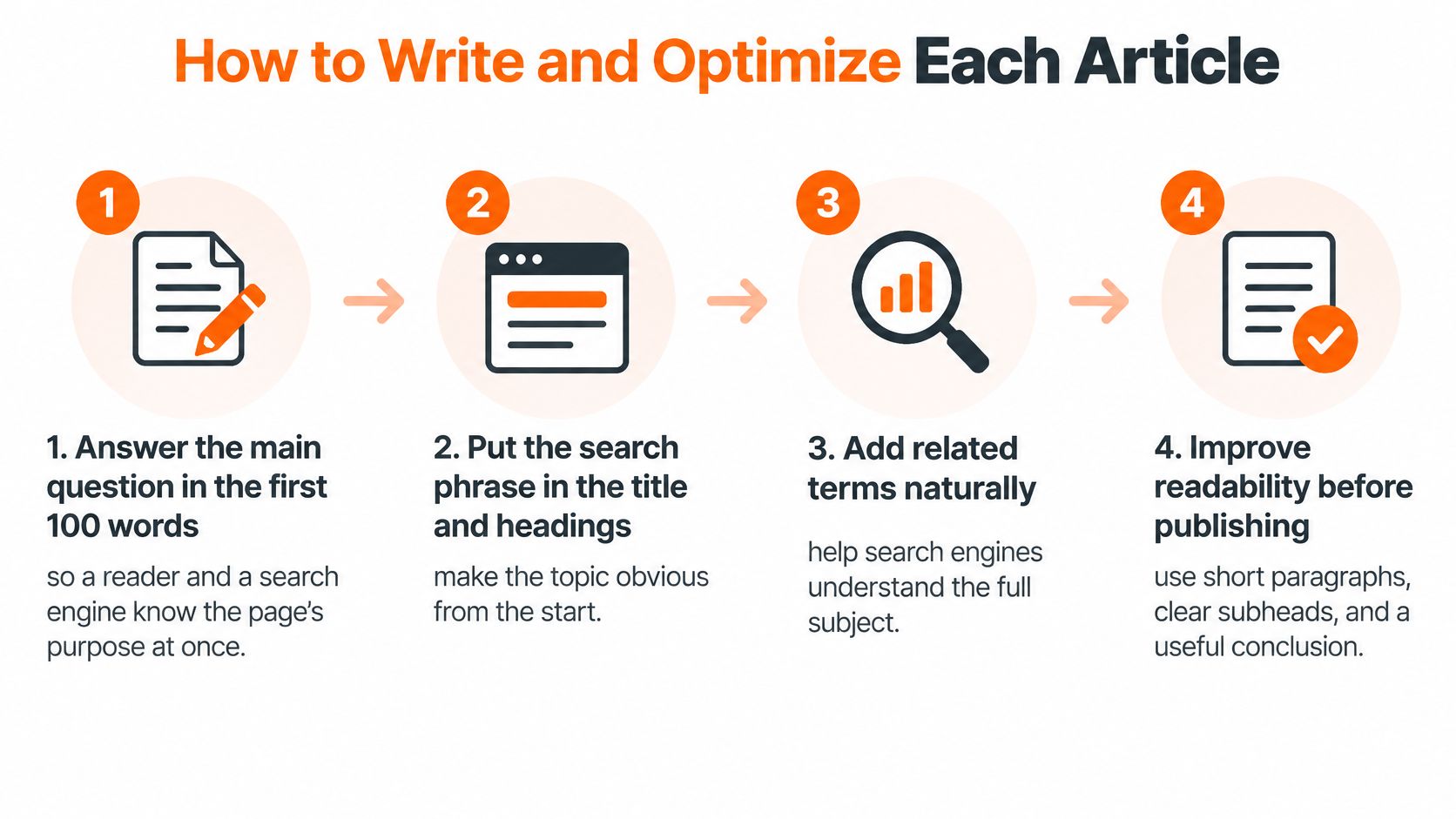
The Seven Steps
Answer the main question in the first 100 words. A reader and a search engine should both know the page's purpose at once. Burying the answer under company history is how tabs get closed.
Put the search phrase where it counts. Use it in the title, main heading, image alt text, and link text, in natural language. Once per spot is plenty.
Turn headings into buyer questions. What does it cost? How long does setup take? What can go wrong? Headings written this way double as a table of contents for a busy reader.
Add evidence no competitor has. Aim for one original number, one customer example, and one expert quote. Say a cybersecurity firm writes about zero trust for mid-size banks and uses its own audit findings in the second section. That page becomes quotable and hard to copy, because rivals don't have those audits.
Link to two to four related articles. Descriptive anchor text like B2B lead scoring checklist tells readers exactly what's next. For pages that also need outside authority, sensible link building tactics matter, but internal links come first because they're free and fully under the team's control.
End with one call to action that fits the stage. A learning reader gets a checklist. A comparing reader gets a demo. Three competing buttons just create a small traffic jam.
Read the draft aloud. Cut any sentence that exists only to repeat the keyword. If it sounds like a parrot with a marketing degree, it goes.
Keywords Without the Stuffing
The most common slip is cramming the target phrase into every paragraph. Readers feel lectured by a robot, and ranking systems see a page written for manipulation rather than people. Use the phrase where it names the topic, then use normal related words everywhere else. Costs, timelines, risks, examples, and tools all signal depth without repetition.
Short paragraphs help too. So do concrete nouns. "The onboarding call takes one working session with the operations lead" beats "the implementation goes well" in every universe.
There's also a visibility layer beyond classic rankings now. Teams tracking AI search can learn how to track citations in Google AI Overviews and check whether clear, quotable sections are getting picked up. Concise definitions and verifiable claims travel well into summaries, while the full article still serves readers who click through for detail.
A Quick Pre-Publish Check
First screen test: The main answer appears without scrolling far.
Evidence test: At least one claim exists nowhere else on the internet.
Link test: Every link helps the reader's next decision.
Read-aloud test: Nothing sounds like it was written to please a machine.
Pass all four, and the article is ready. Fail one, and another editing pass is cheaper than three months of polite disappointment.
Adding Schema Markup Without the Guesswork
Schema markup is best understood as labels on storage boxes. Labels don't make the contents better. They just tell whoever opens the cupboard what's inside, without tipping everything onto the floor.
For search, those labels are machine-readable notes about a page. Google's structured data introduction explains that structured data can make eligible content appear in richer search features, but it isn't a substitute for strong writing or a ranking guarantee. Google supports formats including JSON-LD, Microdata, and RDFa, and recommends validating with the Rich Results Test and URL Inspection tools.
JSON-LD is the format many teams choose because it sits in a script element in the page head or body, separate from the visible text. Writers keep writing. Developers keep the labels tidy. Everyone stays friends.
Six Steps, in Order
Publish the final visible text first. Headings, answers, and dates must exist on the page before any markup describes them.
Generate Article markup from the same facts. Use the headline, author, datePublished, and dateModified shown to readers.
Add FAQ markup only for visible questions. Every marked-up question and answer must appear on the page. Marking up hidden questions can make a page ineligible, and it fools nobody for long.
Validate the code. Run the Rich Results Test and fix critical errors before launch.
Inspect the rendered page. Use URL Inspection and confirm the page isn't blocked by robots.txt, a noindex tag, or a login wall.
Watch Search Console over several months. Crawling and indexing take time, so judge changes on a calm timeline, not by Friday.
Say a 1,500 word article about SEO content writing gets updated in March. The visible date changes, and the dateModified value changes with it. Keeping those in sync is basic honesty, like updating the expiry date when the milk is new.
Schema describes the page. It doesn't rescue it.
A weak article with perfect markup is still a weak article, now wearing a very accurate name badge. Write the page buyers need, then label it correctly.
Measuring Results When Clicks Keep Shrinking
Raw traffic used to be the headline metric. Then AI summaries started answering questions directly on the results page, and the headline got quieter.
Pew Research Center's analysis of Google users found that users who saw an AI summary clicked a traditional search-result link in 8% of visits, compared with 15% of visits when no AI summary appeared, and clicked a link inside the AI summary in only 1% of visits. Fewer clicks doesn't mean content stopped working. It means measurement has to grow up.
Judge each article on three outcomes instead: citation visibility, assisted discovery, and direct conversion. For AI visibility beyond Google, a guide to ranking in ChatGPT answers helps teams think about being named, not just being visited.
Metric | What it tells you | Review cadence
Organic impressions | Whether buyer queries show your page | Weekly
Clicks from search | Whether the title and description earn visits | Monthly
Qualified conversions | Demo or contact requests from article pages | Monthly
Assisted pipeline | Deals where an article was viewed before sales | Quarterly
AI answer citations | Whether AI summaries name or link your page | Monthly sample
Say one article gets 300 visits and brings two demo requests. Another gets 5,000 visits and brings nobody with a budget. The first article wins, and it isn't close. Traffic without buyers is applause from an empty room.
Patience is part of the math. ContentBuck's SEO content is not a fit for companies that need leads within the same week, because SEO content takes 60-90 days to start ranking. Reviewing a new article at day 14 is like planting tomatoes and digging them up to check for salad.
A Monthly Review Routine
Check impressions by query: Confirm the page shows up for buyer questions, not random phrases.
Trace article pages before conversions: Note which pages appear in paths leading to demo or contact requests.
Flag high impressions with almost no clicks: Those pages need a title and description rewrite first.
That third list is the work queue. Rewrite the weakest title, then move down the line.
Brief Your First Buyer-Intent Article
A finished brief removes guesswork before anyone writes a word. Here's one for a B2B payroll firm, filled in properly.
A Worked Brief
Audience: HR directors at companies with 200 staff.
Decision stage: Comparing.
Primary query: best payroll software for multi-state teams.
Unique evidence: The firm's own onboarding data, including how many days a new client takes to run its first payroll.
Expert reviewer: The implementation lead, who checks every number before publication.
Conversion action: A demo request button placed right after the comparison table.
Notice what the brief does. It names a person, a moment, and proof. A writer holding this can't drift into generic payroll trivia, because the reviewer and the evidence won't let that happen.
The 90-Day Plan
Publish four articles over the first 90 days, each from its own brief. At day 90, pull the monthly review metrics and rewrite the weakest title first. Small, steady fixes beat a dramatic relaunch built on vibes.
If the team needs leads this week, pair the program with faster channels like ads or outbound. Search results take months to arrive, and pretending otherwise sets everyone up for an awkward meeting.
For outside help, ContentBuck's SEO Content Writing service produces buyer-intent articles, starts with a one-time SEO audit and keyword map, and costs $500 to $1,500 per month, typically on a commitment of about six months because SEO rewards consistency over one-off posts.
The next move is small. Book the first brief meeting with the team this week, and bring two real sales questions to it.
Frequently Asked Questions
How Long Does SEO Content Writing Take to Work
Plan on 60 to 90 days before judging a new article. Review at day 90, not day 14, and use the waiting time to publish the next briefed pieces.
Does Schema Markup Guarantee Rankings
No. Markup describes a visible page and can make it eligible for rich results. Weak writing gains nothing from perfect labels, however neat the code looks.
Can AI Draft the Articles
Yes, for query lists, briefs, summaries, and editing help. Human experts should still supply firsthand evidence, check consequential claims, and sign off the final version.
Is a Pillar Page Necessary
Usually, yes. One pillar page with five to eight cluster articles linking back gives buyers a path from first question to final decision, instead of scattered posts.
Which Metric Matters Most
Qualified conversions and assisted pipeline. A modest article that brings demo requests beats a popular post that brings no buyers at all.
When Can FAQ Markup Be Added
Only when every question and answer is visible on the page, exactly as readers see them here. The markup mirrors the page. It never invents extra content.
Ready to turn buyer questions into articles that bring demo requests instead of polite pageviews? ContentBuck builds buyer-intent SEO content programs with human-written long-form articles, pillar and cluster planning, and reporting that shows which pages generate leads. Visit ContentBuck to start with an audit and keyword map for the first article brief.
Parth Jasrapuria
Founder at ContentBuck
Building video systems for B2B businesses. Obsessed with YouTube growth, creative strategy, and organic SEO.