SEO Content Marketing Strategy: A Practical B2B Guide
Parth Jasrapuria
Founder
Publishing more content isn't a content strategy. It's a production schedule wearing a small business hat.
A durable SEO content marketing strategy connects buyer questions to search demand, useful content, video, distribution, and measurable business outcomes. That matters because B2B buyers rarely move from one article to a purchase in a single graceful leap. They research a problem, compare approaches, assess risk, involve colleagues, and eventually decide whether a vendor deserves a conversation.
The practical standard is simple: every asset should help a defined buyer answer a real question and take a sensible next step. Traffic can help, but qualified conversations, assisted pipeline, and buyer confidence are the outcomes that keep the lights on.
Why Most B2B Content Programs Fail Before They Begin
Most B2B teams don't fail because they publish too little. They fail because publishing becomes the strategy.
The 2025 B2B research from the Content Marketing Institute and MarketingProfs found that 97% of marketers said their organization had a content strategy, yet only 29% of marketers with a documented strategy rated it extremely or very effective. 58% called their strategy moderately effective, while 13% considered it not very effective or not effective at all.
That gap should make every editorial calendar slightly nervous.
A calendar isn't a commercial system
A publishing schedule answers, “What goes live next?” A strategy answers more useful questions:
Who is searching? A finance leader, engineer, administrator, founder, or buying committee?
What do they need to understand? The problem, the category, implementation risk, pricing, or vendor differences?
What should happen next? Read a comparison, watch a demonstration, request a consultation, or share the page internally?
How will the business know it worked? Organic clicks, qualified opportunities, assisted conversions, or influenced pipeline?
The same research identified lack of resources as a challenge for 54% of B2B marketers and a lack of a scalable content-creation model for 45%. Those constraints explain why random publishing feels productive but often produces uneven results. Teams create what they can finish, not necessarily what buyers need next.
Practical rule: A content brief should name the buyer, intent, business outcome, conversion path, and subject-matter expert before anyone starts drafting.
A useful starting point is understanding how B2B commerce works as a system, including the multiple people and stages involved in a purchase. Fetchin's resource on understanding B2B commerce provides helpful context for that broader buying environment.
For a SaaS company, one article about “workflow software” might attract curious readers. A coordinated set of pages about implementation, integrations, security review, alternatives, and procurement gives an actual buying committee material it can use. The difference isn't word count. It's strategic intent.
The Four Building Blocks of an SEO Content Marketing Strategy
A useful strategy resembles a four-legged table. Remove one leg and the whole thing wobbles, usually at the exact moment someone asks where the pipeline went.
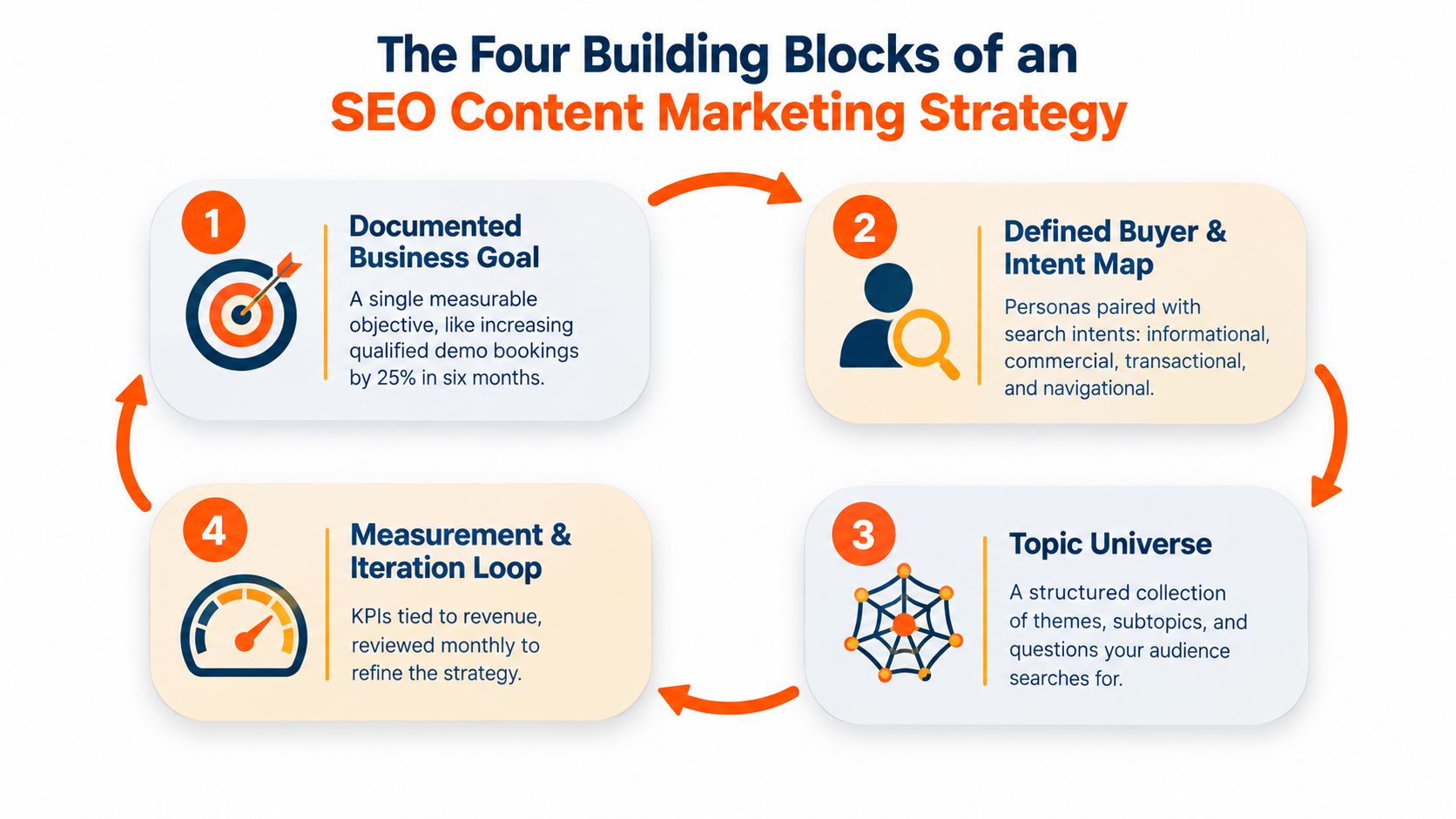
1. Documented business goal
Start with one commercial objective, not a cloud of ambitions. A SaaS team might want more qualified demo bookings from operations leaders evaluating automation tools. That goal determines the topics, calls to action, landing pages, and CRM fields worth tracking.
“Grow organic traffic” is a channel objective. “Create more qualified opportunities from companies evaluating workflow automation” is a business objective.
2. Defined buyer and intent map
A persona without intent is just a fictional biography with a job title. Pair each buyer with the questions that appear at different stages:
Informational: What problem exists, and how is it solved?
Commercial: Which approaches or vendors should be compared?
Transactional: How can the buyer request a demo or start?
Navigational: Which product, brand, or resource does the buyer seek?
A security lead may search for integration requirements while a department head searches for workflow automation alternatives. Both may influence the same purchase.
3. Topic universe
Build a structured collection of themes, subtopics, objections, and questions. Include sales-call language, support tickets, product documentation, competitor gaps, and searches that reveal risk. A topic universe prevents the team from treating every new keyword as a shiny emergency.
4. Measurement and iteration loop
Measurement belongs in the design, not at the end when everyone discovers that the analytics account is mostly decorative. Connect content to impressions, non-branded clicks, rankings by intent class, assisted conversions, qualified opportunities, and pipeline.
For example, a SaaS team could map one pillar topic to comparison pages, integration explainers, implementation videos, and a demo path. Each asset has a job, and the content manager can identify whether the problem is weak demand, poor intent matching, weak distribution, or a broken conversion path.
How to Do Buyer-Intent Keyword Research That Drives Pipeline
Keyword research should begin with buyer language, not a tool's biggest number.
A B2B content lead can gather seed topics from sales calls, support tickets, product reviews, implementation questions, analyst reports, and customer interviews. Those sources reveal how buyers describe pain, risk, and desired outcomes. A keyword tool then expands and organizes that language. It shouldn't replace customer understanding.
Build intent buckets before choosing topics
Useful buckets include:
Problem education: “how to improve product onboarding”
Category evaluation: “customer onboarding software”
Comparison: “product onboarding platform alternatives”
Implementation: “customer onboarding software implementation”
Integration: “onboarding software Salesforce integration”
Risk assessment: “customer onboarding software security”
Commercial action: “book customer onboarding software demo”
A narrow implementation query may attract fewer people than a broad category phrase, but it often signals a buyer who is closer to involving procurement, IT, or operations. Intent class matters more than volume when the commercial goal is qualified pipeline.
Inspect the results before committing
Search the target query manually. Study the ranking pages and ask:
Are the results articles, product pages, comparison pages, videos, or documentation?
Do the top results answer the same question the proposed page would answer?
Is the searcher looking for education, a shortlist, proof, or a product?
Could the company add original evidence, expert insight, a calculator, a demonstration, or a clearer explanation?
Does the topic connect naturally to a relevant conversion path?
Ahrefs' analysis found that 96.55% of indexed pages receive no Google traffic, while 3.45% receive at least one monthly visit. The Ahrefs search traffic study supports a disciplined approach: validate organic potential, match the dominant intent, and earn authoritative links instead of publishing pages because a keyword looks attractive in a spreadsheet.
A fictional B2B video agency might begin with “explainer videos.” That broad seed can become commercially useful queries such as “animated explainer video agency,” “product demo video for SaaS,” “explainer video for website conversion,” and “video production agency with YouTube SEO.” The agency can then decide which query deserves a service page, which belongs in a comparison article, and which is too vague to justify production.
Teams looking for a practical primer on finding the best keywords can use that process to expand seeds, assess competition, and organize candidate topics.
The final filter is pipeline relevance. If a topic attracts people who cannot buy, cannot influence the purchase, and have no realistic next step, it may still support awareness. It shouldn't automatically receive the same investment as a page that helps a real buying committee make a decision.
Planning Pillar and Cluster Topics That Actually Support Each Other
A pillar page is the flagship guide on a commercially central topic. Cluster content handles the specific questions buyers ask around it. The model works when every supporting page strengthens the main topic and gives readers a useful next step.
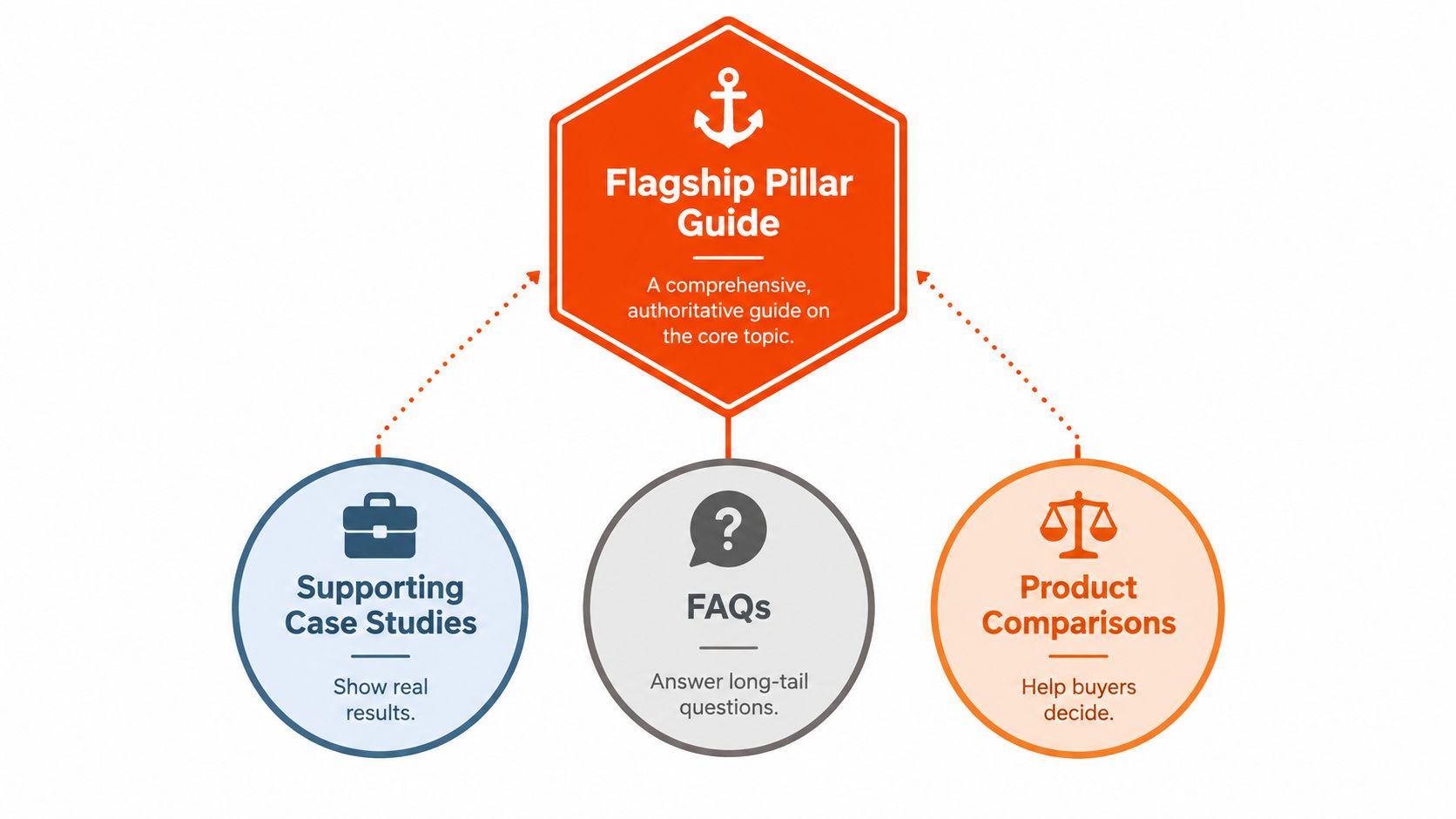
Start with the buyer's decision
A B2B software pillar might target “customer onboarding software.” Its supporting pages could cover:
Customer onboarding software alternatives
CRM and onboarding integrations
Security requirements for onboarding platforms
Onboarding implementation planning
Pricing and purchasing considerations
Customer onboarding examples
Product walkthrough videos
The pillar introduces the category and frames the decision. The clusters answer the objections that stop a buying committee from moving forward. Internal links should connect related pages with descriptive anchor text, consistent terminology, and clear reasons to continue reading.
A page about integrations should link to the relevant section of the pillar. The pillar should link back to the integration page when discussing technical evaluation. This is not a ceremonial web of links. It mirrors the way a buyer investigates a purchase.
Give every node a defensible job
A topic belongs in the cluster when it does at least one of the following:
Answers a distinct buyer question
Targets a distinct intent
Adds original evidence or expertise
Supports a conversion or sales-enablement path
Strengthens the meaning of the central topic
A niche audience with limited search demand may not need a large cluster. A giant pillar with thin supporting pages becomes an orphan hub, a majestic lighthouse with no boats nearby. The model should follow the market, not the other way around.
Raze's SEO playbook for SaaS companies offers additional context for organizing SaaS topics into connected groups. Content teams can also review this B2B content strategy example when evaluating how topic structure, production, and performance fit together.
A practical whiteboard test is simple: write the pillar in the center, add the buyer's major questions around it, then draw a line only when the relationship helps the reader. If a cluster page exists solely to repeat the pillar with a new keyword, it probably doesn't deserve production time.
Choosing the Right Content Formats Including Video
Format should follow the buyer's question. An article works well when a reader needs searchable explanation. A comparison page helps someone shortlist options. A video earns its place when seeing a workflow, interface, process, or expert explanation reduces confusion faster than text alone.
Format | Best funnel stage | Production effort | Repurposing potential
Long-form article | Problem education and evaluation | Moderate | High
Comparison page | Commercial evaluation | Moderate | Medium
Case study | Validation and decision | Moderate | High
Explainer video | Education and consideration | Moderate to high | High
Webinar | Consideration and decision | High | High
Podcast | Awareness and consideration | Moderate | High
Short-form clip | Awareness and retargeting | Low to moderate | High
Match the asset to the friction
A product walkthrough can clarify a complex interface. A customer Q&A can address objections about implementation. An animated explainer can make an unfamiliar technical category understandable before a buyer reaches a sales call. The written page supplies searchable context, transcript text, definitions, internal links, and a conversion path.
The strongest systems don't treat video and SEO writing as rival departments. One expert interview can become a pillar article, a full YouTube episode, short clips, a sales email, and a page section answering a precise buyer question. That creates message consistency without forcing the audience to consume the same asset in the same format.
Video isn't automatically a strategy. It becomes strategic when it answers a buyer question that text, alone, would answer less clearly.
For technical details on making video easier for search systems and viewers to understand, teams can consult this guide to SEO video optimisation. The practical checks include a useful title, accurate description, transcript, accessible player, relevant surrounding copy, thumbnail, chapters where appropriate, and a page that works on mobile.
A sensible decision rule is to assign one primary format to each pillar and one or more supporting formats to the buyer's next questions. An early educational pillar might lead with an article and expert video. A late-stage comparison might lead with a decision page and short product demonstration. The format should reduce risk, not just increase the number of files in the asset library.
A Real B2B Content Marketing Rollout You Can Learn From
Consider a fictional B2B software team that sells workflow automation to operations departments. Its old program consisted of occasional blog posts, isolated product videos, and a dashboard that celebrated sessions while ignoring whether anyone qualified for sales.
The team interviewed sales and support before building its next calendar. Those conversations revealed recurring questions about implementation, integrations, security review, and switching from spreadsheets. The new plan replaced broad topic chasing with an intent map tied to evaluation stages.
The production system
The team selected a central workflow automation pillar and paired it with supporting comparison, integration, implementation, and security pages. A subject-matter expert recorded one structured conversation about how customers evaluate the product.
That recording became:
One long-form article with a transcript and internal links
Three short clips answering narrow buyer questions
A LinkedIn carousel explaining the implementation process
A sales-enablement email for prospects in evaluation
A product walkthrough embedded on the relevant page
The system made the expert's knowledge reusable. It also gave buyers choices. An operations leader could read the guide, an IT reviewer could inspect the integration explanation, and a busy executive could watch the short overview without being punished by a 4,000-word wall of text.
What went wrong
The first pillar targeted a broad vanity term that attracted attention but didn't map cleanly to the product. The team replaced it with a narrower category and implementation topic connected to active sales conversations.
The first video lacked a transcript, so its useful explanation wasn't available as crawlable page content or as a convenient reading experience. The team added a written transcript, structured headings, descriptive metadata, and a clear next step.
The dashboard tracked sessions but not qualified opportunities. The team connected content interactions to CRM records and separated leading indicators from business outcomes. The lesson wasn't that every asset had to produce a direct lead. The lesson was that the team needed to know whether an asset supported research, evaluation, conversion, or sales follow-up.
This fictional example reflects a broader principle: the content unit isn't the blog post. The unit is a buyer question supported by a coordinated set of formats, links, proof, and conversion options.
Measuring What Matters Beyond Sessions and Rankings
A mature measurement system distinguishes visibility from commercial contribution. Impressions and citations can show that search systems notice a page. Qualified pipeline and influenced revenue show whether the content helps the business.
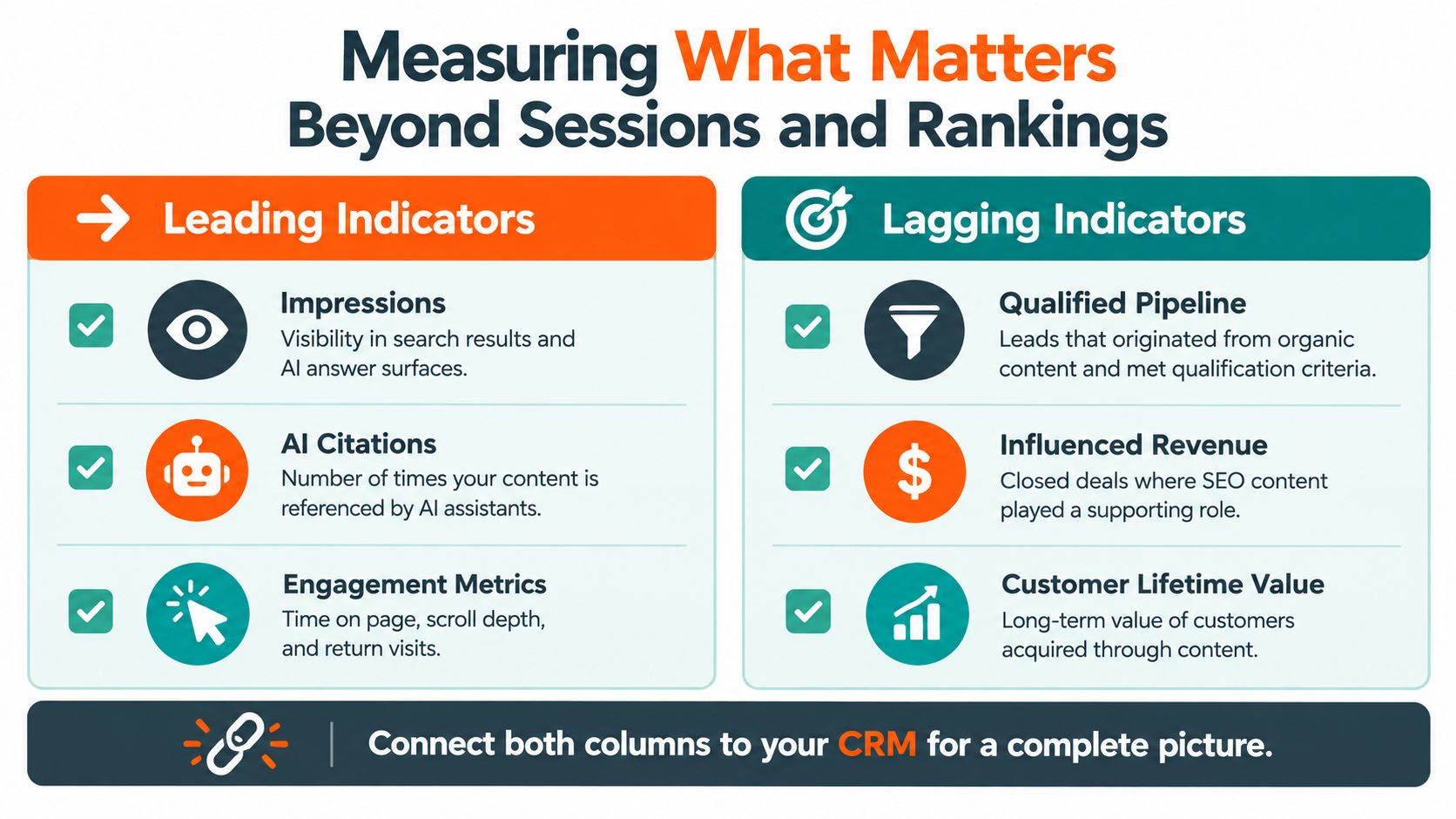
Leading indicators
Track impressions, non-branded clicks, rankings by intent class, engagement, video views, and AI citations. A ranking for an informational query and a ranking for a pricing or implementation query shouldn't be treated as equivalent wins.
AI search makes this distinction more urgent. A Pew Research analysis of nearly 70,000 Google searches found that traditional-result clicks fell from about 15% when no AI Overview appeared to roughly 8% when one did, while more than one-quarter of AI Overview sessions ended without a click, compared with 16% of conventional-result sessions. Separate analysis cited in the same source found a 61% decline in organic CTR for queries displaying AI Overviews between June 2024 and September 2025, while pages cited in summaries received 35% more organic clicks than comparable pages that weren't cited.
The implication isn't “SEO is over.” It is that citation quality, brand recall, and assisted outcomes matter alongside clicks. Content should offer clear definitions, attributed evidence, expert viewpoints, and answer-first structure so search systems can interpret and cite it.
Lagging indicators
Connect content interactions to qualified opportunities, assisted conversions, influenced revenue, sales-cycle progression, and customer value. A page may assist a deal without being the last touch. CRM reporting should preserve that contribution rather than forcing every asset to claim or disclaim the entire deal.
A practical review rhythm can include:
Weekly content standup: publishing status, technical blockers, expert reviews, and distribution
Monthly performance review: intent-class rankings, conversions, AI citations, assisted pipeline, and refresh priorities
Quarterly strategy review: topic gaps, content costs, sales feedback, and whether the program still reflects buyer risk
Teams looking for a revenue-focused measurement framework can use this resource on content marketing ROI for B2B companies. Sessions still have a place, but they shouldn't be allowed to sit at the head of the table like a tiny traffic emperor.
Your 90-Day SEO Content Marketing Rollout Plan
A first quarter should create a working system, not a heroic pile of unfinished drafts. The following sequence gives each phase a checkpoint, success signal, and failure mode.
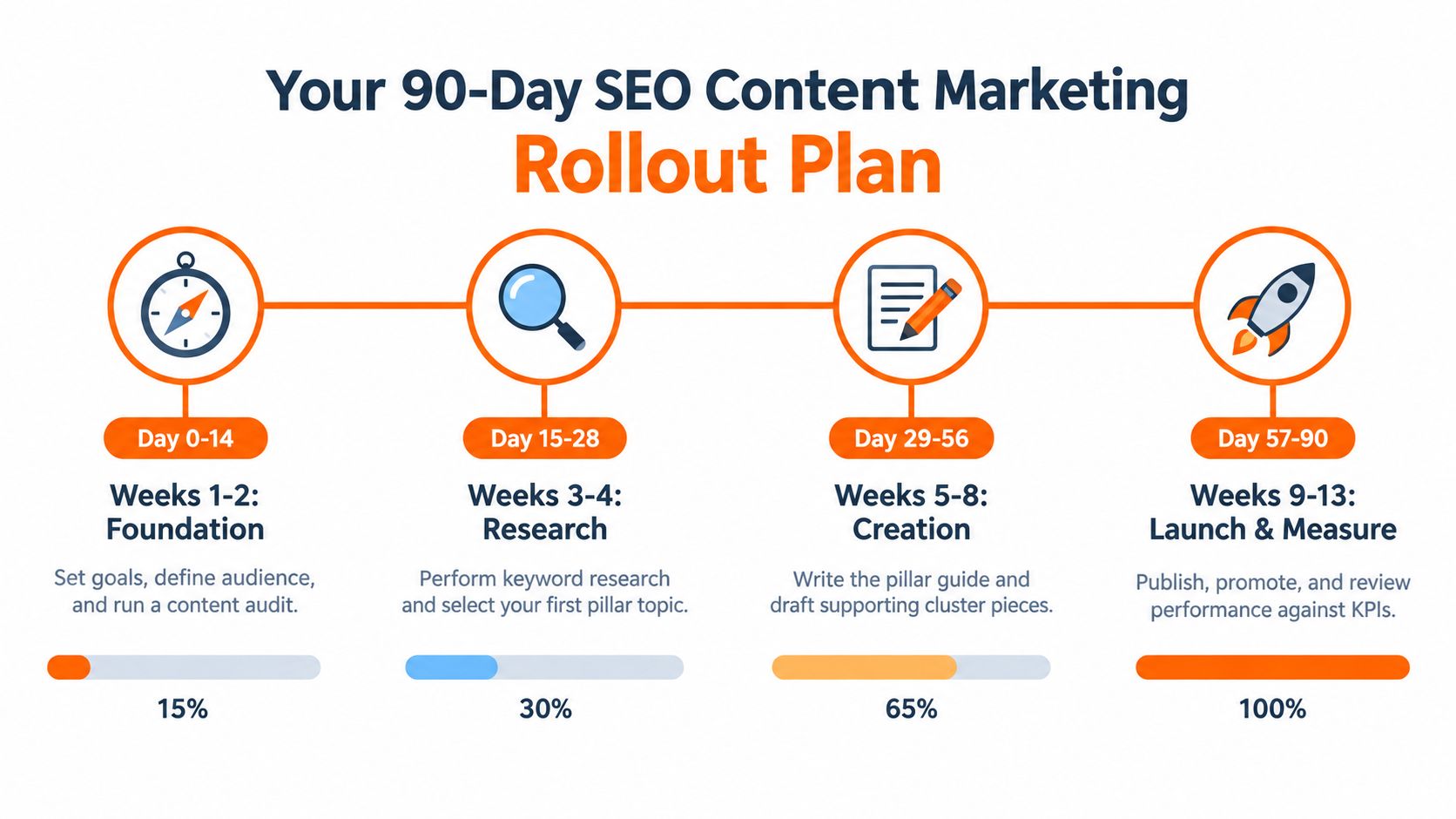
Weeks one and two, foundation
Document the business goal, define buyers, interview sales and support, and audit existing pages. Identify underperforming pages that deserve a refresh, pages without conversion paths, and assets that sales already uses.
Checkpoint: approved buyer and intent map
Success signal: every priority audience has documented questions and a next step
Avoid: skipping sales interviews because the editorial calendar feels more comfortable
Weeks three and four, research
Build the seed list, classify intent, inspect results, and select the first pillar topic with supporting clusters. Validate the dominant page types and identify where the company can add expertise or evidence.
Checkpoint: prioritized topic map
Success signal: each proposed page has a buyer, intent class, format, internal-link destination, and business outcome
Avoid: choosing the broadest keyword just because it has the largest apparent audience
Weeks five through eight, creation
Produce the pillar, supporting pages, video brief, transcript plan, metadata, internal links, and conversion assets. Schedule expert reviews early. A subject-matter expert shouldn't first see a technical article five minutes before publication, unless the team enjoys suspense as a management style.
Checkpoint: production-ready content system
Success signal: the pillar and clusters answer connected buyer questions without duplication
Avoid: publishing video without transcripts or pages without clear next actions
Weeks nine through thirteen, launch and measure
Publish, distribute through sales and social channels, monitor indexing and search visibility, review engagement, and compare early signals with the original intent map. Refresh pages when searcher expectations, product details, or evidence change.
Checkpoint: first performance review
Success signal: the team can identify what gained visibility, what supported engagement, and what influenced qualified conversations
Avoid: judging the program only by sessions during the first review
Once the operating rhythm works, the team can add recurring video production, short-form repurposing, quarterly pillar refreshes, and more precise CRM attribution. The warning signs remain easy to spot: topics chosen without sales input, content shipped without a conversion path, videos created without searchable context, and dashboards that can't answer which buyers moved closer to a decision.
ContentBuck offers buyer-intent keyword research, pillar and cluster planning, SEO-backed articles, video production, YouTube programming, editing, repurposing, and performance reporting for B2B growth teams. Visit ContentBuck to explore a coordinated SEO and video system built around buyer questions, useful content, and measurable pipeline outcomes.
Parth Jasrapuria
Founder at ContentBuck
Building video systems for B2B businesses. Obsessed with YouTube growth, creative strategy, and organic SEO.