Pre Roll Adverts Explained for B2B Marketers
Parth Jasrapuria
Founder
A sales leader opens the video dashboard and asks the question every B2B marketer eventually hears: “Why did the campaign produce so many views but no demos?” The team has completion rates, impressions, and a tidy line graph. What it doesn't have is a clear answer about whether the right buyers noticed the ad, understood the message, or moved closer to a buying conversation.
Pre-roll adverts deserve a better evaluation than "people watched" or "people skipped." They can create early awareness, support retargeting, and introduce a complex product before a prospect visits a website. But the useful question isn't how to get more completed views. It's how to turn limited attention into qualified visits, meaningful engagement, and pipeline evidence.
What Pre Roll Adverts Actually Are
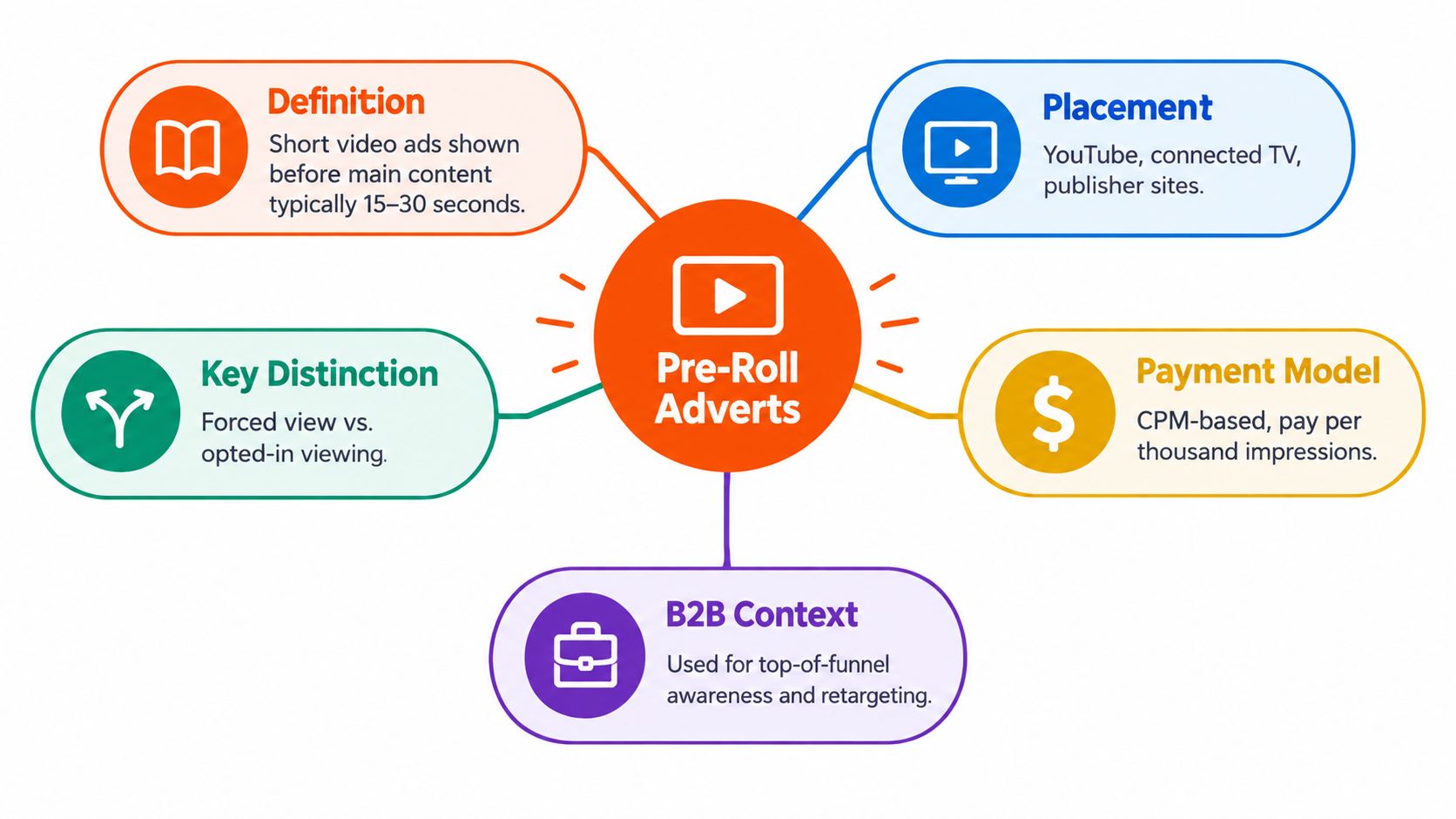
A pre-roll advert is a linear in-stream video ad that plays before the viewer's chosen video content. The viewer selects a product demo, interview, tutorial, or entertainment video, and the commercial appears before that content starts. A mid-roll ad interrupts the content during playback, while a post-roll ad appears after it ends. The IAB's video advertising standards use this distinction to describe how these placements work.
That position gives pre-roll one useful advantage: the ad appears before the main viewing session has properly begun. It also creates a problem. The viewer didn't request the advert, so the opening must earn attention quickly instead of assuming patience.
A B2B software company, for example, might show a short advert before a cloud-security tutorial. The first frame could show an alert reading, “Your security team can't review every access request manually.” The product then demonstrates the workflow, rather than spending the opening on a slow logo animation that says very little to a busy buyer.
Why the technical plumbing matters
Pre-roll adverts run across platforms, publisher sites, connected television environments, and video players. The Video Ad Serving Template, or VAST, provides an XML-based framework that helps ad servers and players exchange delivery, playback, and tracking instructions consistently. The IAB introduced VAST in July 2008, reducing the need for separate technical integrations across every publisher and network, as documented in this history of video advertising standards.
For a B2B team, that infrastructure matters because campaigns rarely stay in one place. A buyer might encounter an ad on YouTube, later watch a publisher-hosted interview, and then return through a retargeting campaign. Consistent delivery data makes those exposures easier to organise and compare.
The format combines guaranteed placement before selected content, measurable delivery signals, and an opening window before a skip option appears on skippable inventory. That doesn't guarantee a lead. It gives marketers a structured opportunity to make the first seconds useful.
The Main Pre Roll Ad Formats and Their Duration Limits
A campaign becomes easier to plan when the ad format matches the job. Three formats appear most often in B2B video planning: skippable in-stream, non-skippable in-stream, and bumper ads.
Skippable in-stream ads
A skippable YouTube in-stream ad can run before, during, or after another video. The viewer receives a Skip option after 5 seconds, so the opening must identify the audience, problem, and promise quickly. Google's format guidance says there's no maximum length for this format, although videos shorter than 3 minutes typically perform better in reserved placements.
A SaaS company testing a new workflow product might create a 30-second advert with three different openings. One could begin with a reporting problem, another with a product screen, and a third with a customer-facing consequence. The skip behaviour helps the team understand which premise earns further attention, although the campaign still needs downstream measurement.
Non-skippable in-stream ads
Non-skippable ads are designed to deliver the complete message because the viewer can't skip them. Google limits this format to 15 seconds or less in standard video campaigns, according to its non-skippable in-stream ad guidance.
This format suits one concise promise. A cybersecurity company might say, “Stop phishing before it reaches your team. Book a demo.” It isn't the right container for a detailed product tour, a founder biography, and an interpretive dance about compliance.
Bumper ads
A 6-second bumper ad is built for a brief, memorable awareness message. Google describes this as a short non-skippable format, useful when the audience needs to remember a brand or category rather than understand a complicated product immediately.
A B2B brand could use a bumper to repeat one visual phrase, such as “Make access reviews automatic,” then use a longer skippable ad later for the explanation. The trade-off is simple: non-skippable formats provide more controlled message delivery, while skippable ads create a stronger test of voluntary attention. Bumpers are efficient reminders, but they leave almost no room for a complex value proposition.
Writing the First Five Seconds That Earn the Next Twenty
A 30-second B2B advert can fail before the product appears. In one common creative pattern, the opening shows a polished logo sting, a sweeping office shot, and a voiceover explaining that the company has “reimagined business operations.” By the time the buyer hears what the product does, the skip option has arrived and the meeting invite has become more interesting.
A stronger version starts with the buyer's problem:
“Finance teams lose hours reconciling invoices that should already match.”
The screen shows two mismatched records, then a product view resolving the discrepancy. The brand appears in the interface and returns at the close. The same 30-second budget now begins with a recognisable pain instead of a corporate curtain-raiser.
The three-part hook
A reliable opening structure names the audience, the pain, and the proof.
Audience: “For revenue teams managing complex renewals…”
Pain: “…manual handoffs hide expansion opportunities.”
Proof: “This workflow flags the next action before the account review.”
The wording doesn't need to sound like a slogan. It needs to make the right viewer think, “That's about my team,” before the ad asks for anything.
A strong opening also survives sound-off viewing. On-screen text should carry the central idea, contrast should separate the subject from the background, and the first visual should change the viewer's expectation. A product screen, before-and-after workflow, alert, or human reaction can create more useful movement than a decorative animation.
The historical in-stream advertising research found that 15-second pre-roll had an average completion rate of 87% in the study, while its average click-through rate was close to 10%. The same research reported that interactive versions produced click-through rates 11% to 35% higher than non-interactive pre-roll, depending on the call to action. Those figures are historical benchmarks, not promises for current campaigns, but they reinforce a practical lesson: concise creative and low-friction action matter.
Creative rule: Treat the first five seconds as the entire advert. Everything after that should reward the viewer for staying.
Choosing the Right Ad Length for Each Campaign Job
Length should follow the campaign objective, not the production team's enthusiasm for another feature explanation. The IAB identifies 6-, 15-, and 30-second durations as standard linear-ad lengths, while its guidance also describes bumper creative as roughly 3 to 10 seconds. The IAB digital-video format guidance also says the ad duration should be exact, although transcoding can create variations of no more than 1 second.
Length | Best B2B Use | Typical Objective
6 seconds | Brand reminder, category cue, retargeting prompt | Reach and recall
15 seconds | One product benefit, direct response message | Consideration and qualified visits
30 seconds | Product story, workflow demonstration, audience-specific proof | Demand generation and warm retargeting
A six-second advert works when the audience already knows the context. A cloud platform might show a recognisable dashboard and the line, “Close the reporting gap.” It doesn't need to explain the entire platform. It needs to make the next exposure easier to remember.
A 15-second version can deliver one benefit and one action. For example, a compliance platform can show an access review moving from spreadsheet to automated workflow, then invite the viewer to see the process. The creative should resist adding a second benefit just because there's still a little time.
A 30-second product story earns its place when the placement and audience justify more explanation. Warm account audiences, engaged viewers, and high-intent contextual environments can support a clearer demonstration. Cold audiences may respond better to a short problem-led message before receiving the longer version through retargeting.
The practical testing ladder is straightforward: use 6 seconds for memory, 15 seconds for a single benefit, and 30 seconds for proof and context. Producing several focused variants usually gives a media team more learning than creating one oversized advert and hoping every viewer has brought a packed lunch.
Targeting and Bidding Without Burning the Budget
Pre-roll targeting works best when B2B teams combine three signals instead of trusting one broad audience definition.
Audience signals identify likely buyers
Audience signals can include in-market behaviour, lookalike modelling, account lists, and job-related attributes where a platform makes them available. A SaaS company selling procurement software might start with people researching software categories, then layer company or role signals that better reflect the buying committee.
The purpose isn't to create the narrowest possible audience. It's to remove obvious mismatches while leaving enough reach for the campaign to learn.
Context adds meaning
Contextual placement looks at the content surrounding the advert. Relevant channels, topics, industry publications, and business podcasts can place a message near the questions buyers already ask. A finance-operations advert beside an educational video about invoice controls has a clearer relationship than the same advert beside unrelated viral content.
Placement controls then refine that environment. Teams can review channel quality, exclude obvious junk placements, and preserve useful adjacent content instead of blocking entire categories automatically.
First-party data connects exposure to accounts
CRM uploads, consented website audiences, and company lists help a B2B team connect media activity to known prospects. A campaign might show a broad problem advert to a category audience, then serve a product demonstration to site visitors or selected accounts. That sequence is usually more sensible than showing a detailed demo to everyone who happens to watch business content.
Bidding should match the evidence the campaign can provide. CPV bidding fits campaigns focused on views or completed viewing behaviour. CPM suits reach and exposure planning. Target CPA makes more sense when the platform has enough reliable conversion data and the conversion event reflects business value rather than a low-intent click.
Aggressive CPV bidding can exhaust a budget quickly when the audience is poorly matched. Frequency caps, placement exclusions, conversion-quality checks, and regular creative rotation protect the campaign from scaling a bad assumption.
Measuring What Actually Moves Pipeline
Completion rate is useful, but it isn't success. A viewer may finish a forced ad while doing something else, skip a voluntary ad after the opening, or remember the brand without clicking. None of those behaviours automatically equals a qualified opportunity.
A large study of 2,078,090 ad-and-content viewing sessions found worldwide completion for skippable pre-roll at approximately 52%, with the United States benchmark about five percentage points lower. On mobile, roughly two-thirds of users skipped at or before the midpoint. The study's findings support a practical creative decision: the first 5 to 10 seconds need to carry the audience, problem, and value proposition.
Completion also varies by placement. A quasi-experimental study found ads were 18.1% more likely to complete in mid-roll than pre-roll, while pre-roll ads were 14.3% more likely to complete than post-roll. Reported average completion rates were approximately 97% for mid-roll, 74% for pre-roll, and 45% for post-roll. The placement study shows why media position belongs in the analysis.
A scorecard for awareness
Awareness campaigns should track:
Viewability: Did the player render the advert in a measurable way?
Attentive seconds: How long did viewers appear to watch or actively attend?
Recall: Can the intended audience remember the brand or message?
Branded search lift: Did interest in the brand increase after exposure?
Qualified reach: Did the campaign reach the intended roles, accounts, or markets?
A 2025 comparison reported a 48% attention rate for Teads CTV HomeScreen ads versus 32% for YouTube skippable pre-roll, a difference of 16 percentage points. The attention research illustrates why completed views and attentive time can tell different stories.
A scorecard for demand generation
Demand campaigns should add engaged-view conversions, landing-page quality, assisted conversions, remarketing progression, and CRM-sourced opportunities. The marketing operations team can create an exposure audience, connect consented identifiers where permitted, and compare later visits, form submissions, sales acceptance, and opportunity creation.
Pipeline rule: A completed impression is a media event. A qualified opportunity is a business outcome. Reporting should keep those labels separate.
Brand Safety and Suitability for B2B Pre Roll Campaigns
Brand safety asks whether an advert appeared beside harmful or unacceptable content. Brand suitability asks whether the surrounding content fits the company's values, audience, tone, and commercial context. Those decisions overlap, but they aren't interchangeable.
A blanket exclusion list can remove useful educational, news, or creator content where buyers research problems. A platform-level safe label may also hide a mismatch in tone, accuracy, or subject matter. A serious B2B policy therefore needs more detail than “safe” or “unsafe.”
A practical decision framework
Define unacceptable contexts. List content categories that the company won't tolerate, such as misinformation, harmful material, or synthetic media risks that conflict with policy.
Document tolerable contexts. Record categories that may be acceptable but require judgement, including mature industry discussion, controversial news, or creator commentary.
Match controls to the policy. Use channel, topic, keyword, inventory, and third-party controls without blocking every broad category by default.
Report the trade-offs. Review blocked impressions, eligible reach, frequency, cost, placement quality, and conversion quality together.
Industry commentary reported that 87% of media professionals considered creator or adjacent-content suitability important, 83% expected brand safety to become a growing concern, and 82% valued third-party measurement to avoid adjacency to deepfakes. The 2025 industry discussion shows why suitability now belongs in campaign planning rather than being left to a last-minute blocklist.
Privacy rules add another layer. GDPR, CCPA, LGPD, and other frameworks create different requirements across markets, so exposure measurement should move toward consented first-party outcomes where possible. Safety is essential. Suitability is strategic. A campaign needs both.
A 30-60-90 Day Plan and Frequently Asked Questions
A lean B2B team can start without turning the campaign into a six-month committee project.
Days 1 to 30
The team should identify the priority audience, map the buyer problem, choose the first format, and produce three hook variants. Each version can use the same core footage while changing the opening claim, visual proof, and on-screen text.
The first review should focus on early retention, engaged visits, placement quality, and audience fit. A polished advert that attracts the wrong viewers is still wearing an expensive costume to the wrong party.
Days 31 to 60
The next phase adds layered targeting, a length test, and a written suitability policy. The media team can compare audience signals against contextual placements, then separate broad awareness from account-focused retargeting.
The creative team should refresh the opening rather than only changing the end card. If viewers leave before the product appears, a new button won't repair the missing argument.
Days 61 to 90
The final phase connects pre-roll exposure to the CRM, scales the strongest hooks, and retires weak variants. Reporting should show exposure, attentive behaviour, qualified visits, engaged-view conversions, assisted conversions, and opportunities in one view.
ContentBuck is one production option for B2B teams that need YouTube pre-roll assets with hook writing, scripting, editing, captions, branding, and platform-ready 16:9 delivery.
Frequently asked questions
How does pre-roll differ from native video?
Pre-roll is an in-stream placement that appears before selected video content. Native video usually refers to video presented within a publisher or social feed in a way that matches the surrounding content experience. The placement, user action, and measurement setup differ, even when both formats use the same underlying video.
Do skippable ads still bill on a five-second view?
Billing depends on the platform, campaign objective, and buying setup. The five-second point describes when the viewer receives the Skip option for YouTube skippable in-stream ads, not a universal billing rule. The campaign manager should check the selected platform's current buying terms.
How can a team retarget viewers without annoying them?
Use sequencing instead of repetition. A viewer who watched a problem-led advert can receive a product proof message, then a customer-use-case or consultation message. Frequency caps, exclusions for completed actions, and fresh creative prevent the campaign from becoming the digital equivalent of a colleague repeating the same sentence in every meeting.
Can a small B2B team start without a large production budget?
Yes. A focused 6-second or 15-second concept can test the core message before the team produces a larger product story. Screen recordings, clear captions, a strong script, and several opening variants can create useful learning without building an advertising blockbuster.
Pre-roll works when the team treats attention as a limited resource and pipeline as the final test. The campaign should earn the first seconds, respect the viewer's context, and connect exposure to outcomes the revenue team recognises.
ContentBuck helps B2B teams plan and produce pre-roll adverts, including hooks, scripts, editing, captions, branding, and platform-ready video variants. Visit ContentBuck to turn a campaign idea into a measured video acquisition system.
Parth Jasrapuria
Founder at ContentBuck
Building video systems for B2B businesses. Obsessed with YouTube growth, creative strategy, and organic SEO.