YouTube Short Form: B2B Growth Guide for 2026
Parth Jasrapuria
Founder
YouTube Shorts now reach over 70 billion daily views, making them one of the largest distribution channels available to B2B marketers. Yet most companies still treat those views as a vanity metric instead of designing Shorts to create qualified traffic, assisted conversions, and sales conversations.
That gap is the genuine opportunity in YouTube short form. A Short can introduce a SaaS problem, demonstrate a workflow, challenge an industry assumption, or put an expert in front of a potential buyer before that buyer visits a website. But attention alone won't sell a complex product. B2B buyers need context, proof, and repeated exposure, so the commercial job of a Short is to earn the next step.
Why YouTube Shorts Are the B2B Sleeping Giant
Shorts aren't only for dance trends, comedy sketches, and consumer brands. A software company can use a vertical clip to show a reporting mistake, a consultancy can explain a procurement risk, and an infrastructure vendor can answer one question that usually stalls a buying committee. The format works when the idea is specific enough to understand quickly and valuable enough to remember.
YouTube reported that Shorts averaged more than 30 billion daily views across over 100 countries in June 2022, after reaching 5 trillion total views by December 2021. Later reporting cited more than 1.5 billion monthly logged-in Shorts users. Those figures establish the channel's scale, but they don't prove that every viewer is a buyer. A large audience is an invitation to build a qualification path, not a reason to celebrate every scroll.

Discovery is not demand generation
A Short generally sits at the discovery end of the buying journey. It might reach an operations leader searching for a faster reporting process, but that viewer may still need a long-form explanation, comparison page, customer proof, or product demonstration before booking a call.
A practical B2B path looks like this:
Discovery: A Short names a narrow pain, such as inaccurate forecasting.
Education: A linked long-form video explains the underlying process.
Evaluation: A comparison or product page shows how different approaches work.
Conversation: A form, demo request, or sales interaction captures intent.
The B2B YouTube marketing guide offers useful context for connecting channel programming with search demand and commercial goals. For a broader view of production and distribution choices, marketers can also review Klap's complete 2026 video guide.
Revenue rule: A Short should have a job after the view. If nobody knows what the viewer should do next, the clip is entertainment, not a pipeline asset.
The Origin Story of YouTube Shorts
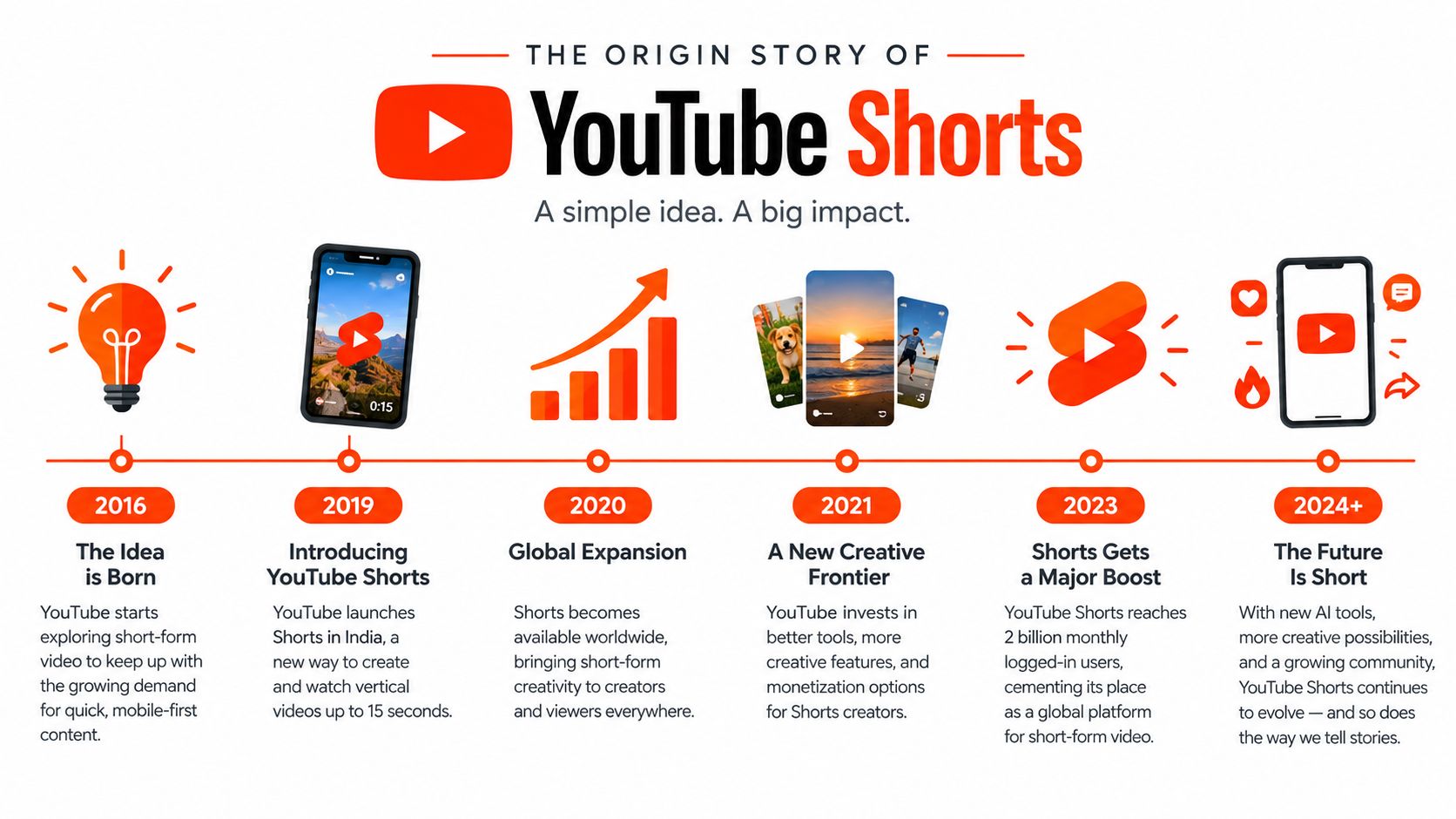
YouTube Shorts began as an early beta in India in September 2020, when YouTube announced a vertical-video experiment with new creation tools. The launch followed India's June 2020 TikTok ban, which created an opening for competing short-video platforms, although YouTube presented the beta primarily as an expansion of creator tools.
That starting point matters because Shorts wasn't introduced as a mature global product. YouTube tested the format in one major mobile-video market, observed how creators and viewers behaved, and then expanded it. By June 2022, YouTube said Shorts was available in more than 100 countries. The history explains why Shorts belongs inside YouTube strategy rather than being treated as an external TikTok clip pasted into a new channel.
A native format inside a wider ecosystem
The product's growth also shaped its strategic role. Shorts can introduce viewers to a channel whose deeper material includes long-form videos, live streams, and posts. That makes the format especially useful for expert-led B2B brands, where a brief observation can create curiosity and a longer explanation can establish credibility.
The best B2B teams don't ask whether a Short can explain an entire product. Usually, it can't, and forcing it to do so produces tiny lectures with captions moving faster than a legal disclaimer. Instead, the Short should isolate one useful idea and make the next piece of content feel necessary.
The historical rollout also supports a platform-specific production approach. Vertical framing, fast openings, captions, clear spoken language, and a self-contained payoff aren't cosmetic choices. They're responses to how viewers encounter Shorts inside a personalized YouTube environment.
The following video provides a visual reference for the format's development and role within YouTube's broader content system.
How the YouTube Shorts Algorithm Actually Works
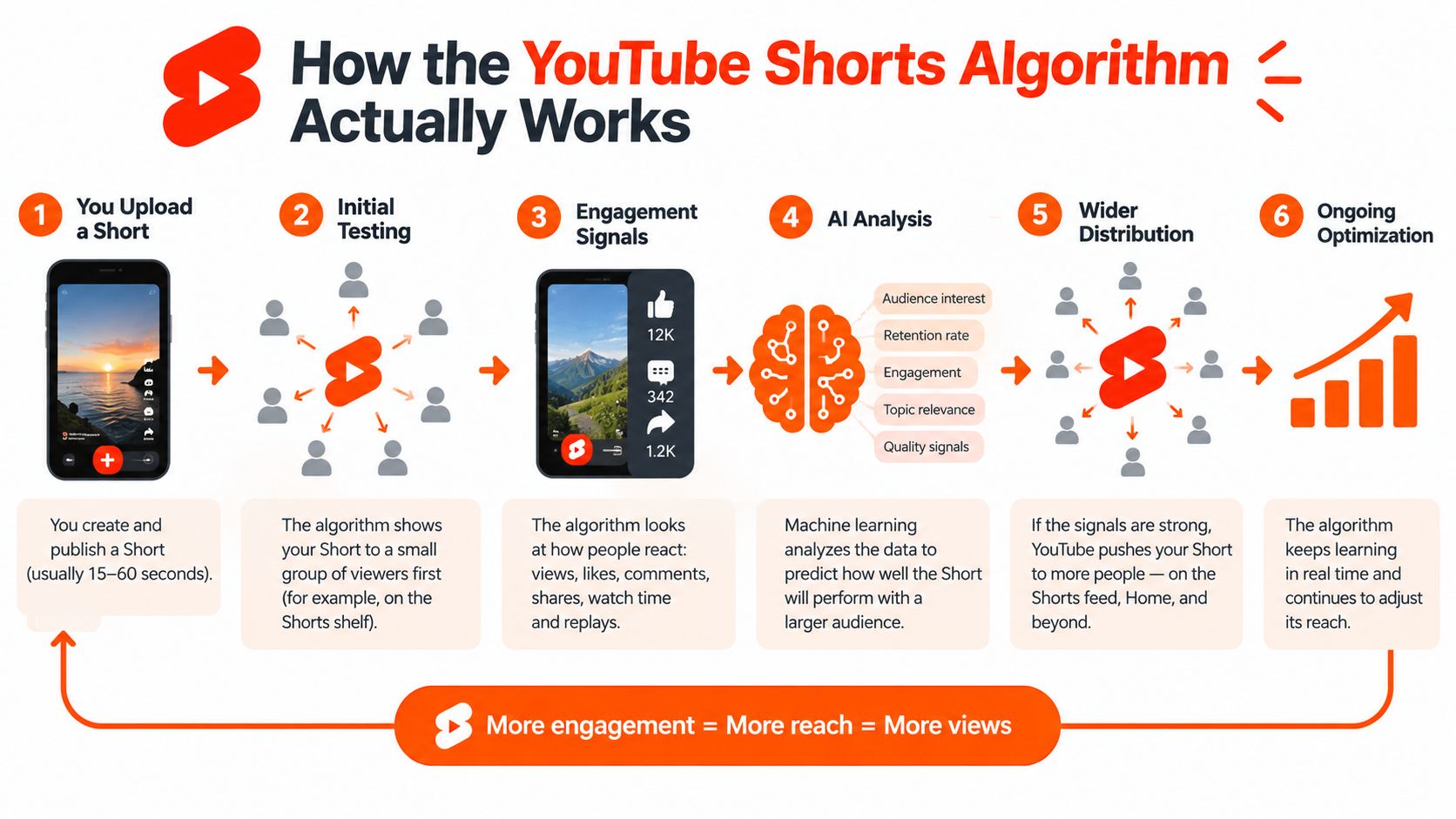
Views alone do not determine whether a Short reaches useful prospects. YouTube personalizes distribution around viewer response. For each impression, the system observes whether someone watches, ignores, or marks the video as uninteresting, then weighs that behavior alongside average view duration, average percentage viewed, likes, and post-watch survey signals.
For B2B teams, the opening is therefore a distribution test as much as a creative choice. A viewer who understands the business problem quickly may continue. A vague introduction invites a swipe, regardless of the expertise behind it.
Test the decision point, not just the topic
Create several openings for one commercial idea, then compare how each version earns attention:
Problem-first hook: “Your sales forecast may be wrong for a simple reason.”
Contrarian hook: “More dashboard data won't fix a broken forecast.”
Outcome-first hook: “This workflow gives revenue teams a cleaner view of risk.”
Each hook should identify the intended audience and problem quickly. The rest of the clip must provide evidence, a practical takeaway, or a clear answer before interest fades. Metadata can help YouTube associate the video with relevant search intent, but it cannot compensate for repeated viewer rejection.
Repurposing requires the same discipline. A webinar timestamp is only raw material. Extract one complete idea, give it enough context to stand alone, and finish with either a useful resolution or a natural reason to explore a deeper resource. That structure helps connect discovery to the next stage of a B2B buying journey without forcing a Short to explain an entire product.
A practical video SEO optimisation resource can support titles, descriptions, and search alignment. Recommendation performance still rests on audience response. Compare viewed-versus-swiped behavior, average view duration, and average percentage viewed across hook variations. Keep the version that attracts relevant buyers and moves them toward a meaningful next action, not just the one that generates the largest audience.
The Shorts-to-Pipeline Problem for B2B
A Short can collect attention without creating demand. That distinction is uncomfortable because the dashboard may show impressive view activity while the sales team receives no additional conversations. The format's discovery strength becomes a weakness when marketers treat reach as evidence of buyer intent.
Short-form video is reported as the highest-ROI format by 55% of B2B marketers, while YouTube Shorts generate more than 70 billion daily views according to the cited industry reporting. Those facts make the channel commercially important, but they don't establish that a viewer is ready to buy. A person can enjoy a clever pricing observation and still have no budget, authority, or immediate need.
The missing measurement layer
B2B teams need an attribution model that recognizes assisted influence. A Short may not receive the final click, but it can introduce a category, prompt a channel visit, or lead someone toward a long-form explainer. The measurement plan should therefore track the path rather than award all credit to the last interaction.
Useful events include:
Qualified channel visits: Did viewers explore other videos aimed at the same buyer problem?
Long-form session starts: Did the Short create interest in a detailed explanation?
Website visits: Did viewers reach a relevant comparison, solution, or use-case page?
Conversion assistance: Did exposed accounts later complete a form or begin a sales conversation?
Subscriber quality: Are new subscribers in the target market, or are they just enthusiastic scrollers?
A context-free thought-leadership clip may create broad awareness. A purpose-built Short that names a specific operational pain may attract fewer viewers but produce more relevant downstream behavior. For a practical lead-generation framework, teams can consult this guide on how to generate leads from YouTube.
The commercial question isn't “How many people watched?” It is “What did the right viewers do after watching?”
Choose the right next step
Awareness content should usually invite a related explanation, not demand a demo from a stranger. Evaluation content can point to a comparison page, product walkthrough, calculator, or implementation guide. A direct sales CTA makes sense only when the Short has already established a meaningful problem and the viewer has a clear reason to act.
This is why a revenue-focused Shorts program should classify each clip by buyer stage. Without that classification, every video ends with the same awkward “book a demo” request, even when the viewer has only just learned the company exists.
Repurposing Long-Form Content and What Works
Repurposing is an editorial decision, not a cropping exercise. A technically complete podcast answer can become a weak Short once the host's question, episode title, and surrounding discussion disappear. The viewer has no obligation to reconstruct that context. The opening and edit must make the audience, problem, and payoff clear on their own.
Start with the commercial role of the source segment. A clip can support awareness, demonstrate expertise, or create a path toward a sales conversation. Those jobs require different edits.
Repurposing approach | When it fits | What to evaluate
Standalone insight | A principle remains clear without explanation | Completion and rewatches
Lightly framed excerpt | An expert answer needs brief context | Average percentage viewed and channel visits
Rewritten Short | A buyer problem needs a stronger hook and payoff | Long-form starts, website clicks, and assisted conversions
A standalone insight might show a founder naming one forecasting mistake and its consequence. A lightly framed excerpt could open with, “A CFO asked why the forecast changed every week,” before the expert explains the process. A rewritten Short would use the source material differently: replace the opening, add visual proof, and end with a next step that fits the viewer's likely stage.
The editing test is straightforward:
Can a new viewer identify the audience and problem immediately?
Does the setup make the answer credible without the full episode?
Does the payoff arrive before attention drops?
Is the next action relevant to the viewer's likely buying stage?
Would the clip still make sense if the original episode never existed?
A podcast producer may remove the host's long question, add a concise setup through text or voiceover, and place the strongest sentence near the beginning. That creates an independent entry point instead of publishing a random thirty-second slice selected by a convenient cut point.
Teams creating a repeatable content engine can use a resource on how to stretch one asset into ten, then apply editorial judgment to each variation. Ten weak fragments will not solve the Shorts-to-pipeline problem. Several focused clips, each tied to a real buyer concern and a relevant next step, can give sales teams more useful openings for later conversations.
Optimizing Your Shorts for Maximum Impact
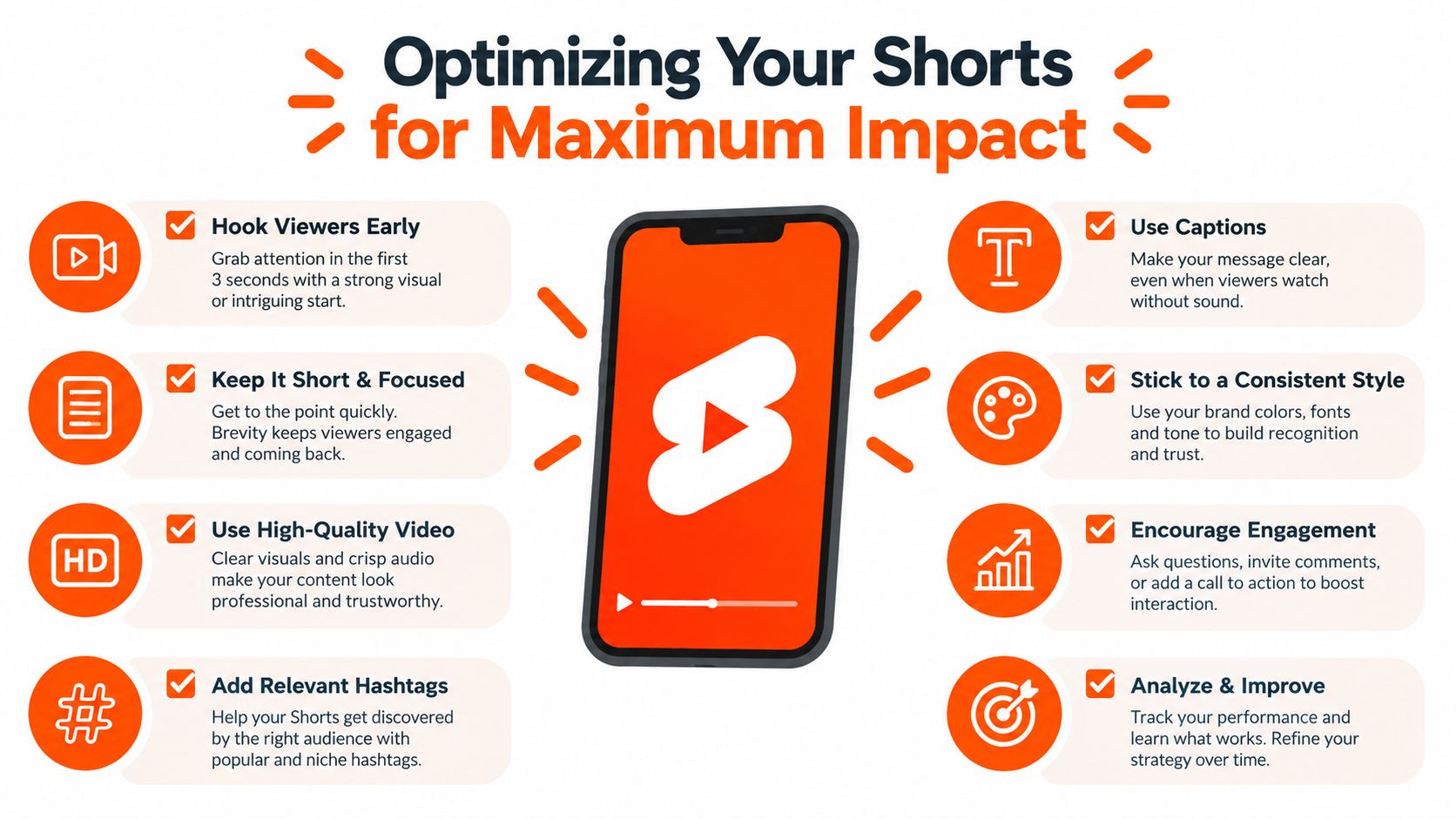
Shorts performance depends less on a target duration than on whether the viewer gets a useful answer before attention fades. A 20-second spreadsheet shortcut may communicate more clearly than a rushed 60-second version. A 90-second SaaS workflow demonstration may need that time to remain understandable. YouTube also categorizes square or vertical videos of up to three minutes as Shorts when uploaded on or after October 15, 2024.
For B2B teams, the edit should serve the next commercial step. Remove dead air, explain one idea, and connect the takeaway to a relevant resource, product page, or sales conversation. A Short that earns views but gives interested buyers no sensible path forward has not solved the Shorts-to-pipeline problem.
Edit for comprehension, trust, and the next action
Use this quality check before publishing:
Name the problem immediately: Tell the intended buyer who the clip helps and why the issue matters.
Choose vertical or square framing: Keep speakers, product interfaces, and captions legible on mobile screens.
Add accurate captions: They preserve comprehension for viewers watching without sound.
Show proof early: Use a screen recording, workflow step, diagram, or specific example instead of a broad promise.
Give one relevant CTA: Direct viewers to a useful video, guide, page, or conversation that matches their likely buying stage.
Use original or licensed media: Commercial footage and music should not create avoidable copyright claims.
Copyright needs a separate review. A Short longer than one minute with an active copyright claim can be blocked globally. Original footage, properly licensed assets, or YouTube-approved music reduce that risk. A product explanation that disappears from every market cannot generate pipeline, regardless of its editing quality.
Review each source video for context, captions, branding, proof, and the intended next step. For practical upload instructions, see Mallary.ai's guide to publishing Shorts.
Building a Sustainable Shorts Workflow
A sustainable Shorts program starts with a revenue path, not a search for viral ideas. Add each webinar, podcast, product demo, or long-form YouTube episode to a content queue with its target buyer, business problem, and next action defined. Editors can then select moments for discovery, education, or evaluation, while the channel team knows where each viewer should go next.
A B2B video agency such as ContentBuck can manage this queue by turning long-form videos, webinars, podcasts, and demos into formatted short clips, alongside broader YouTube editing and strategy work. The operating principle is simple: one source asset should produce several distinct pieces, each serving a different buyer question or sales stage.
Before production starts, assign ownership:
Strategist: Defines the audience, problem, and intended next step.
Subject-matter expert: Checks technical accuracy and removes risky simplifications.
Editor: Builds the hook, captions, visual proof, and platform-ready cut.
Channel manager: Publishes, reviews viewer behavior, and records downstream actions.
Sales or revenue operations: Checks whether target accounts engage or enter active conversations.
Templates should standardize captions, safe areas, brand treatment, and review steps. They should not force every expert into the same delivery, music, or opening. Different hooks and demonstrations give the team more useful learning than identical cuts.
Batch production limits context switching. An editor can review several source videos, tag candidate moments, and create variations in one session. The resulting library should map clips to common objections, buying stages, and follow-up resources. Sales receives usable conversation starters, rather than a folder named “final_final_really-final.mp4.”
For upload mechanics, see Mallary.ai's guide to publishing Shorts.
Frequently Asked Questions About YouTube Shorts
Do YouTube Shorts drive B2B revenue?
They can influence revenue as a discovery and qualification layer, but views alone don't prove pipeline impact. Connect each Short to a relevant long-form video, comparison page, educational resource, or sales action, then monitor qualified traffic, channel behavior, website clicks, and assisted conversions.
How often should a B2B company publish?
A sustainable cadence matters more than an arbitrary volume target. Teams should publish often enough to test different buyer problems and hooks, while maintaining accurate editing, clear positioning, and useful follow-up content.
What length works best?
There is no universal ideal duration. YouTube says the right length depends on the topic, audience, and purpose. A short demonstration may need only a brief explanation, while a workflow needs enough time for the viewer to understand the sequence.
Does a Short need expensive equipment?
No. Clear audio, useful lighting, stable framing, readable captions, and strong scripting matter more than a cinematic studio. Screen recordings, product footage, and well-framed expert video can all support a credible B2B clip.
How does Shorts monetization work?
Shorts advertising revenue comes from ads shown between videos in the Shorts Feed. YouTube calculates creator payments using eligible engaged views, excludes non-original Shorts and artificial views, and requires acceptance of the Shorts Monetization Module. The lower Partner Program entry level requires 500 subscribers, three public uploads during the previous 90 days, and either 3,000 qualified long-form watch hours in the previous 365 days or 3 million qualified Shorts views in the previous 90 days. Full Shorts-feed ads and YouTube Premium revenue require 1,000 subscribers plus either 4,000 qualified long-form watch hours in 365 days or 10 million qualified Shorts views in 90 days. These thresholds come from YouTube's Partner Program guidance, and meeting them doesn't guarantee earnings.
What should a team do first?
Choose one buyer problem, create several hook variations, connect every clip to a relevant next step, and review downstream behavior rather than celebrating raw reach. The strongest program treats Shorts as part of a content and sales system, not as a daily lottery ticket with captions.
ContentBuck helps revenue-focused B2B companies plan, produce, edit, and repurpose YouTube content, including short clips from long-form videos, webinars, podcasts, and product demos. Visit ContentBuck to build a Shorts workflow connected to search visibility, buyer education, and sales conversations.
Parth Jasrapuria
Founder at ContentBuck
Building video systems for B2B businesses. Obsessed with YouTube growth, creative strategy, and organic SEO.