Video Editing Companies: 7 Picks and How to Choose
Parth Jasrapuria
Founder
Five browser tabs, all open on lists of video editing companies. A desktop folder named final_final_v3 holding 47 gigabytes of raw footage. A marketing lead who has watched the same 12-minute product demo nine times and still can't decide whether the intro drags. That's a matching problem, not a research problem.
Video is mainstream business equipment now. Wyzowl's survey of 266 marketing professionals, run in late 2025, found that 91% of businesses use video for marketing, and 82% of marketers said it produced a good return on investment (Wyzowl). So the question isn't who's best. It's who fits your use case, your workflow, and your budget, and what happens when the first cut comes back wrong. If you're weighing whether software can handle the timeline before a human ever touches it, Trupeer's AI video editing guide covers where automation holds up and where it doesn't.
Seven companies follow, each matched to a situation rather than ranked by vibes. The decision framework sits at the end.
1. ContentBuck
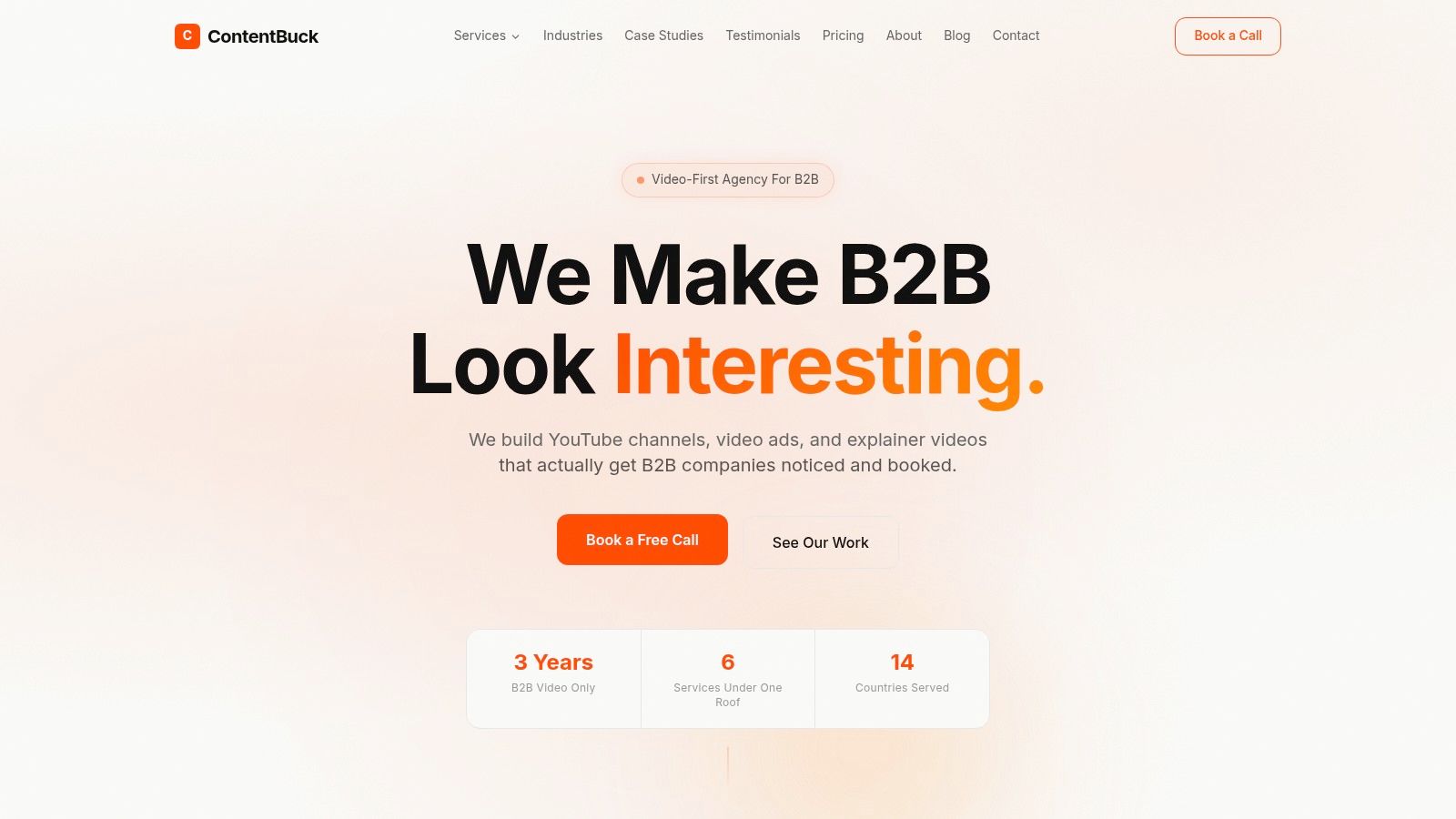
ContentBuck is a B2B-only video and content agency, and that single filter removes half the market for you. No consumer brands, no lifestyle shoots, no wedding reels. What it sells is a pipeline: strategy, scripting, production, editing, SEO, and repurposing under one roof, covering YouTube channel growth, animated explainers, paid video ads, podcast production, buyer-intent SEO content, and ongoing editing subscriptions.
What the engagement looks like
Packages include weekly YouTube production with short-form clips, 60 to 90 second explainers, and queue-based editing or ad creative with 24-hour turnaround. Explainers land about 14 days after script sign-off. The unlimited editing subscription runs on a flat monthly fee with no contracts, requests go through a project board, and revisions are unlimited and turned around within 24 hours. The Growth plan covers up to 40 short-form and 5 long-form videos a month, two active requests at a time, a dedicated editor, and Slack and email support.
Published case studies report 60% lower cost per lead, 12,000 YouTube subscribers in three months, and 34,000 monthly organic visitors.
Match it when: your team produces 8 or more raw video assets a month and the buyer is a CTO or IT director. Below one or two videos a month, a freelancer costs less, and ContentBuck says so itself.
That last point is the honest part most vendors skip.
Two market forces make the commercial framing matter. Ad creative decays: a 2026 benchmark covering 368 Meta ad creatives found click-through rate down 5.5% within the first 250,000 impressions and cost per acquisition up 19.6% by the 500,000 to 1 million impression range (The Interconnections). An editing queue therefore needs a refresh cycle built in. Search compounds the same way, with BrightEdge finding organic search drove 51% of visitors across B2B and B2C websites and 73% in its business-services segment (BrightEdge). A cut video plus a page explaining the same service is what converts attention into pipeline.
Pros
One partner, whole funnel: strategy, scripting, editing, SEO, and distribution in one contract.
Speed: 24-hour turnaround on most requests, with a 12-hour rush option.
No lock-in: flat monthly fee, no contracts.
Measurable proof: the case-study outcomes above, published on the site.
Cons
B2B only: consumer and lifestyle brands need a different shop.
Not for tiny volumes: one or two videos a month belongs with a freelancer.
Not a motion house: complex motion graphics and 3D animation sit outside the service.
Editing, not direction: full ad strategy and creative direction live in the separate Ad Creatives service.
Website: ContentBuck (contentbuck.com).
2. Anthem Content
Say a SaaS company has a webinar library nobody watches twice and a podcast that died after episode six. Anthem Content is built for that pattern. It's a B2B video partner covering one-off production, ongoing editing subscriptions, podcast production from planning through delivery, and video asset management, so footage gets reused instead of buried in a drive.
The strategy-plus-production combination is the differentiator. A team gets help planning and shooting, then keeps a recurring queue for edit requests rather than briefing a new vendor every quarter.
Match it when: you want a partner for the whole video programme, not a per-video vendor.
The category has real depth behind it. The U.S. Bureau of Labor Statistics counted 143,120 producers and directors in May 2025 at a mean annual wage of $113,300, with 37,700 of those professionals employed in motion-picture and video industries (BLS). Post-production is a sized industry as well, valued at USD 25.85 billion globally in 2024 (Market.us). Pricing reflects that. Expect a real conversation, not a rate card.
Pros
B2B focus: relevant to SaaS and professional-services buyers.
Broader than editing: strategy and production included.
Subscription option: suits teams with a steady request flow.
Cons
No public pricing: subscription cost requires a sales call.
More than you need: straightforward editing jobs will feel over-engineered.
Self-published proof: testimonials come from the company, not an independent source.
Website: Anthem Content.
3. Shootsta
Twelve offices, forty people filming on their phones, and one brand manager staring down eleven different logo treatments. Shootsta's answer is a platform plus a repeatable process: brief, approve, and produce inside locked brand templates, with professional editors doing the finishing work. It suits organisations that want employees capturing footage themselves without the output looking like a staff talent show.
Turnaround runs on your plan
First-cut turnaround depends on the plan you choose, so confirm the exact timing for your tier before committing. Higher tiers add support for multiple departments or locations, and the service supplies filming equipment and training so your own team captures footage that editors then finish. For a company producing a steady stream of internal comms, recruitment clips, and event coverage across sites, that setup removes the per-video briefing cycle.
The category Shootsta plays in has real momentum behind it. One market estimate valued real-time collaborative video-editing platforms at $1.34 billion in 2025, projected to reach $4.43 billion by 2034 at a 14.2% CAGR, with software at 68.5% of 2025 revenue (Dataintelo). When you evaluate vendors here, ask whether the workflow supports simultaneous review, searchable media, proxy editing, permissions, and clean handoffs between editors, producers, and clients. Those features separate a true collaboration platform from a shared folder with a login page.
Pros
Brand governance: templates and approval steps keep distributed teams consistent.
Self-filming support: equipment and training reduce reliance on production crews.
Published starting prices: easier first-pass budgeting than a quote-only shop.
Cons
Built for programmes: occasional one-off jobs sit badly on this model.
Starting prices only: a specific scope will quote higher.
Check the tier: confirm which features and service levels your plan includes.
Website: Shootsta.
4. beCreatives
beCreatives sells a monthly editing subscription for marketing teams and agencies that need a recurring queue of short- and long-form work. Captions, motion graphics, color correction, audio enhancement, and aspect-ratio versions sit in the standard scope, which makes it a repurposing machine rather than a single-format shop.
Plan details list one active request at a time, unlimited revisions, Slack collaboration, and a quality-check step. Pricing and turnaround estimates are public, and a 14-day trial or money-back offer is advertised. Before committing, it's worth reading how these beCreatives alternatives compare on throughput and scope.
Why subscriptions took over
The money moved this way across the whole category. Straits Research estimated the global video editing software market at $2.42 billion in 2025, forecast to reach $4.45 billion by 2034 at a 7.0% compound annual growth rate, with subscription products generating 82.0% of market revenue (Straits Research). Buyers now expect recurring access to capacity, review, and asset libraries rather than a one-time post-production purchase.
Pros
Public pricing: budgeting doesn't need a discovery call.
Broad post-production scope: captions, grading, motion graphics, and resizing included.
Low-risk trial: the 14-day offer lets you test before committing.
Cons
One request at a time: parallel throughput is limited.
Turnaround varies: length and complexity decide the clock.
Editing only: no strategy, SEO, or distribution support.
Website: beCreatives.
5. Video Husky
Video Husky is the safe, unglamorous pick for recurring YouTube, podcast, interview, webinar, course, and social-ad edits. Packages come at several workload levels, each client gets a dedicated editor plus project management support, and the workflow accepts multiple submissions while working one active project at a time.
Why one-at-a-time is fine
Queue-based delivery might seem limiting until you consider your own publishing schedule. Many editors don't require six videos on a Tuesday. They need the same editor who already knows the intro style, the lower-third placement, and which jokes to cut. Up to six exports per project are described in the workflow, and subtitles and thumbnails are available as add-ons.
This structure exists because editing stopped being a tape-room job. Nonlinear editing let editors rearrange media without following the original recording order, and tapeless workflows removed the physical handoffs that used to slow everything down (Britannica on video editing). A remote editor working a monthly queue is the direct descendant of that shift.
Pros
Published packages: monthly costs are easy to compare.
Dedicated editor: coordination stays with one person plus a workspace.
Format coverage: handles most common online-video types.
Cons
Sequential delivery: requests don't all progress at once.
Not a growth agency: no SEO, strategy, or full-funnel acquisition work.
Tier limits: capacity and included output change by package, so read the fine print.
Website: Video Husky.
6. Vidchops
Vidchops runs on credits, and the credit math is the whole story. One credit is described as either one long-form video or four short-form videos, so a YouTube channel plus its social clips fits one plan instead of two subscriptions.
Monthly plans are advertised without long-term contracts, a dedicated editor and video-proofing workflow come standard, and royalty-free stock footage and audio are listed in plan details. A 14-day money-back guarantee is advertised on the pricing page.
Where the model bites
Credits don't roll over. A slow month means unused capacity disappears, so value depends on consistent output rather than good intentions. Pages also show differing prices and terms, so confirm the current offer and get the scope in writing before you sign. If the credit model doesn't match your volume, these Vidchops alternatives cover services that bill differently.
Send one real episode through the credit system before buying three months. A single test tells you more about proofing quality than any portfolio page.
Pros
Simple output model: credits mix long-form and short-form cleanly.
Repurposing built in: one plan covers YouTube and social.
No long-term contract: monthly plans, advertised as flexible.
Cons
Expiring credits: inconsistent demand wastes money.
Editing only: no B2B strategy, SEO, or production support.
Inconsistent pricing pages: verify the current offer directly.
Website: Vidchops.
7. Lemonlight
Call Lemonlight when the problem is that no footage exists. It's a full-service production company covering pre-production, filming, and post-production, with formats that include product videos, explainers, testimonials, advertisements, and animated videos, supported by a crew network across many markets.
Curated videos built from stock footage are the option for projects that don't justify a shoot. Everything else is project-based, which means schedules and quotes depend on scope, and revision rounds belong in the written agreement. For a sense of what drives those quotes, this breakdown of video editing costs separates footage volume, complexity, and turnaround from the headline number.
The AI question
AI now sits in the room during production. Lemonlight's own survey of 500 marketers found 84% reported using artificial intelligence at some point in the video-production process in 2025 (Lemonlight). That's a reason to ask any production partner which steps stay human: shot selection, story structure, and the judgment call on what a product claim means.
Pros
Filming plus editing: one provider for the full project.
Multi-market crews: useful when shoots happen in several cities.
Format range: commercials, testimonials, product videos, explainers, animation.
Cons
Project-based: poor fit for high-volume quick edits.
Higher cost base: production capacity you may not need if footage already exists.
Quote-dependent: timelines and revision rounds need confirming.
Website: Lemonlight.
Video Editing Companies Compared
Seven providers, three ways of working: flat-fee subscriptions, a platform model, and per-project quotes. The engagement model matters more than the logo, because it decides how fast requests move, what revisions cost, and whether the invoice stays predictable month to month.
Provider | Engagement Model | Best For | Pricing Signal
ContentBuck | B2B content agency with retainers and projects | B2B teams seeking end-to-end video, SEO, and content support | Flat monthly fee for unlimited editing; no contracts
Anthem Content | One-off production or ongoing video partnership | SaaS and professional-services teams with recurring video needs | Subscription pricing not published
Shootsta | Platform-based editing service with optional filming equipment and training | Larger teams producing video regularly across departments or locations | Published starting prices; confirm plan details
beCreatives | Monthly editing subscription with one active request at a time | Marketing teams and agencies needing recurring edits and repurposing | Public plan pricing; trial or money-back offer listed
Video Husky | Monthly editing subscription with a queue-based workflow | Teams producing recurring online video across multiple formats | Published monthly packages; capacity varies by tier
Vidchops | Monthly editing subscription using credits | Creators and businesses needing regular long- and short-form edits | Public monthly pricing; confirm current offer and terms
Lemonlight | Project-based, full-service video production | Brands needing filmed campaign assets or polished production | Quote depends on project scope
The split in the last column tells you plenty. Subscription players like beCreatives, Video Husky, Vidchops, and ContentBuck publish flat fees because their model depends on predictable volume. Lemonlight and Anthem Content quote per engagement, so expect a scoping call before a number. Shootsta splits the difference with published starting prices and plan details that need confirming. One honest quirk in Vidchops' favor: credits roll a queue like a subscription, but they also cap output, which keeps your spending honest when your video calendar gets ambitious.
The 5-Minute Decision to Match Your Use Case to the Right Partner
Start with the three situations that cover most buyers.
A SaaS team shipping weekly YouTube episodes plus paid ad variants needs an agency that handles both. ContentBuck fits that profile: unlimited video editing on a flat monthly subscription, 24-hour turnaround per request, a dedicated editor, and unlimited revisions, all with no contracts. A creator slicing long-form episodes into clips fits Vidchops or Video Husky. A brand that needs filmed campaign assets and testimonial shoots fits Lemonlight.
Four questions settle the rest faster than any demo call.
Count your monthly volume: how many raw videos need editing each month? One or two, a freelancer costs less than any subscription. Eight or more, a subscription or retainer pays for itself.
Decide the scope: editing only, or editing plus strategy, scripting, and distribution? Editing-only vendors cost less. Full-funnel partners replace two or three vendors and price accordingly.
Check published pricing against the budget: a company hiding its rate card will still send an invoice, just later.
Trial the shortlist: send one real project to two vendors before signing anything.
One more question belongs on that list now: how much of the workflow is AI? Wistia's 2025 State of Video report found 41% of surveyed brands used AI for video creation in 2025, up from 18% in 2024. Faster output multiplies mistakes too. Ask which tasks stay human-reviewed, whether your footage trains a model, and who approves translated versions.
How much do video editing companies cost?
Two pricing worlds. Editing subscriptions publish monthly plans and bill for capacity. Full-service production quotes per project after scoping footage, locations, and crew. ContentBuck's unlimited video editing runs on a flat monthly fee with no contracts, which makes it a straightforward comparison point against per-project production quotes.
What turnaround is realistic?
A queue-based service turns most requests around in a day or two. Filmed production runs on a schedule measured in weeks. Anything faster than 24 hours needs a rush option agreed in advance.
How do revisions actually work?
Unlimited revisions sound generous until you check the definition. Confirm how many rounds, what counts as a new request, and how long revisions take. ContentBuck turns revisions around within 24 hours alongside the original edit.
Do subscriptions beat project-based production?
Only on volume. Subscriptions win when you publish weekly and the queue stays full. Project work wins for a single campaign, a launch film, or anything requiring a shoot. If you're weighing clip-generation software for repurposing, this ranking of AI video clipping tools shows where software stops and an editor starts.
If that pattern sounds familiar, a B2B team drowning in raw footage and short on editing capacity, ContentBuck handles that work on a flat monthly subscription with 24-hour turnaround, unlimited revisions, and a dedicated editor, covering webinars, product demos, podcast cuts, and social clips. Engagements run without contracts, and most editing requests come back within a business day. Visit ContentBuck to book a free discovery call and see which plan matches your publishing volume.
Parth Jasrapuria
Founder at ContentBuck
Building video systems for B2B businesses. Obsessed with YouTube growth, creative strategy, and organic SEO.