Video Editing Costs: A B2B Guide to Pricing Models
Parth Jasrapuria
Founder
Video editing costs can range from $30 to $200 per finished minute, or from a flat monthly fee when a team needs ongoing production. The surprising part is that hourly pricing often gives the least reliable view of the final bill, because complexity, format volume, revisions, and turnaround speed matter more than the clock alone.
A five-minute interview can cost less than a one-minute product ad. The interview may need clean cuts and light audio work. The ad may require custom animation, multiple hooks, captions, color treatment, sound design, and versions for every channel where a paid campaign might appear. The timeline looks short. The invoice has other ideas.
The Hidden Reality of Video Editing Costs
Video editing pricing looks simple until the brief gets real. A talking-head cut, a SaaS explainer, and a multi-format ad campaign all use the same software, but they create very different workloads and risk.
The bill grows in the places buyers often undercount. Revision rounds, unclear briefs, extra aspect ratios, rushed delivery, motion graphics, and messy source footage can turn a clean quote into a larger invoice fast. Each item may seem minor on its own, yet together they consume schedule and margin.
Hourly pricing reflects that reality, but it still hides the full cost structure. Entry-level editors often sit around $20 to $45 per hour, mid-level editors around $45 to $85 per hour, and senior specialists around $85 to $150 or more per hour, according to the 2026 video editor hourly rate guide. Agency and specialist work can reach $100 to $250 per hour when the job calls for advanced motion design, color grading, or a compressed deadline.
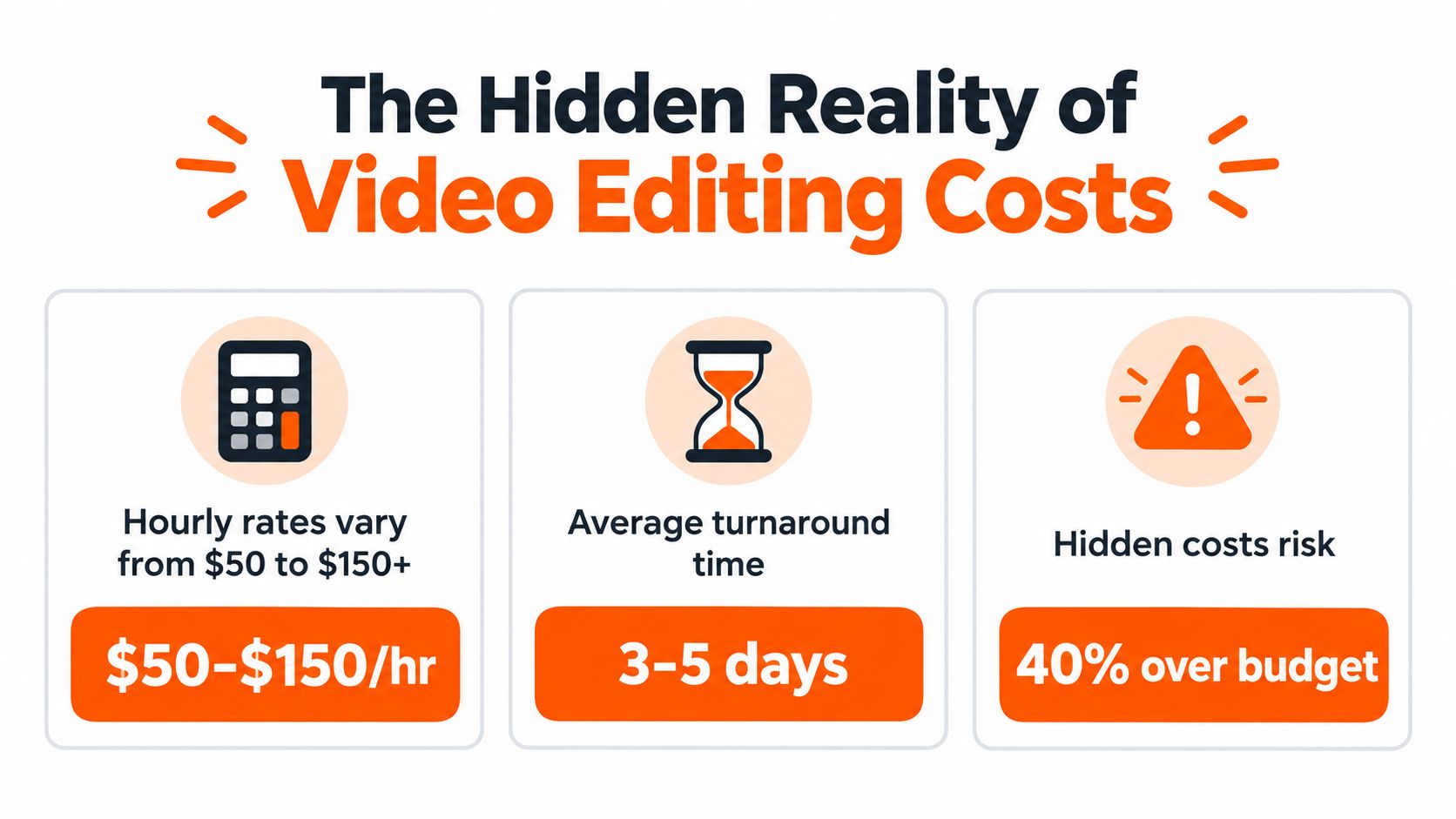
A cheap rate can still produce an expensive edit. An editor who needs heavy direction, spends extra time organizing footage, or misses the story the first time can cost more than a senior editor who gets there quickly.
The practical test is scope discipline. Buyers should compare quotes using the same inputs.
Deliverables: Define the main video, short clips, captions, thumbnails, and aspect ratios.
Source material: State how much footage the editor will review and whether files are organized.
Finishing level: Separate basic cutting from audio cleanup, color grading, animation, and compositing.
Feedback process: Specify who gives notes and how many revision rounds are included.
Turnaround: Identify the normal schedule and any rush requirement.
That discipline matters because pricing shifts with project shape. Professional editing often lands around $75 to $200 per finished minute, while a completed video edit commonly falls between $200 and $2,000, based on the 2026 video editing pricing survey. Those figures can both be true, because a finished minute may require very different amounts of review and creative work.
For B2B teams comparing explainer formats, the guide to explainer video rates is a useful reminder that editing is only one cost center. The key buying question is how much usable output the team needs for distribution, repurposing, and channel coverage, not just how many minutes end up in the final file.
Choosing Between Hourly, Project, and Retainer Models
The right payment model depends on how stable the work is and how much output the team needs. Hourly billing buys flexibility, project pricing buys a defined deliverable, and a retainer buys ongoing capacity. For active B2B teams, the key question is unit economics. What does each asset cost once repurposing, revisions, and coordination are included?
Hourly pricing suits uncertain scope
Hourly work makes sense when the footage is hard to scope or the creative direction may change. A startup testing its first customer interview series might use this structure while it learns what its audience responds to.
The upside is clarity on effort. The buyer pays for recorded work instead of accepting a fixed number that may or may not match the actual workload. The downside is variance. If three stakeholders send separate notes, the editor can spend more time sorting feedback than improving the story.
Hourly pricing works best when the buyer controls the variables:
A single decision-maker consolidates feedback.
The brief states the audience and desired action.
The footage is labeled and easy to review.
The editor gets a realistic deadline.
Extra deliverables need approval before work starts.
Project pricing creates a clear boundary
Project-based pricing fits a one-off webinar edit, a product launch video, or a defined brand asset. The buyer knows the expected cost before production begins, and the editor can shape the work around a specific outcome.
The boundary needs to be written carefully. “One video” can mean one horizontal master, or it can mean a master plus vertical, square, captioned, silent, short-form, and ad-ready variants. Those are different workloads wearing the same label.
A professionally produced two-minute explainer commonly costs $3,000 to $12,000, while corporate brand videos involving multi-day shoots and full post-production can reach $8,000 to $25,000. The range reflects production complexity, not just editing time.
For teams comparing setup and ongoing support, subscription vs freelancer trade-offs in video editing also matter. A fixed project fee can look clean on paper, then get stretched by revisions, extra cuts, or versioning for different channels.
Retainers turn editing into capacity
Retainers fit active B2B teams that publish continuously. A monthly arrangement can cover podcast clips, product demos, paid-social variants, webinar edits, and thought-leadership videos without starting a fresh procurement process for every asset.
Monthly editing services can start around $395 to $500 for limited output and rise into the low thousands for higher volume or a dedicated editor. The value is not just a lower sticker price. It comes from repeated context, predictable availability, and less administrative friction.
A retainer is not automatically cheaper for a team that publishes only occasionally. For a marketing department shipping content every week, it usually lowers the cost per asset because setup, brand familiarization, and coordination happen once and carry through the full stream of deliverables.
Why Complexity Drives Your Final Invoice
Video length is a weak proxy for editing effort. A five-minute interview may involve one camera, clear audio, and a straightforward narrative. A one-minute animated explainer may require a storyboard, custom illustrations, kinetic text, voiceover timing, sound design, and several rounds of visual adjustment.
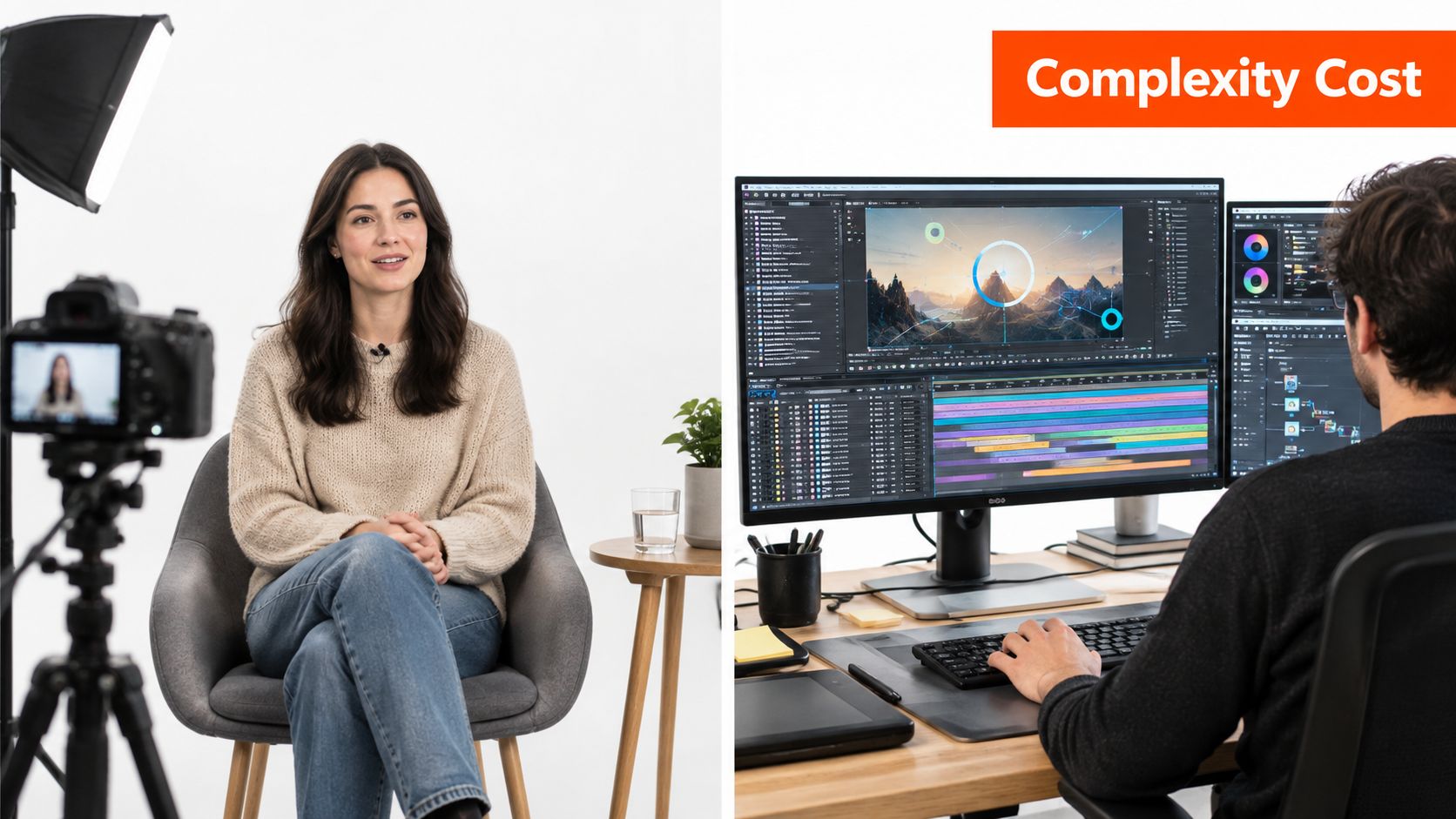
Four workload multipliers
Motion graphics add design and animation work. A lower third may be simple. A product interface animation that follows a cursor, highlights features, and transitions between screens is a miniature design project hiding inside the edit.
Multi-camera footage creates a synchronization and selection problem. The editor must align angles, choose the strongest performance, maintain continuity, and avoid cuts that make the speaker look as if they have teleported across the room.
Color correction and grading serve different purposes. Correction balances exposure and skin tones. Grading creates a consistent visual mood. Footage captured under mixed lighting can require careful treatment before it looks suitable for a polished B2B brand.
Audio cleanup often decides whether a video feels professional. Background noise, inconsistent volume, room echo, clipped dialogue, and music that fights the speaker all require attention. Viewers may forgive a plain background. They rarely forgive dialogue they can't understand.
The video editing rate breakdown by finished minute places common freelance rates at $20 to $45 per hour for entry-level work, $45 to $85 for mid-level work, and $85 to $150 or more for senior specialists. It also places many finished edits around $30 to $100 per finished minute, with an 8 to 12-minute YouTube edit often costing $300 to $1,500. These ranges widen when the project includes complex finishing or extensive repurposing.
A practical brief should identify each complexity driver before the editor quotes:
How much raw footage needs review?
How many cameras or audio sources are involved?
Are graphics supplied, adapted, or created from scratch?
Which versions and aspect ratios are required?
Who approves the final cut?
What happens when the deadline moves forward?
This video offers useful visual context for the relationship between production and post-production:
The buyer isn't paying for screen time. The buyer is paying for decisions, craft, and the number of production problems the editor must solve before the audience sees a clean result.
The Unit Economics of B2B Video Volume
A B2B team rarely needs one isolated video and then silence. It needs a steady stream of assets for LinkedIn, YouTube, paid campaigns, sales enablement, webinars, product launches, and internal distribution. The relevant question becomes what does each usable asset really cost after repurposing?
Suppose a team commissions one long-form recording. The commercial value may come from the main edit, short clips, captions, vertical versions, ad hooks, and snippets for sales outreach. Project pricing treats each request as a separate purchase. A retainer treats the editing function as a shared monthly production line.
That distinction matters because every project carries setup costs. The editor must review the brief, locate assets, understand the brand, establish the visual style, organize files, and prepare exports. Repeating those steps for every small job is like buying a whole pizza one slice at a time. The slices may look affordable until someone counts the boxes.
A simple unit economics model
Use this formula for each production cycle:
True cost per asset = total monthly editing spend ÷ usable assets delivered
“Usable” matters. A file that exists but doesn't meet the channel requirements isn't a completed business asset. A retainer's value improves when the workflow produces a reliable mix of long-form videos, short clips, ad variants, captions, and platform-ready exports.
Model | Monthly Cost | Assets Produced | Cost Per Asset
Project-based | Variable per request | Irregular, based on approved projects | Usually higher when volume is fragmented
Limited monthly service | About $395 to $500 | Limited output | More predictable, but capacity is constrained
Higher-volume retainer | Low thousands | Larger recurring queue | Lower when the team uses the available capacity
Dedicated editing capacity | Flat monthly fee | Ongoing production across formats | Lowest when the queue stays consistently active
The limited-service and low-thousands ranges come from market guidance on subscription-style video editing, which also describes video-editing market growth as a projection from $3.75 billion in 2026 to $4.99 billion by 2031. The same source projects video-editing software growth from $2.54 billion in 2026 to $3.80 billion by 2034. Those projections point to an expanding production ecosystem, but they don't prove that every retainer saves every buyer money.
When retainers win
A retainer usually wins when the team has recurring source material, a stable approval process, and enough work to keep the queue moving. It doesn't win when a company buys capacity and then sends one video every few months.
The useful comparison isn't “monthly fee versus one invoice.” It's monthly fee versus the total cost of separate briefs, repeated onboarding, scattered feedback, rush requests, and missed publishing opportunities. Teams should calculate the cost per approved asset, not the price printed on the first proposal page.
For businesses evaluating queue-based or unlimited video editing services, the contract should define what “unlimited” means, including active requests, turnaround rules, revision handling, accepted formats, and any exclusions. A clear queue beats an exciting label.
Real-Life Examples of Budget Busters
A software company once chose an editor because the hourly rate looked inexpensive. The brief covered a product demo, but nobody documented the expected versions. After the first cut, the sales team requested a shorter opening, paid media wanted a vertical version, the product team corrected screen captures, and the founder asked for a different music track.
None of those requests felt outrageous. Together, they changed the job. The original estimate covered one edit, while the actual requirement involved several audiences, formats, and approval groups. The low hourly rate became irrelevant because the team had bought an undefined process.
Practical rule: A quote is only useful when the deliverable list is more specific than the word “video.”
The same problem appears with revision rounds. A marketing manager may send one batch of notes, then a sales leader sends another, followed by a subject-matter expert who notices a technical nuance late in the process. The editor isn't just changing clips. The editor is rebuilding decisions that the client team never settled before production began.
A better operating model assigns one owner for feedback, sets a consolidated review window, and separates factual corrections from creative preferences. “The logo feels too small” and “the product claim is inaccurate” shouldn't travel through the same approval lane.
A healthier recurring workflow
A SaaS marketing team with frequent webinars and product updates can create a monthly queue instead:
The editor receives a defined content calendar.
Brand elements, fonts, music preferences, and caption rules stay consistent.
Long-form edits and short-form cutdowns share the same source material.
The team requests variants while the project context is still fresh.
Performance data informs future hooks and openings.
The advantage isn't a fictional overnight transformation. It's operational consistency. A dedicated relationship reduces the number of times the marketing team has to explain what “on brand” means, while the editor learns which moments deserve emphasis and which internal jokes should remain safely outside the final cut.
Public rate guides show a broad market from roughly $10 to $300 or more per hour, with agency work often around $100 to $250 per hour and freelancers around $25 to $150 per hour, as summarized by this analysis of video editor costs. The same analysis warns that price doesn't consistently predict quality. That is why buyers should inspect the workflow, examples, revision policy, and turnaround commitment rather than selecting the cheapest number.
How to Pick the Right Path for Your Team
The right video editing arrangement depends on three variables: output volume, internal coordination, and tolerance for unpredictable spend. A small team with occasional needs shouldn't buy a large production system. A growth team publishing every week shouldn't manage every clip as a fresh emergency.
Use the following decision path.
Choose hourly for discovery
Hourly pricing fits a project with uncertain footage or an evolving creative direction. It also works for a small one-off task, such as cleaning up an interview or trimming an internal presentation.
Before approving the work, ask for an estimate of hours and define a stop point. The formula is straightforward: estimated editing hours multiplied by the hourly rate, plus add-ons and a revision buffer, as outlined in this video editor rates guide. A three-hour edit at $50 per hour can become a $200 or higher invoice once revisions and extras are included. The arithmetic is simple. The scope is where the gremlins live.
Choose project pricing for a defined outcome
Project pricing is sensible when the team knows exactly what it needs. Examples include a finished customer story, a conference highlight, or a launch video with an approved script and a fixed set of exports.
The proposal should state:
The primary deliverable and every derivative format.
The number of included revision rounds.
Whether captions, music, sound mixing, and color work are included.
Who supplies graphics, footage, and brand assets.
The cost and timing of additional requests.
Choose a retainer for an active content engine
A retainer is usually the most practical option for a lean B2B team that needs a steady stream of clips but doesn't want to hire, train, and manage a full-time production department. It also suits paid media teams that need ongoing creative variations and podcast teams that repurpose every episode across channels.
A buyer should choose a retainer when the monthly queue is predictable enough to use the capacity. A buyer should avoid one when the marketing calendar is mostly empty or approvals regularly stall production.
The national video editing price snapshot reports that many customers pay around $65 per hour, while the broader range runs from about $40 to $300. Those figures are useful for market orientation, but they don't answer the more important question: how many approved assets will the team receive for the total spend?

FAQs about video editing costs
Is hourly pricing always cheaper for a small business? No. It can be economical for a tightly defined one-off task, but unclear footage and repeated revisions can erase the advantage. A small business should compare the total expected invoice and management time, not only the hourly figure.
Should a B2B team pay per finished minute? Per-minute pricing can simplify comparison when the finishing standard is clear. It becomes misleading when one quote includes motion graphics, captions, and multiple versions while another covers only a basic cut.
What should a video editing brief include? It should include the audience, objective, source footage, desired duration, formats, graphics, audio expectations, review owners, revision limits, and deadline. The more decisions made before editing begins, the fewer expensive surprises appear later.
Are retainers cheaper than project rates? They can be cheaper per asset when the team maintains a steady queue and reuses the editing relationship across formats. They won't be cheaper if the buyer pays for unused capacity.
For a team assessing video editing costs, the next action is practical: list every asset produced in the last month, add the revisions and format changes that followed, and calculate the actual cost per approved file. ContentBuck offers flat-fee, queue-based video editing with a dedicated editor and 24-hour turnaround for ongoing B2B production needs, so teams can compare that model against fragmented project invoices by visiting ContentBuck.
Parth Jasrapuria
Founder at ContentBuck
Building video systems for B2B businesses. Obsessed with YouTube growth, creative strategy, and organic SEO.