Unlimited Video Editing Services: A B2B Guide for 2026
Parth Jasrapuria
Founder
The most popular advice about unlimited video editing services is also the least useful: submit as much as you want, pay one predictable fee, and watch an endless stream of polished videos appear. That fantasy lasts until a podcast, webinar, product demo, and urgent ad variant all land in the queue on the same morning.
"Unlimited" usually describes requests, not infinite production capacity. The buying question is throughput: how many publishable videos can the service deliver within its queue rules, turnaround windows, revision process, and available editor capacity? That distinction matters for B2B teams, where a delayed video can hold up a campaign, sales enablement launch, or weekly content schedule.
The outsourced video editing services market was valued at about USD 4.37 billion in 2024 and is projected to reach roughly USD 10 billion by 2035, with a forecast CAGR of 7.8% during 2026 to 2035, according to the outsourced video editing services market forecast. Unlimited plans fit inside that wider move toward recurring external production capacity, but only when buyers understand the operating model behind the label.
What Unlimited Really Means And What It Doesn't
Unlimited video editing services generally let you submit an ongoing stream of requests without paying for every individual export. That doesn't mean a provider can edit fifty videos on Monday and return all of them on Tuesday. The service still has a finite number of editors, active request slots, review stages, and working hours.
Most plans work like a prioritized production lane. You submit a request, the provider places it in a queue, an editor works on the active item, and the next request starts after delivery or approval. Independent comparisons describe practical limits such as one active request, turnaround windows of 24 to 72 hours, and revision controls. Those mechanics can produce roughly 6 to 12 videos for basic tiers and about 20 to 30 videos for higher tiers, depending on scope and complexity, as detailed in this comparison of unlimited video editing services.
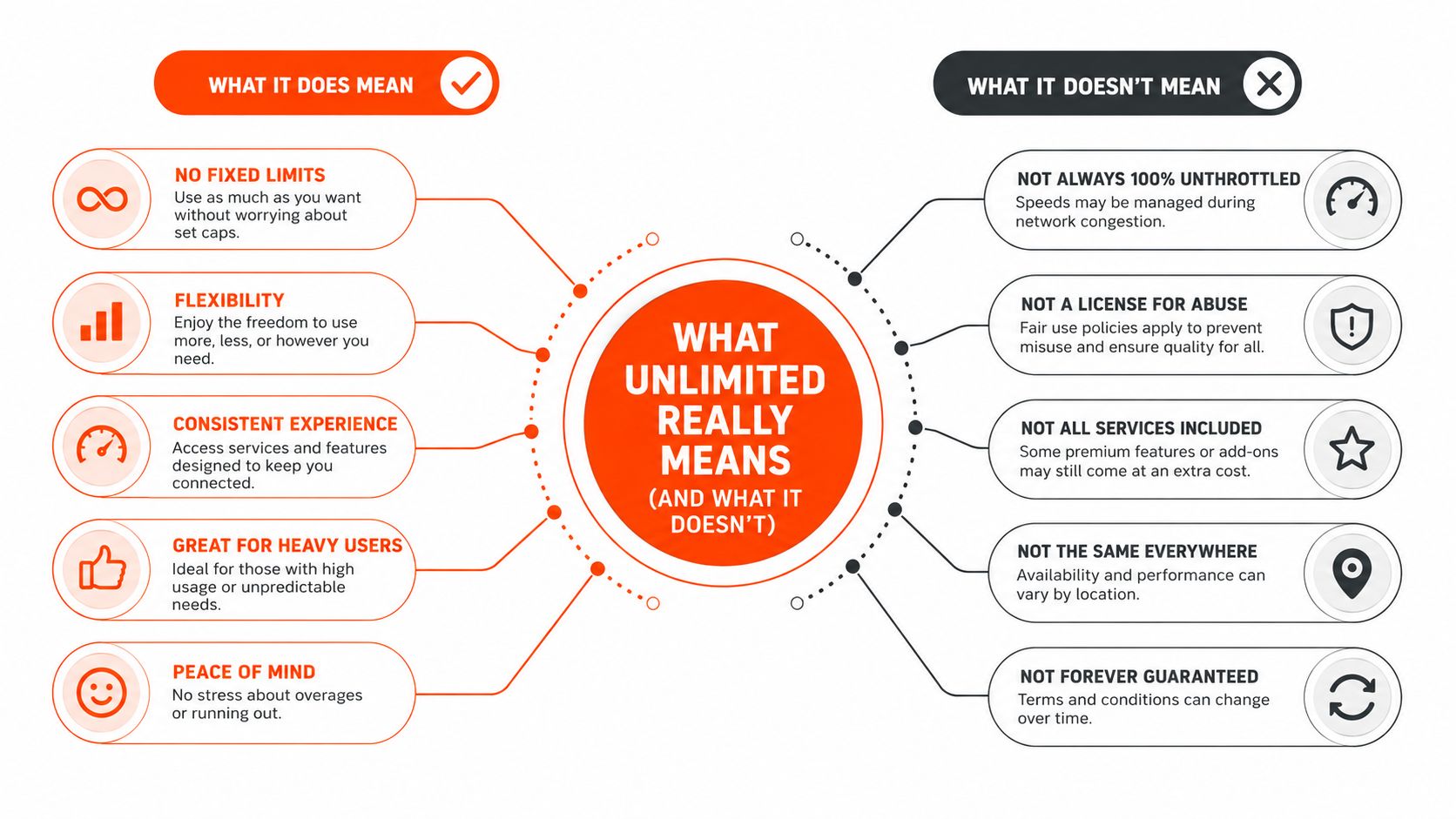
The expectation gap
A marketing team might expect ten finished podcast episodes, thirty social clips, several webinar recaps, and a handful of ad versions in one month. The provider might interpret that workload as a sequence of long-form projects, each with source review, audio cleanup, captions, brand graphics, exports, and revisions. Both sides can believe they agreed to “unlimited editing,” while one side is counting tickets and the other is counting production hours.
A simple podcast cut may move quickly because the edit scope repeats. A webinar with multiple speakers, poor audio, slides, cutaways, branded lower thirds, and several aspect ratios consumes much more queue capacity. The word unlimited doesn't erase that difference.
Practical rule: Judge a plan by its expected monthly throughput, active slots, and scope restrictions, not by the number of requests you can submit.
Before signing, ask for examples based on your actual formats. You need to know whether “unlimited” supports a dependable publishing cadence or merely gives you permission to add more tickets to a very polite waiting room. For a deeper reality check, see whether unlimited video editing is actually unlimited.
How the Queue-Based Model Actually Works
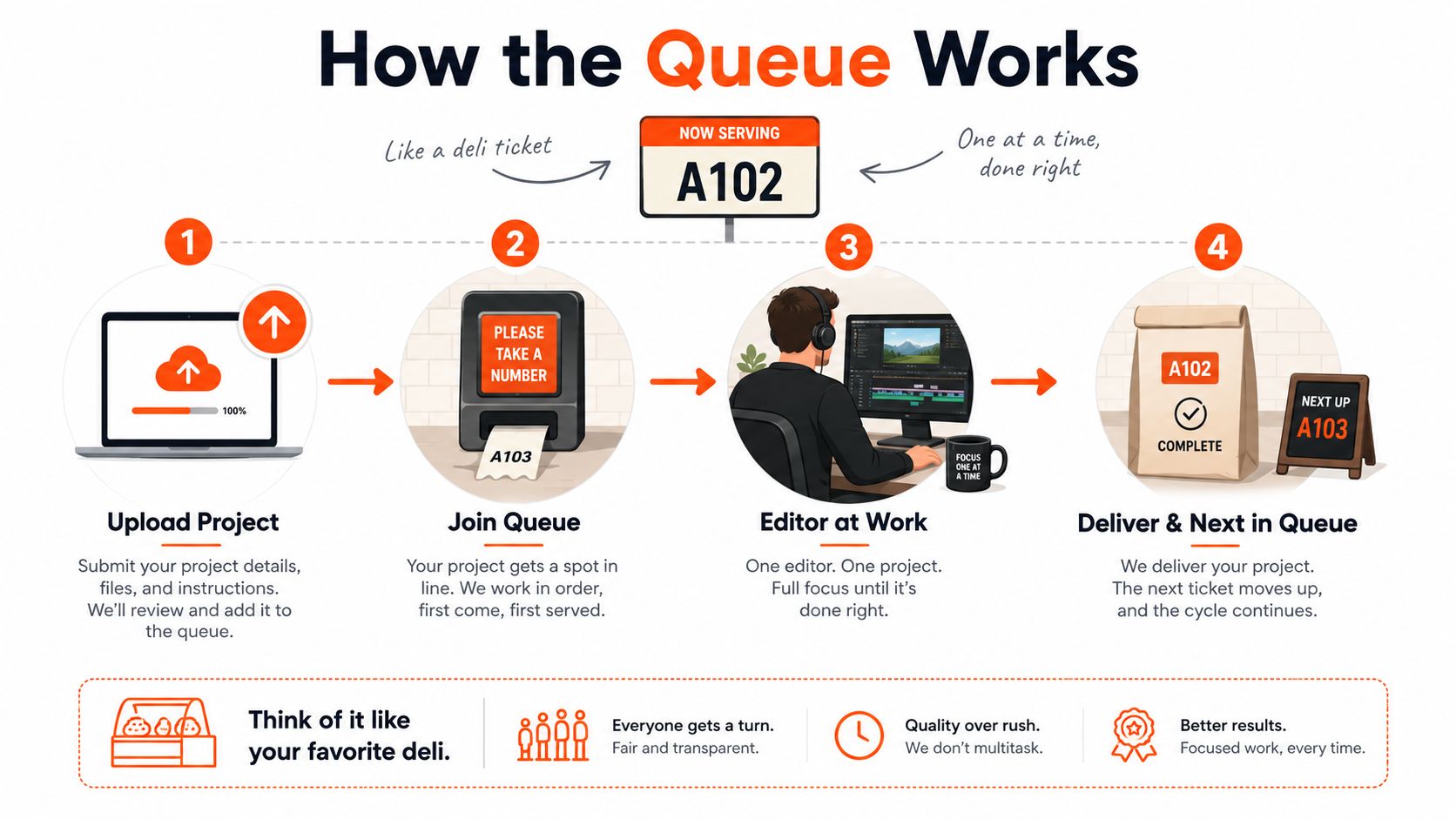
The queue resembles a deli counter with a dedicated slicer. You can order as many sandwiches as you like, but one slicer still has to make them, and asking for a wedding cake doesn't make the sandwich line move faster.
A typical workflow has four moving parts:
Submission: You upload footage, a brief, references, brand assets, and the desired output.
Queue placement: The provider checks the scope, assigns priority, and places the request into an active or waiting slot.
Editing: An editor cuts, formats, captions, mixes audio, adds graphics, and exports the draft.
Review: You approve the draft or request changes. The revision may occupy the same production lane before the next request begins.
A realistic week
On Monday, a B2B marketing team submits a podcast episode with a clear structure, a reference edit, and a caption style. The editor delivers a first cut within the agreed window. On Tuesday, the team returns timestamped revisions, such as “remove the pause at 08:14” or “use the approved intro animation.”
On Wednesday, the team queues a webinar recap. The podcast revision may still occupy the active slot, so the webinar waits. By Friday, the team might receive the recap and begin requesting short clips, or it might still be reviewing the long-form cut. That outcome isn't automatically poor service. It reflects the number of decisions and deliverables inside the queue.
Standardized formats keep the line moving. Podcast cuts, product demos, webinar highlights, short-form clips, and ad variants often benefit from reusable Premiere Pro or After Effects templates, caption presets, audio chains, folder structures, and export settings. A bespoke motion graphics sequence does not receive the same efficiency just because the subscription says unlimited.
The onboarding process for an unlimited video editing service should therefore document formats, naming conventions, brand rules, approval owners, and escalation paths before the first busy week arrives. Otherwise, every request becomes a tiny archaeological dig through old Slack messages.
Comparing Unlimited Retainers Against Other Models
B2B teams usually compare three options: an hourly freelancer, a project-based agency, and a flat monthly retainer. None is universally right. The correct choice depends on how often your team publishes, how repeatable the formats are, and how much coordination you can tolerate before coffee becomes a project dependency.
Freelancers offer flexibility and direct access to a specialist. The downside is availability. Your preferred editor may be booked when a product launch suddenly needs new ad variants, and a new freelancer may need time to learn your voice, graphics, audio preferences, and approval habits.
Project agencies handle larger or more complex assignments well. They may bring producers, editors, designers, and motion specialists together, but project minimums, statements of work, and change requests can make small recurring edits feel like they need their own legal department.
Unlimited retainers work best when the team has repeatable content and enough volume to keep the queue active. Current US freelance rates cluster around $25 to $150 or more per hour, with mid-level specialists commonly at $55 to $95 per hour, senior editors at $95 to $175 per hour, and motion or VFX specialists reaching $100 to $250 per hour, according to this 2026 freelance video editor rates guide.
Monthly cost comparison by content volume
The table below uses a $75 hourly planning rate for the freelancer column. It shows why a true total-cost comparison needs an agreed editing scope. Without a defined number of hours per video, freelancer and agency totals can't be accurately calculated.
Monthly Volume | Freelancer ($75/hr) | Project Agency | Unlimited Retainer
10 videos | $75 × approved hours per video × 10 | Quoted per project and scope | Flat monthly fee, subject to queue rules
20 videos | $75 × approved hours per video × 20 | Quoted per project and scope | Same flat fee, if work fits capacity
30 videos | $75 × approved hours per video × 30 | Quoted per project and scope | Same flat fee, if work fits capacity
The hidden cost sits outside the invoice. Every new editor needs context. Every agency project needs onboarding. Every revision delay creates internal coordination work. A retainer can reduce vendor switching, but it won't rescue a team that submits vague briefs or takes days to approve drafts.
The broader video editing market was estimated at USD 3.54 billion in 2025 and is forecast to reach USD 4.99 billion by 2031, with North America identified as the largest regional market and Asia Pacific as the fastest-growing, according to this video editing industry growth analysis. That expansion supports recurring production models, but demand growth doesn't guarantee that every unlimited plan has suitable capacity.
For a practical comparison framework, review this 2026 guide to unlimited video editing services.
Who Actually Benefits from Unlimited Editing
Unlimited editing suits teams with high volume, repeatable formats, and fast internal approvals. It doesn't suit every video project, and that limitation is useful. A subscription should support a production system, not encourage a team to throw every creative idea into one queue and hope the editors discover a strategy by Thursday.
A SaaS company publishing a weekly YouTube show may use one long-form interview as the source for a polished episode, short clips, social cutdowns, captions, and sales enablement snippets. The formats repeat, the visual language stays stable, and the team can brief the editor with a familiar structure.
A professional services firm can repurpose a webinar into a concise recap, speaker clips, quote-led social videos, and a sales follow-up asset. The subject matter changes, but the workflow remains recognizable. That repetition lets editors reuse templates instead of rebuilding every project from a blank timeline.
Performance marketers have a different advantage. They may need ongoing ad variants with new hooks, openings, subtitles, product shots, and calls to action. The value comes from keeping the creative lane open for refreshes, not from commissioning one expensive hero video and then admiring it in a folder.
Podcast-heavy teams also benefit because post-production becomes a recurring operation. The editor learns the host's pacing, preferred intro, caption treatment, music levels, and cut style. Fewer handoffs mean fewer explanations like, “Please don't make the guest sound as if they're broadcasting from inside a saucepan.”
A quick fit test
Answer these questions before choosing a plan:
Volume: Do you have a steady flow of videos, rather than occasional one-off requests?
Repeatability: Can you define standard formats for podcasts, webinars, demos, clips, or ads?
Brief quality: Can your team provide source files, timestamps, examples, and clear scope?
Approval speed: Does one accountable person review drafts without a long committee meeting?
Complexity: Are most projects editorial and production-ready, rather than bespoke documentary or advanced VFX work?
If most answers are yes, a retainer may produce useful operational efficiency. If your team needs only occasional, highly custom films, a project agency or specialist freelancer may fit better. The key is matching the commercial model to the shape of the work.
SLAs Turnaround Times and Quality Trade-Offs
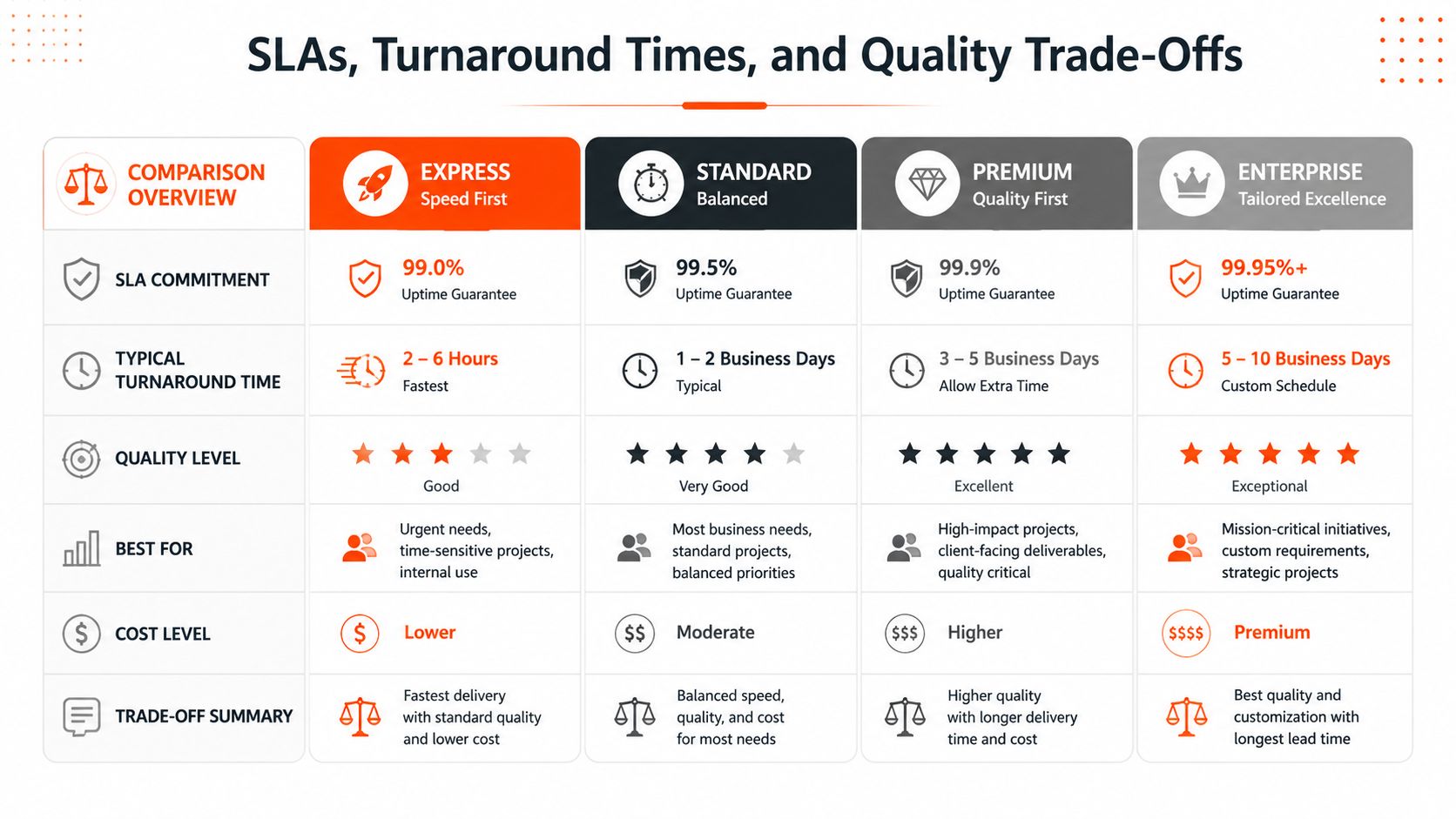
A short SLA doesn't guarantee a finished video in the same condition as a longer production window. It tells you how quickly the provider intends to move a request through its workflow, assuming the brief, footage, and feedback are ready.
Independent agency guidance places premium ongoing-content turnaround around 24 to 48 hours, while freelancer revision turnaround commonly runs one to three days per round. Subscription and premium agency models may offer same-day to 24-hour delivery for suitable work, as outlined in this guide to video editing turnaround times.
What usually degrades first
When volume rises, technical execution isn't always the first problem. Brand consistency can slip when multiple editors interpret the same visual rules differently. Editor continuity can weaken when the provider moves work between available staff. Revision depth can shrink when the queue is overloaded or the scope is too broad for the selected tier.
Ask vendors these questions before you evaluate a promise:
Rush work: What qualifies for urgent delivery, and does it displace existing queue items?
Editor assignment: Will one editor learn the account, or can any available editor take the task?
Complexity limits: Are motion graphics, long-form footage, large files, or advanced color work excluded?
Revision policy: Does a revision return to the same editor, and what counts as a new request?
Escalation: Who steps in when the draft misses the brief or the deadline?
A mature provider can explain these rules without hiding behind the word unlimited. Faster tiers usually depend on narrower scope, fewer active slots, or stricter input requirements. Quality stays stable when the team controls the number of variables, uses approved references, and reviews work consistently.
Why Your Briefing Process Determines Success
Unlimited video editing amplifies your operating habits. If your team gives clear direction and approves quickly, the queue can move with purpose. If your team sends “make it pop” at 4:57 p.m., the editor may need a crystal ball, a brand guide, and a small emergency snack.
A useful brief answers four questions: what is being edited, who is watching, what must change, and what does finished mean? Include the source link, target platform, aspect ratio, duration range, brand assets, reference examples, required text, music direction, and a delivery deadline. Add timestamps for removals or selects instead of asking the editor to search through an hour of footage for “the good bit.”
Brief templates that keep work moving
Podcast cut
Episode source and speaker names
Required intro and outro
Removal timestamps
Caption and title style
Full-length output plus requested short clips
YouTube, LinkedIn, or other destination formats
Ad variant
Product or offer
Audience and funnel stage
Approved hook options
Mandatory claims and disclaimers
Call to action
Aspect ratios and naming convention
Reference ad that matches the desired pacing
Webinar repurposing
Full recording and slide deck
Key moments with timestamps
Speaker clips to prioritize
Brand graphics and lower thirds
Recap length and short-form requirements
Approval owner and publishing deadline
The queue rewards decisions. A clear brief doesn't just help the editor. It protects every request behind yours from unnecessary back-and-forth.
Approvals create another hidden bottleneck. If three stakeholders provide contradictory notes in separate tools, the editor can't know which instruction wins. Use one review location, one decision owner, and consolidated feedback. Frame.io or a similar proofing workflow can keep comments attached to exact frames instead of scattering them across email threads and chat windows.
Making the Decision and Common Questions
A sensible vendor decision starts with a small operational audit. List your recurring formats, estimate the complexity of each, identify who approves drafts, and ask providers to explain expected throughput for that mix. Don't accept “unlimited” as an answer to a capacity question.
Look for clear scope definitions, named turnaround windows, a defined active-request policy, a reliable review tool, and an escalation process. Be cautious when a vendor offers vague promises, refuses to explain complex-project limits, has no clear editor continuity, or treats every revision as a fresh mystery.
FAQs
What happens if I need a rush job? Ask whether rush work is included, whether it changes the queue order, and what project types qualify. A fast request still needs complete footage and a usable brief.
Can I pause my subscription? Pause rules vary by provider. Confirm notice requirements, how unused capacity is handled, and whether active projects must be completed before the pause begins.
Who owns the project files? Confirm ownership and delivery of source files, project files, exports, licensed assets, and templates before signing. The answer should appear in the agreement, not live in a hopeful Slack message.
How should I handle confidential or pre-launch content? Ask about access controls, storage, staff access, confidentiality terms, and file deletion procedures. Share only the material the editor needs for the assigned request.
Does unlimited mean unlimited output? No. It usually means ongoing submissions under a queue-based capacity model. Review active slots, turnaround windows, scope limits, and realistic throughput before comparing plans.
Google's FAQPage guidance says markup should represent visible, official questions and answers, with at least one valid Question item in the page's mainEntity array, as explained in its FAQ structured data guidance. FAQPage remains a valid Schema.org type, but Google no longer shows FAQ rich results in Search as of May 2026, while the markup can remain on a page without causing problems, according to this summary of Google's FAQ rich-result change. If you implement it, test the page with Google's URL Inspection tool and ensure it isn't blocked by robots.txt, noindex, or login requirements, as stated in the FAQPage technical documentation.
For B2B teams, ContentBuck offers queue-based unlimited video editing for webinars, product demos, podcasts, YouTube content, and short-form clips, with a dedicated editor, flat monthly pricing, unlimited revisions, and 24-hour delivery per request. Visit ContentBuck to assess whether its workflow matches your content volume, approval process, and required publishing cadence.
Created with Outrank
Parth Jasrapuria
Founder at ContentBuck
Building video systems for B2B businesses. Obsessed with YouTube growth, creative strategy, and organic SEO.