Is YouTube Worth It for B2B Companies? a Video RFP Guide
Parth Jasrapuria
Founder
Most B2B YouTube advice starts with posting cadence. That is backwards.
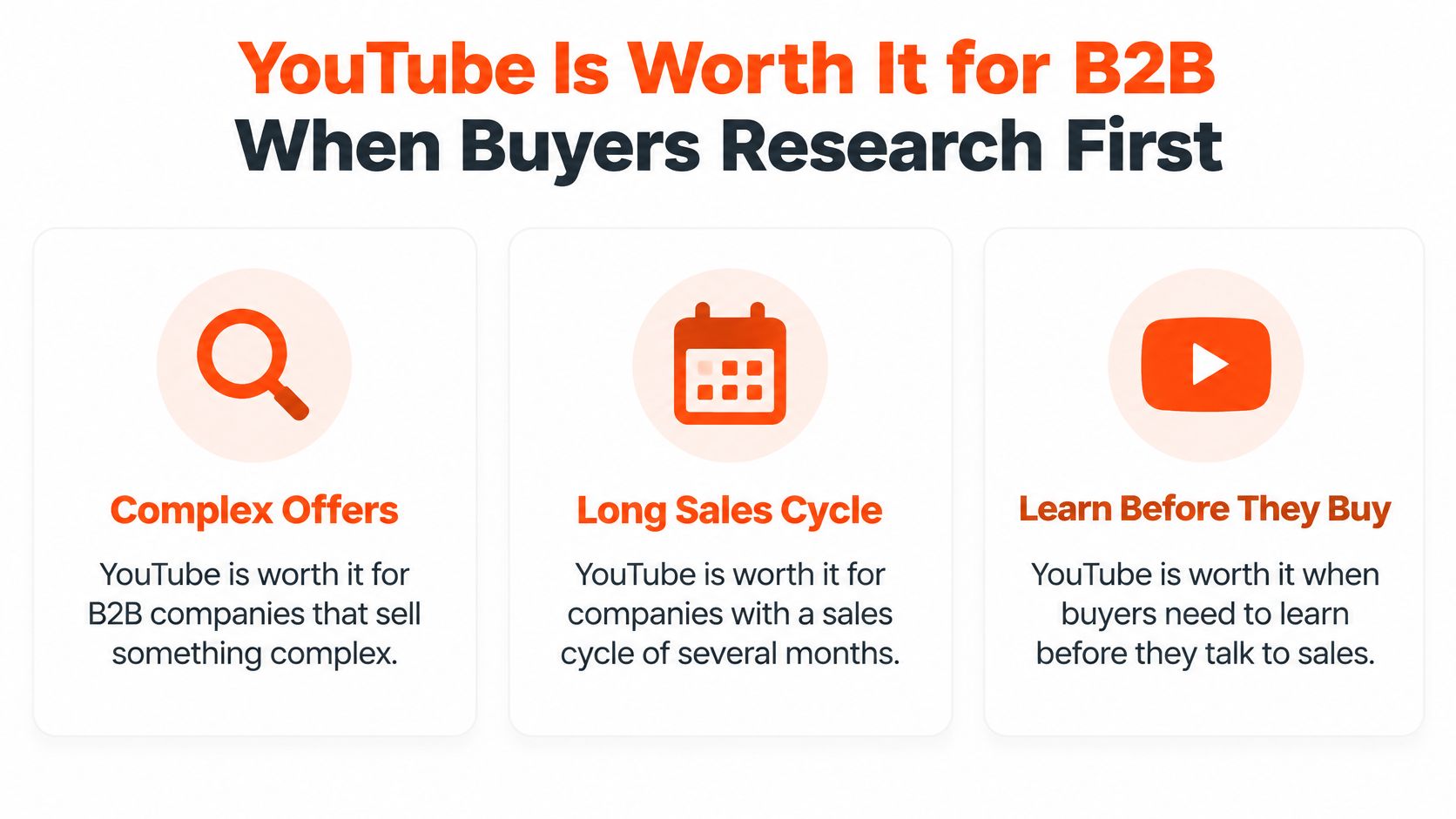
YouTube is worth it for companies selling something complex, where the sales cycle runs several months and buyers research before talking to sales. The buyer evidence supports that judgement: in the 2025 Google and National Research Group study, 60% watched a product or service tutorial while weighing vendors, and Gartner research cited by Google puts YouTube's influence on a recent purchase decision at 65%. It is not worth it when the target is ten qualified meetings by next Friday.
The popular advice to post consistently and let subscribers arrive is how channels become storage lockers. Consistency without a buyer question behind each upload creates a bigger pile of videos nobody needed. A channel earns its budget when it changes what an account does next: watches a walkthrough, opens a pricing page, books a demo.
Judge YouTube on those actions over three to six months. Then turn that judgement into a video RFP with scope, deliverables, scores and a timeline. That gives the next vendor call evidence to discuss, while the showreel stays in its proper place as supporting material.
YouTube Is Worth It for B2B When Buyers Research First
Buyers of complicated software and services start researching long before anyone fills in a demo form. A 2025 Google and National Research Group study of 2,063 US senior leaders and B2B decision-makers across enterprise, SaaS and web services found that during evaluation 60% watched a product or service tutorial and 63% visited a brand's website. Those two numbers sit side by side for a reason. The tutorial and the site visit are the same research session.
Post-purchase behaviour tells the same story. In that study, 83% used Google or YouTube to better understand the product after buying, which is where a lot of vendors lose a renewal conversation they never knew was happening. Google also cites Gartner research reporting that 65% of B2B buyers had been influenced by YouTube during a recent purchase decision.
This isn't a new habit that appeared with short-form video. Google's B2B Path to Purchase research reported that 70% of B2B buyers and researchers watched video during the buying journey, a 52% increase over two years, and nearly half watched at least 30 minutes of B2B-related video while researching. Buyers settled into this pattern years ago. Plenty of marketing teams haven't caught up.
Where the business case gets honest
Video rarely closes a deal on its own. It gets a company onto the shortlist, answers the objection a sales rep would otherwise handle on call three, and shortens the pause between "interesting" and "send me pricing". That's worth money, but only if the channel is built around questions buyers type.
The real question: not whether buyers watch video, but whether the videos answer the questions the sales team hears every week.
A channel nobody can trace back to a buyer question produces beautiful footage and zero meetings. Tie the work to a B2B content strategy that drives pipeline, so the tutorial, the landing page and the sales follow-up all point at the same problem.
Check Whether Your Sales Cycle Makes YouTube Pay
Run a fit test before a budget line exists. YouTube compounds like a savings account: dull for two months, then useful. It's a terrible instrument for a team that needs pipeline this week, and no amount of thumbnail design fixes that.
Your situation | Fit for YouTube | What to do first
Sales cycle of 3 months or longer with a complex product | Strong fit | Build an organic channel around buyer questions
Need qualified leads within one week | Poor fit | Use faster channels first, since YouTube takes 3-6 months
Paid ad spend under $3K a month | Weak fit for video ads | Start with organic videos before buying ad creative
Paid LinkedIn ads of $5K+ a month for IT services | Good fit for video ads | Build creatives aimed at CTOs and IT directors
Not running paid ads yet and wants organic growth | Organic fit, not ads | Publish searchable explainers and demos first
Read your row before you read a proposal
Two companies can run the same playbook and get opposite results. A payroll software company with a six-month cycle and four stakeholders in every deal fits: HR, finance, IT and the CFO each want a different answer, and a library of short explainers reaches all four at 11pm without booking a call. A five-person IT services firm that needs ten new meetings by Friday doesn't fit. The channel would still be warming up when the quarter closes.
ContentBuck's own fit rules are blunt. YouTube is a 3-6 month investment and isn't suited to clients who need leads within a week. Video ad creative is probably not right for companies not yet running paid ads, or for IT services firms spending under $3K a month, while it suits firms spending $5K+ a month on LinkedIn ads that need creative to reach CTOs and IT directors.
If nothing is publishing yet, organic comes first. Buying ad creative for a channel with three uploads and no proof only buys expensive traffic that bounces off a half-empty page.
Before the RFP goes out, get the arithmetic straight. The true cost of a B2B YouTube channel covers scripting, editing, thumbnails and the two to four hours a month your own team has to show up for.
Fit test in one line: can you name four people who must agree before a deal closes, and will they still be deciding in three months? Then YouTube deserves a budget.
Find the row that matches your situation, because that row sets the budget and the timeline you'll write into the RFP next.
How to Write the Scope and Deliverables for Your Video RFP
A video RFP fails in the same spot every time. It asks for "a brand video" and receives something nobody can grade. Google's assessment of YouTube's marketing opportunities notes that viewers rank YouTube as the leading platform for researching or deciding about a brand, product or service, and claims 86% higher incremental long-term ROAS than paid social. Reach isn't the problem. A brief that never names a buyer question is.
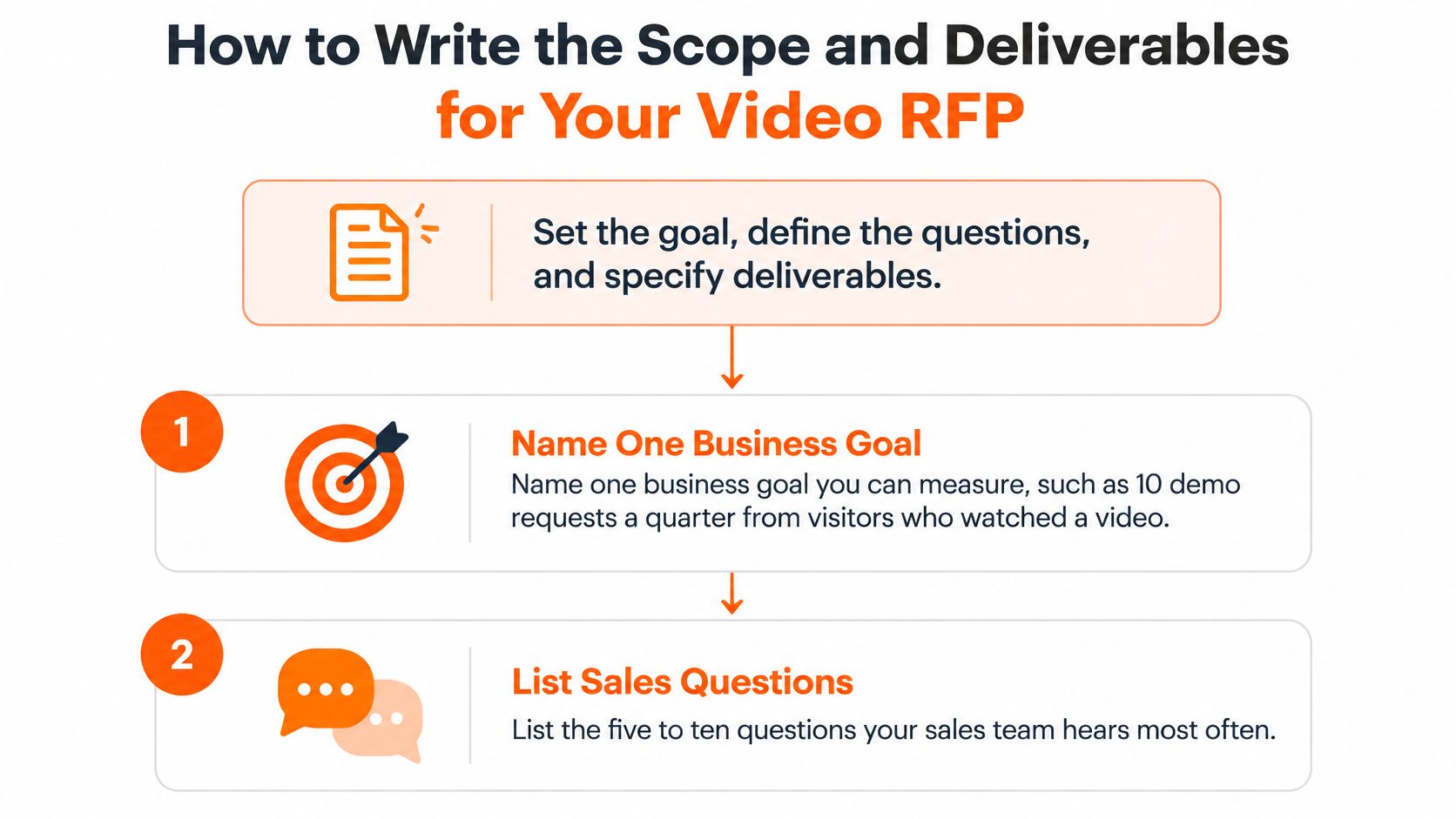
Name one business goal you can measure. Ten demo requests a quarter from visitors who watched a video beats "build awareness" every time, because the second one can't be graded and nobody will argue about it in a review.
List the five to ten questions your sales team hears most. Each video answers exactly one. If discovery calls keep hitting the same worry about implementation time, that's a script, not a talking point for the deck.
Match format to buyer stage. Short clips for problem recognition, 6 to 15 minute videos for search-led evaluation, 60 to 90 second explainers for ads and comparison pages. Short brand videos tend to earn early attention; the longer ones earn trust during evaluation, when a buyer will sit through fifteen minutes if the answer is good.
Count deliverables per format, including the unglamorous ones. Scripts, edited masters, captions, thumbnails, chapters, SEO descriptions and short clips all belong on the page, because the vendor who "assumed" captions will bill for them later.
Set revision limits and name approvers. Two rounds, one named approver per stage. A committee that reviews by consensus can stretch a two-day edit into three weeks, and nobody will admit it happened.
Spell out formats, rights and plumbing. 16:9 for YouTube, 9:16 for Shorts, commercial usage rights in writing, plus where the transcript lives and which landing page each video links to.
Length should be earned by complexity, not by a weekly target. B2B content marketing benchmarks put the average B2B demo video at about 15 minutes 14 seconds while average viewing lasts about 5 minutes 14 seconds, and completion runs around 65% for videos under one minute against roughly 20% past 20 minutes. Front-load the answer, or watch people leave at minute two.
Format | Length | Buyer stage | Deliverables to list in the RFP
Short clip | Under 60 seconds | Problem recognition | Script, captions, 9:16 master, three hook variations
Explainer | 60-90 seconds | Product comparison and ads | Script, professional voiceover, animation, multiple aspect ratios
Long-form video | 6-15 minutes | Search-led evaluation | Script, edit, thumbnail, chapters, SEO description, 3-5 short clips
Product walkthrough | 10-20 minutes | Proof and implementation | Screen recording, narration, edited customer proof
A payroll software firm with a six-month cycle writes its RFP with one explainer and one 12-minute walkthrough, then checks every line against a question the team hears weekly, such as how payroll tax setup works across three states. If a deliverable can't be traced to a question like that, it doesn't go in the first RFP. The annual brand film can wait until the channel pays for itself.
Teams planning to batch scripts can lean on an AI long video generator for first drafts, then have a human rewrite the opening 30 seconds so it sounds like a person. For the approval chain, the guide to briefing a B2B video agency covers who signs off before anything goes into production.
Score Video Vendors With Criteria That Matter
Showreels are edited by professionals, which is the point of them. A vendor can look brilliant for 90 seconds and still have never opened an analytics tab. Write the criteria before watching anything, score each bid from 1 to 5 per criterion, multiply by the weight the team agreed, and compare totals side by side.
Criterion | What to ask for | Red flag
B2B experience | Named B2B clients and the video formats they bought | Portfolio is mostly consumer or lifestyle work
Proof of results | Case studies with meetings, leads or pipeline, plus source links | Only view counts, no business metric
Process and revisions | Written revision limit, approval steps, a named editor | Revisions billed by the hour with no cap
Turnaround | Delivery time per format, such as 24-hour edits or about 14 days for explainers | No timeline in writing
Measurement | Reporting on click-through rate, watch time and conversions | Reports only subscriber counts
Pricing model | Flat monthly fee or per-project quote with a clear list of what is included | Vague bundles with extras added later
The rows that cause most regret
Proof of results separates the field fastest. Say a logistics software firm is sorting three bids. One report lists subscriber counts, another names nine demo bookings from a single video, and the second bid wins. The deciding detail isn't the number, it's that the vendor knew what the number meant.
Revisions and turnaround come second. Ask for a written cap and a named editor, then check the clock per format: 24-hour edits on ad variants, about 14 days for an explainer after script sign-off. A vendor who won't commit to a timeline in writing will test everyone's patience by month two.
Measurement is the row that explains a stalled channel. Anything that starts and ends with subscribers is a warning sign. Ask what lands in the monthly report: click-through rate, watch time, and conversions tied to a named event such as a demo form.
For comparison while scoring, ContentBuck offers YouTube Growth for B2B, which builds organic channels that generate inbound demos, and delivers it in the United States, United Kingdom, Australia, Canada, Germany and Singapore.
Scoring rule: a vendor who can't name a business metric from a past project won't report one on yours.
Set a Realistic Timeline and Measure Pipeline, Not Views
A video channel moves slower than an ad campaign and faster than a rebrand. Budget several months before the pipeline reading means anything. Judging a channel in week six is like weighing a cake while it's still batter.

Phase | Typical timing | What happens
RFP response and vendor scoring | 2-3 weeks | Vendors reply and you score bids against your criteria
Script approval | 1-2 weeks, longer with legal review | Stakeholders sign off the script before production starts
Explainer delivery | About 14 days after script sign-off | Animation, voiceover and multiple aspect ratios delivered
Channel launch and weekly uploads | Weekly from month one | Long-form videos published with SEO, captions and chapters
First results worth judging | 3-6 months | Enough impressions and viewers to read click-through and retention
Why committees break last-click reports
Buying groups make attribution messy. A 2025 B2B buyer-trends discussion reports that 44% of software decisions involve a buying committee, rising to 71% among enterprise companies. Picture a CRM buyer watching three tutorials across four months, then booking a demo after a branded Google search. The last-click report credits the search and hides the videos completely.
Track a short list instead, each read against the channel's own baseline:
Impressions-to-click-through rate. A workable directional range for B2B content is 3-5%, and the 2025 video marketing statistics summary puts most videos in a 2-10% band with many channels clustering at 2-5%.
First-30-second retention, which tells you whether the opening kept the promise the title made.
Average percentage viewed, read separately for 40-second clips and 12-minute walkthroughs.
Qualified website sessions, meaning visitors from target accounts, not traffic from a country you don't sell to.
Assisted pipeline, with the video touchpoint attached to the CRM record.
Low early numbers aren't failure until enough impressions exist to build that baseline. Meanwhile, connect the channel to a business event. Google's guidance for video action campaigns tells advertisers to switch on conversion tracking when the goal is online conversions, so a demo form or pricing request counts instead of a completed view. Without it, the team knows thousands of people watched and nothing about who raised a hand.
Timelines do move when the content is right. ContentBuck built a financial consultancy's YouTube channel from scratch, and three months later it had 12,000 subscribers and 18 meetings booked directly from YouTube. That's the shape of a realistic early win: modest reach, real meetings.
For the path from view to booked call, this video lead generation playbook maps each video to the next ask, and B2B YouTube benchmarks give you numbers to grade against instead of consumer view counts.
The rule to keep: judge each video by the next action it drives. One demo request beats 40,000 views from people who will never buy.
Common Questions About YouTube for B2B Teams
Can we reuse a webinar or a recorded sales call?
Yes, and it's the cheapest content a team owns. Cut the strongest five to ten minutes, add chapters, and link the video to the page where buyers book a call. A SaaS team can turn one recorded sales call into a nine-minute objection-handling video that answers the exact worry stalling deals.
Do we need written permission before filming a customer?
Yes. Get signed consent for filming and for using the customer's name, and settle usage rights in the RFP so nobody argues about it after the edit is approved. A friendly verbal "sure, go ahead" is not permission, it's a future email chain with legal.
What if our product changes every quarter?
Build evergreen how-to videos around the problem the product solves, not the feature menu. A cybersecurity firm can keep its ransomware prevention video for years and update only the screenshots, and viewers will never notice the interface changed twice.
Can a small team run this without a full agency?
Yes, with one owner and a schedule. Batch two videos a month, and have someone from sales check each script against three real buyer questions before filming. That single review step catches more problems than any tool in the stack.
ContentBuck builds and runs B2B YouTube channels end to end: weekly long-form production, scripting, editing, captions, thumbnails, YouTube SEO, plus short clips from every video so the same shoot feeds LinkedIn and your ads. If the fit test says go, start with a Free YouTube Audit to see which buyer questions the channel already answers and which ones it misses. Free discovery calls have limited spots each month, so visit ContentBuck and book one before the calendar fills.
Parth Jasrapuria
Founder at ContentBuck
Building video systems for B2B businesses. Obsessed with YouTube growth, creative strategy, and organic SEO.