YouTube Channel Fastest Growing: 7 Agencies Compared
Parth Jasrapuria
Founder
A founder searches for the fastest growing YouTube channel, opens seven agency tabs, and closes the laptop with no clearer idea of what any of it costs. Three pitches promise viral velocity. Two cite a case study without a date. One publishes a price, which feels like spotting a unicorn in a car park. None of that is the founder's fault. "Fastest growing" describes a service, not a number anyone has agreed to hit.
Scale helps set the bar. MrBeast gained 115,966,562 subscribers during 2024, the biggest single-year gain on the platform that year according to Dexerto's fastest-growing channel report. That's a global entertainment machine, not a yardstick for a B2B channel with a sales team of four.
The seven services below get the same treatment: public pricing, promised deliverables, and proof quality. Each one also gets the question that makes an agency go quiet. For how owned YouTube work fits the rest of a channel mix, the Mallary.ai multi-platform reach guide covers the distribution side.
1. VID
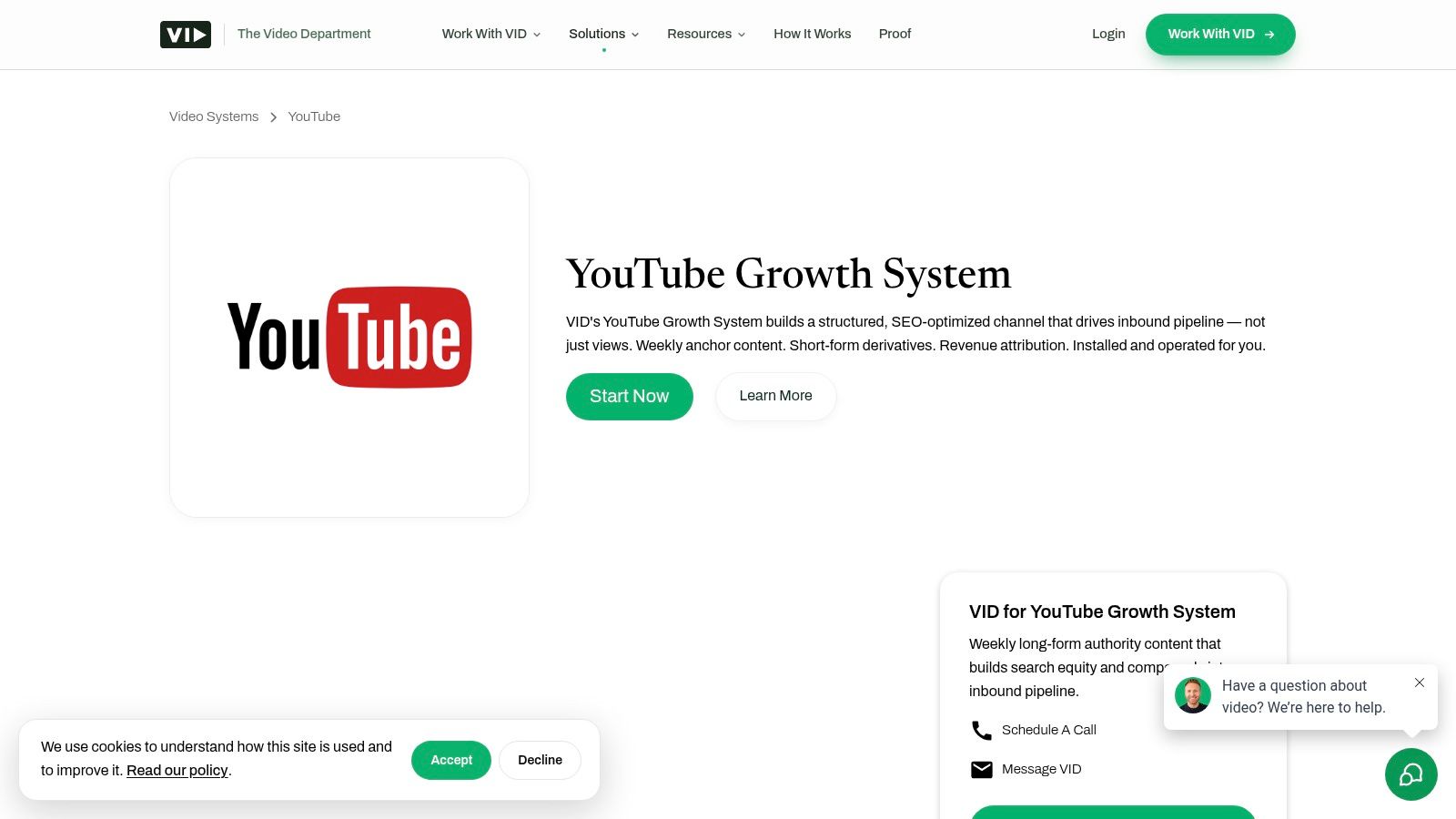
VID pitches YouTube as a pipeline channel, and that framing is the right test of fit. The VID YouTube channel service centers on search-optimized channel and content planning, built to connect publishing to inbound demand. A SaaS team that wants steady publishing tied to inbound demand will recognize the thinking. A team hoping for one viral hit should look elsewhere.
What to Check in a VID Proposal
No public pricing means the proposal is the product. Make it spell out how many long-form videos a month, who writes the script, who builds thumbnails, who owns uploads, and what the monthly report measures. Get every line in writing before the retainer starts, because scope that isn't listed is scope you'll pay for twice.
Fit: B2B teams that want a repeatable content operation instead of one-off editing.
Friction: pricing is quote-only, and pipeline is a goal, never a guarantee.
Ask: "Which deliverables sit inside the retainer, and which arrive as a change order?"
VID is a channel retainer, not an ad shop. If the same budget line covers UGC-style ad creative, browse top UGC ad tools as a separate comparison so a clip vendor never gets priced against a growth retainer.
When a provider claims a channel grew fast, ask fast compared with what. A benchmark of 16,975 channels with at least 100,000 subscribers found the top 10% in the 100,000 to 1 million band grew 7.0% a month, while the top 1% managed at least 54%, according to the TrendReport growth benchmark. Put those percentages beside the agency's promise.
Plain rule: a B2B channel that produces three qualified demo requests a month beats one that doubles its subscriber count and books nothing.
2. Kohsarian
Kohsarian is the price tag in the window.
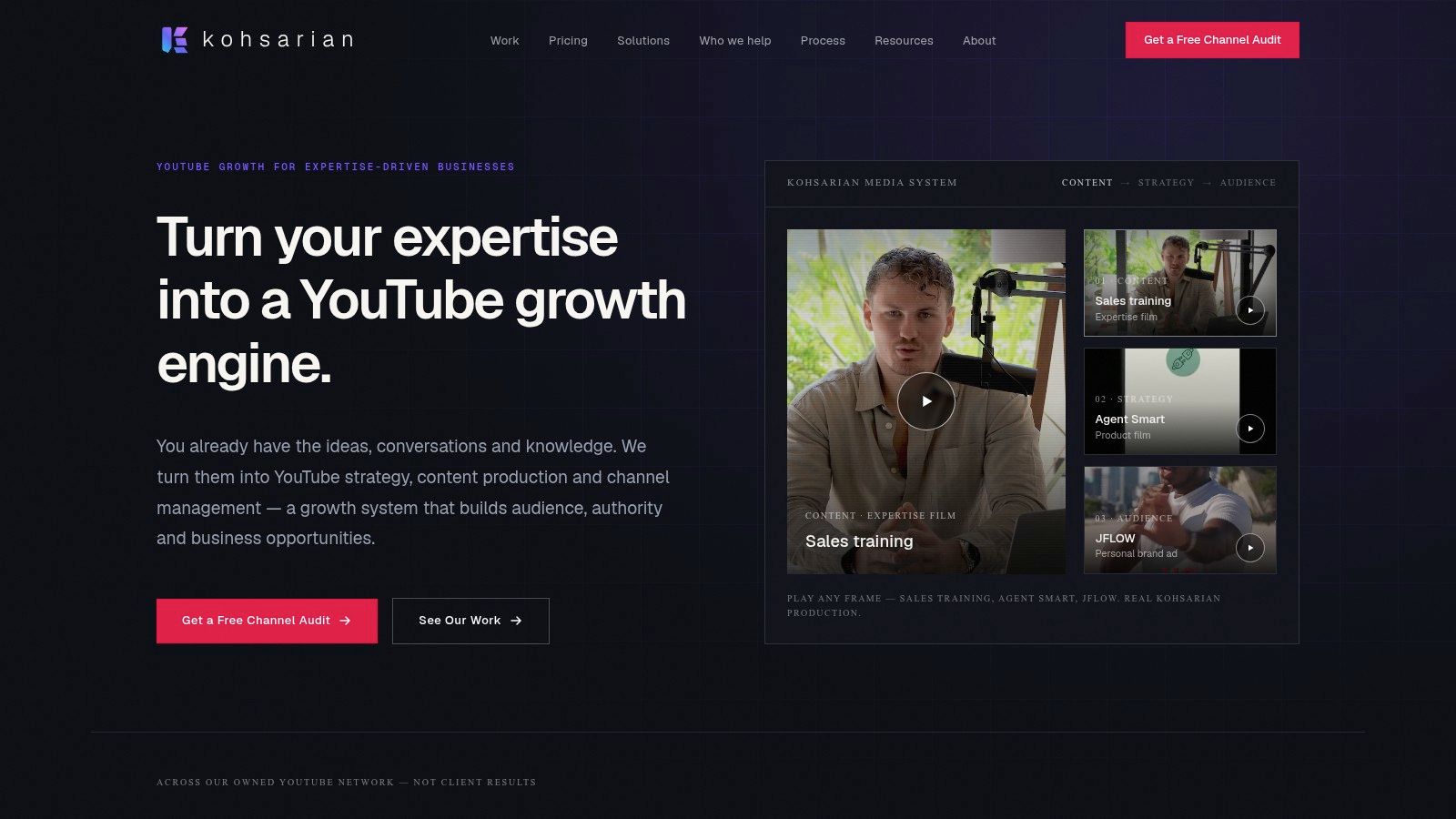
Start with the part many providers keep behind a sales call. Kohsarian lists a Growth plan at $1,500 per month with 4 to 8 videos, eight Shorts, a strategy call, analytics review, and optimization. Full Management sits at $2,500 per month and adds a content calendar, competitor monitoring, community management, and reporting. Standalone channel management starts at $750 per month, while editing, thumbnails, Shorts, and audits carry their own starting prices.
Public numbers make the first meeting faster. They also make the word "starting" do real work. Treat "fastest growing" as the pitch, then price the workload behind it: a calendar that publishes four clips and a calendar that publishes eight long videos are different animals wearing the same label.
The Questions That Move the Price
Length is the sleeper. A four-minute explainer and a fifteen-minute webinar cut are not the same job at the same count.
Revisions: how many rounds are included before the meter restarts?
Publishing: who owns the upload, description, tags, and end screens?
Talent: is the on-camera person included, or do you supply one?
Proof: will the report show watch time, search rankings, and lead actions, or just subscriber confetti?
A clean quote still doesn't define growth. YouTube's Partner Program needs 1,000 subscribers plus either 4,000 valid public watch hours in 12 months or 10 million valid public Shorts views in 90 days, and Shorts Feed watch time doesn't count toward the 4,000 hours, per YouTube's eligibility requirements. Ask which scoreboard the agency is optimizing, because the honest answer changes the proposal.
Before a kickoff call, map the scope to a written YouTube channel growth strategy so cadence, pillars, and reporting are priced before the retainer starts.
3. Touchstorm
This one is built for brands that already have a media plan and a budget line.

Touchstorm covers the unglamorous setup work, including a channel audit, topic research, and a growth plan, then keeps going into ongoing management, production, paid media, and influencer marketing. If YouTube sits next to a LinkedIn budget and a creator campaign, this shape fits. If you're a five-person team with one camera, it probably doesn't, and the honest move is to ask about minimum scope in the first email.
Where the Money Actually Comes From
Three revenue lines get blended into one promise in most pitches. Owned reach is the library. Paid reach is rented. Earned reach is the influencer clip you can't keep. A report that merges all three hides which one is working.
Owned: your channel and its back catalog.
Paid: views that stop the day the budget does.
Earned: borrowed attention you can't invoice.
Then there's ad revenue, which is arithmetic rather than reach. Monetized creators keep 45% of the Shorts advertising revenue allocated to them from the Creator Pool, including when music is used, and payment follows the creator's share of eligible Shorts views rather than a fixed rate per view, per YouTube's Shorts revenue-sharing explainer. Views earned before the creator accepts the Shorts Monetization Module don't count at all. A channel can be growing fast and earning nothing from the clips doing the growing.
Ask for one sample report that separates owned, paid, and earned. Public pricing isn't listed, so confirm the minimum budget and who owns measurement across all three.
4. YouTube Videos Agency
A full-service shop like this one makes the first job figuring out who touches the work.
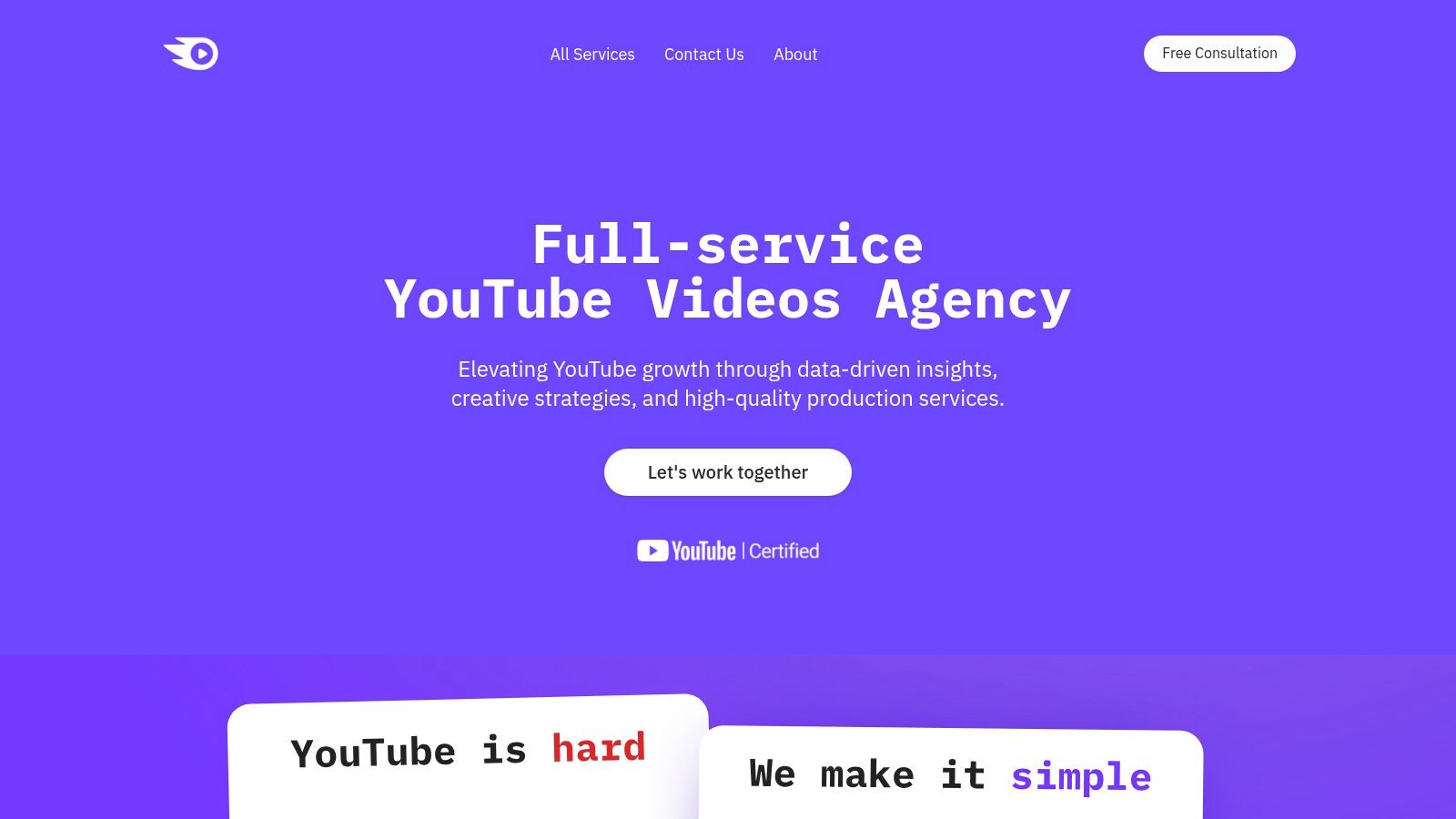
The testimonials on YouTube Videos Agency name clients and quote results. Treat them as marketing until someone shows the analytics behind them. A testimonial is a story. A before-and-after is evidence.
The service list runs wide, and breadth cuts both ways. Audits, strategic consultancy, keyword research, SEO, upload scheduling, analytics, scripting, storyboarding, editing, and thumbnails all sit under one roof. Pricing comes as a custom quote. So the useful question is who does which part.
Separate Strategy From Production
Ask for names and roles before you sign. A senior strategist setting direction while a junior editor cuts the video is normal and fine, as long as you know which is which.
Who picks topics? If the editor does, the channel follows whatever is easy to edit.
Who writes the script? Scripting drives retention more than the camera body does.
Who reads the analytics? A dashboard nobody interprets is decoration with a login.
Proof at this level looks specific: a dated before-and-after, a named client, analytics screenshots, and a clear statement of what changed and what was spent to get there. Request exactly that. If an agency can only offer praise quotes, that answers the question too.
The questions to ask a YouTube growth agency checklist covers the contract points this comparison can't fit.
One fix costs almost nothing. Bad audio loses viewers faster than a dull thumbnail, and a better mic setup for YouTube recordings runs cheaper than a month of any retainer here.
5. DeepVision Marketing
This provider publishes the package, so the math is easy to run before the call.
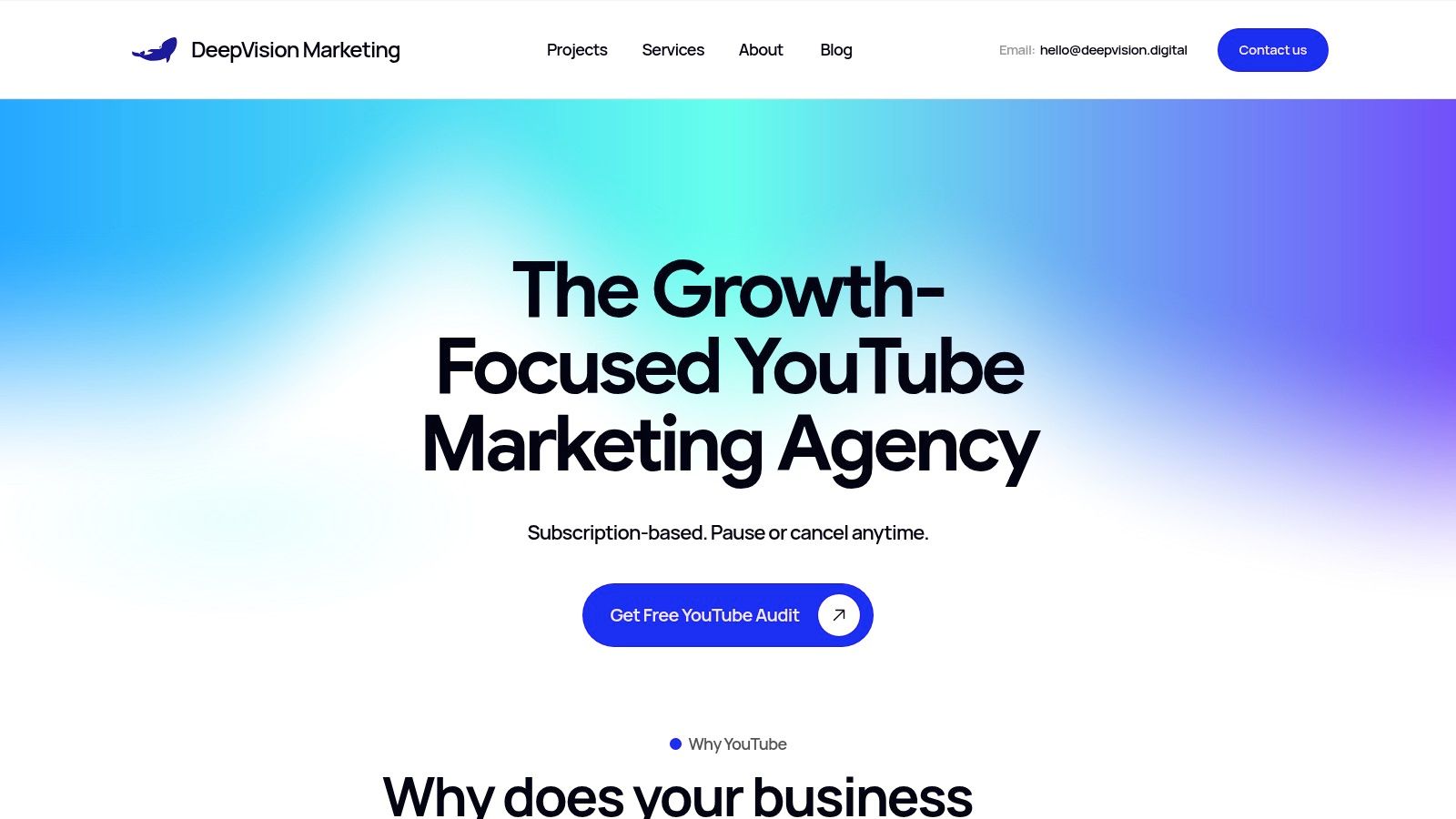
DeepVision Marketing lists Full YouTube Growth at $2,499 per month with eight long-form videos and 30 Shorts repurposed from them, plus a channel audit, a six-month strategy, thumbnails, SEO, distribution, and a dedicated channel manager. The site says plans can be paused or canceled, and enterprise scope is custom.
Thirty Shorts from eight videos works out to roughly four clips per video. That's a repurposing operation, efficient by design and also the reason to test the ratio against your category.
Why the Shorts Ratio Isn't Universal
The 30-to-8 split is a default, not a law. An analysis of 18,000 channels found that business channels using Shorts had 39% more subscribers than long-form-only channels, while gaming channels that avoided Shorts had 85% more subscribers than mixed-format channels, according to AIR Media-Tech's 2026 growth guide. Same format, opposite result.
That same guide reports a study of 274 channels where business and education channels performed best with Shorts at roughly 25% to 40% of uploads. So ask how the ratio was set for your niche, and what happens in month three if it needs to change.
Distribution: which platforms, how many posts, and who schedules them.
The manager: full time on your account, or shared across a dozen clients?
The exit: pausing is only cheap if the deliverables stop with the invoice.
6. Koch Consulting
This one aims at firms that sell expertise rather than entertainment.
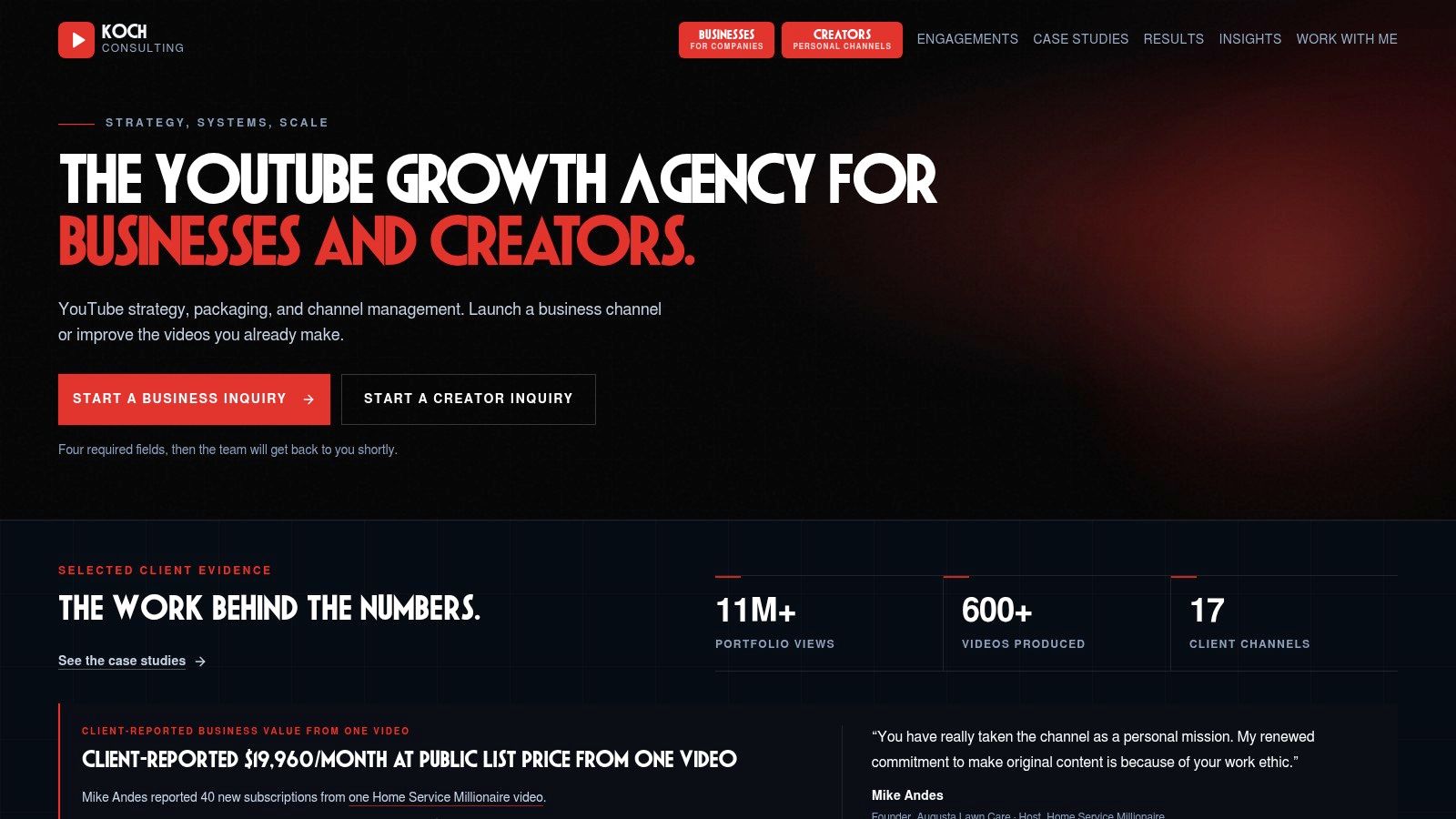
Koch Consulting focuses on YouTube growth and consulting for businesses, with dedicated pages for B2B companies and professional-services firms. The contact form asks about your channel and your primary need, which is at least a sign someone reads the answers. Pricing and detailed inclusions arrive by contact, so the first call doubles as the price list. The site also features a client-reported subscription result tied to a single video.
Business focus is the selling point. Expertise-led channels sell trust, and trust compounds slower than a prank clip.
Growth Charts Reward the Format That Pays Least
The framing matters. In one 2026 sample, six of the ten fastest-growing channels were primarily Shorts-led, and across 274 channels Shorts RPM came in at only 3% to 14% of long-form RPM, per AIR Media-Tech's audience growth analysis. The same analysis notes that a second dataset found Shorts break out slightly more often than long-form but generate fewer views per breakout.
Ask for the client, the offer, and the outcome. A logo wall without a number is decoration.
A consulting firm needs the buyer, not the scroll. So request a comparable client in the same industry with a similar sales cycle, and ask what that video produced in booked meetings.
7. yt.agency
This is the smallest operation on the list, and the site says so on purpose.
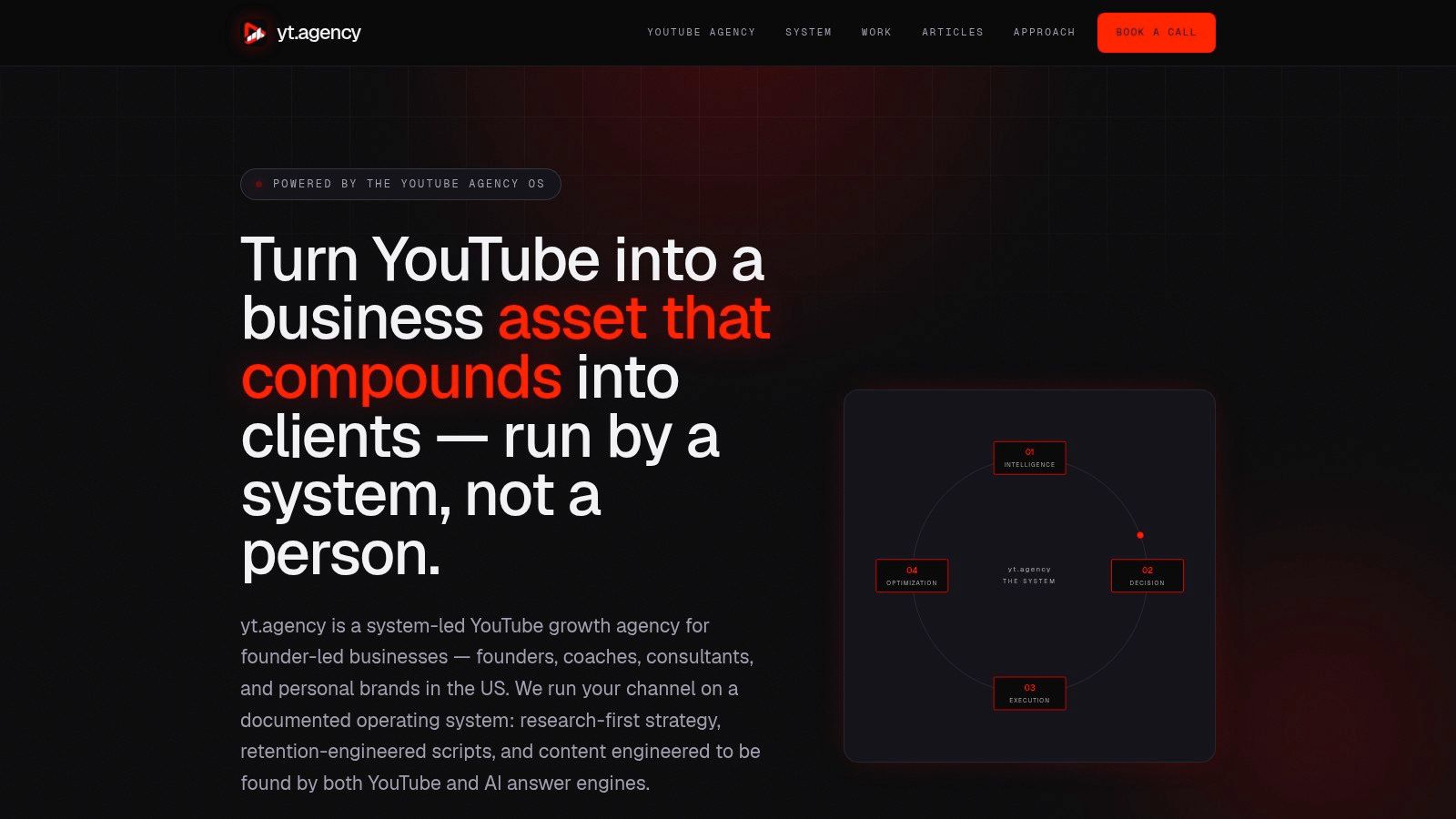
yt.agency states a limit of two new channels per month and leans on founder-led strategy, topic selection, and video packaging. It also describes a 90-day checkpoint where work continues without charge if agreed growth targets aren't reached.
That commitment is unusual, and it only means something if the metric is written down. "Agreed growth" can mean subscribers, views, watch time, or one of those measured on a quiet Tuesday.
Packaging Is Distribution
Its advice about supporting videos with text, descriptions, and chapters lines up with how Shorts get sorted. YouTube's systems weigh whether viewers choose to watch or skip a recommended Short, how long they watch, the average percentage viewed, likes, and post-watch survey feedback, per YouTube's Shorts discovery guidance. The opening two seconds and the title do the same job as the thumbnail, which is why packaging earns a line in the contract.
Capacity: what does two new channels a month mean for your launch date?
The checkpoint metric: subscribers and views are different promises, so pick one.
Day 91: free work needs an end condition, in writing.
If the sourcing and delivery model matters as much as the promise, this YouTube channel growth service breakdown shows what to compare side by side.
How the 7 YouTube growth services compare on pricing, scope, proof, and fit
Item | Public Pricing | Core Services | Proof Shown on Site | Best For
VID | Not publicly listed | B2B YouTube production, search-optimized planning, inbound-focused content systems | Website case studies | B2B teams building repeatable YouTube content operations
Kohsarian | From $750/month for channel management; plans at $1,500 and $2,500/month | Video production, Shorts, strategy, channel management, analytics | Public service and package details | Businesses seeking priced production or channel-management options
Touchstorm | Custom proposal | YouTube strategy, channel management, production, paid media, influencer marketing | Website describes longstanding YouTube-specialist experience | Established brands with broader marketing programs
YouTube Videos Agency | Custom quote | Strategy, audits, SEO, production, scheduling, analytics, channel management | Named clients and agency-published testimonials | Businesses seeking end-to-end YouTube support
DeepVision Marketing | Full YouTube Growth plan at $2,499/month | Long-form videos, Shorts repurposing, strategy, SEO, thumbnails, distribution | Published package deliverables, turnaround, and revision details | Teams wanting regular video output and multi-platform distribution
Koch Consulting | Contact provider for pricing | YouTube growth and consulting for businesses, B2B, and professional services | Named examples and a client-reported result | Expertise-led B2B and professional-services channels
yt.agency | Not publicly listed | Founder-led strategy, topic selection, and video packaging | Published 90-day checkpoint and continued-work commitment tied to agreed targets | Channels seeking close strategic collaboration and defined growth checkpoints
Your Next Move: Turn Agency Promises Into Written Targets
Write three lines before the next call. The goal ("20 qualified demo requests from YouTube in nine months"). The metric ("views on search-intent videos, watch time, and form fills tagged to YouTube"). The checkpoint ("review at day 90, decision at day 180"). Then send those three lines to every provider and ask each to answer in writing. The ones who reply with a specific number and a specific plan earn the second meeting.
Scale resets the picture. The platform's most-subscribed channel passed 300 million subscribers in July 2024, 400 million in June 2025, and 500 million in June 2026, while a separate industry report attributed about 117 million new subscribers to it during 2025 alone, per BusinessStats' subscriber milestone summary. Nobody selling a monthly retainer is promising that. What a real provider should promise is measurable movement in the searches your buyers type.
Three Questions With No Polite Answer
"Show me a client whose channel grew slower than promised, and tell me what you changed." Honest agencies have one ready.
"Which line of the report leads the outcome?" Watch time and returning viewers predict next quarter. Subscriber totals don't.
"What do you need from us each month?" A founder who won't record for 20 minutes stalls any retainer, however good the editing.
Timelines settle more arguments than slogans do. YouTube compounds over months, and ContentBuck, which builds YouTube channels for revenue-focused companies, says plainly that YouTube is a 3-6 month investment and doesn't suit companies needing leads inside a week. That's the kind of statement worth holding every provider to, because it tells you what happens in month two when the graph is still flat.
Judge the report at the checkpoint, not the mood at the kickoff. Watch time up, returning viewers up, search rankings up, and a rising count of form fills tagged to YouTube is a channel working. Subscribers alone is a vanity number with good posture.
ContentBuck builds B2B YouTube channels end to end, from strategy and scripting to four long-form videos a month, 3 to 5 short clips from each, thumbnails, uploads, and a monthly review covering watch time, search rankings, and the leads the channel produced. If this comparison left you with a shortlist and a blank checklist, a free YouTube audit is the fastest way to see what your channel is really competing against. Visit ContentBuck to start.
Parth Jasrapuria
Founder at ContentBuck
Building video systems for B2B businesses. Obsessed with YouTube growth, creative strategy, and organic SEO.