YouTube Channel Growth Service: Prices, KPIs and Red Flags
Parth Jasrapuria
Founder
The marketing team has a folder full of webinar recordings, a YouTube channel that wakes up occasionally, and a sales leader asking whether any of it generates pipeline. Meanwhile, a vendor has sent a proposal promising more subscribers. The proposal looks polished. The connection to revenue looks less polished.
A YouTube channel growth service should solve that gap, not just make the upload calendar busier. The right partner helps relevant buyers discover useful videos, understand the offer, and take a measurable next step. The wrong one delivers a bigger view count and the business equivalent of an empty shopping cart.
What a YouTube Channel Growth Service Actually Covers
A complete service acts like a personal trainer for a channel, not a gym membership that only provides a locker. It helps decide what to publish, prepares the material, manages production, and checks whether the work attracts the intended audience.
ContentBuck offers YouTube Growth for B2B, building organic channels that generate inbound demos. Its service includes full scripting, editing, captions, thumbnail design, uploads, YouTube SEO, short clips, and a monthly channel strategy review.
The work should connect audience research to production decisions.

The difference between production and growth
Say a cybersecurity firm wants IT directors to discover its audit-readiness service. A useful topic would be How to Prepare for a SOC 2 Audit, supported by an expert explaining evidence collection, ownership, and common preparation mistakes.
The provider turns that expertise into a script, edits the recording with clear on-screen graphics, packages the video, and creates standalone Shorts from useful moments. A generic editor might remove pauses and add music. A growth partner also explains why that buyer would watch.
That distinction matches YouTube's explanation of recommendations: the system considers viewing choices, viewing history, watch behavior, feedback, and satisfaction signals. A broad comedy clip might attract attention without attracting anyone responsible for buying cybersecurity services.
A complete scope
The client supplies expertise, evidence, access, and approval. The provider manages the production workflow, while keeping factual decisions with the people qualified to make them.
A complete scope should include:
Research and positioning: Buyer problems, search intent, competing videos, and a clear editorial angle.
Scripts and production: Expert interviews, recording guidance, editing, and captions.
Packaging: Titles, descriptions, and thumbnails that accurately describe the payoff.
Distribution: Uploads, relevant short clips, and appropriate supporting channels.
Reporting: Audience behavior, content lessons, and business actions.
Cheap offers often remove research and reporting first. That leaves a channel with neatly edited videos and no clear reason for the right person to watch them.
Pricing Models and What Each One Really Costs
YouTube channel growth service pricing models
Pricing Model | What You Pay For | Typical Commitment | Best Fit
Monthly retainer | Strategy, scripting, production, editing, and monthly reporting | Monthly, with the minimum term specified in the quote | Teams wanting steady output and a long-term plan
Per-video package | Each finished long-form video, sometimes with Shorts | Per project or batch | Buyers testing the format
Credit-based project | Prepaid credits spent on edits, clips, or thumbnails | Prepaid, with expiry and lock-in terms stated | Launches and short bursts of work
Unlimited editing subscription | Flat monthly fee for queued editing of supplied footage | Monthly | Teams with raw recordings and in-house strategy
Freelancer hourly rate | Time from an editor or strategist | Hourly or per project | Small teams managing planning internally
Price means little until the buyer knows what it buys. No comparable dollar prices are established here, so the useful comparison is scope, capacity, and internal workload, with actual costs supplied through written quotes.
The costs outside the quote
Monthly retainers can remove coordination work, but only when the agreement includes the whole workflow. Filming, specialist animation, travel, and expert interview time need explicit treatment rather than a cheerful assumption.
Per-video packages make a pilot easier to approve. However, a finished video might exclude topic research, thumbnails, upload management, or performance analysis. The buyer should compare the cost of a publish-ready asset, not just an exported file.
Credit-based projects suit uneven demand. The important details are what each task consumes, whether unused credits expire, and how revisions affect the balance.
Unlimited editing subscriptions sell access to a queue, not infinite simultaneous output. A team can submit plenty of requests while still waiting for its current requests to finish.
Freelancer hourly rates can look economical until the marketing manager becomes the producer, scriptwriter, and quality-control department. Internal coordination belongs in the cost calculation.
Capacity isn't strategy
The Growth plan includes up to 40 short-form videos and 5 long-form videos monthly, with 2 active requests at a time, 24-hour turnaround, advanced editing with motion graphics, a dedicated editor, unlimited revisions, and Slack and Email support.
That is a different purchase from an editing subscription that only trims supplied footage. It also shouldn't be confused with the separate YouTube Growth scope, which includes channel planning and scripting.
Buying rule: Compare the finished workflow, not the cheapest unit on the price sheet.
Before comparing proposals, obtain a written list of monthly deliverables, revision terms, active-request limits, turnaround definitions, and minimum commitments. A low price per video isn't a bargain when nobody has decided who the video is for.
KPIs That Show Whether Growth Is Real
KPIs for judging a YouTube channel growth service
Tier | Metric | Where to Check | Healthy Sign
Attention | Impressions and thumbnail click-through rate | YouTube Studio Reach report | Click-through remains steady across comparable uploads
Attention | Average view duration and audience retention | YouTube Studio video-level Engagement and retention reports | Viewers stay through the opening and reach the useful explanation
Qualified demand | Visits from target companies or job titles | Tagged web analytics plus consented identity or CRM data | Identifiable visitors match intended accounts
Qualified demand | Demo or contact requests with YouTube as source | CRM source field | Qualified requests increase across reporting periods
Revenue influence | Assisted pipeline from YouTube-touched deals | CRM multi-touch reports | Evidence and uncertainty accompany the estimate
Revenue influence | Closed-won deals where YouTube came up | CRM plus sales call notes | Sales notes identify videos buyers watched
Views and subscribers begin the story. They don't finish it.
According to YouTube's 2025 U.S. impact report, 76% of U.S. small and medium-sized businesses with a channel said YouTube helped grow their customer base by reaching new audiences. That is a self-reported business finding, not a promise that any particular B2B channel will generate leads.
Attention establishes whether the content works
Impressions show opportunities to be seen. Click-through indicates whether the packaging interests viewers, while retention helps reveal whether the video delivers.
A useful report compares similar topics and traffic sources. A tutorial found through search shouldn't automatically be judged against a broadly distributed Short.
For a separate subscriber-building resource, Veo3 AI's YouTube subscriber growth guide can sit alongside the commercial scorecard. Subscriber development remains a channel-building task, not proof of sales impact.
Qualified demand checks who arrived
Add UTM-tagged links to relevant landing pages and preserve those tags through forms into the CRM. Include a self-reported discovery field so buyers can mention videos watched before the tracked visit.
UTM tags identify campaign traffic. They don't magically reveal job titles or employers. Those details require form responses, existing contact records, or appropriately configured identification tools.
The B2B YouTube benchmarks guide can support planning discussions, but the channel's own baseline should guide operational decisions. A narrow tutorial attracting buying-committee members can be more valuable than a viral clip attracting unrelated viewers.
Revenue influence needs evidence
Connect relevant video interactions to opportunities, then check sales notes. The monthly performance review should cover watch time, search rankings, and lead submissions and proposal requests attributed to YouTube content.
A prospect might watch several videos, read articles, and return through branded search before booking. The report should describe influenced pipeline, identify confirmed versus inferred touches, and explain any estimated range.
A provider reporting only views has demonstrated distribution, not the business result.
Vanity Metrics and Monetization Traps
A spreadsheet celebrating 10,000 views can still represent zero software sales when the audience consists of students or people outside the company's service market. A view package is especially suspect when the seller can't explain how viewers are acquired.
Subscriber totals also don't establish monetization readiness. YouTube's Partner Program eligibility guide sets full advertising-revenue eligibility at 1,000 subscribers, plus either 4,000 valid public watch hours during the previous 12 months or 10 million valid public Shorts views during the previous 90 days; Shorts Feed watch hours don't count toward that watch-hour route.
Eligibility isn't a subscriber trophy
Consider a hypothetical software channel with the required subscriber count but insufficient qualifying watch hours. It hasn't met that route's viewing requirement, regardless of how enthusiastically the vendor decorates the dashboard.
Channels must also follow monetization policies, have no active Community Guidelines strikes, enable two-step verification, and connect an AdSense for YouTube account. Meeting the audience threshold isn't the entire application process.
The expanded Partner Program guide describes a different route in eligible countries: 500 subscribers, three valid public uploads during the previous 90 days, and either 3,000 qualified public watch hours during the previous 12 months or 3 million qualified Shorts views during the previous 90 days. That can provide access to fan-funding features, not the same advertising milestone.
Keep revenue projections in their lane
The YouTube RPM calculator can help explore advertising-income scenarios. It shouldn't replace a B2B pipeline model based on qualified opportunities.
Any growth report should answer:
Validity: Which viewing activity qualifies for the relevant program?
Audience fit: Which viewers match the intended buyer?
Business action: What did those viewers do beyond watching?
A dashboard needs answers, not confetti.
Vendor Questions, Red Flags and Stalling Mistakes
Treat vendor selection like a job interview. The marketing leader is hiring a team to represent the company's expertise, not ordering a decorative subscriber counter.
This checklist makes the discussion concrete.
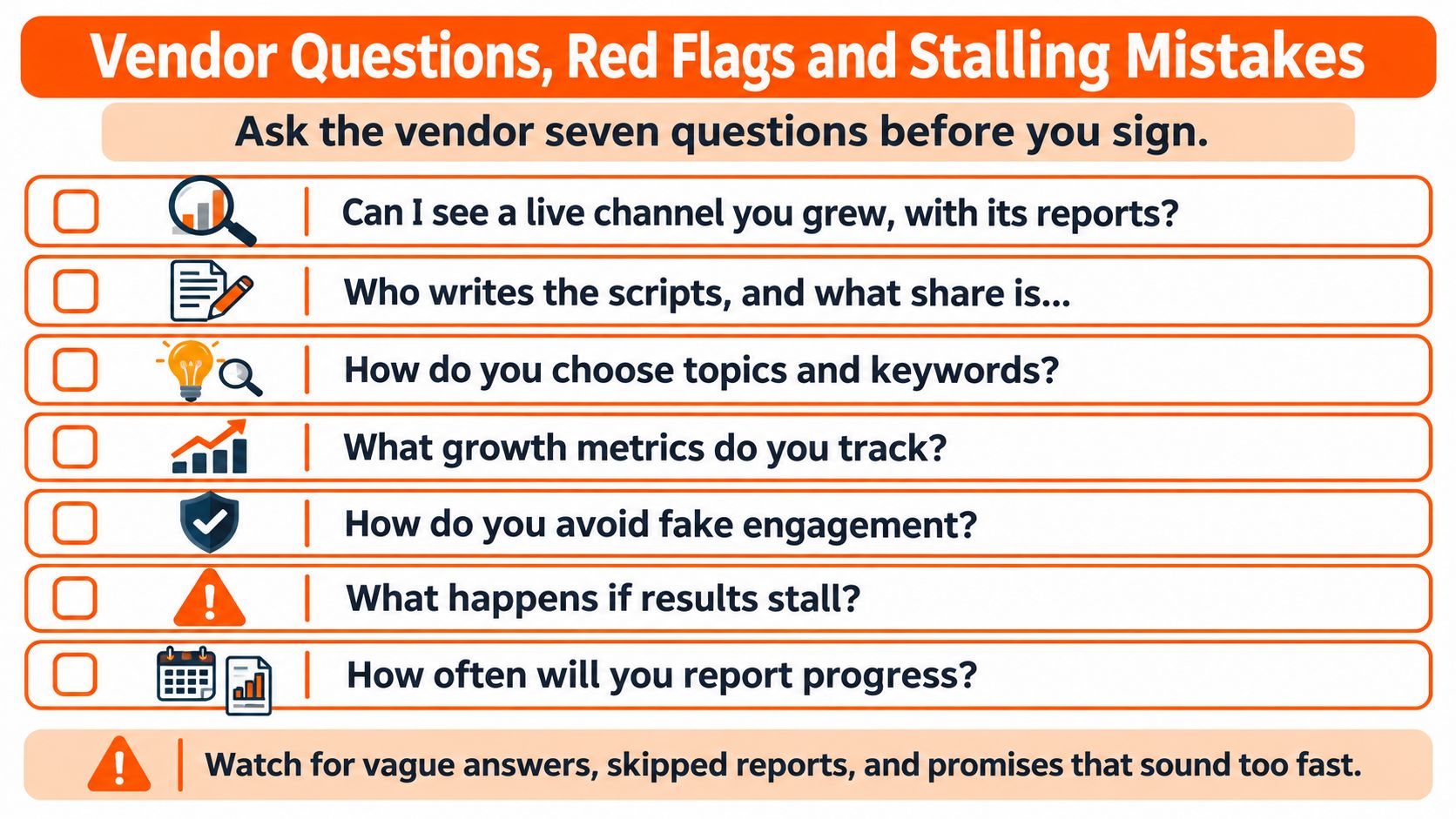
Questions that expose the operating model
Can the vendor show a live channel it grew, together with reports?
Who writes scripts, and which parts are AI-assisted?
Who checks expert facts?
Which steps require client approval?
How does the team handle required synthetic-content disclosure?
What does the monthly report contain?
Who retains channel access, source files, and finished assets after cancellation?
Red flags include guaranteed subscriber counts, unexplained view packages, identical videos with swapped titles, and no identifiable subject-matter expert. Expert participation needn't mean a talking head in every upload, but somebody credible must own the claims.
Green flags include a documented workflow, named production contacts, clear ownership terms, and a useful pre-contract audit. A unified production team also helps keep YouTube content, website video, ads, and articles grounded in the same expertise.
AI efficiency needs editorial control
In July 2025, YouTube's monetization policies renamed repetitious content to inauthentic content, clarifying the treatment of repetitive or mass-produced material. AI assistance isn't automatically disqualifying; original analysis, evidence, and human review matter.
Realistic altered or synthetic material requires disclosure where applicable, and disclosure alone doesn't reduce reach or monetization eligibility. The workflow should assign that upload decision to a named owner.
Stalling mistakes and practical fixes
Funny packaging, poor fit: Judge a thumbnail alongside retention and qualified actions, not clicks alone.
Generic topics: Script for a defined buyer, such as an IT director preparing for an audit, rather than anyone willing to watch.
Repetitive output: Replace near-identical uploads with distinct expert explanations.
Untested thumbnails: Compare clear alternatives on comparable audiences.
YouTube's impressions guide counts an impression when a thumbnail appears for more than one second with at least 50% visible; 1,000 clicks from 20,000 registered impressions equals 5% click-through. A hypothetical test could compare Product Update against Cut SaaS Churn: 3 Fixes.
A flashy thumbnail followed by immediate exits resembles a giant cake sign outside a plumbing shop. Excellent attention, questionable business.
A Realistic Timeline From Month One to Month Six
Allow a 3–6 month investment, not a one-week rescue mission for pipeline. That is the provider's stated planning window, not a guaranteed time to results.
The milestones below describe a working sequence rather than automatic growth.
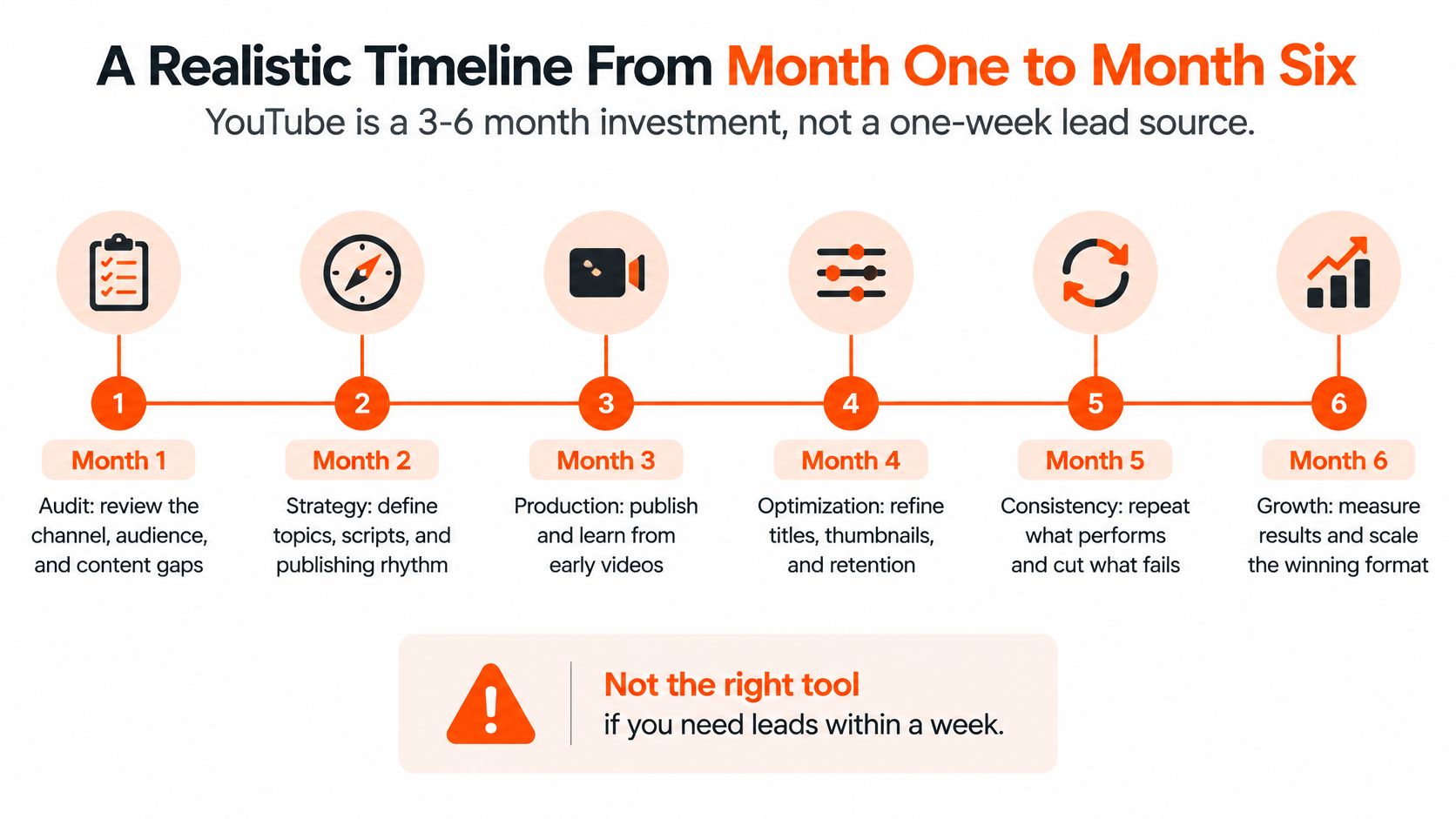
Typical channel growth timeline
Period | What the Service Does | Signs of Progress
Month 1 | Audit, audience research, positioning, and initial scripts | A clear topic list and planned thumbnail tests
Month 2 | Initial uploads, title and thumbnail tests, and short clips | Early impression and click-through readings
Month 3 | Evaluate search and suggested traffic for audience patterns | Returning viewers and improving view duration where content fits
Months 4–6 | Build on useful videos and tighten the sales feedback loop | Prospects mention relevant videos on discovery calls
What progress looks like in practice
For a financial consultancy starting from scratch, the early work should establish whose questions the channel answers. A finance director choosing an adviser needs explanations of decisions, risks, and trade-offs, not a montage of office coffee.
As publishing continues, the team can identify which questions attract relevant viewers and which explanations hold attention. Sales feedback should then inform the next scripts, especially when prospects repeatedly mention the same uncertainty.
ContentBuck reports building a financial consultancy's channel from scratch to 12,000 subscribers and 18 meetings booked directly from YouTube within 3 months. This is a provider-reported customer result, not an independent benchmark; the meetings are the commercially important outcome.
Its separate project management SaaS example is also a provider-reported result: a video titled How We Built a $2M Inbound Pipeline Using YouTube generated 180+ inbound leads. The pipeline amount is part of the video's title, not evidence that every channel can produce that outcome.
The accompanying video provides context for that example.
Checkpoints prevent expensive optimism
Neither example establishes a universal deadline. Topic fit, the offer, production consistency, and sales follow-up all affect the commercial result.
At the month-three checkpoint, the buyer should assess audience relevance, production reliability, and early demand signals. At month six, the discussion should address whether to scale, revise the positioning, or stop.
A timeline is useful when it defines decisions. It becomes dangerous when a vendor sells it as a promise.
Frequently Asked Questions About YouTube Channel Growth Services
These answers address the practical decisions lean B2B teams face before hiring.
Does the company's expert have to appear on camera?
No. A named expert can narrate screen recordings or demonstrations, provided a real specialist reviews the facts and the series clearly identifies that person's expertise.
How many videos a month is enough?
A sensible starting scenario for a small B2B team is four strong long-form videos monthly, supported by relevant clips. The team should reduce that pace if expert review or production quality starts slipping.
Can a vendor guarantee results?
No credible vendor can guarantee organic subscribers or qualified leads. It can commit to deliverables, review schedules, testing procedures, and transparent reporting.
Is YouTube worth it for a small B2B team?
It can be worthwhile when videos answer genuine buying questions and someone follows up on demand. It isn't a suitable emergency channel for a company needing immediate pipeline.
Which KPI should the buyer check first?
Start by comparing thumbnail click-through and retention across the initial uploads. Add qualified-demand reporting as soon as tagged links and CRM source capture are working.
Pick a Growth Partner and Start With a Free Audit
A useful buying decision starts with a business goal, not a preferred editing style. Cinematic transitions won't fix an offer aimed at the wrong audience.
Write a specific commercial goal. A hypothetical cybersecurity brief might target qualified demo requests from UK IT directors. That gives the vendor a buyer, an action, and a market to plan around.
Score the operating model. Compare pricing clarity, reporting across attention and commercial outcomes, an explicit AI and disclosure policy, and a named editor or account manager. A proposal should explain who does the work and how the buyer can judge it.
Start with diagnosis. Request an audit, compare its findings with the commercial goal, and agree on the first formal decision checkpoint before committing. An audit should identify concrete topic gaps, packaging problems, and tracking omissions, not just recommend more uploads.
A package with 4 long-form videos monthly and full scripts is a practical starting scope for a team with limited production time. The agreement still needs to define expert availability and approval responsibilities.
ContentBuck offers a Free YouTube Audit, and its free discovery calls have limited spots each month. A tight launch schedule is a reason to arrange the discussion early, not a reason to skip vendor checks.
The next step is to book the audit with a written goal and the vendor checklist ready. The findings should determine whether the channel needs a growth partner, editing support, or a clearer offer first.
For B2B teams comparing a YouTube channel growth service, ContentBuck offers strategy, scripting, production, editing, and channel management tied to inbound demand. Book the Free YouTube Audit, bring the commercial goal and vendor checklist, and use the findings to choose the next step.
Parth Jasrapuria
Founder at ContentBuck
Building video systems for B2B businesses. Obsessed with YouTube growth, creative strategy, and organic SEO.