Explainer Video Services: A B2B Buyer's Guide
Parth Jasrapuria
Founder
Almost every buyer has already seen the format work. Wyzowl's long-running survey series reported that 98% of consumers had watched an explainer video to learn about a product or service in its late-2025 survey of 266 respondents. That doesn't prove a video will book demos. It proves buyers expect a short, clear explanation before they read a long page. Good explainer video services therefore start with the buying model, the price, and the measurement plan, not with a pretty style frame.
Three Ways to Buy an Explainer Video
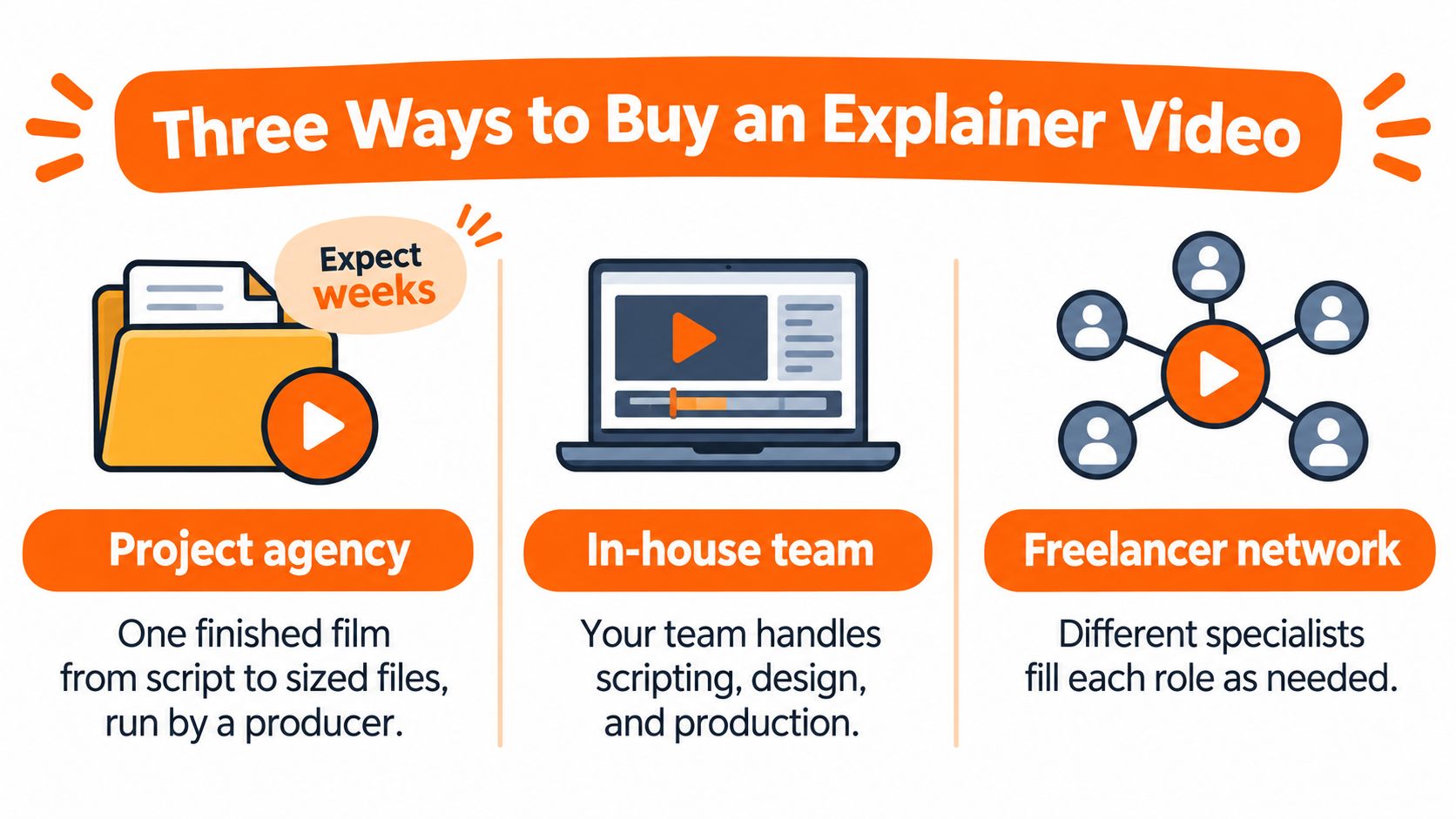
Buyers usually choose between three models, plus a hybrid for teams that need both a flagship film and weekly variants. The right choice depends on who manages the work, how often new cuts are needed, and whether the first version must be right.
Model | What you buy | Typical speed | Who manages it | Choose it when
Project agency | One scripted explainer with visuals, voiceover and sized files | Weeks; listed packages run 10 to 14 days after script sign-off | Agency producer or project manager | The homepage or sales film must be right the first time
Monthly subscription | A queue of edits, ad variants and short clips | 24 to 48 hours per request on the listed editing plans | Dedicated editor on a flat plan | You need fresh hooks every week, not one film a year
Freelance | A scoped asset you art-direct | The date fixed in that person's calendar and written scope | You | The job is simple and someone inside can run the brief
Hybrid | A flagship film plus a later cut-down queue | Slow once, then fast on variants | Producer for the film, editor for the queue | Sales needs both a story and weekly ads
What Each Model Feels Like in Practice
A project agency sells one finished film. The producer runs script, storyboard, animation, voiceover, captions, and sized files for web, ads, and social. Say an HR platform team replaces a dense homepage paragraph with a 75-second film about one manager's chaotic Monday. The sequence shows the problem, the mechanism, the outcome, and one next step. Nobody has to decode a feature list while their coffee goes cold.
A monthly subscription sells a queue, not a single event. A dedicated editor turns webinars, demos, and the main explainer into ad variants and short clips on a flat plan. Turnaround should be written into the plan before money changes hands. A freelancer sells one scoped asset. The invoice can be lower, but the buyer writes the brief, gives feedback, checks captions, and chases the final file. That's fine when an internal marketer has time and taste. It's painful when that person is also running launches, ads, and three sales requests before lunch.
Practical rule: Pay an agency for judgement and management, a subscription for volume and speed, and a freelancer only when internal direction is already strong.
Context matters, but context isn't proof. Explainer videos were created by 68% of surveyed marketers in the 2026 edition of the same Wyzowl dataset, so the format is now normal buying behaviour, not a novelty. Performance still depends on message clarity, audience fit, and distribution.
ContentBuck is a B2B video production agency that offers YouTube channel growth, SaaS explainer videos, B2B ad creatives, podcast video repurposing, SEO content writing, and unlimited video editing subscriptions. That mix fits the hybrid model because one film can feed later cuts. Teams on the agency side of the market face the opposite problem, finding qualified buyers, which is why a clear view of client acquisition for video production companies helps buyers understand how serious providers build pipeline instead of relying on referrals alone.
Explainer Prices and Delivery Times
Prices should be read like a menu, not guessed from a sales call. The priced SaaS packages below show what changes when the number rises: length, revision room, project files, speed, and ad cuts.
Package | Length | Price | Delivery | Revisions and extras
Core SaaS explainer | 60 seconds | $1,800 | 14 days | 2 revision rounds
Full Suite SaaS explainer | 90 to 120 seconds | $2,999 | 12 days | Unlimited revisions and raw project files
Premium SaaS explainer | Up to 3 minutes | $3,999 | 10 days priority | Custom animation, dedicated project manager, 30s and 15s ad cuts
Monthly subscription | Queue of short cuts | Flat monthly fee quoted before start | 24 to 48 hours per request on listed editing plans | Unlimited revisions on the Starter and Growth editing plans
Freelance asset | One scoped film | Fixed quote agreed before work starts | The date fixed in the freelancer's written scope | Revision rounds set in the written scope
What the Extra Money Buys
Core at $1,800 is the short homepage tour. A buyer gets a 60-second animated explainer, 2 revision rounds, and 14-day delivery. Two rounds means comments arrive twice, so internal reviewers should agree before round one. If legal, product, and the founder all send separate notes on different days, the package won't save the calendar.
Full Suite at $2,999 buys room to breathe. The film runs 90 to 120 seconds, with unlimited revisions, raw project files, and 12-day delivery. Raw files matter next quarter when a product name, price, or screen changes. Without them, a small edit can become a new production wearing a fake moustache.
Premium at $3,999 buys length, management, and distribution assets together. It covers up to 3 minutes with custom animation, a dedicated project manager, 30-second and 15-second ad cuts, and 10-day priority delivery. That row suits a story that needs more than 90 seconds and ads that must ship with the film, not six weeks later.
Say a SaaS founder compares the $1,800 Core package with a lower freelance quote. The useful questions aren't glamorous. Who writes the script? Is professional voiceover included? Are captions, square and vertical files, and ad cuts extra? How many revision rounds are included, and what happens on round five when a product name is wrong?
A low quote that hides script, voiceover, or extra formats isn't a low price. It's a partial price.
Delivery clocks need the same plain reading. The listed times run after script sign-off, not after the first hello. A team that takes nine days to approve a script has spent nine days, even if production later takes ten. Finance should therefore see the full row, length, delivery start point, revision rule, and file list, before approving the number.
Buyers who want to test scope before a call can use the video cost calculator to map length and extras against budget. The calculator doesn't replace a written quote. It stops the common mistake of comparing a finished agency film with a freelance animation fee that excludes half the work.
There's no honest market average in this guide for unnamed shops. Inventing one would help nobody. A buyer can compare real rows, ask what's missing, and match the package to the job. That's less exciting than a bargain headline, but it's how budgets survive contact with production.
Which Buying Model Fits Each Job
Match the model to the job, not to the team's mood that week. A HubSpot summary of Wyzowl research reports that 78% of people would rather watch a short video to learn about a product than read an article or manual, while 91% say video quality affects their trust in a brand. Those figures support placing video where text fails. They don't promise sales.

Three Jobs, Three Different Buys
The homepage explainer is an agency job. One story has to work above the fold, in outbound email, and in sales follow-up. For PeopleOS, a 75-second animated explainer was built around a single buyer scenario, placed above the fold on the homepage, and used in every outbound sequence. One clear scene beats five features fighting for the microphone.
The product page that text can't carry also suits a project film. Say an API security vendor sells to technical buyers who won't read a long manual before a first call. A 60 to 90 second animation can show data moving through one security checkpoint, name the risk that gets stopped, and end on "book a security review." The buyer sees the mechanism instead of imagining it from paragraphs and diagrams.
The always-on ad programme is a subscription job. One 30-minute webinar can become a full episode, a 45-second problem clip, an objection-handling clip, and a vertical post with the strongest customer line. That queue needs an editor who can ship variants every week. It doesn't need a fresh procurement process every time a hook tires.
Homepage film: Agency, because script and trust carry the page.
Complex product page: Agency or hybrid, because the mechanism must be accurate.
Weekly ad hooks: Subscription, because volume and speed matter more than ceremony.
One conference recap: Freelancer, if marketing can art-direct and review it.
A freelancer can still be the right buy for a narrow task. A conference recap, a simple screen walkthrough, or a founder clip with a locked script doesn't always need a producer. The failure mode appears when a freelancer is asked to run weekly hook tests, manage stakeholders, and invent strategy between invoices. That's like asking a wedding photographer to run the cafeteria. Talented person, wrong kitchen.
Quality also changes the choice. A shaky homepage film doesn't just look cheap. It gives buyers a reason to doubt the product behind it. If the page sells security, finance, or workflow reliability, the video has to feel careful. Buyers notice mismatched captions, robotic voiceover, and screens that don't resemble the product.
The simplest test is frequency. One important film points to a project. A stream of cuts points to a subscription. A small asset with strong internal direction points to a freelancer. Teams that need all three across a quarter should buy the hybrid on purpose, not drift into it after the first film succeeds.
How to Brief and Test the Video
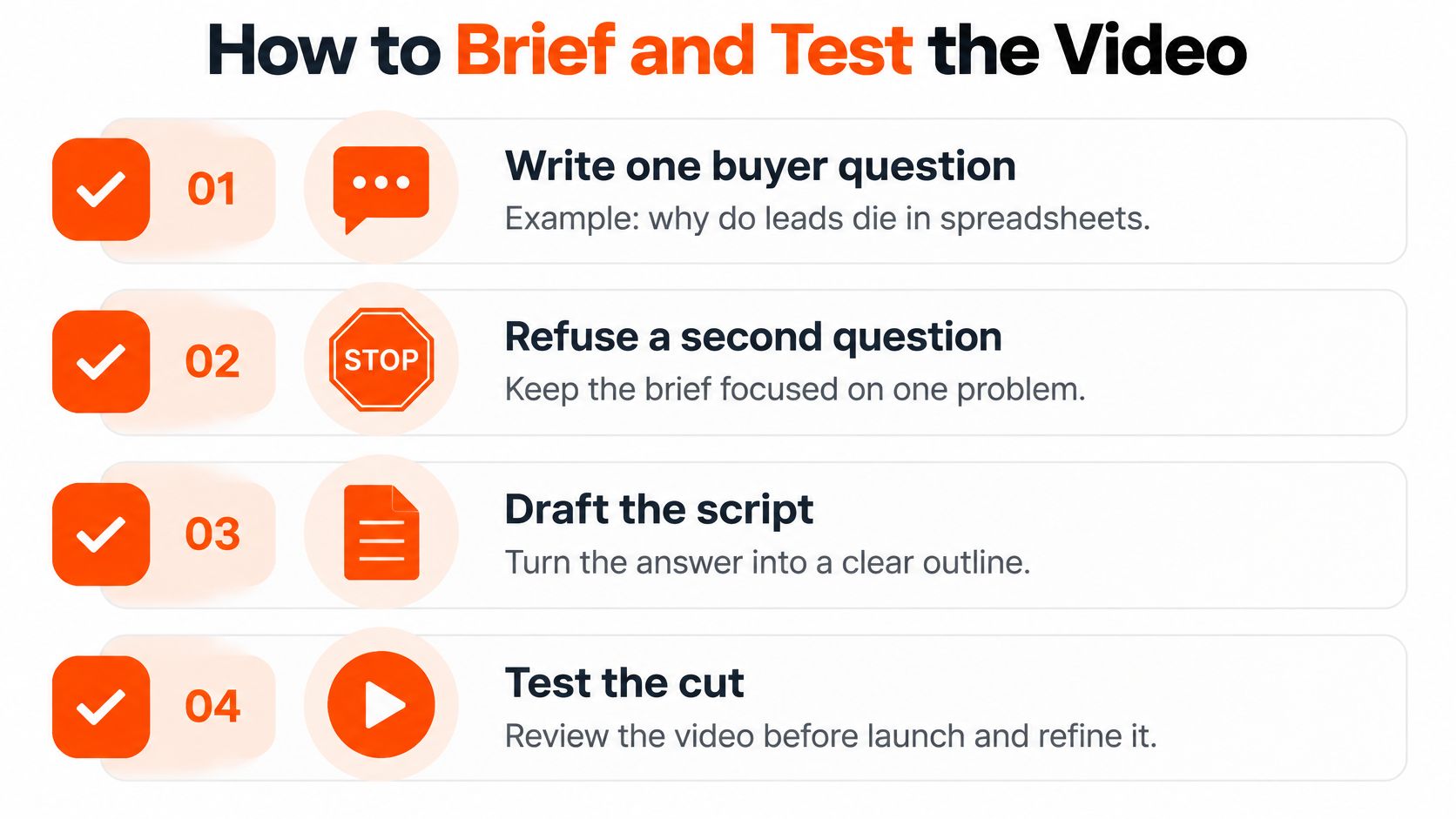
A weak brief makes strong animators guess. The path below works with an agency, a subscription, or a freelancer because it fixes the thinking before production starts.
A Brief a Busy Team Can Finish
Write one buyer question: For example, "why do leads die in spreadsheets?" Refuse a second question until the first film ships.
Draft four beats: Problem, mechanism, outcome, action. Aim for 60 to 90 seconds unless the offer needs longer.
Match the spoken line to the button: If the voiceover says "book a demo," the screen shouldn't say "learn more" and hope for telepathy.
List files before animation:16:9 for the site, 1:1 and 9:16 for social, captions, a transcript, and a poster frame for muted viewing.
Approve the script in writing: Delivery clocks start at sign-off, not at the kickoff call.
That written approval step sounds dull. It prevents the loudest argument in video production, where everyone remembers a different promise. A short guide on how to brief a B2B video agency can help a team turn those five points into a one-page brief. During production, keeping designers and developers aligned matters for the same reason. Named owners, clear review rounds, and one source of truth stop small comments from becoming rebuilds.
Test the Hook, Not Opinions
Google Ads video experiment guidance describes a basic two-armed A/B test with one control campaign and one treatment campaign where the video asset changes. Audience, bids, and ad format can stay the same, which helps isolate the creative. Say one opening says "Cut reporting time" and the other says "Stop losing leads in spreadsheets." For lead generation, conversion rate or cost per conversion tells the buyer more than views.
Google also documents an advanced option that can test up to 10 experiment arms. More arms need more traffic. A small B2B audience split ten ways produces noise with confidence, which is still noise.
Change one thing, keep the audience steady, and judge the action the business wants. Pretty thumbnails don't get a vote.
After launch, check play rate and the early drop-off before blaming the offer. A weak poster frame means people never start. A sharp fall once the mechanism appears means the explanation may be confusing. Those are different illnesses with different medicine.
Captions and a transcript also help global buyers without a full dub on day one. Modular scripts help when product names change often. One scene can be re-recorded and re-animated without rebuilding the whole film. Buyers should ask how scenes are structured before production, not after the first product rename lands in the inbox.
How to Judge ROI Without Fake Lifts
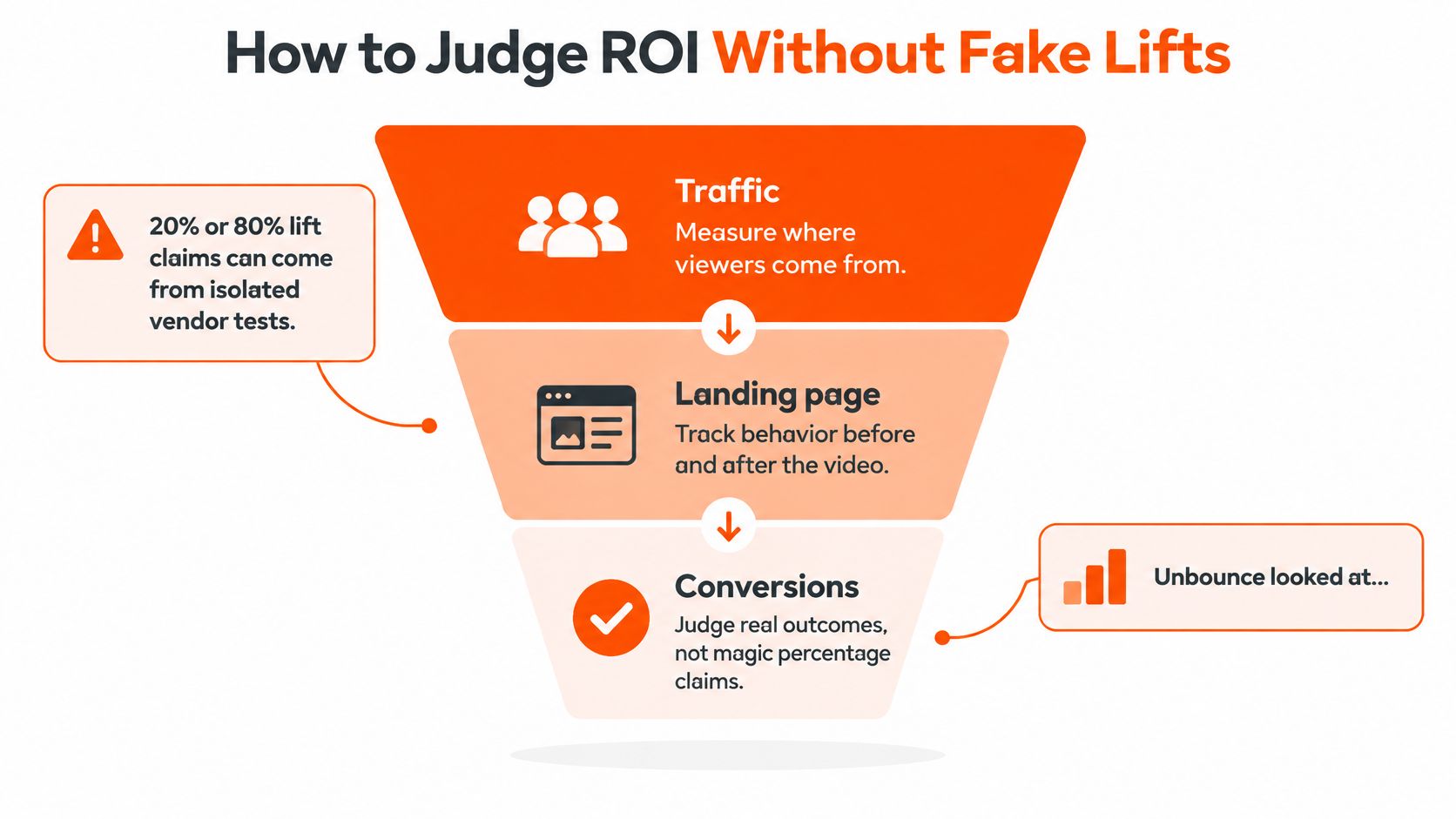
Start by killing the magic percentage. An independent analysis of SaaS video statistics summarized that widely repeated claims such as 20% or 80% conversion increases came from isolated vendor-reported tests, while Unbounce's analysis of approximately 35,000 landing pages per period found video had a minimal or negative average effect. A serious buyer should plan a test, not a parade.
The Metric Stack That Holds Up
Keep a no-video control where traffic allows it. Hold traffic source and page layout steady. Then read the stack in order, from attention to money.
Play rate: The share of page visitors who press play instead of scrolling past.
Completion points: Events at 25%, 50%, 75%, and 100%, plus CTA clicks.
Qualified action per visitor: Demo requests, trial starts, or qualified form completions divided by all visitors, not only viewers.
Assisted pipeline: Meetings and opportunities from accounts that engaged with the video.
Revenue quality: Meeting rate, opportunity rate, and revenue per visitor in the CRM.
Segment results by device, channel, page intent, and placement. A 60 to 90 second film can help a high-intent product page and slow a cold paid-social page where visitors wanted a form, not a cartoon. Averaging those pages together hides the useful answer.
For B2B teams, account-level reading matters more than raw views. Tag video viewers in the CRM where consent and tooling allow it. Compare video-engaged target accounts with similar accounts that never played the film. Count assisted meetings and opportunities, and keep last-touch credit separate. A modest film watched by the right operations leaders can beat a viral clip watched by students, creators, and someone's cousin who loves animation.
One primary goal: Pick demo requests, trial starts, or sales-call mentions before production. A video judged on five goals usually gets excused on all five.
Report the baseline, test window, traffic source, and limits of attribution. Long B2B cycles and multiple stakeholders mean the film may influence a deal without being the final click. That's a reason for multi-touch reporting, not a reason to claim every later deal as video revenue.
The PeopleOS result needs careful labels. A 34% conversion rise after a homepage explainer was delivered for an HR workflow SaaS company is a ContentBuck-reported case that has not been independently verified. It should never be quoted as a benchmark or promised to another buyer. A video ROI calculator can model cost against demo value, but the inputs still need a baseline and a control. Otherwise the calculator becomes a spreadsheet wearing a party hat.
Explainer Video Services FAQs
Short answers help buyers compare providers without a sales call. These five questions cover price, timing, model choice, accessibility, and length.
How Much Do Explainer Video Services Cost
Listed SaaS packages run from $1,800 for a 60-second Core film to $3,999 for a Premium film of up to 3 minutes with ad cuts. Subscription and freelance prices are quote-based. Buyers should ask for script, voiceover, captions, formats, revision rounds, and project files in writing. If a quote only says "one video," it isn't finished.
How Long Does an Explainer Take
Listed packages deliver in 10 to 14 days after script sign-off. The clock starts at approval, not at kickoff. A slow internal review can therefore make a fast production schedule look late. One named approver and one combined feedback round protect the date better than urgent messages in three tools.
Should a Team Choose an Agency, Subscription, or Freelancer
Choose an agency for one film that must be right. Choose a subscription for weekly cuts, ad variants, and short clips. Choose a freelancer when someone inside can write the brief, art-direct the asset, and review files. Choose a hybrid when sales needs a flagship story now and fresh hooks every week after launch.
Are Captions, Subtitles, or Dubbing Needed
Start with accurate captions and a transcript. They're useful for muted viewing, search, accessibility, and global buyers who read English faster than they process spoken product terms. Add subtitles when a market justifies translated on-screen text. Add dubbing or a re-recorded regional voiceover only where the audience, deal size, and compliance needs justify the extra production. Translation isn't just swapping words. Acronyms, interface terms, reading speed, and claim wording can change meaning. A short global master with strong captions often beats five rushed local versions that all say slightly different things.
How Long Should the Video Be
Sixty to ninety seconds is enough for one narrow buyer question. Longer films need a reason, such as a multi-step mechanism, a regulated workflow, or several proof points that can't be cut without lying by omission. If the script needs three minutes to explain the main idea, the idea may need sharpening before the animation needs lengthening. Nobody awards extra demos for stamina.
These answers work best as buying checks, not as universal laws. A provider that can't state price drivers, delivery start points, file lists, or accessibility steps in plain language will struggle with the harder parts too. Clear answers before production usually mean fewer surprises after the invoice.
Choose a B2B Explainer Partner This Week
Use a partner test with three signs. First, the provider writes or sharpens the script instead of animating whatever paragraph arrives. Second, turnaround and revision limits are stated in writing. Third, the provider can explain how play rate, completion, CTA clicks, and assisted meetings will be measured.
Signs to Walk Away
Walk away from a promise of a fixed conversion lift. Walk away from a lifestyle brand film pitch for a product that needs explaining. Walk away when the portfolio looks lovely but nobody can say which buyer question each film answered.
A revenue-focused B2B team needs a film plus the system around it. Animated explainer videos from ContentBuck run 60 to 90 seconds and include a script written by its copywriters and a professional voiceover. Delivery is listed at 14 days after script sign-off, with formats for web, ads, and social. That structure fits a homepage or product page where comprehension has to turn into a demo request, trial start, or sales conversation.
Search visibility should support the same goal, because a strong film on an invisible page helps too few buyers. Teams comparing growth partners can use a roundup of b2b saas seo agency options to check how video, search, and landing pages are planned together. The point isn't to buy every service. It's to avoid a video strategy that ends at export.
This week, three actions are enough.
Write the one buyer question in the buyer's words.
Pick the package shape that fits length, revisions, files, and ad cuts.
Book a discovery call with the page URL, current conversion rate, and one desired action ready.
Free discovery calls have limited spots each month, so early booking matters. Bring the ugly numbers too. A partner that only wants the polished story cannot fix the page that's losing buyers.
If a provider can't describe the measurement plan, keep shopping. The right partner should sound a little less like a film studio and a little more like a careful adult with a brief, a calendar, and a dashboard. Boring in the best possible way.
ContentBuck builds animated explainer video services for B2B teams that need complex products understood fast, with copywriter-led scripts, professional voiceover, and files sized for web, ads, and social. Bring one buyer question, the page that must perform, and the action the film should earn. Visit ContentBuck to book a discovery call and choose the package that fits the job.
Parth Jasrapuria
Founder at ContentBuck
Building video systems for B2B businesses. Obsessed with YouTube growth, creative strategy, and organic SEO.