Sponsored LinkedIn Messages: A Practical 2026 Guide
Parth Jasrapuria
Founder
A marketing lead has a sensible offer, a carefully built account list, and a dashboard full of numbers that don't quite explain whether sales will get any meetings. Then a sponsored message appears in LinkedIn, looking more like a note from a professional than another banner fighting for oxygen.
Sponsored LinkedIn messages can put a relevant offer inside a professional inbox. But the useful question isn't whether someone opened the message. It's whether the campaign reached an eligible audience, prompted a meaningful action, and produced a meeting worth attending.
Message Ads or Conversation Ads
Mid-scroll on LinkedIn, a member notices a message from someone whose profile looks relevant to their work. It's an advertisement delivered through Messaging, not an ordinary feed post or a personal invitation to connect.
According to LinkedIn's Sponsored Messaging overview, Message Ads and Conversation Ads appear in LinkedIn Messaging on desktop and mobile when members are active, with cost-per-send charging and platform-controlled delivery frequency. Conversation Ads support brand awareness, website visits, lead generation, and website conversions.
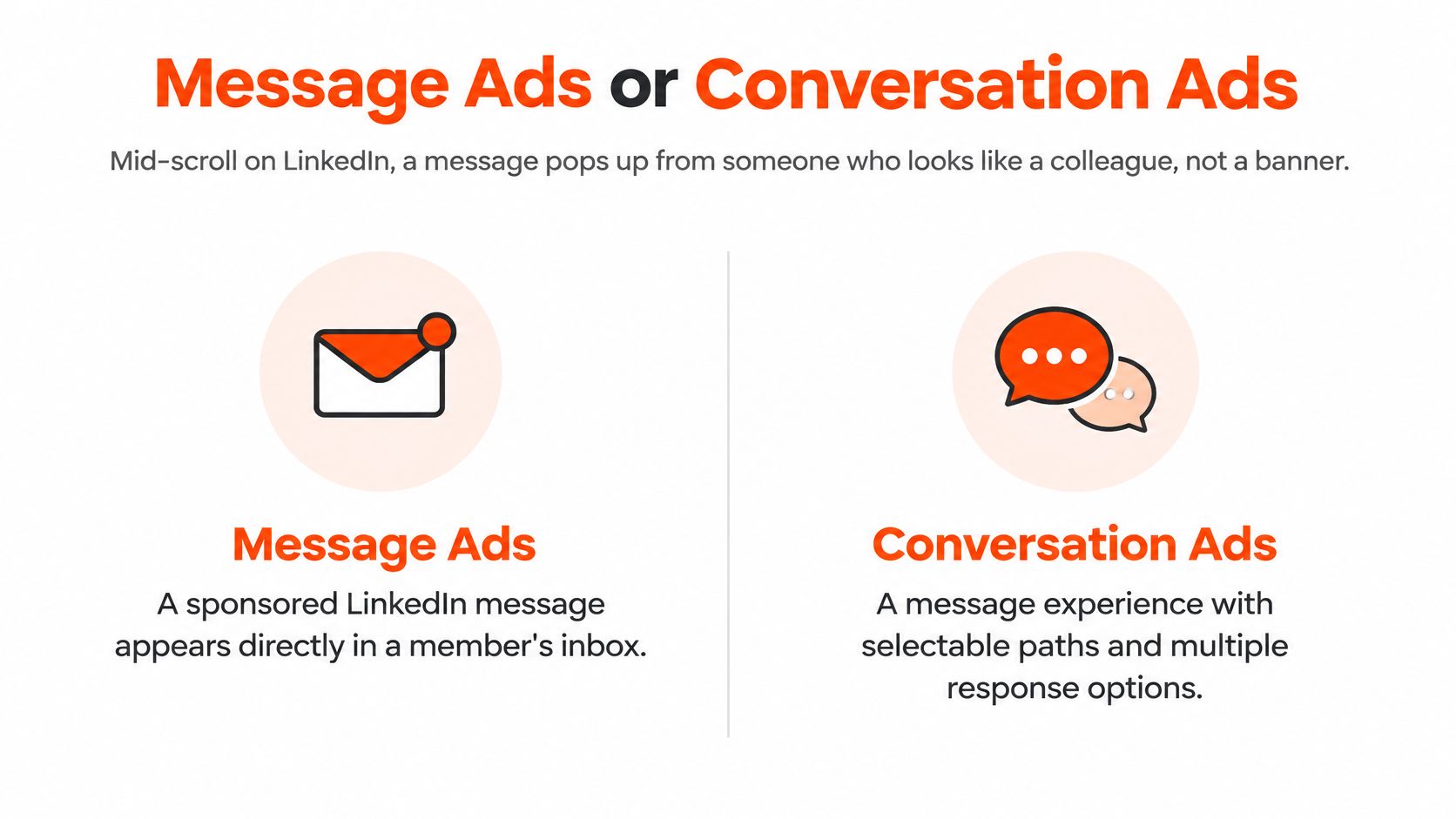
The distinction is the experience after opening. A Message Ad presents a direct offer; a Conversation Ad lets the member choose a path.
Message Ads versus Conversation Ads
Format | What the member sees | Charge | Best job | Objectives
Message Ads | One subject, body, links, and a CTA button in the inbox | Cost per send | One clear offer such as a demo or event | A single next step
Conversation Ads | A button-led chat with branches | Cost per send | Different intents in one flow | Brand awareness, website visits, lead generation, website conversions
The comparison below shows how those experiences differ.
Choose the shortest useful route
Consider a fictional SaaS company offering a churn teardown to heads of customer success. If the offer needs only a brief explanation and a booking destination, Message Ads keep the journey simple.
Conversation Ads make more sense when readers need different next steps. A curious prospect could request a one-pager, while a buyer already reviewing churn software could choose a product discussion. A branch should answer a real need, not exist because someone discovered another button.
Neither format turns paid messaging into unlimited personal outreach. The advertiser isn't an overexcited sales intern with a bottomless resend button.
For teams polishing their approach, Ploot's guidance can help them avoid common LinkedIn messaging mistakes. Teams comparing inbox offers with visual feed campaigns can also use ContentBuck's guide to video advertising on LinkedIn to keep the placements distinct.
Format rule: A clear offer with a direct destination suits Message Ads. A genuinely useful choice suits Conversation Ads.
The practical decision is simple: choose the Message Ads row for a straightforward invitation. Choose Conversation Ads when a guided choice helps the member move forward.
Check Consent Language and Reach
A saved audience isn't a promise that every person in it can receive a sponsored message. Account matching, inbox eligibility, and language selection aren't interchangeable.
LinkedIn's advertising product updates explain that EU Sponsored Messaging reaches members who have consented to receive these ads, and members can withdraw that consent through privacy settings. The same guidance distinguishes English-language Sponsored Messaging, which reaches English-profile members, from Sponsored Content's broader English-language targeting behavior.
That distinction matters before anyone opens the budget spreadsheet. An account list can look wonderfully large until eligibility filters arrive with a clipboard.
Forecast the reachable audience
Consider a hypothetical account-based marketing list of 8,000 CMOs across several regions. That starting count shouldn't become the send forecast.
The campaign planner should separate regions, check profile-language targeting, and review the eligible audience estimate in Campaign Manager. For an EU segment, consent further constrains potential delivery. The forecast should use the smaller reachable audience, without inventing a universal percentage reduction.
Localization deserves its own decision. Translating the greeting while leaving the offer, landing page, and calendar experience in another language doesn't create a coherent buying journey.
Region: Review where the selected messaging format can reach eligible members.
Profile language: Match the campaign language to the intended audience.
Local experience: Align the message, destination, and follow-up.
Forecast: Base expected sends on eligible reach rather than the raw account list.
Respect the reporting boundary
LinkedIn provides aggregated professional demographics rather than a named list of everyone who viewed an advertisement. Individual identity becomes available through appropriate interaction or information sharing, not through an advertiser's wishful thinking.
A sales slide naming people who supposedly opened the ad would therefore overstate what the reporting establishes. An aggregate audience report isn't a secret attendance register.
The inbox is a professional room with a door policy, not a billboard rented by the hour. That constraint doesn't make sponsored messaging useless. It makes careful planning necessary.
Before launch, the campaign owner should confirm regional eligibility, profile language, localized copy, and realistic reporting expectations. Nobody should promise sales a named viewer list that the platform doesn't provide.
How to Plan Target and Launch
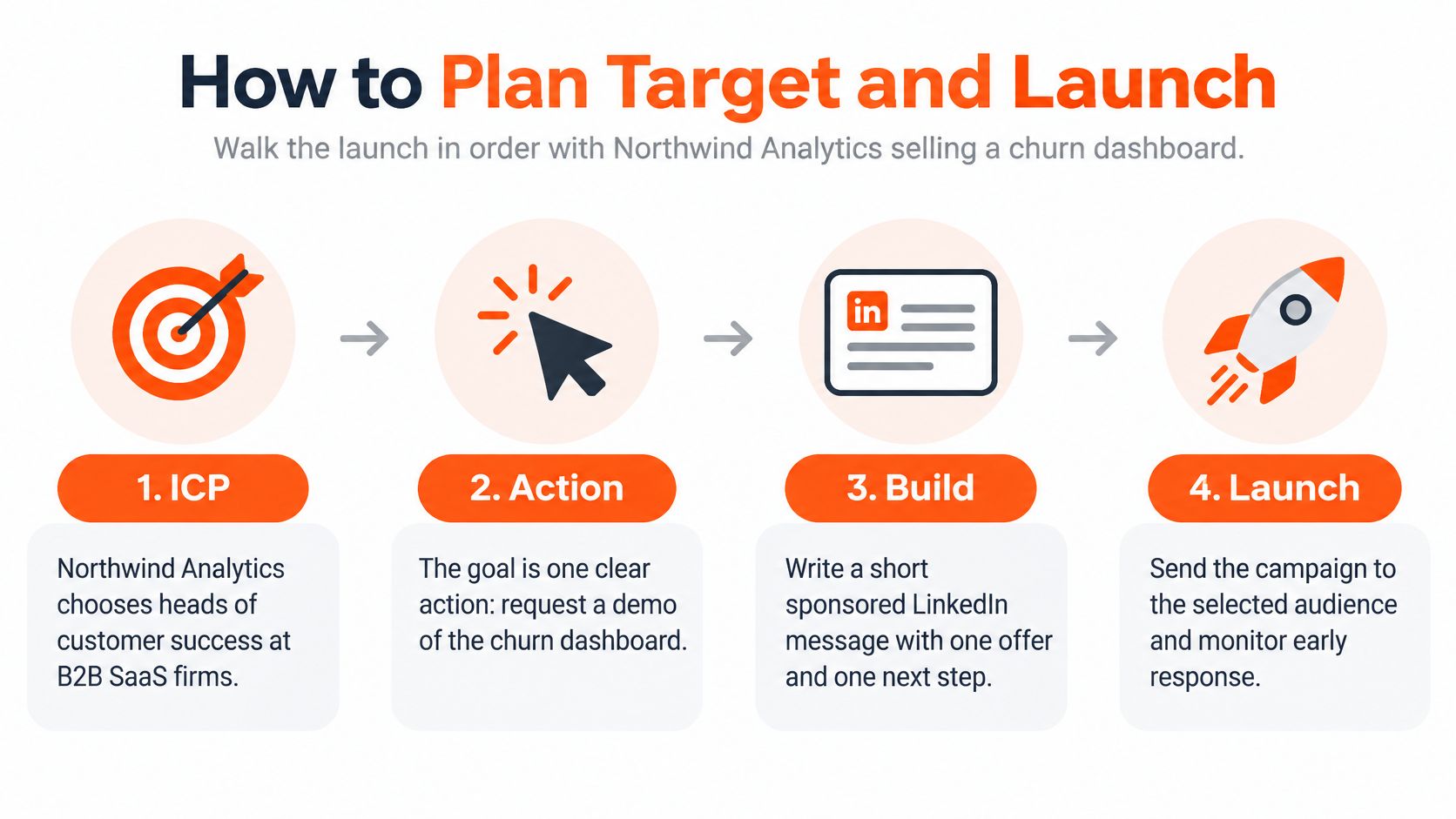
Northwind Analytics is a fictional company selling a churn dashboard to B2B SaaS customer success leaders. Its campaign needs a working path from audience selection to a qualified meeting, not another document named “final-final-copy.”
The launch sequence keeps the commercial decision ahead of the writing.
Build the campaign in order
Name the buyer and action. Northwind chooses heads of customer success at B2B SaaS firms and offers a hypothetical 20-minute churn teardown. The action is a qualified booking, not a mixture of ebook downloads, webinar registrations, and vague interest.
In Campaign Manager, build the audience using relevant job titles, seniority, company size, and geography. Apply the regional and language reach checks before forecasting delivery. Northwind should use its eligible segment, not congratulate itself on the size of its imported spreadsheet.
Select a credible sender. A customer success lead or founder with a relevant profile fits this offer better than a person whose role has no obvious connection to retention. The sender profile should make the invitation understandable before the recipient reads every word.
Choose the format and available objective that match the journey. Northwind can start with a direct teardown invitation rather than constructing a branching experience without a reason.
Connect the destination and tracking. Add UTM parameters that identify the campaign, audience, offer, and variant. Configure LinkedIn Conversion Tracking for the relevant booking action, then connect CRM records so the team can distinguish an initial form submission from a qualified, completed meeting.
Set the cost-per-send bid and review the frequency controls available in the account. Northwind should record its repetition setting alongside the budget, rather than assume that more exposure automatically creates more interest.
Launch with a controlled daily budget. Let the campaign run through the week rather than making a weekday-only assumption. Keep the initial experiment narrow enough that the team can explain what changed.
Review results after sufficient delivery and downstream activity. Pause the weaker version only when the comparison has enough evidence to support that decision, not because a stakeholder disliked a verb after lunch.
Keep paid delivery separate from outbound activity
Paid Sponsored Messaging and sales outreach shouldn't share an undifferentiated reporting bucket. A campaign send, a connection request, and a manual sales message are different activities with different controls.
The Social Search's explanation can help teams navigate LinkedIn outreach limits while keeping the paid campaign operationally separate.
A walkthrough can support the hands-on setup process.
Before activation, Northwind should submit a test booking, inspect its campaign tags, and check the CRM record. The finish line is a live campaign with functioning measurement, not a beautifully edited paragraph attached to a broken calendar.
Write Copy Inside the Real Limits
Sponsored message character and link limits
LinkedIn's Message Ads specifications set the following maximums and require the platform-added Not Interested option.
Element | Maximum | Example that fits
Subject line | 60 characters | A faster way to cut SaaS churn
Message body | 1,500 characters and 10 emojis | One pain, one proof, one ask
Clickable links | 3 | Demo page, one-pager, calendar
Hyperlinked text | 70 characters | Watch the 60-second teardown
CTA button | 20 characters | Book a teardown
Not Interested | Required and added by LinkedIn | Do not write a second one
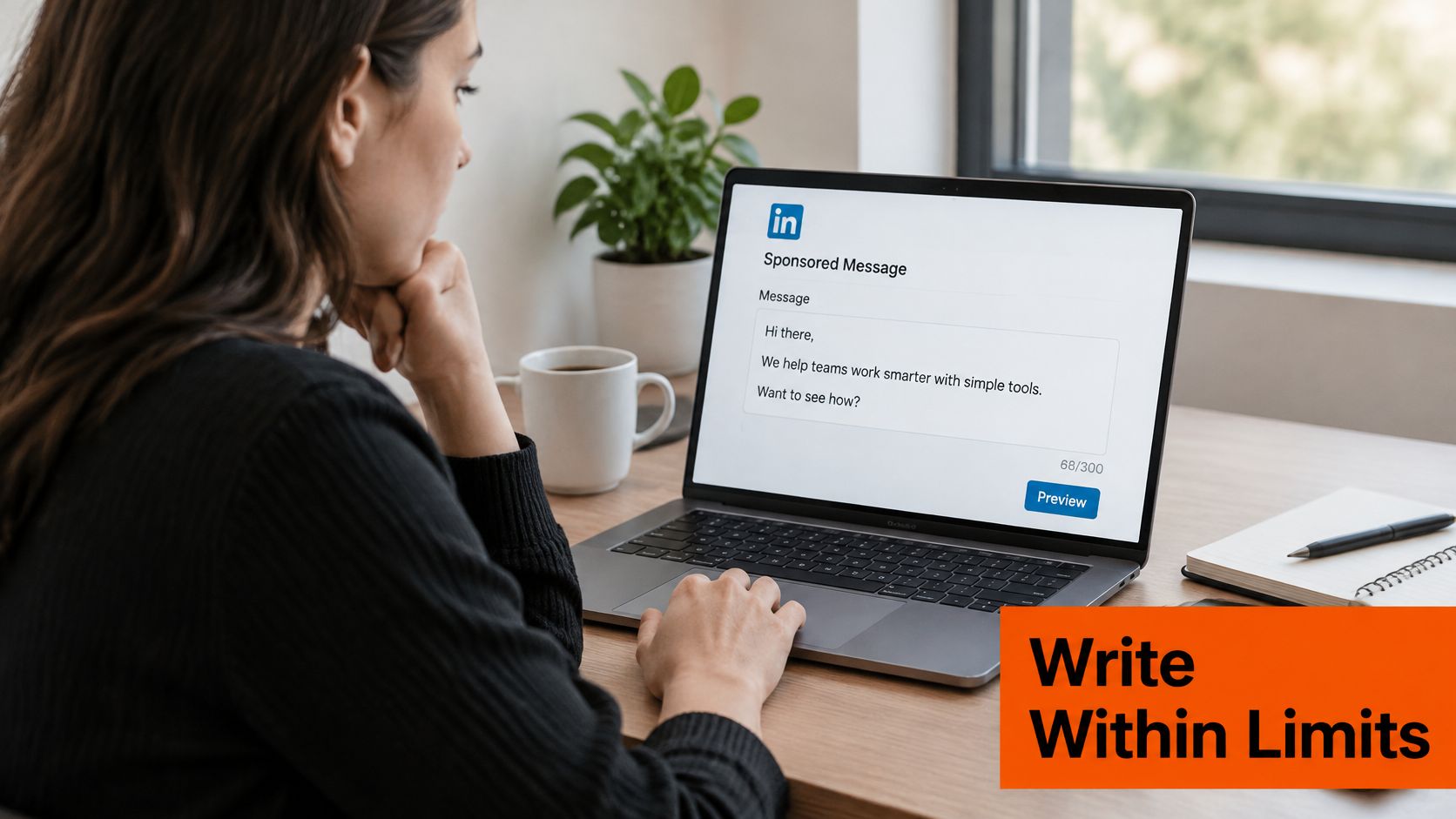
The maximum isn't a writing target. An inbox message doesn't need to become a miniature newsletter wearing a subject line.
Personalization macros can insert recipient details such as first name, last name, company, job title, or industry. Those fields help with relevance, but inserting a company name into a generic pitch doesn't magically turn it into insight.
Replace the brochure with an offer
For Northwind's hypothetical campaign, the tight version could read:
Subject: A faster way to cut SaaS churn
Body: Hi {first name}, churn signals at {company} may appear before the renewal conversation. Northwind's teardown maps those signals and identifies where a customer success team could investigate first. A short walkthrough makes the process concrete.
CTA: Book a teardown
That example offers a defined deliverable without inventing a customer result. If Northwind has genuine proof, it can replace the process explanation with a substantiated outcome.
The bloated alternative would stack a webinar invitation, an ebook download, a product demo, a company introduction, and several links. The recipient would need a project manager just to choose a button.
A short message keeps the offer visible.
Use performance guidance without promising results
LinkedIn's Sponsored Messaging tips report 46% higher average CTR for body copy under 500 characters, a 21% CTR lift associated with hyperlinks, and member-sent advantages of 16% in open rate, 10% in CTR, and 10% in conversion rate. The same guidance places the highest opens on Tuesdays and the most clicks on weekends, supporting a full-week test rather than a schedule based on office habits.
These are platform findings, not a guarantee that shorter text will rescue an irrelevant offer. The writing order should remain buyer, action, sender, pain, useful asset or proof, then CTA.
For a Message Ad template, the body can identify the recipient's churn problem, explain the teardown, and lead to booking. For a Conversation Ad, the opening can introduce that same problem, with branches labeled See the teardown, Send the one-pager, and Talk to Northwind. There's no need to invent an additional rejection branch.
Pipecorn's LinkedIn ad strategies for B2B leads provide broader acquisition context. A documented ad creative strategy helps the team test hooks, assets, and destinations separately instead of changing everything together.
One pain, one proof, one ask.
Measure Sends Opens and Meetings
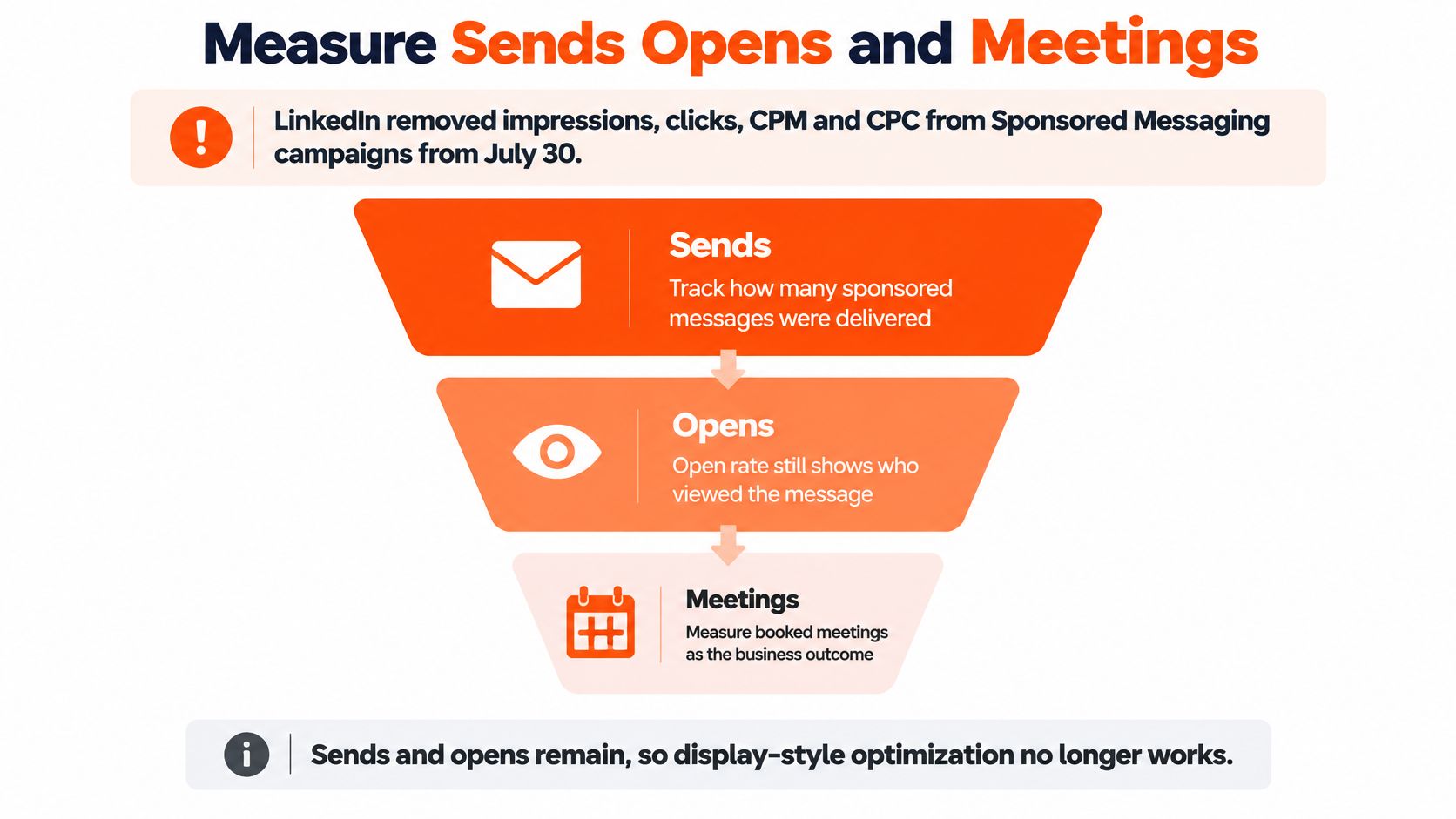
A campaign can send messages, earn opens, and still book no meetings. Measure each step separately so the team can see where interest fades. LinkedIn's Sponsored Messaging guidance says impressions, clicks, CPM, and CPC were removed from Sponsored Messaging reporting, while sends and opens remain available.
That shift changes what the dashboard can show. Separate delivery, available message interactions, website activity, and CRM outcomes instead of treating them as interchangeable. The funnel below maps those steps. Opens are reported in aggregate, not as a list of named viewers.
Build a scorecard with clear denominators
LinkedIn's measurement guidance supports tracking sends, first opens, click-to-open, and tracked conversions separately. Click-to-open equals clicks divided by opens. Since the generic click metric is no longer reported, use an available interaction source and define it consistently. For Conversation Ads, button reporting can show which paths attract activity. For website destinations, tagged sessions describe downstream traffic, but they are not the same as clicks.
What to track after the messaging metric change
Stage | How to calculate it | Benchmark or action
Sends | Messages LinkedIn delivered | Denominator for open rate
Open rate | First opens divided by sends | Compare with the campaign's own historical baseline
Click-to-open | Available, consistently defined clicks divided by opens | Build an internal baseline using the same measurement source
Conversation branch | Button clicks on each path | Keep, revise, or cut that path
Qualified outcome | Meetings or pipeline in the CRM | Decide whether the campaign stays
Older benchmarks can offer context, not a forecast. TechCrunch's Sponsored InMail launch coverage reported early pilot open rates of approximately 45% and click-through rates of 4%–7%. NAV43's 2025 Conversation Ads guide reported an average open rate of 50%–60%. The formats, periods, audiences, and reporting definitions differ, so establish a baseline for your own campaign rather than copying either figure.
Diagnose the point where intent disappears
Weak opens are a reason to review the sender, subject, audience, and delivery context. Strong opens but little interaction point to an offer or next step that may not feel compelling. If people interact but meetings remain scarce, examine the destination, booking friction, follow-up, and qualification criteria.
Agree on what counts as a qualified lead before reading the CRM results. Otherwise, marketing and sales may give the same outcome different labels.
A lower open rate can still accompany a stronger campaign if a tightly qualified audience produces more sales meetings per send.
Test one variable at a time: audience, sender, offer, or Conversation Ad branch. Keep other conditions stable where possible. If you change the audience, avoid changing the bid, message, and destination at the same time.
Questions People Ask Before They Spend
What do sponsored LinkedIn messages cost?
There isn't a universal public price: LinkedIn's bidding guidance describes auction-based pricing tied to optimization and bidding, and defines a custom frequency cap over seven days. A hypothetical demand-generation team could compare a webinar invitation with a demo offer while controlling repetition, but its budget forecast still needs an actual delivery estimate rather than an assumed flat fee.
Is this the old Sponsored InMail?
Yes, Sponsored InMail is the historical name behind the channel's development, while Message Ads and Conversation Ads describe the formats advertisers now evaluate. A team finding Sponsored InMail in an older webinar campaign should treat it as historical terminology, not assume its screenshots, setup options, or benchmark definitions remain current.
Will a campaign get an 800% conversion increase?
That isn't a sensible forecast: LinkedIn's Premium acquisition case study reported a 75% open-rate increase and more than an 800% conversion-rate increase compared with its earlier email campaigns. A SaaS team selling a churn dashboard has a different offer and buying journey, so that result is neither a promise nor a performance ceiling.
What happens if nobody replies?
A reply isn't the required outcome for every campaign. Northwind's hypothetical teardown invitation could generate calendar bookings without inbox conversation, so the team should inspect sender credibility, audience eligibility, offer relevance, tracked interactions, and qualified meetings per send before declaring the campaign unsuccessful.
The common thread is commercial intent, not inbox theater. Pricing, terminology, and benchmark stories matter only when they help the team make a better launch or investment decision.
Launch One Offer This Week
A useful first campaign doesn't need a complicated conversation tree. It needs a buyer with a recognizable problem, a credible sender, and an offer that makes the next step easy to understand.
For Northwind, a short video teardown or personalized audit could make the churn dashboard tangible. The destination should show the promised asset or booking experience immediately, not send the prospect wandering through a product website like a visitor looking for the exit at a conference.
Agree on the decision before launch
A hypothetical Northwind test could launch on September 7, 2026, target its strongest eligible regions, and hold its go-or-no-go review on September 21, 2026. Those dates are an example operating plan, not a performance promise.
Before launch: Agree on the minimum send count, qualification definition, and acceptable meeting economics.
During delivery: Check tracking and operational problems without constantly rewriting the experiment.
At review: Assess qualified meetings per send and resulting sales opportunities, not whether the subject line won an internal popularity contest.
If delivery is insufficient, the review should conclude that the test needs more evidence rather than manufacture a winner. If the offer gets interaction but no qualified meetings, the next experiment should address that specific gap.
The immediate action is concrete: draft the subject, build the eligible audience, verify the booking path, and launch the offer. A second CTA can wait until the first has produced a meeting number.
ContentBuck makes video ads for LinkedIn and Meta, with video ad requests including hook writing, script, editing, captions, and platform-specific versions for LinkedIn and YouTube. Its Unlimited Ad Editing service covers LinkedIn, Meta, and YouTube formats with a bi-weekly creative refresh. For a video-led teardown or audit offer that supports a focused sponsored messaging campaign, visit ContentBuck.
Parth Jasrapuria
Founder at ContentBuck
Building video systems for B2B businesses. Obsessed with YouTube growth, creative strategy, and organic SEO.