Ad Creative Strategy: The B2B Growth Playbook
Parth Jasrapuria
Founder
B2B ad performance isn't usually rescued by another round of audience tinkering. A tighter LinkedIn job-title filter won't fix a video that opens with a logo, a slow animation, and the emotional energy of a tax form. The audience may be right. The message is giving qualified buyers no reason to stop.
That changes the job of paid acquisition. Ad creative strategy must treat hooks, angles, formats, testing, and refreshes as an operating system, not a final coat of paint applied after targeting and bidding are finished. The teams that build this system learn faster, waste less spend on polished underperformers, and give automated platforms better material to distribute.
Why Your Ad Creative Strategy Matters More Than Targeting
Targeting still matters, but it has become an easy place to hide. A B2B marketer can spend a week debating whether a campaign should target “VP Marketing” or “Head of Demand Generation,” then launch an ad that says, “Scale your growth with our platform.” The targeting document looks precise. The creative looks interchangeable with every competitor in the category.
The stronger question is what happens after the impression. Creative quality can account for up to 80% of in-market success for traditional TV and up to 89% for digital advertising, according to Nielsen's analysis of creative impact. The same source cites Nielsen Catalina Solutions research estimating that creative contributed 47% of sales impact on average across TV and digital, based on nearly 500 U.S. studies from 2016 to 2017. Kantar's global testing program, also discussed by Nielsen, tested more than 13,000 ads across 75 markets and found that ads featuring product benefits produced a 10-point increase in persuasion.
Those findings don't make targeting irrelevant. They show that audience selection can't compensate for a weak promise. Automated bidding can find likely buyers, but it can't invent a credible reason for those buyers to care.
The creative advantage is operational
Academic research has moved creative away from the “art versus science” argument. A 2020 meta-analysis synthesized 93 data sets from 67 papers and 878 effect sizes, finding positive effects for advertising creativity while stressing that originality and appropriateness both matter. A creative can be unusual and still fail if nobody understands why the product is useful.
Industry evidence points in the same direction. Research covering 16 CPG categories, 91 brands, and 2,551 creatives concluded that experiential content was the most effective, with content and executional elements working together to improve elasticity. Earlier IPA case-study evidence found that strategically sound creative campaigns generated 5.7 points of share growth per point of excess share of voice, compared with 0.5 for non-creative campaigns. Those figures appear in the Journal of Marketing Research meta-analysis, which provides useful context for treating creative decisions as measurable business inputs.
Practical rule: If a team spends more time adjusting bids than developing distinct messages, the account probably has a creative bottleneck.
For B2B teams, the advantage rarely comes from making the most expensive commercial. It comes from making the clearest claim for a specific buyer problem, then producing enough credible variations to learn which framing earns attention and action. A useful reference for more natural, creator-led executions is this guide from ClipCreator.ai, especially for teams testing UGC-style ads without pretending that a software demo belongs in a perfume commercial.
The shift is simple but uncomfortable. Targeting asks who might buy. Creative asks why that person should stop, believe, and act now. In mature ad platforms, the second question deserves more attention.
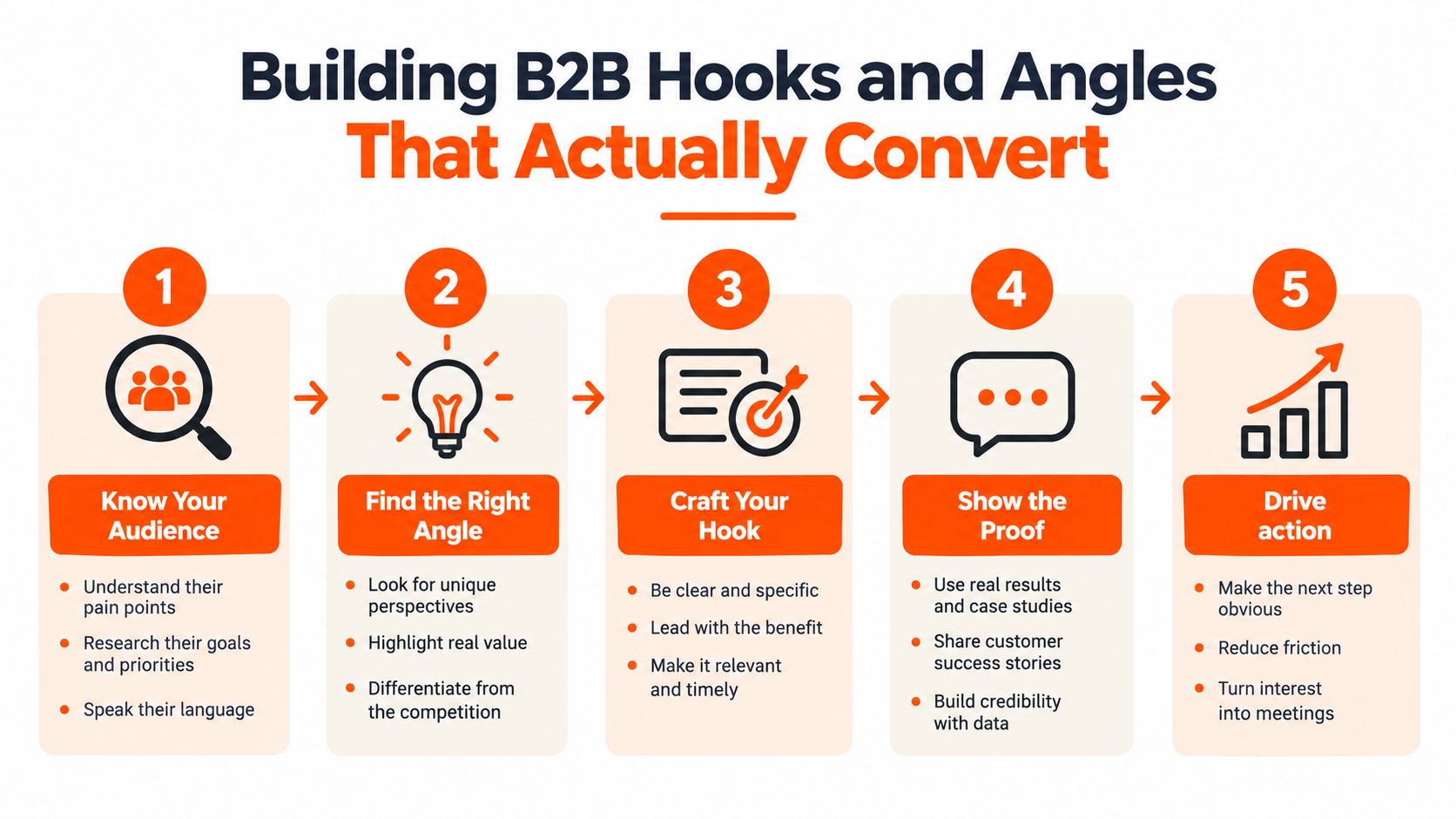
Building B2B Hooks and Angles That Actually Convert
Nobody wakes up hoping to watch a SaaS product demo. A buyer may need the product, approve the budget, and still scroll past it because the first frame looks like every other enterprise ad on the feed.
The opening three seconds carry a disproportionate burden. A video ad has to interrupt the pattern, identify a problem or desired outcome, and make the next few seconds feel worth watching. That doesn't require a stunt. It requires a sharp decision about what the viewer should understand immediately.
Start with concepts, not colour changes
A concept is a meaningful idea about the buyer's problem. An execution is the way that idea gets filmed, animated, narrated, or designed. Changing a background from blue to green isn't concept development. It's interior decorating for an ad that may already be lost.
A practical concept set for a B2B analytics platform might include:
The expensive delay: “The report isn't late because the analyst is slow. It's late because five systems still need manual cleanup.”
The hidden workflow: Show the spreadsheet, Slack thread, and dashboard that a revenue leader checks before trusting a forecast.
The buyer's objection: “Your team doesn't need another dashboard. It needs one number that finance and sales accept.”
The proof-led explanation: Start with a before-and-after workflow, then show the product only where it removes a visible step.
The uncomfortable comparison: Contrast a polished reporting process with the messy handoffs underneath it.
Each concept gives the production team a different hypothesis. If every variation says the same thing with a different caption, the campaign learns almost nothing.
Teams that need help generating starting points can use a B2B hook generator, then apply human judgment. A generator can produce angles quickly. It can't know whether a buyer will trust the claim, whether legal will approve it, or whether the sales team will recognise the problem.
Make the first frame earn the second
The best hook usually combines a recognisable tension with a specific promise. “Are you struggling with growth?” fails because almost every business is struggling with something, and the question gives the viewer no fresh information. “The forecast is wrong before the sales meeting starts” creates a sharper reason to continue.
Three opening patterns work well for complex products:
Name the costly symptom. A finance automation ad can open on a reconciliation spreadsheet and the line, “The reporting week vanishes right here.”
Challenge a familiar workaround. A project management platform can say, “Another status meeting won't repair a broken handoff.”
Show the consequence first. A security product can lead with, “The alert wasn't missed because the team lacked tools. It was buried under noise.”
The body then has to pay off the hook. If the opening mentions broken handoffs, the next scene should show the handoff and the product's role in fixing it. Otherwise the viewer receives a bait-and-switch, which is a poor foundation for a demo request.
Keep production repeatable
B2B acquisition doesn't need a film crew for every test. A strategist can write one clear script, record a credible subject-matter expert, and create platform-specific versions with different openings, captions, framing, and calls to action. A founder speaking plainly from a meeting room may outperform a polished office montage because the buyer understands the source of the claim.
A workable brief specifies the audience problem, the single benefit, the proof point, the opening line, the visual action, and the next step. It also states what stays fixed. Without that discipline, a team changes the hook, offer, landing page, audience, and duration at once, then calls the result a test. That is closer to creative roulette.
The production question isn't “How can this ad look more expensive?” It is “What can the buyer understand before the thumb moves?”
Running A/B Tests Without Wasting Your Budget
A/B testing becomes expensive when teams treat every early movement as a verdict. One ad gets a slightly better click-through rate after two days, someone pauses the control, and the account spends the next week celebrating a random fluctuation. The dashboard looks decisive. The evidence isn't.
A serious creative test starts with a dedicated testing campaign and a budget of about 10% to 20% of total spend, as outlined in this practical ad creative testing guide. The test should have a declared success metric, a fixed audience and offer, and a clear rule for when the team can make a decision.
Define the experiment before launch
For a B2B video campaign, the test question might be, “Does the operational-risk angle generate more qualified demo requests than the time-saving angle?” That is useful. “Which video performs better?” is too vague.
The team should decide the following before launch:
Primary outcome: Choose qualified conversions, not whichever metric happens to look attractive on the first morning.
Controlled variables: Keep audience, placement, duration, landing page, CTA, and budget allocation consistent when the hook is the variable.
Decision threshold: Set the required confidence and conversion volume before anyone sees the result.
Learning window: Allow enough time for the test to cover a normal business cycle rather than a brief burst of unusually active traffic.
A solid standard uses 95% confidence, 80% statistical power, and at least 50 conversions per variant before making a decision. Higher-volume teams can test two to three variations per ad group and allow seven to 14 days for results to settle. The exact figures and the risks of early stopping are detailed in the same ad creative testing methodology, which is useful when internal stakeholders start requesting a winner before the data has matured.
Respect the sample size
A difference that looks meaningful may be noise. The source guidance notes that a 20% performance difference can require roughly 50 conversions per variant at 95% confidence, while a 10% difference may require around 2,000 impressions per variation or more, depending on metric volatility. Those aren't universal laws for every account. They illustrate why low-volume B2B campaigns need patience.
The test should also avoid CTR as the only judge. A provocative hook can collect inexpensive clicks from curious people who have no interest in buying enterprise software. The more reliable decision usually combines attention, engagement, qualified conversion rate, cost per qualified action, and downstream pipeline quality.
Use a test matrix instead of a pile of guesses
A simple matrix prevents creative teams from changing everything at once:
Test variable | Version A | Version B
Opening | “The forecast is wrong before the meeting” | “Five handoffs are hiding inside the forecast”
Body | Workflow explanation | Customer problem narrative
CTA | See the workflow | Review the process
Held constant | Audience, offer, landing page, duration | Audience, offer, landing page, duration
This setup gives the result a usable meaning. If Version B wins, the team has learned something about the angle. It hasn't merely discovered that one video had a brighter thumbnail.
The practical discipline is less glamorous than launching a fresh campaign. It also prevents the classic failure mode, spending a large budget to confirm a hunch that was never properly isolated.
Measuring What Actually Matters in Creative Performance
A creative can generate applause and still fail the revenue team. High click volume doesn't prove buying intent, especially when the opening promises one thing and the landing page asks for something else. B2B measurement has to follow the buyer from attention to action to pipeline quality.

The first layer measures whether the ad earns attention. For video, hook rate means three-second video views divided by impressions, a definition provided by this explanation of video-ad hook testing. Hold rate, average watch time, and completion then show whether the opening made a believable promise or merely created a brief interruption.
The second layer measures intent. CTR can reveal whether the message creates enough interest for a click, but it shouldn't become the campaign's north star. A video with a modest CTR and strong demo quality may be more valuable than a click magnet that fills the CRM with people who wanted to see a clever punchline.
Connect the ad to the sales process
The reporting chain should answer four practical questions:
Attention: Did the opening stop the scroll?
Understanding: Did viewers stay long enough to grasp the benefit?
Action: Did qualified prospects submit a demo request or begin the intended next step?
Business value: Did those prospects enter pipeline, progress, and become revenue?
A polished production can lose at the second question if it explains the company instead of the buyer's problem. An informal talking-head ad can win if it gives a credible operator a clear story and a specific benefit. Kantar's finding that benefit-led ads produced a 10-point increase in persuasion reinforces why clarity often beats decoration, as documented in Nielsen's creative effectiveness discussion linked earlier.
Teams looking to connect creative decisions with commercial outcomes can review data-driven creative for growth as a reference point for joining production feedback with performance reporting. The useful principle is straightforward. Every creative asset needs a business hypothesis, not just a design brief.
A B2B video campaign also needs platform context. The same asset may attract attention on LinkedIn, hold viewers differently on YouTube, and produce another kind of response in a retargeting sequence. A practical overview of B2B video marketing statistics can help teams frame channel questions, but account decisions should still come from the campaign's own conversion and pipeline data.
A useful dashboard labels each asset by concept, hook, audience, offer, and funnel stage. That lets a growth leader see that “the product demo failed” may mean “the opening failed,” while the same body performed well after a stronger hook. Without those labels, teams kill useful material and repeat the same mistake with a new colour palette.
Scaling Winners and Fighting Ad Fatigue
A winning ad rarely dies with a dramatic announcement. It gets a little less attention, then a little more expensive, while the team keeps defending it because it once performed well. Eventually the account is carrying a former champion like a football club refusing to retire a striker who hasn't scored in months.
A 2026 benchmark report found that the median advertiser launches 13 new creatives per week, while the top quartile launches 53 or more, and only about 5% to 8% of ads become real winners, according to Singular's creative benchmark report. Another benchmark cited there says roughly 5% of ads earn at least 10 times the account median spend. The operational lesson is not to predict winners perfectly. It is to create enough structured exploration that failure is affordable.
Build a refresh rhythm
Suppose a B2B software ad wins because it shows a revenue leader escaping a manual reporting process. The concept may remain useful after the first execution fades. The team can refresh the opening, change the speaker, demonstrate a different workflow, or answer a new objection. Those are iterations on a proven idea.
A different result calls for a new concept. If the original message is “save time,” changing the caption to “save hours” doesn't create a fresh strategic angle. It just puts a new hat on the same idea.
The benchmark methodology recommends generating five to seven distinct concepts, using one execution per concept, testing with equal budgets, and evaluating after 1,000 or more impressions per concept or three to five days. Teams can then take the top two to three concepts and iterate hooks in 48 to 72-hour cycles. Those figures are operating guidance, not permission to end every test on a timer. Conversion volume and business-cycle context still matter.
Watch frequency before the results collapse
Ad fatigue has a visible media signal. Industry reporting identifies a frequency above 3.0 impressions per user as a consistent fatigue signal, while showing the same ad five or more times in a week can cut conversion rates by 30%, as reported by Rocketium's ad-fatigue guidance. The exact response will vary by audience, offer, and channel, but rising frequency paired with weaker engagement deserves attention.
A refresh workflow should monitor:
Hook decay: Fewer viewers stop during the opening.
Message saturation: Comments and sales calls reveal that the promise no longer feels fresh.
Cost pressure: Qualified actions become more expensive while reach remains constrained.
Pipeline quality: Lead volume holds steady, but sales acceptance weakens.
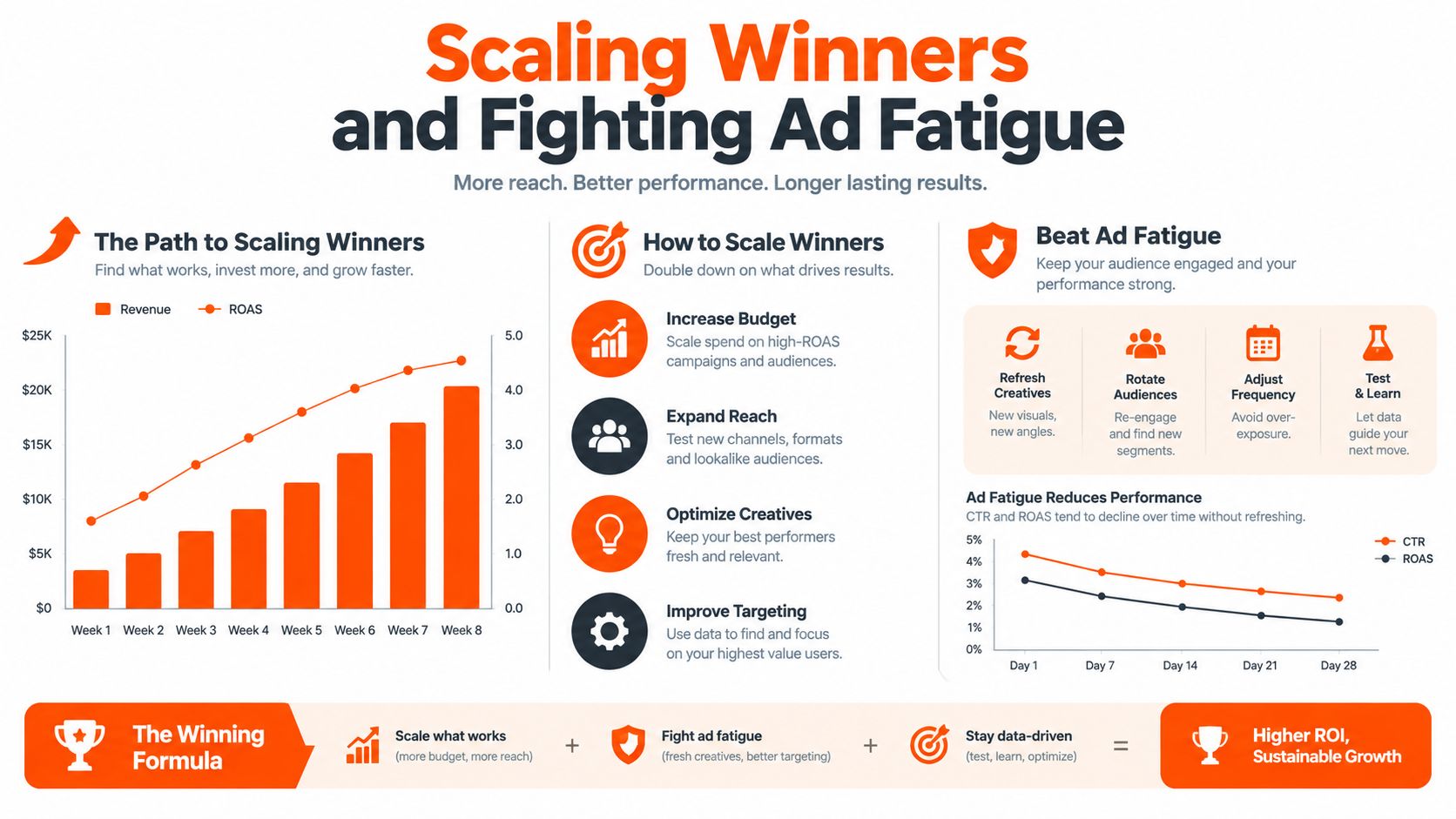
The safest workflow keeps a queue of approved concepts, scripts, raw footage, captions, and platform exports. That prevents the familiar emergency response, asking a designer for “something fresh” after performance has already fallen. Creative refresh should be scheduled while the winner is still useful, not after the account has started charging a premium for showing yesterday's joke.
Frequently Asked Questions About Ad Creative Strategy
How many creative variations should a B2B team test?
Higher-volume teams can test two to three variations per ad group, while a broader exploration phase can begin with five to seven distinct concepts. The important distinction is between concepts and cosmetic variations. Three different hooks around three different buyer problems create more learning than three edits of the same opening.
Should B2B ads use AI-generated creative?
AI can accelerate ideation, scripting, transcription, resizing, and versioning. It doesn't remove the need for a human strategist to verify product claims, buyer relevance, brand credibility, and legal requirements. AI-generated ads can work when the message is specific and the execution feels credible. They can also produce polished generic content at a speed that makes bad advertising harder to escape.
What should video teams test first?
The opening is usually the cleanest starting point. Teams can create three to five versions with different openings while holding the body, CTA, audience, placement, and duration identical, then compare hook rate, defined as three-second video views divided by impressions. Once the opening earns attention, the next test can examine proof, benefit framing, or CTA alignment.
Does FAQ schema guarantee rich results?
No. FAQ schema is structured data, usually written in JSON-LD, that tells search engines a page contains question-and-answer pairs. Google has said FAQ rich results are now shown only for well-known, authoritative government and health sites, rather than regularly for other sites, as summarised in this 2026 FAQ schema explanation. Marketers can still use valid schema to clarify page content, but they shouldn't promise a rich-result display.
How should a lean team manage production?
A lean team should maintain a creative backlog organised by buyer problem, angle, hook, proof, format, and status. One owner should connect ad results to the next brief, while sales should report whether leads understand the promise and fit the buying process. A B2B video partner such as ContentBuck can plan, script, edit, format, and refresh ad creatives for channels including LinkedIn, Meta, and YouTube, which gives an overloaded team a defined production workflow instead of another disconnected vendor.
The strongest ad creative strategy is not a single winning video. It is a repeatable system that turns buyer insight into concepts, concepts into testable hooks, and test results into the next production queue.
ContentBuck offers B2B teams ongoing ad editing, hook and script development, platform-specific video formatting, and creative refreshes informed by performance data. Teams that need a dependable production engine for paid acquisition can visit ContentBuck to review the available video-led services.
Parth Jasrapuria
Founder at ContentBuck
Building video systems for B2B businesses. Obsessed with YouTube growth, creative strategy, and organic SEO.