Qualified Leads Marketing: What It Is and How It Works
Parth Jasrapuria
Founder
Qualified leads marketing is the practice of identifying and nurturing prospects who match an ideal customer profile and show clear buying intent, so a team spends time on people who are more likely to buy. In a common B2B benchmark, only 31% of leads become MQLs, and only 13% of MQLs become SQLs, while just 2.3% of website visitors become leads.
That explains a familiar office mystery. A marketing team celebrates a busy landing page, sales receives a spreadsheet full of names, and then everyone discovers that many “leads” are students, job seekers, curious competitors, or people who downloaded a guide because the cover looked useful. The sales team starts treating the spreadsheet like a box of mystery chocolates. Some are delicious. Most are not.
Qualified leads marketing solves that problem by connecting acquisition, content, scoring, nurturing, and sales handoff. The aim isn't to collect the biggest pile of contacts. It's to build a reliable path from relevant visitor to serious buying conversation.
What Are Qualified Leads in B2B Marketing
A software company can attract hundreds of visitors to a product page and still struggle to create sales conversations. Traffic proves that people noticed the company. It doesn't prove that those people have the right problem, the authority to act, or a reason to buy soon.
A qualified lead usually fits the company's core customer attributes, has a problem the product can solve, and has enough budget, authority or influence, and purchase timing to make a buying conversation sensible. HubSpot's sales qualification guide uses these practical criteria to distinguish a promising prospect from a merely interested contact.
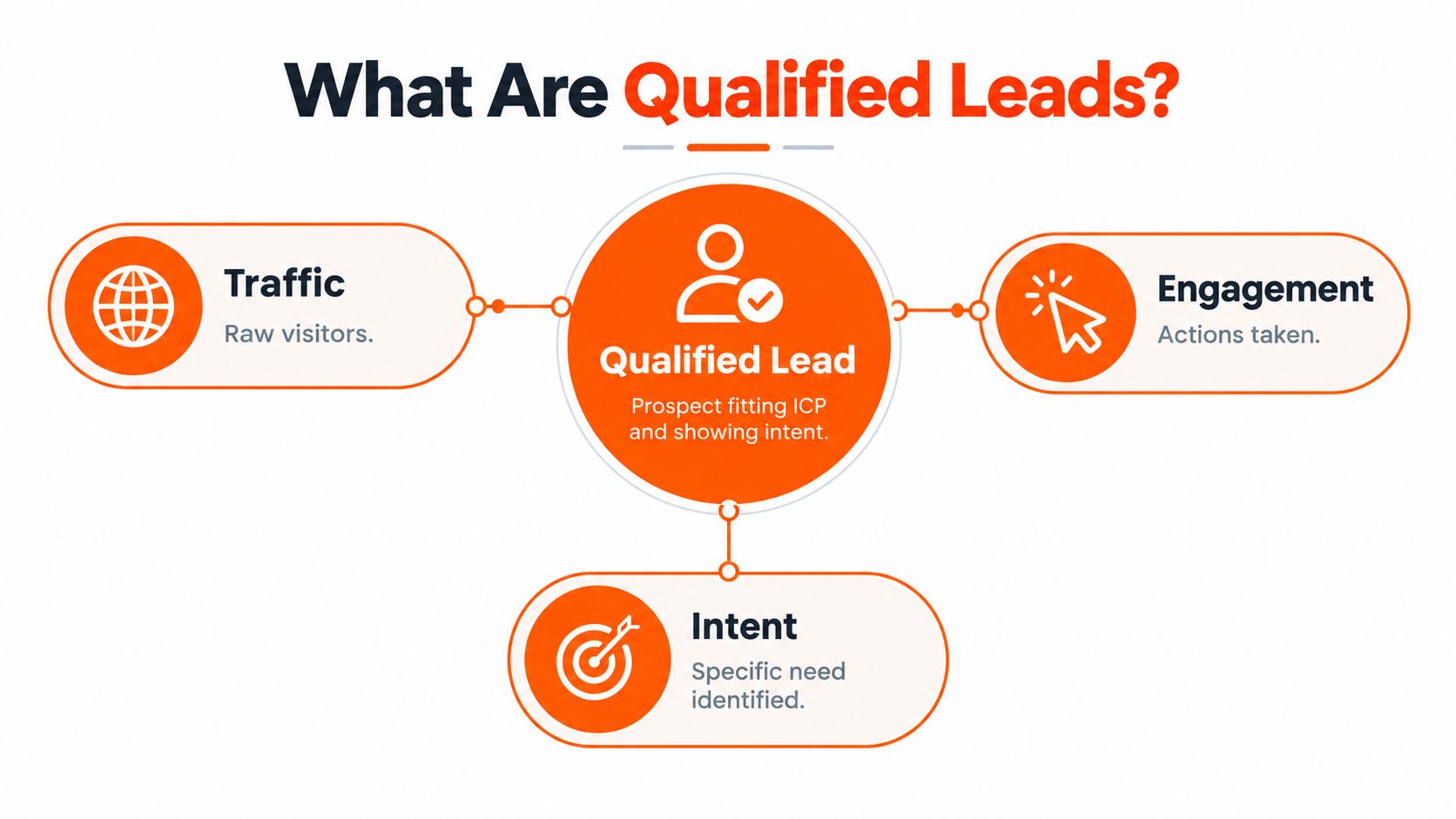
A useful example is a video production firm selling to B2B software companies. A visitor who watches a short explainer is engaged. A visitor who works at a software company, returns to the pricing page, studies a case study, and requests a consultation shows a stronger combination of fit and intent.
Interest is not readiness
Marketing often creates the first useful interaction. A person may read an article, watch a webinar, or download a checklist. Those actions matter, but they don't automatically make the person ready for a sales call.
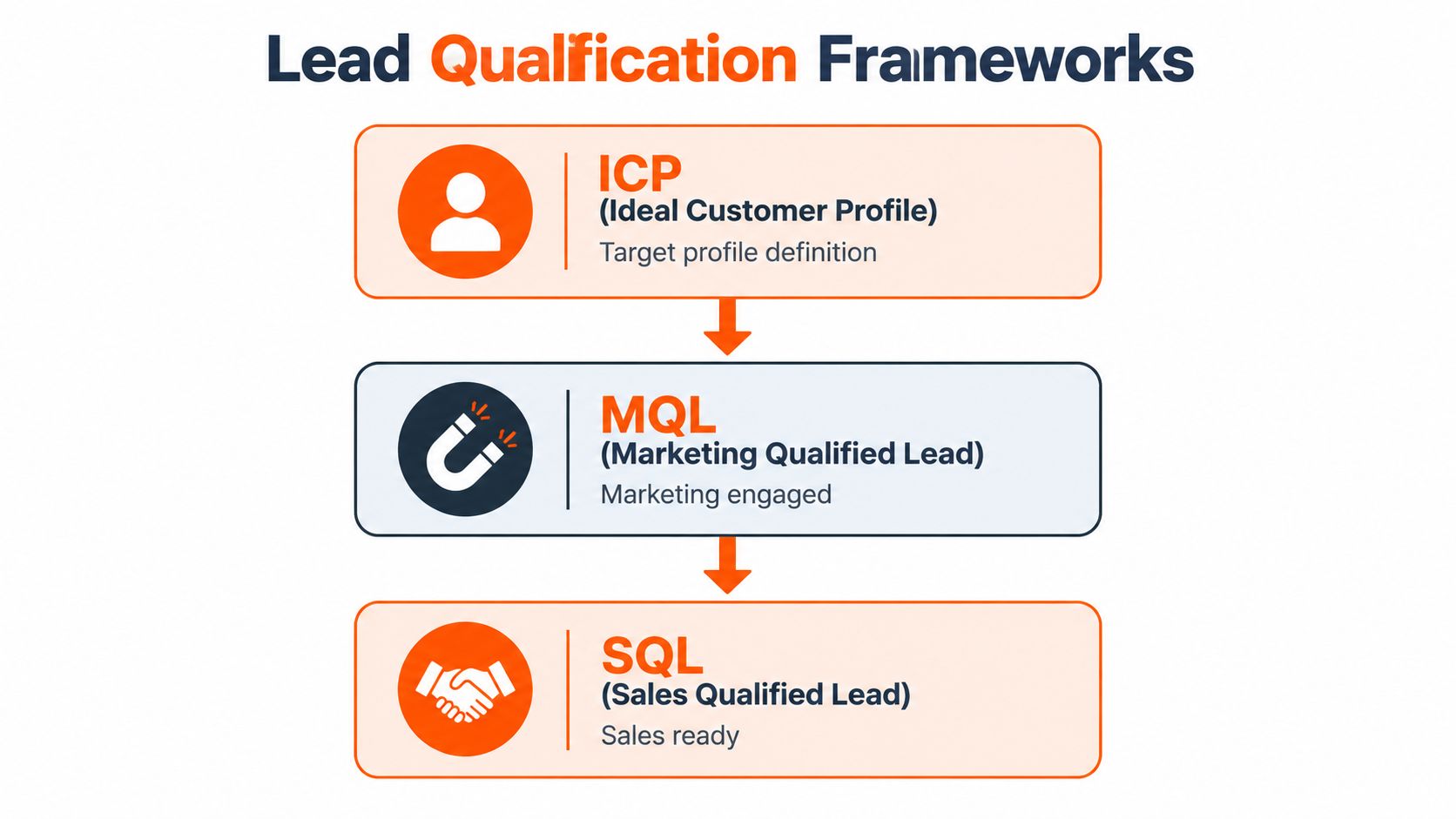
An MQL, or marketing-qualified lead, has shown enough relevant engagement and fit for marketing to continue targeted nurturing or suggest sales review. An SQL, or sales-qualified lead, has passed a stricter check and appears ready for direct sales contact. The difference is similar to browsing a restaurant menu versus asking the waiter whether a table is available.
A glossary such as the B2B video marketing glossary can help teams keep terms consistent, while a practical step-by-step lead qualification guide can turn definitions into an operating process.
Practical rule: A download records an action. Qualification explains whether that action matters commercially.
The funnel makes the challenge clear. The cited benchmark reports that 31% of leads reach MQL status, only 13% of MQLs reach SQL status, and 2.3% of website visitors become leads (benchmark details). Every stage narrows the audience. That isn't automatically a failure. In B2B marketing, a smaller group with a real need is often more useful than a large audience collecting free PDFs like souvenirs.
ICP MQL and SQL Frameworks Explained
Qualification becomes easier when the team separates three questions: Who should the company attract? Who deserves continued marketing attention? Who is ready for sales?
ICP defines the right audience
An ideal customer profile, or ICP, describes the type of company most likely to benefit from the offer. It can include industry, company size, geography, business model, technology environment, use case, and likely buying role.
For example, an analytics platform might define its ICP as a growing B2B software company with a large volume of product data, a marketing leader responsible for reporting, and an active need to connect campaign performance to revenue. A student researching analytics for an assignment may enjoy the content, but that student isn't the target account.
The ICP keeps acquisition focused. It shapes keyword choices, YouTube topics, landing page language, ad audiences, and the examples used in educational content. Without an ICP, marketing can attract anyone with an internet connection and call the result “demand.”
MQL identifies meaningful engagement
An MQL combines ICP fit with useful engagement. The contact may have joined a webinar, watched product education, returned to a comparison page, or downloaded an asset that matches a known business problem.
Engagement alone isn't enough. A person can watch every video about enterprise software and still lack budget or authority. A strong MQL rule therefore combines firmographic fit, role fit, and behavioural signals.
SQL confirms sales readiness
An SQL has crossed the handoff line. That may happen after a request for pricing, a demo booking, a consultation request, or a clear answer to a qualification question. The exact signal depends on the business model and sales process.
Oliverlist's explanation of MQL and SQL stages describes qualification as measurable handoff stages. Marketing validates that an MQL is engaged enough for sales contact, while sales confirms that an SQL is ready for a direct conversation.
A simple operating sequence looks like this:
Define the ICP: List the company and buyer attributes that matter.
Set the MQL rule: Require a sensible combination of fit and engagement.
Set the SQL rule: Identify an action or conversation that indicates buying intent.
Record the reason: Capture why the lead advanced, stalled, or was rejected.
Review outcomes: Adjust the rules when sales results disagree with marketing assumptions.
A company building a video channel can apply the same logic to its programming. An introductory topic may attract broad awareness, while a detailed comparison video can attract people evaluating vendors. Guidance on how to start a YouTube channel for business becomes more useful when channel topics connect to the ICP and the next buying step.
Lead Qualification Frameworks and Scoring Models
A sales representative has a promising contact, but the right next question depends on the buying situation. Choose BANT when the representative can ask direct discovery questions during the first call. Choose ICP-based qualification when buying decisions happen at the account level. Use engagement scoring as a secondary tie-breaker, not as proof that someone intends to buy.
Three practical models
BANT fits sales-led processes with clear discovery conversations. Oracle outlines the model in its lead scoring explanation. It helps a representative test commercial readiness directly, but it can reject an early researcher before that person is ready to discuss a purchase.
ICP-based qualification works best when the company matters as much as the individual contact. A lead from a target account can deserve attention even with limited tracked activity. This approach suits account-based teams that would rather develop the right account than wait for one contact to generate a perfect activity record.
Engagement scoring helps content-led teams sort a busy database. Watching a product video, visiting a pricing page, attending a webinar, or opening a nurture email can signal attention. The signal still needs context. A highly active student or consultant may never become a customer.
Framework | Best For | Key Benefit | Common Pitfall
BANT | Sales-led teams with clear discovery calls | Tests commercial readiness directly | Can disqualify early researchers too soon
ICP-based scoring | Account-based marketing and focused B2B offers | Keeps attention on valuable company profiles | May overlook a strong buyer outside the original profile
Engagement scoring | Content-led acquisition and nurture programs | Shows which contacts are paying attention | Confuses activity with purchase intent
A useful score combines positive and negative signals. A pricing-page visit may increase priority, while a poor industry fit may reduce it. Record the reason behind each score too. Without that explanation, a number becomes a confident-looking mystery that sales cannot challenge or improve.
A video-led acquisition program can apply the same rule. A broad educational video may create awareness, while a comparison video from a target account may support a sales follow-up. The content earns attention, the account establishes fit, and the next action clarifies intent.
For a broader explanation of what lead qualification means for pipeline, compare the selected model with actual movement from lead to opportunity. Sales acceptance and useful conversations matter more than a database filled with impressive scores.
Why Qualification Quality Beats Lead Volume
A campaign can fill the CRM by lunchtime and still leave sales hungry for real opportunities. A thousand contacts may look impressive on a dashboard, but representatives must still separate plausible buyers from students, consultants, and companies with no reason to purchase. A weak filter turns marketing success into a sorting exercise.
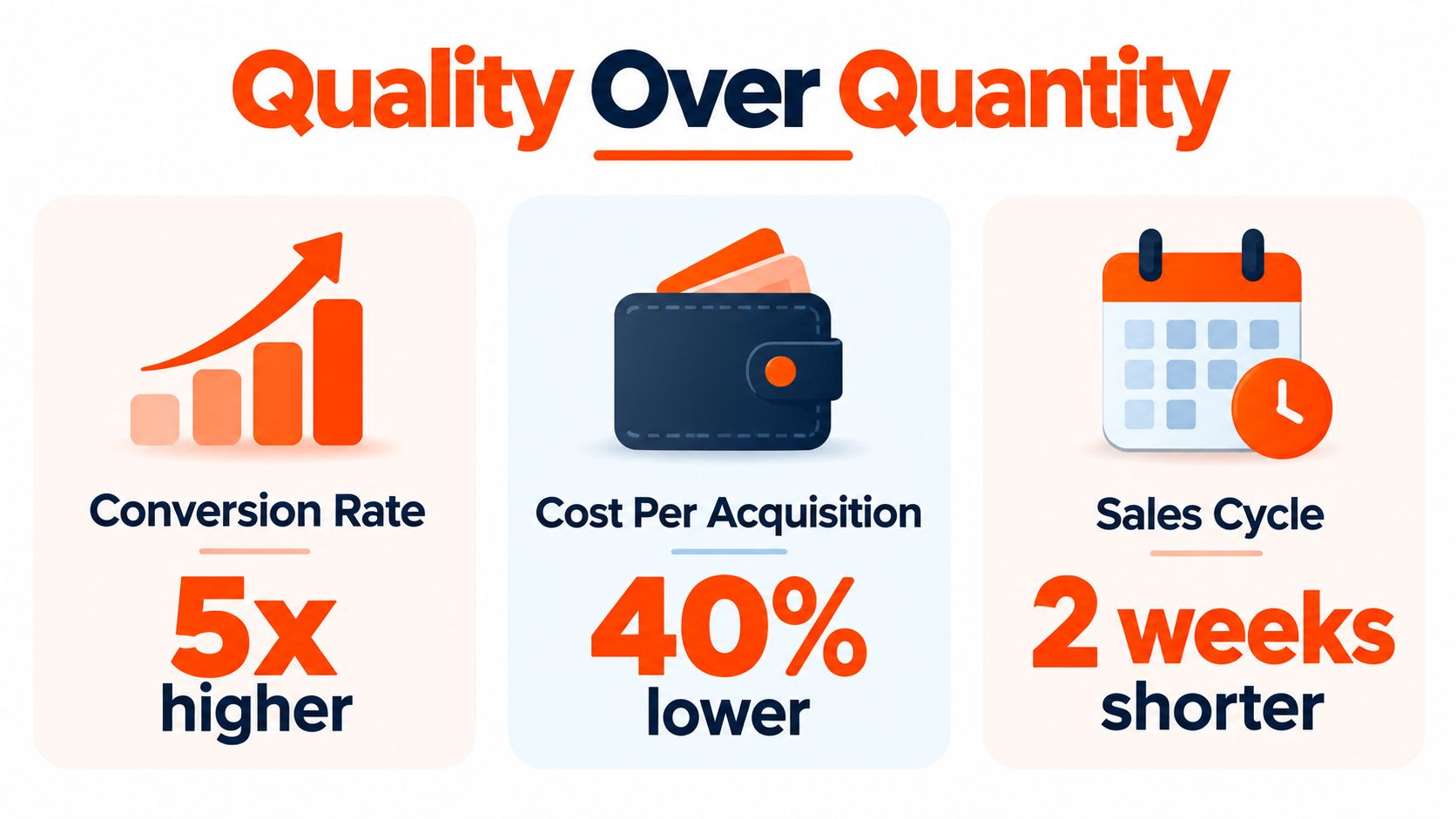
One cited benchmark puts conversion at 40% for properly qualified leads, compared with 11% for unqualified leads, a roughly fourfold difference (qualification conversion benchmark). Those figures are not a promise for every business. They illustrate how combining company fit with buying intent can improve the quality of the sales queue.
The hidden cost of a loose filter
Consider a cybersecurity vendor serving regulated businesses. A broad campaign may attract students, small firms outside its service area, consultants collecting examples, and security leaders with an active problem. Sending every contact directly to sales forces representatives to do the filtering by hand.
A better route gives each signal a job. Educational contacts can enter nurture. A form can ask about company size, industry, and the problem under review. Someone requesting a security assessment can go to sales because the action indicates stronger intent, while the account details help confirm fit.
The result may be fewer MQLs, yet sales spends more time with accounts that have both a plausible need and a reason to discuss it. Content creates the first signal, account information tests fit, and a purposeful next action clarifies intent across the funnel.
Landbase places a healthy MQL-to-SQL operating range at 10% to 30% (B2B qualification benchmarks). The useful question is not how many people complete a form. It is how many survive the handoff and become productive sales conversations.
A smaller sales queue can be healthier when every contact has a clear reason for being there.
Quality-first marketing also improves channel decisions. Teams can compare sources by qualified conversations, learn which topics attract serious buyers, and spot forms that collect weak-fit contacts. They can then adjust content, scoring, and follow-up instead of celebrating cheap clicks that never reach sales.
Content and Video Strategies for Qualified Leads
Content attracts attention, but qualified leads marketing requires content to attract the right attention. A broad educational article may introduce a problem. A comparison page, product walkthrough, or buyer checklist can reveal that a visitor is evaluating options.

A B2B software company might build a content path around one commercial problem. An early video can explain why reporting is difficult. A deeper article can compare reporting workflows. A product demonstration can show how the company handles the problem. A landing page can then invite a qualified visitor to request a conversation.
That sequence works because each asset performs a different job:
Search content answers specific buyer questions and attracts people researching a problem.
Long-form video demonstrates expertise and lets prospects judge whether the company understands their situation.
Animated explainers simplify technical products that are difficult to describe in a paragraph.
Comparison pages help active evaluators understand differences between approaches.
Lead magnets and nurture emails collect context and continue the conversation without forcing an immediate call.
Fit must shape the content
A video about “marketing tips” may earn broad attention. A video about “revenue reporting for B2B SaaS marketing teams” gives the audience a clearer reason to self-select. The second topic may be narrower, but it provides stronger information about who cares.
The same principle applies to calls to action. An early educational article might offer a checklist. A product comparison can offer a consultation. The offer should match the visitor's stage rather than shouting “Book a demo” at someone who has only just learned the problem exists.
Salesforce notes a practical gap in many qualified-lead explanations. They define MQLs, SQLs, fit, intent, and scoring, but often don't show how to define qualification around both fit and ability to buy (Salesforce guidance on lead qualification). Content teams can close that gap by asking qualification questions inside the experience, not hiding all responsibility inside a CRM.
A YouTube strategy can support this system when topics, descriptions, links, and landing pages point toward a clear next step. A guide to generating leads from YouTube becomes more valuable when the channel tracks which topics create relevant enquiries, rather than treating views as the final business outcome.
The video below illustrates how educational content can support a qualification journey:
The system should connect content signals to account and buyer information. A person who watches a video may remain anonymous. A person who watches, returns to a comparison page, submits a form with a relevant role, and asks about implementation has provided a much stronger picture. Qualification is therefore a design problem involving content, forms, tracking, nurture, and handoff rules.
Measuring Success with Qualified Lead KPIs
A KPI dashboard can look busy while sales still receives the wrong conversations. A qualified leads marketing program needs measures that follow a contact from first capture to sales action and pipeline progress. The goal is not to collect more numbers. It is to find where qualification helps, where it filters too aggressively, and where content attracts attention without creating useful demand.
The essential scorecard
Lead-to-MQL conversion shows how many captured leads meet the agreed marketing definition. A high rate may signal loose criteria. A low rate can point to weak targeting, poor content alignment, or an ICP that is too narrow. Review this metric beside the source, topic, form response, and account fit.
MQL-to-SQL conversion tests whether sales agrees with marketing's quality judgment. External benchmarks can offer context (MQL and SQL benchmark source), but your own historical conversion pattern matters more. A video viewer, a returning comparison-page visitor, and a buyer requesting implementation details should not carry the same interpretation.
Sales acceptance rate records how often sales accepts an MQL for active follow-up. It often says more than MQL volume because it measures whether the handoff gives sales a credible reason to act.
Cost per qualified lead connects campaign spending with leads that meet the shared criteria. This comparison helps distinguish a cheap channel producing poor-fit contacts from a focused channel producing fewer, more useful opportunities.
A workable review cycle
Use a simple review loop:
Document the rules: Write down the fit, engagement, and intent conditions for MQL and SQL.
Create a baseline: Track stage movement, acceptance, response time, and disqualification reasons.
Inspect rejected leads: Group reasons such as poor fit, no active need, unclear authority, or premature timing.
Change one input: Adjust a score, form question, topic, or routing rule so the result remains clear.
Recalibrate quarterly: Teams often start MQL thresholds near 70 points, within a broader 60 to 100 point range, then compare the score with actual conversion data (lead scoring practice).
Measurement habit: Every rejected lead should teach marketing something about targeting, timing, or intent.
The loop becomes useful when content performance joins CRM feedback. If a topic brings high-fit accounts but few enquiries, improve its call to action. If a video attracts many viewers but little sales acceptance, add clearer qualification steps. Sales records the outcome, marketing studies the pattern, and both teams adjust the funnel instead of arguing over whose spreadsheet wins.
Frequently Asked Questions About Qualified Leads
What makes a lead qualified?
A qualified lead matches the company's target customer profile, has a problem the offer can solve, and shows enough buying context to justify attention. Fit without intent can mean “good audience.” Intent without fit can mean “enthusiastic wrong person.” Strong qualification needs both.
Should every MQL go to sales?
No. An MQL should meet the shared marketing criteria, but sales should receive it only when the agreed handoff conditions make a conversation useful. A new contact who downloaded an introductory guide may need nurture, while a suitable buyer requesting pricing may warrant immediate routing.
What should happen when sales rejects an MQL?
Sales should record a reason rather than merely marking the lead as rejected. Marketing can then separate poor fit from weak timing, missing authority, or unclear need, and route each category into an appropriate nurture or disqualification path.
Can qualification rules differ by industry?
Yes. A qualification process for professional services may focus on project scope and decision access. A software company may examine product use case, technical requirements, and implementation timing. The shared principle remains the same: define the criteria in observable terms.
Is lead scoring enough?
No. A score helps prioritise contacts, but it doesn't replace human context. A high score based on repeated content visits may reflect serious research, internal training, or one person having too much time and too much coffee. Sales conversations and outcome data must validate the score.
ContentBuck provides B2B video production, YouTube growth, animated explainers, SEO content, ad editing, and funnel assets that can connect buyer-intent topics with qualified inbound lead workflows. Teams building a content-led acquisition system can visit ContentBuck to explore services and choose a practical next step.
Parth Jasrapuria
Founder at ContentBuck
Building video systems for B2B businesses. Obsessed with YouTube growth, creative strategy, and organic SEO.