Paid YouTube Promotion Made Simple for B2B Teams
Parth Jasrapuria
Founder
A marketing director approves a YouTube budget after a vendor promises access to “high-intent CTV audiences.” Six weeks later, the dashboard is full of views, the sales team has heard almost nothing, and the campaign report still uses the word “awareness” as if it were a pipeline stage.
That outcome isn't inevitable. Paid YouTube promotion works for B2B when the format, bid strategy, audience, creative, and measurement signal match the buying stage. It fails when a team buys cheap reach first and tries to explain the business case afterward.
Why B2B Teams Are Pouring Money Into Paid YouTube Promotion
A finance leader watches an ERP comparison before booking a demo. A security architect studies a breach-response walkthrough. An operations director searches implementation risks late at night, after the corporate webinar calendar has finally stopped sending invitations. Those moments are why B2B teams keep testing paid YouTube promotion.
YouTube puts video research in front of a large addressable audience. Its potential advertising reach was about 2.53 billion users globally in January 2025, representing 45.5% of internet users, and increased 1.6% year over year. By April 2026, India had 518 million reachable users through YouTube ads and the United States had 259 million. YouTube advertising revenue reached about $40.37 billion in 2025, up from $36.15 billion in 2024, according to YouTube advertising statistics compiled by SocialPilot.
That scale supports international campaigns and country-specific account plans. It does not justify moving an entire demand budget into video. YouTube is no longer a side experiment reserved for consumer brands with attractive products and suspiciously cheerful office footage, but B2B teams still need to buy it with a pipeline plan.
Reach is useful. Reach is not the plan.
B2B marketing teams usually use paid YouTube promotion for three practical reasons:
Buyers research in video: Complex software and services are easier to assess through demonstrations, interviews, and customer-problem scenarios than through polished claims alone.
Competitors occupy the research journey: Category advertisers can appear around relevant channels, searches, and topics before a buyer visits a vendor's site.
Video adds another attention environment: A buyer who ignores a display ad may still watch a useful explanation while researching a business problem.
The expensive mistake is counting every view as progress toward revenue. A campaign optimized for inexpensive views can build recognition, yet still produce no sales-qualified opportunities. Set the funnel stage, format, bid strategy, and measurement signal before launch. Awareness campaigns should earn attention. Consideration campaigns should produce identifiable engagement. Pipeline campaigns need CRM-connected outcomes.
In 2026, last-click CPA often gives YouTube too little credit or assigns credit to the wrong touchpoint. Read engaged views, site behavior, lift in branded demand, assisted conversions, and CRM progression alongside attributed conversions. A cheap final click may just be collecting demand created by several earlier video exposures.
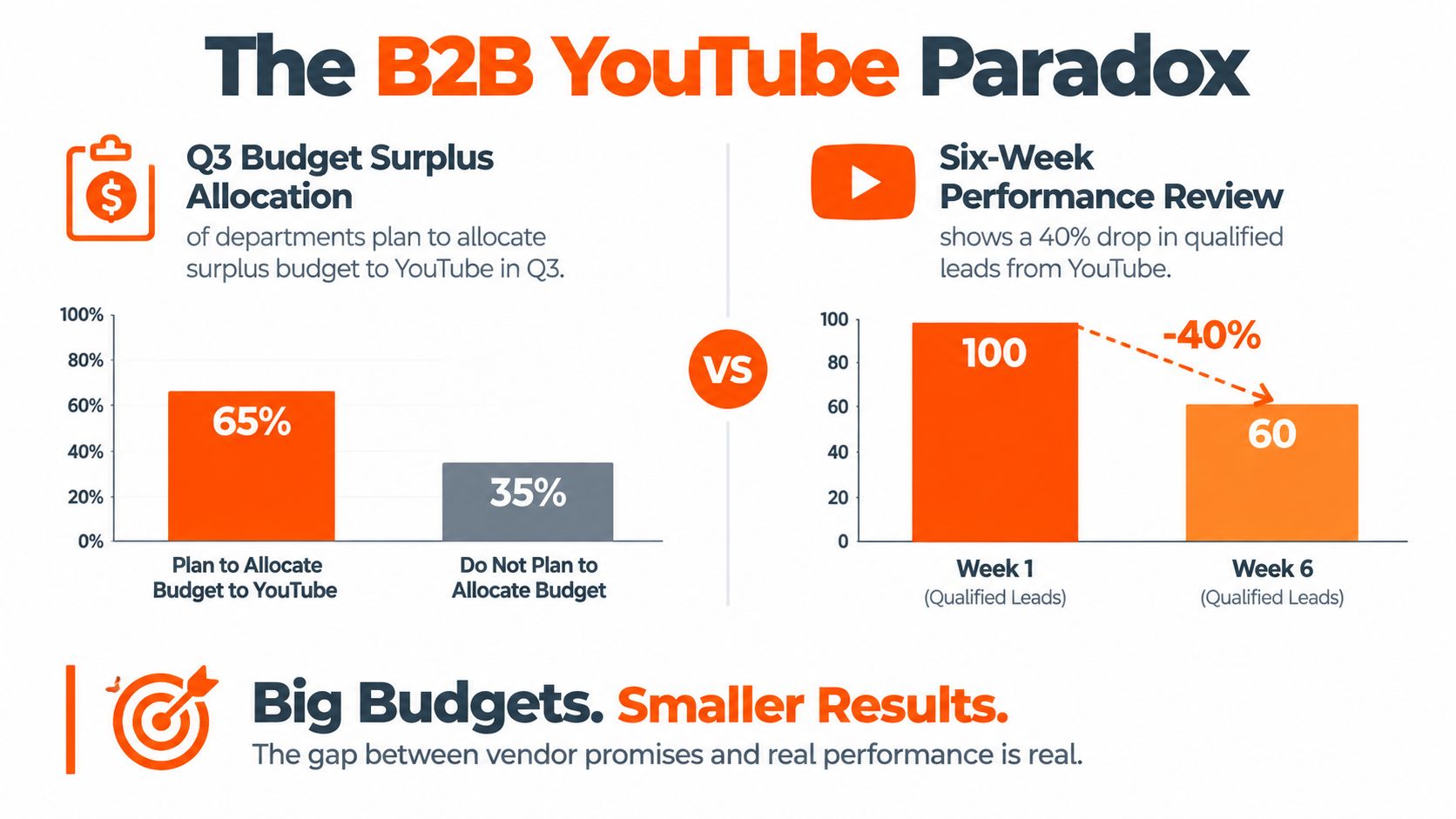
Use this B2B YouTube benchmarks guide to set a starting point, then replace generic expectations with account-level evidence. The question is whether the campaign creates qualified attention that sales can recognize later in the CRM.
Practical rule: A view is an interaction. A qualified view shows that the right person stayed long enough to understand the message. A pipeline opportunity is a business outcome. Those measures are not interchangeable.
Picking the Right YouTube Ad Format for Your Goal
The format should follow the action the campaign needs. A product demonstration, a category reminder, and a buyer actively comparing vendors shouldn't receive the same video just because the media plan has one asset available.
Google lists several YouTube advertising formats, including skippable in-stream, non-skippable in-stream, in-feed video, bumper, masthead, Shorts, and audio ads in its Google Ads format guidance. Each format creates a different creative constraint.
Format choices for real B2B situations
Skippable in-stream is the practical default for consideration campaigns. A cybersecurity firm could use a product-led explanation to drive whitepaper downloads, but the opening must make the risk and payoff clear before the viewer can skip. Viewers can skip after 5 seconds, so the first sentence isn't an introduction. It's the audition.
Non-skippable in-stream fits warm retargeting better than cold prospecting. An HR software company could show a short proof point to people who already watched a webinar or visited a pricing page. The format typically runs for 15 or 20 seconds, depending on regional standards, so the message needs one job, not a compressed company history.
Bumper ads are up to 6 seconds and non-skippable. A logistics consultancy might use one to reinforce a category idea after a longer video has introduced the problem. Bumpers can support recall, but they offer no room for a complicated value proposition. Trying to explain an enterprise transformation in six seconds is how marketing departments invent new forms of punctuation.
In-feed video ads suit active research. A logistics consultancy targeting people searching for the best ERP for manufacturing could use a clear thumbnail and a practical title to attract viewers comparing options. These placements can capture attention closer to a research action than a broad awareness placement.
Shorts ads can help a software company introduce a new category through concise mobile-first stories. A SaaS brand might use a practitioner problem, a fast visual demonstration, and a single next step rather than shrinking a horizontal webinar into a vertical postage stamp.
Format | Best Funnel Stage | B2B Use Case | Key Trade-off
Skippable in-stream | Consideration | Product demonstration or whitepaper offer | The first 5 seconds must earn continued attention
Non-skippable in-stream | Retargeting | Reminder for webinar or pricing-page visitors | Limited time for proof and explanation
Bumper | Awareness and recall | Category message or brand reminder | Strong reach potential, minimal room for detail
In-feed video | Active research | Comparison, search-led education, competitor context | Thumbnail and title carry much of the initial burden
Shorts | Early demand generation | Mobile-first category education | Lower room for complex product explanation
Audio | Awareness and reinforcement | Message delivery during relevant listening | No visual demonstration
Masthead | Broad launch visibility | Major product or event announcement | Requires a large, carefully managed media commitment
The decision rule is simple: pick the format by the action required, not by the inventory that happens to be cheapest. A campaign seeking demo requests needs a different path from one trying to make a new category recognizable.
Targeting the Right People Without Wasting Budget
B2B targeting starts with intent, not job titles. Buyers don't always identify themselves as “VP of infrastructure” inside an ad platform, but they do search for cloud migration risks, watch security architecture videos, visit competitor channels, and read implementation guides.
Build targeting in layers
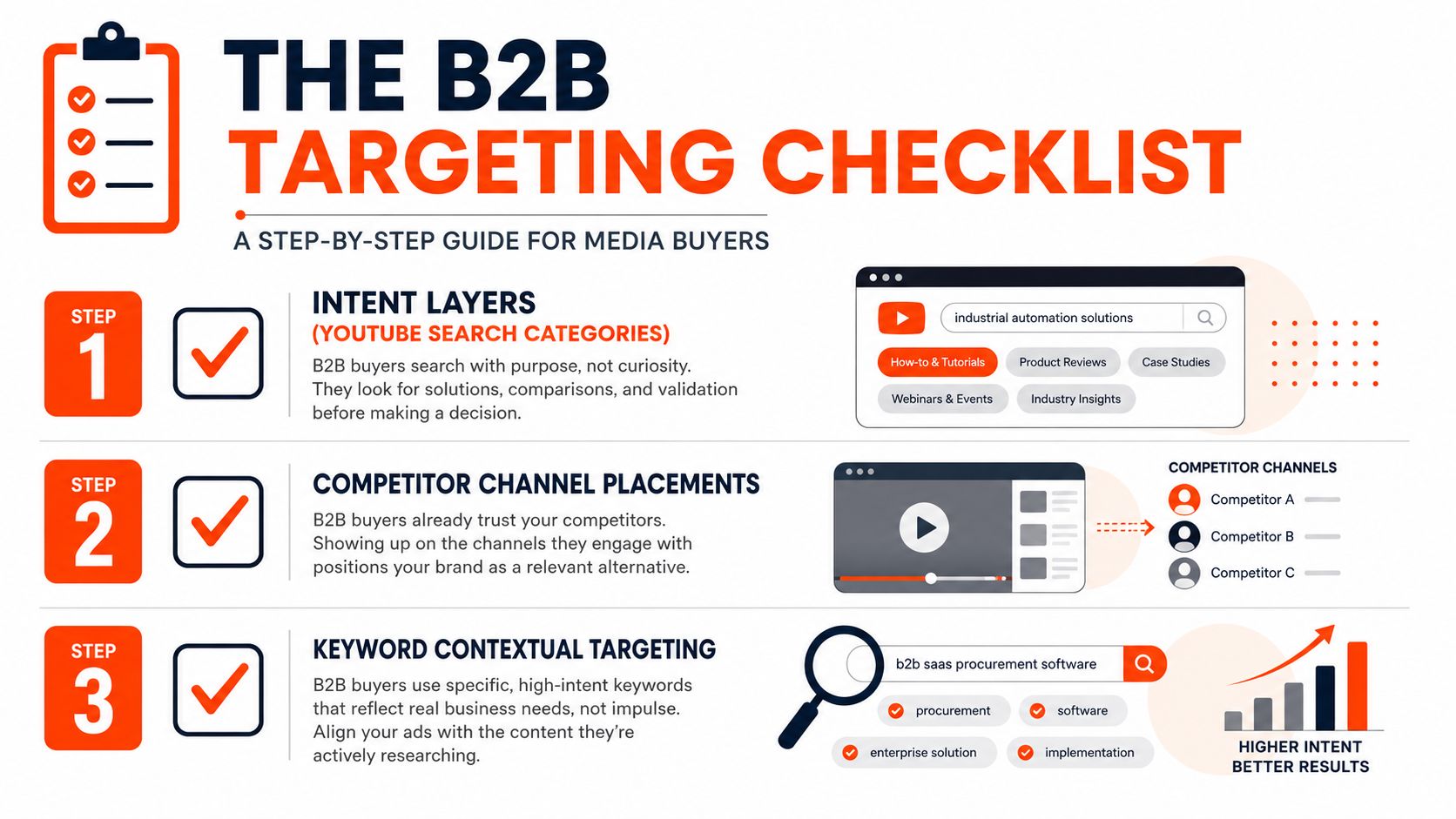
The first layer should include YouTube search categories, competitor channel placements, and keyword contextual targeting. These signals connect the ad to a problem or research environment. A consulting firm selling supply-chain transformation can target videos and topics around inventory planning, procurement systems, and operational resilience instead of hoping a broad business audience will stumble into relevance.
The second layer uses first-party data. CRM lists, webinar attendees, product users, and pricing-page visitors can support retargeting and audience exclusions. Lookalike modelling should come after a team has enough qualified source records to describe a meaningful pattern. A list of random leads is not a model. It's a spreadsheet wearing a blazer.
The third layer applies demographic or job-function filters where the available data supports them. Teams using Display & Video 360 may find more suitable B2B controls than a basic Google Ads setup, but the filter should remain subordinate to intent. A job title without a relevant problem creates polite impressions and expensive silence.
A SaaS targeting example
A cloud-migration SaaS campaign could begin with in-market cloud infrastructure keywords and relevant YouTube search categories. The team could then add known IT decision-maker audiences, exclude employee traffic, and create separate ad groups for cold prospects, site visitors, and existing opportunities.
The campaign should avoid the broad “give the algorithm room” approach until the conversion event is trustworthy. An algorithm trained on demo requests needs clean conversion data, sensible exclusions, and enough room to find qualified people. Otherwise, it may locate the easiest form completion rather than the best account.
The targeting checklist should include:
Intent signals: Start with topics, searches, channels, and contextual keywords connected to the buying problem.
Competitor controls: Review competitor placements and exclude irrelevant entertainment or consumer content.
First-party audiences: Upload CRM and engagement lists, then separate prospects, customers, employees, and lost opportunities.
Traffic exclusions: Remove staff traffic and known internal activity before reading performance.
Account protection: Add competitor and partner exclusions where the account strategy requires them.
Frequency management: Set exposure limits around the buying cycle so a prospect doesn't see the same message until it becomes office folklore.
A narrow audience isn't automatically better. A useful audience is one that combines relevant intent, credible first-party evidence, and a conversion action that sales values.
Writing Creative That Survives the 5-Second Skip
The opening five seconds carry disproportionate weight in skippable in-stream advertising. Google's mechanics allow a viewer to skip after that point, so the creative needs to establish the problem before the brand animation finishes doing its little corporate ballet.
A B2B team should write at least three hook variations before producing the full video:
Problem hook: Name the costly operational problem in plain language.
Contrarian hook: Challenge the assumption that keeps the buyer stuck.
Outcome hook: Show the result the buyer wants, then explain the mechanism.
A cybersecurity firm might open with, “Most incident-response plans fail during the first handoff,” rather than, “Welcome to our platform.” The first version creates a reason to continue. The second announces a meeting nobody accepted.
In-feed creative needs a different treatment
In-feed ads behave more like search results than interrupted television. The thumbnail should present one visual idea, the title should state a useful promise, and the landing page should continue the same argument. Logos belong in the design, but a thumbnail shouldn't look like a logo shipment exploded across it.
A SaaS company can test a feature-led opening against a problem-led opening, but unsupported completion-rate lifts shouldn't be presented as established results. The correct process is to track retention and completion within the account, then keep the winning angle only if the audience quality remains acceptable.
Hook Style | Best For | Average View-Through | Risk
Problem-led | Pain-aware buyers | Measure in the live campaign | Can attract curiosity without buying intent
Contrarian | Crowded categories | Measure against a control creative | May sound clever while hiding the offer
Outcome-led | Consideration and conversion | Measure with retention and post-click quality | Can overpromise if proof is weak
Feature-led | Product-aware audiences | Measure by segment | Often loses cold viewers before the explanation begins
Teams without an internal production bench can use a resource such as the ShortGenius AI ad creative tool to develop variations quickly, then let human reviewers check claims, brand fit, and audience relevance. Speed helps only when the testing question is clear.
The production budget shouldn't dictate the message. A clear screen recording with a sharp hook can outperform an expensive shoot with no point. Creative testing should connect the first five seconds to the landing-page promise, the conversion event, and the audience that saw the ad. The ad creative testing framework from ContentBuck offers a useful reference for structuring that process.
Choosing a Bidding Strategy That Matches Your Funnel
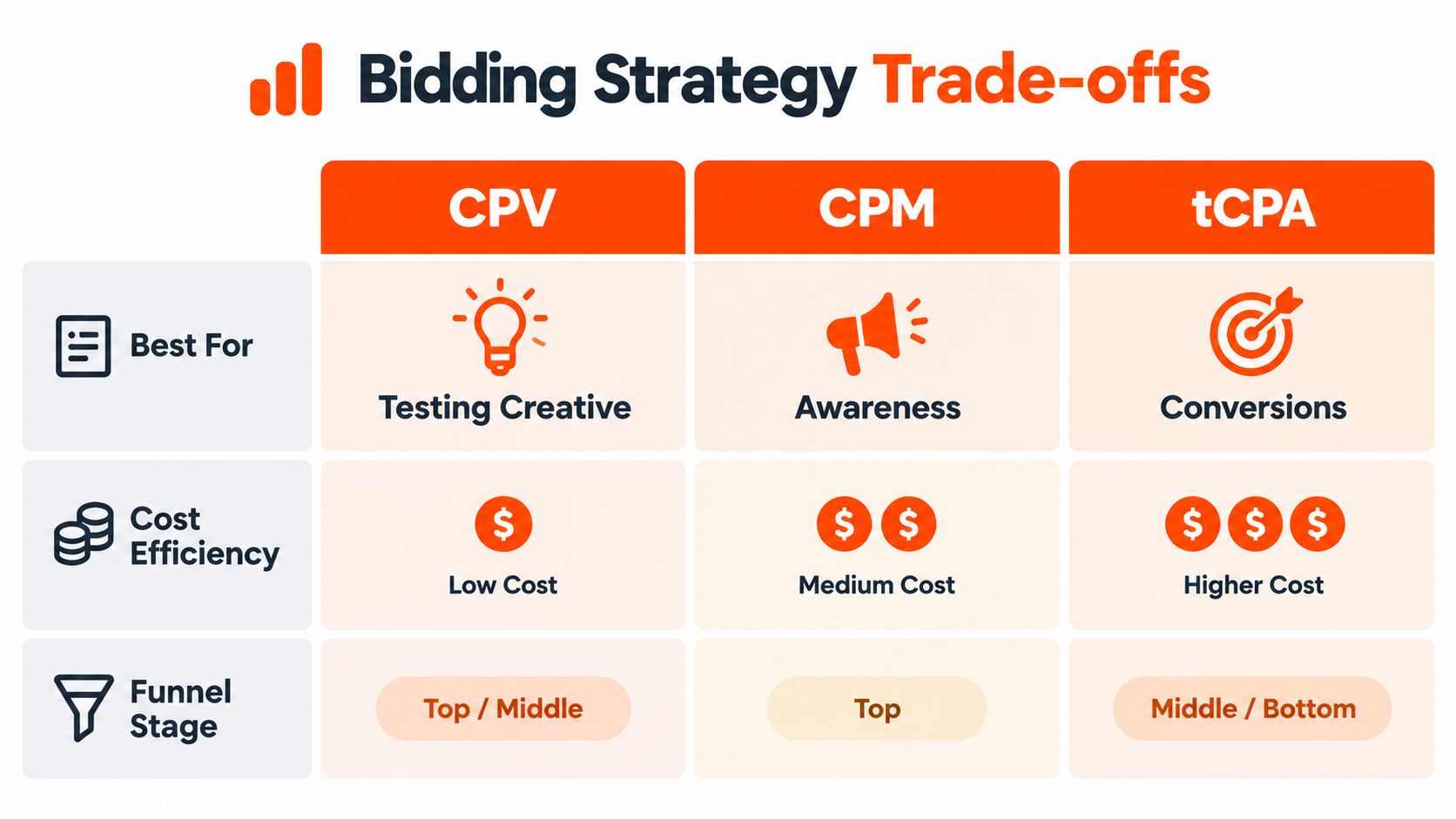
Bidding models answer different questions. CPV asks whether the campaign can buy attention efficiently. CPM asks how efficiently it can buy exposure. Target CPA asks whether the platform can find conversion actions at an acceptable cost. Confusing those questions is how a team celebrates inexpensive views while sales finds no qualified accounts.
With CPV bidding, an advertiser pays when a viewer watches 30 seconds, watches the full video if it is shorter than 30 seconds, or interacts with the ad, whichever comes first, according to Google's YouTube CPV explanation. A short ad can therefore create a billable view before completion, while a longer ad reaches the view threshold later unless the viewer interacts sooner.
The practical trade-offs
CPV suits creative testing and upper-funnel education. Industry benchmark data reports an average YouTube ad view rate of 31.9% and an average cost per view of about $0.026, while the same benchmark source reports an average click-through rate near 0.65%. Those figures from Shno's YouTube marketing benchmark summary are directional, not a promise for a particular account.
CPM works when an awareness campaign has a defined account list, category audience, or launch objective. It provides exposure control, but it doesn't prove that people understood the message or moved closer to a sales conversation.
Target CPA belongs lower in the funnel, after the conversion action is reliable and the account has sufficient historical signal. A platform shouldn't be asked to find high-quality pipeline when the pixel fires on duplicate forms, employee visits, and accidental button clicks.
A cybersecurity firm with a long buying cycle may use CPV for category education, then retarget engaged viewers with a conversion campaign. If the CRM records sales-qualified opportunities cleanly, target CPA can later support the lower-funnel group. The right structure isn't CPV versus target CPA. It is CPV for learning, conversion bidding for validated action.
Bid discipline: Smart Bidding can't repair broken conversion tracking. It can only optimise the signals the account gives it, including the bad ones.
Set bid floors and ceilings based on the campaign's economics, adjust bids for valuable in-market or job-function audiences only when the data supports the adjustment, and separate prospecting from retargeting. Teams should also test whether a low CPV produces meaningful watch time, qualified site visits, and CRM activity. Cheap attention isn't a bargain if it attracts nobody who can buy.
Connecting Paid Promotion to Organic YouTube Growth
Paid and organic YouTube shouldn't operate as rival departments fighting over the same thumbnail. Paid promotion can expose topics, hooks, and audience segments that the organic team can develop into a durable channel strategy.
The first useful connection is creative intelligence. If a paid video keeps viewers through a difficult explanation, that topic may deserve a longer organic episode, a comparison playlist, or a recurring series. If viewers leave when the video reaches a particular claim, the script probably needs work before the company spends more money amplifying it.
The second connection is audience development. Engaged viewers can support remarketing, channel programming, and follow-up content. A finance consultancy might promote a video about forecasting problems, then publish a related playlist that answers implementation questions in a logical order. The paid campaign introduces the issue. Organic content earns deeper attention.
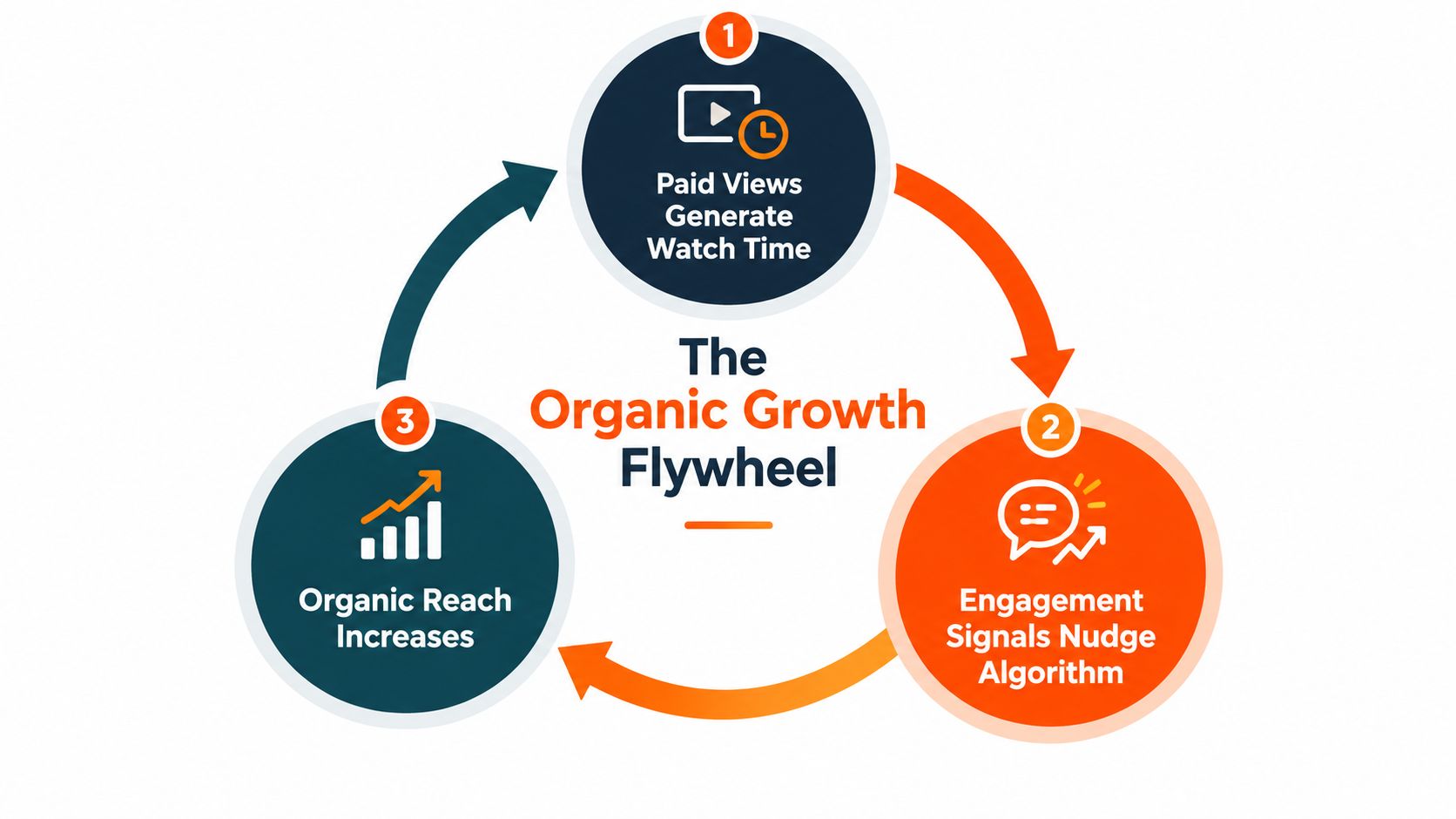
The three-part flywheel
Paid views create learning: Watch time, retention, comments, and post-view behaviour show which ideas attract meaningful attention.
Engagement informs programming: The channel team uses those signals to choose subjects, titles, thumbnails, and follow-up formats.
Organic content extends the journey: Search-friendly videos and playlists give interested viewers another door into the company.
This isn't a guarantee that paid views will automatically increase organic distribution. YouTube performance depends on viewer behaviour and content relevance, so teams should evaluate organic outcomes separately instead of folding every view into one flattering chart.
A founder-led software company can also combine paid promotion with practical free YouTube growth tactics for founders, such as stronger titles, community activity, and distribution through existing audiences. Paid media shouldn't replace those basics. It should reveal which basics deserve more attention.
A repurposing checklist makes the connection operational:
Script reuse: Turn ad arguments into long-form videos, sales enablement clips, and search-led articles.
Thumbnail testing: Use paid thumbnail learnings as hypotheses for organic uploads, then validate them with organic data.
Audience planning: Let retargeting pools inform which topics need a follow-up video.
Playlist design: Group related questions so a viewer can continue without returning to search.
Sales alignment: Give the sales team clips that answer the objections appearing in campaign and CRM data.
The YouTube channel growth strategy guide can help teams organise those activities. Paid and organic are one funnel with two doors, provided both teams measure what happens after the first view.
Measuring Results and Knowing When to Change Course
A B2B campaign can produce cheap views and still fail to create pipeline. Set the measurement plan before launch. Each funnel stage needs a primary KPI, a supporting signal, an audience cohort, and a clear definition of business value. Awareness may rely on qualified reach and attention. Consideration should include retention, engaged visits, and content progression. Pipeline campaigns need CRM-qualified actions, opportunity creation, and assisted influence, not clicks alone.
The platform's reporting needs scrutiny in 2026. Google Ads accounts were auto-migrated to Data-Driven Attribution, with Last-Click as the only alternative, while video reporting still lacks an impression-share metric, according to this explanation of YouTube Ads measurement changes. A last-click CPA can look poor when YouTube introduced the buyer earlier in the journey. That is a measurement problem, not automatically a media problem.
A weekly operating rhythm
Review campaigns in a fixed order:
Audience quality: Check whether engaged viewers belong to target accounts or merely consume content cheaply.
Retention: Review the opening, drop-off points, average watch behaviour, and differences between formats.
Frequency: Look for repeated exposure without fresh engagement or site activity.
Creative wear-out: Compare current retention and click behaviour with earlier results for each variant.
Post-click quality: Match form submissions to CRM records, account fit, meeting progression, and disqualification reasons.
Budget allocation: Shift spend only after separating prospecting, retargeting, in-stream, in-feed, Shorts, and other relevant groups.
Use benchmarks as orientation, not as automatic verdicts. Industry guidance suggests a skippable in-stream view rate baseline around 15% to 25%, with strong campaigns often reaching 30% to 40% or higher. Reported medians sit around 31.9%, while SaaS is reported at about 26%. YouTube advertising benchmarks from Benchmarketing provides useful context, but account fit and downstream action matter more than winning a benchmark spreadsheet.
Conversion reporting needs the same discipline. Industry guidance places average CTR near 0.65%, with in-feed formats often around 1.0% to 3.0% or higher, skippable in-stream around 0.5% to 2.0%, and Shorts around 0.1% to 0.5%, according to Brafton's social advertising benchmarks. A click is still not a qualified opportunity. For monetization context, see UK YouTube RPM explained. RPM is not a B2B acquisition KPI, so do not confuse publisher economics with pipeline efficiency.
The decision tree
Scale when target accounts engage, retention holds, CRM quality remains stable, and assisted pipeline supports the cost.
Iterate when attention is acceptable but the landing page, offer, audience layer, or handoff loses qualified prospects. Change the weakest part first. Replacing every asset at once produces a fresh set of unanswered questions and an impressively large invoice.
Pause when tracking is unreliable, employee traffic contaminates results, frequency rises without meaningful action, or the campaign attracts the wrong audience.
Teams using creator sponsorships or paid placements must handle disclosure correctly. YouTube requires creators to select the paid promotion box for paid product placements, sponsorships, or endorsements. The promotion must also follow YouTube's paid promotion policies, Google Ads policies, Community Guidelines, and applicable local law.
Frequently asked questions
Is paid YouTube promotion useful for B2B pipeline
Yes, if the campaign separates education from conversion and connects viewer behaviour to CRM outcomes. Video can introduce a buyer who later converts through search, direct traffic, or a sales interaction, so direct clicks cannot carry the entire verdict.
Which YouTube format should a B2B team start with
Skippable in-stream is a practical starting point for product education and consideration. In-feed suits active research, Shorts suits concise mobile-first reach, and bumpers suit short recall messages. The offer and buying stage should choose the format.
How should a team judge a low-cost view
Check whether the viewer is relevant and continues into meaningful behaviour. Review retention, qualified visits, audience fit, conversion quality, and assisted pipeline before increasing spend.
Should last-click CPA be trusted
Last-click CPA remains useful for comparison, but it should not be the only decision metric. Data-driven attribution, view-through behaviour, qualified engagement, CRM progression, and controlled audience comparisons can reveal influence that last-click reporting misses.
What should happen when performance declines
Check tracking, audience saturation, frequency, creative fatigue, landing-page continuity, and CRM quality. Then rotate the weakest hook or format, not the entire campaign by instinct. A dramatic rebuild often avoids the data rather than fixing the campaign.
ContentBuck offers B2B teams video-led acquisition support across YouTube strategy, ad creative, editing, explainers, channel production, and SEO-backed content, with ongoing creative requests and refreshes available through its operating model. Teams planning paid YouTube promotion can visit ContentBuck to discuss a campaign system connecting creative production, distribution, and pipeline measurement.
Parth Jasrapuria
Founder at ContentBuck
Building video systems for B2B businesses. Obsessed with YouTube growth, creative strategy, and organic SEO.