10 B2B SEO Company Picks: A 2026 Buyer Guide
Parth Jasrapuria
Founder
Three quotes land in the same week. One agency wants $3,000 a month, one wants $10,000 a month, one wants $120,000 a year, and all three promise page-one rankings. All three PDFs use the word "synergy". Two mention "answer-engine optimisation" without explaining it, which is a long way of saying the robots now answer the question, so your page had better be the thing they quote.
The price gap usually isn't a quality gap. It's a scope gap. The $3,000 quote buys strategy and a keyword sheet. The $10,000 quote buys articles, on-page work, and a dashboard. The $120,000 quote buys a team, original research, digital PR, and a monthly call where someone shows a slide about pipeline. What's left out of each proposal matters more than what's in it.
This list compares all ten the same way: who it fits, what it's a bad fit for, what month one delivers, and whether the price is published. Ten minutes of reading gets a shortlist of three.
Coming up: worked examples of what goes wrong when a team buys on price alone, a comparison table, a reusable six-question call script, and an FAQ on how long SEO takes, what to budget, and whether anyone can guarantee rankings. For the measurement side that outlives rankings and sessions, see measuring SEO beyond rankings and sessions. No agency here is a magic wand, and the limitations are printed on purpose.
1. B2B SEO Content Agency | ContentBuck
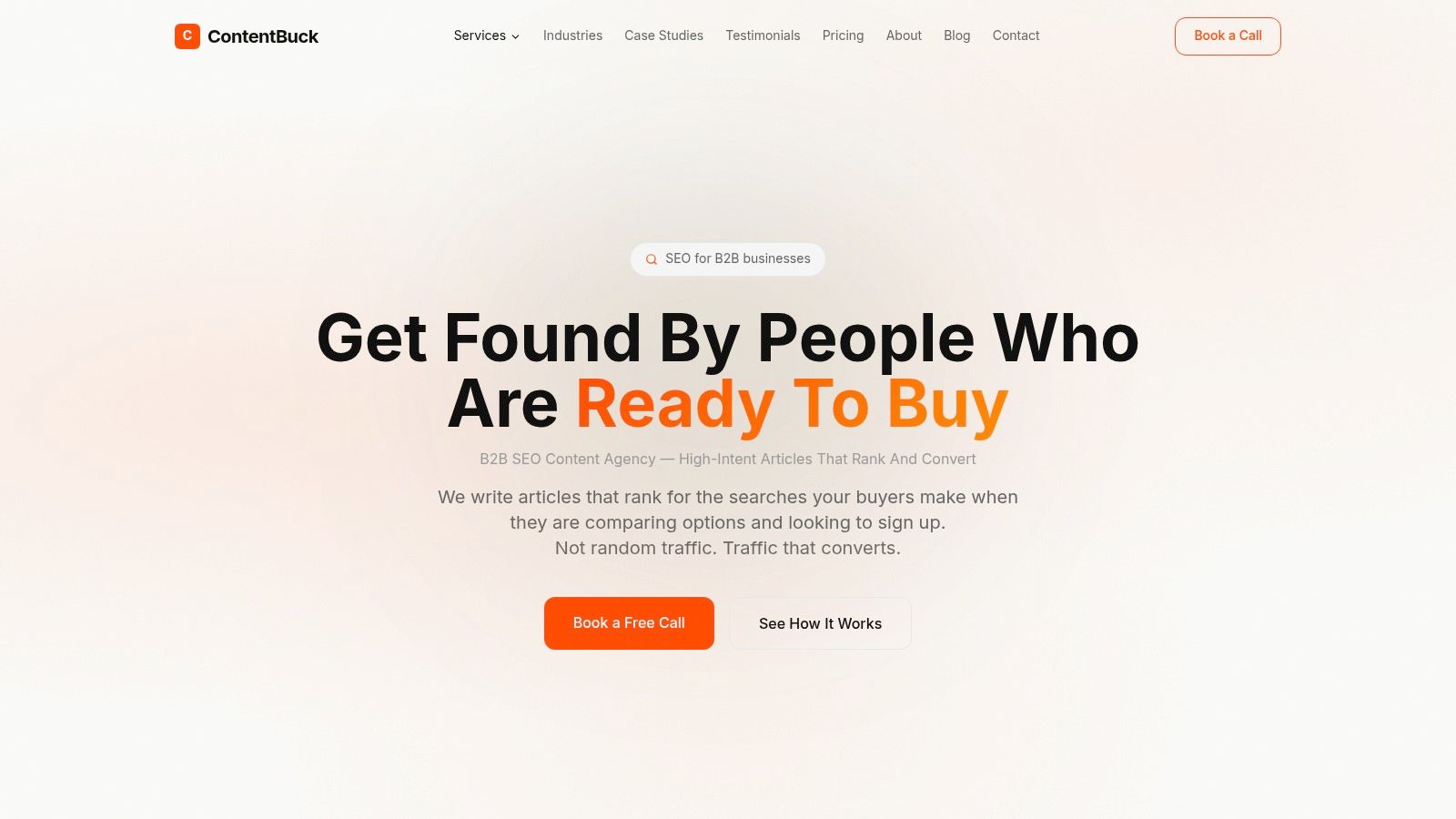
ContentBuck runs SEO content like a production line rather than a retainer-shaped promise. Buyer-intent keyword research feeds a pillar-and-cluster map, human writers turn it into articles of 2,500 to 4,000 words, and finished pages get on-page optimisation, internal linking, and backlink outreach to DR 40+ technology and industry publications. Its SEO content service is built for B2B only, which shows in the proof and calls to action aimed at buying committees.
The demand is there. An Ahrefs roundup of B2B SEO statistics reports that 66% of B2B buyers use internet search results when exploring products they may purchase, and that SEO takes roughly 11% of B2B marketing budgets, ahead of market research at 9% and print advertising at 8%.
Who It Fits
Teams that want strategy and execution under one roof and can commit to six months, because the program is designed around that runway. Video usually joins the plan, and the 2025 B2B content marketing benchmark from the Content Marketing Institute reports 61% of surveyed organisations expected to increase video investment during 2025.
Where It Falls Short
Anyone who needs leads this week. SEO content takes 60 to 90 days to start ranking, and a single post buys very little. Human-written 3,000-word articles cost more than an AI content farm, and that premium is the product.
Month One
Keyword research, cluster map, publishing calendar, and the first articles in production, plus monthly reporting that names which pieces produce leads and proposal requests. The B2B SEO content case study reports 12 articles in three months taking a client from zero to 34,000 monthly visitors.
2. RevenueZen
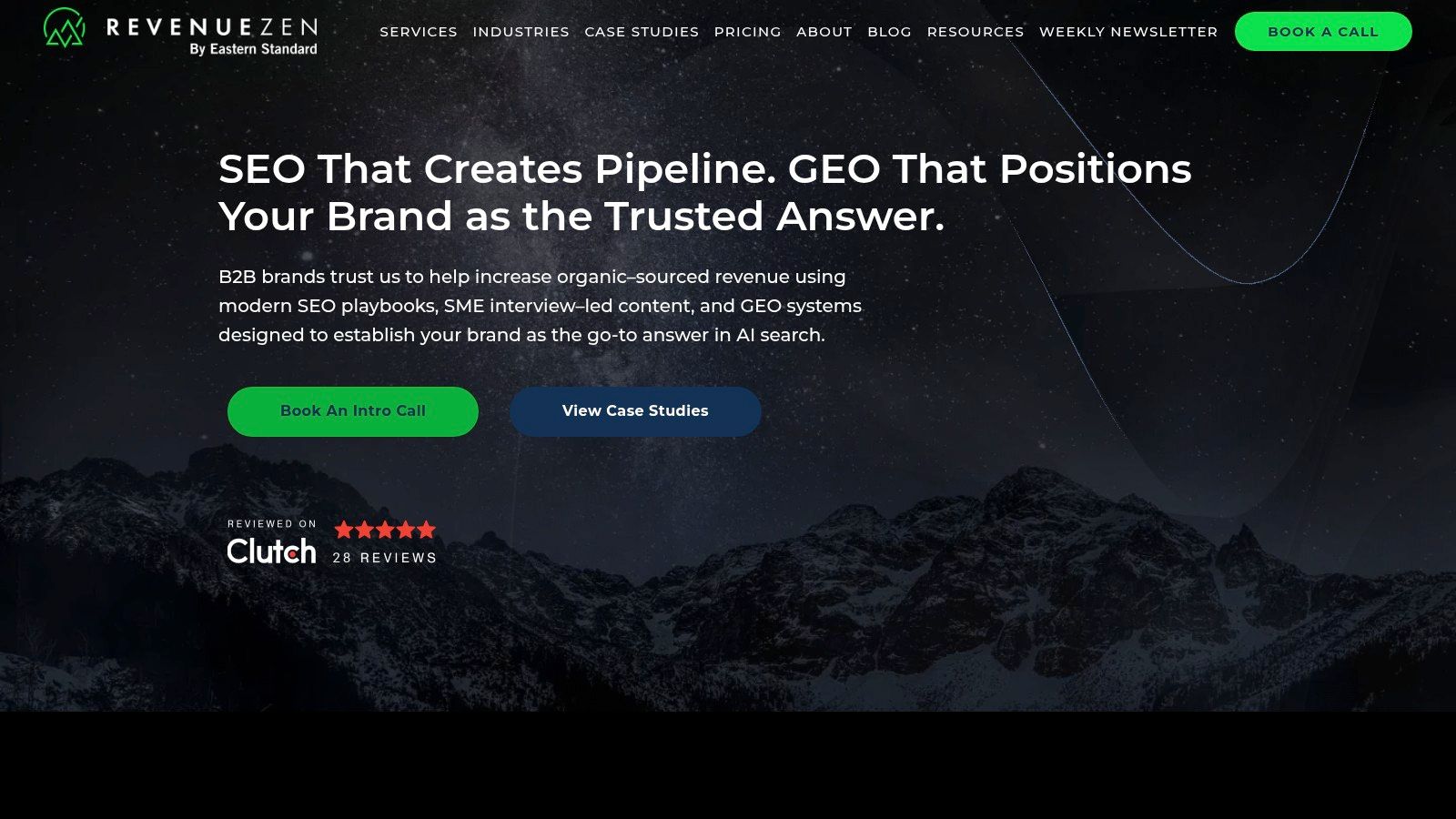
RevenueZen sells SEO as pipeline rather than pageviews. Buyer-intent strategy, content, link building, technical audits, and AI-search visibility sit inside one service, and the entry point is published: a Foundation plan starting at $3,000 per month. Details sit on the RevenueZen site.
The revenue framing holds up. A Resourcera compilation of B2B SEO statistics reports that 49% of B2B marketers use SEO and that organic search has an average conversion rate of 5.0%. Five conversions per hundred visits isn't a traffic story, it's a lead-quality story, and it's the number a CFO will ask about.
Read the tier before falling in love with the price: the Foundation plan doesn't include link building, so ask which month that starts and what it adds to the invoice.
Who It Fits
Lean B2B teams that want a specialist, a published budget anchor, and reporting framed around qualified pipeline.
Where It Falls Short
Buyers who assume $3,000 buys the full program. Link building and heavier content output push the number up, and results still depend on how fast the client's own team implements page changes. For a deeper read on matching an agency to a software business, see choosing an SEO agency for SaaS.
The First 90 Days
Audit, keyword prioritisation, a first content batch, and tracking wired to CRM stages instead of form fills alone.
3. Directive
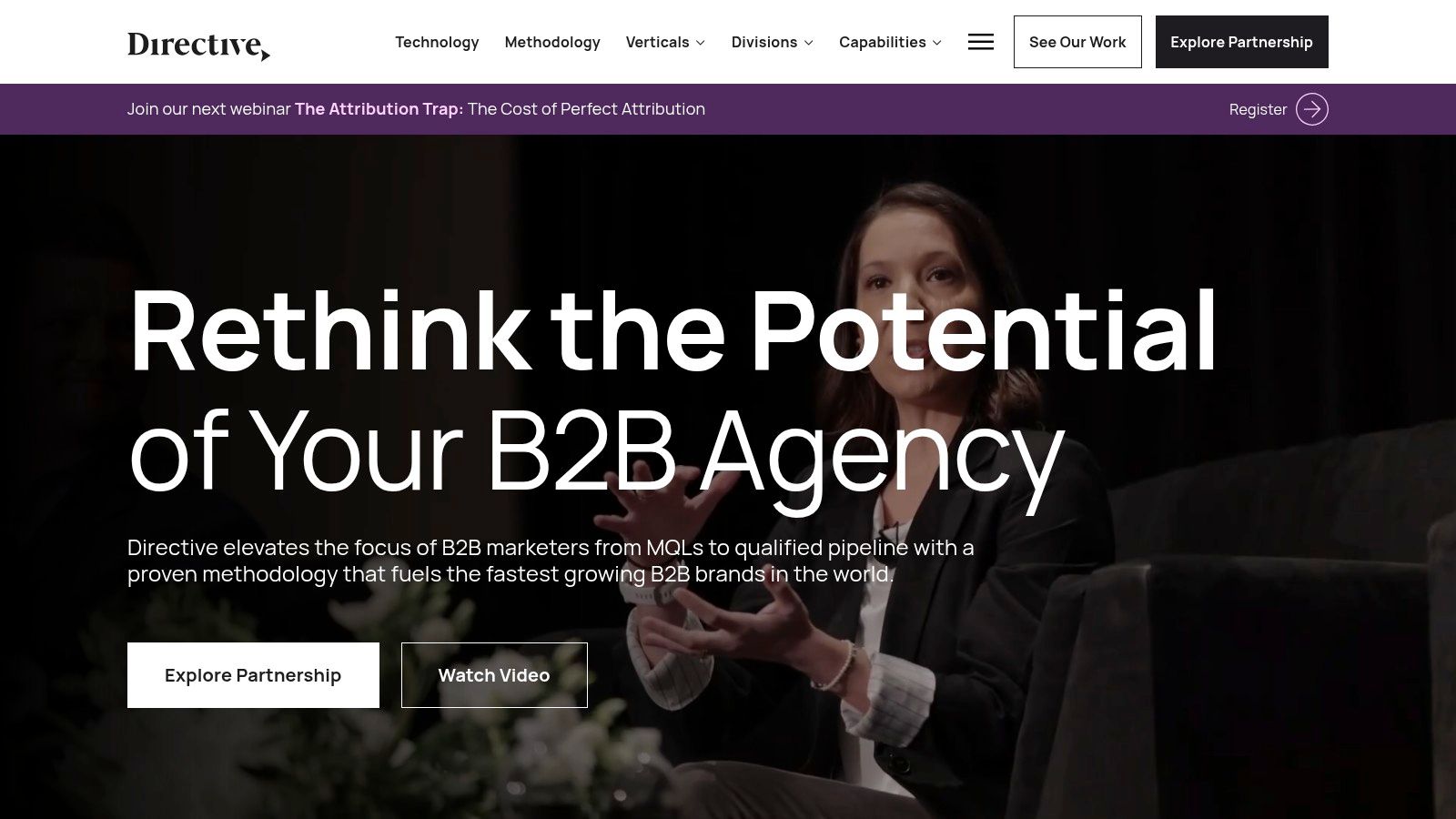
Directive is a B2B SaaS and technology marketing agency that sells SEO inside a wider performance program. Technical work, buyer-focused content, and high-intent page optimisation run next to paid media, which suits companies that would rather not referee four vendors. The agency's site publishes B2B case studies including work for Vyond.
Search rewards a narrow band of results. Sixth City Marketing's B2B SEO statistics roundup reports the first five organic results capture 67.6% of organic clicks, and that 96.98% of U.S. desktop Google clicks go to results within the top 10 positions. Position 14 is a hobby, not a channel.
Who It Fits
SaaS teams already spending on paid media: one team can align the ad landing page and the organic page instead of arguing about which channel gets credit.
Companies chasing high-intent pages: comparison and alternatives pages get the most attention, which is where late-stage buyers live.
Marketing leaders who want one dashboard: SEO, paid, and conversions reported together.
Where It Falls Short
An SEO-only brief looks overpriced here, because the value sits in coordination. Pricing isn't published on the reviewed service page, and case-study gains are client-specific rather than a forecast.
The First 90 Days
Technical audit, fixes on the highest-intent pages, a content calendar, and conversion tracking rebuilt around pipeline.
4. Omniscient Digital
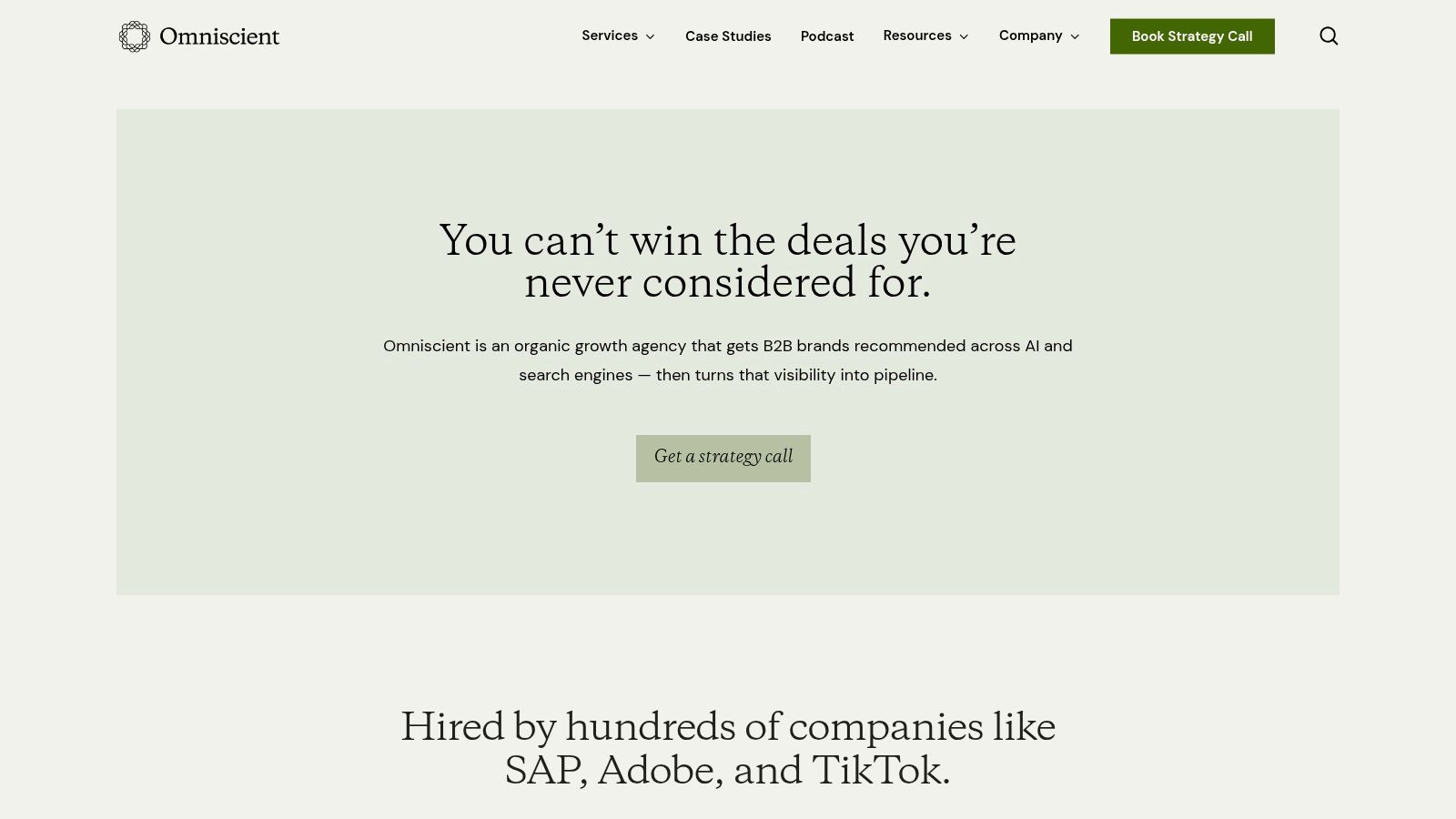
Omniscient Digital sells organic growth to established B2B brands: SEO strategy, content, technical work, digital PR, and answer-engine optimisation, with full-service engagements starting at $120,000 per year. Buyer research leads the process and the output is judged on business impact rather than a fixed article count. Scope and positioning sit on the Omniscient Digital site.
The AI-search emphasis is well timed. Webbiquity's synthesis of B2B buyer research reports that 51% of B2B software buyers open research in an AI chatbot more often than Google, up from 29% a year earlier, and that original research was the strongest trust signal for B2B content at 70%. Expert opinion ranked at 64%, peer insight at 62%, and case studies at 54%.
Original data is the cheapest credibility a B2B brand can manufacture. A short benchmark survey beats the twelfth "ultimate guide" nobody cites.
That points to a specific content plan: fewer generic explainers, more proprietary numbers, documented methodology, and consistent product facts across review sites and third-party publications. Teams that want citations from AI systems have to look like a source, not a summariser. The article-level mechanics of that are covered in SEO content writing that earns links and citations.
Who It Fits
Funded B2B teams with an in-house subject-matter expert and a budget that can carry a quarterly cadence.
Where It Falls Short
The published minimum rules out small budgets, and the team thinks in quarters. Buyers who need a single product page fixed should look elsewhere.
The First 90 Days
Research, narrative positioning, a content roadmap, and the first original asset in motion.
5. SimpleTiger
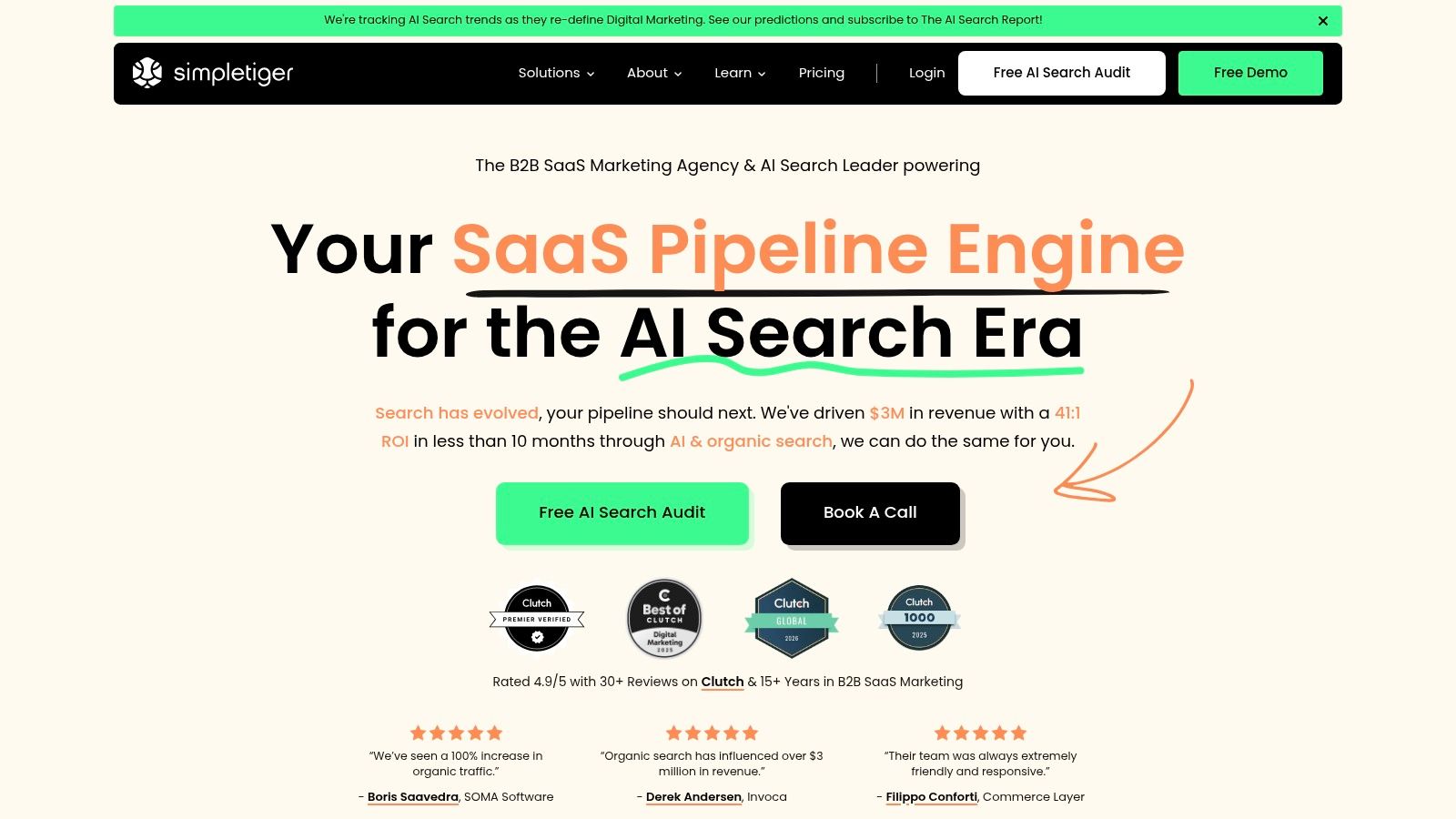
SimpleTiger works with software companies and nothing else. Packages span advice-and-guidance engagements, outsourced execution, and more aggressive growth programs, with published tiers running from $4,000 to $150,000+ per month. Technical audits, content production, and link building are all on the menu at SimpleTiger.
SaaS buyers research hard long before a rep appears. Search Engine Land's B2B SEO statistics guide reports buyers spend approximately 27% of the purchase journey on online research, which is why comparison pages and technical audits earn their keep here.
Who It Fits
Software companies at different stages. The lower tiers suit a team that owns execution and wants direction; the growth tiers suit a team with no content capacity at all.
Where It Falls Short
SaaS specialisation is a poor match for a manufacturer, a consultancy, or a distributor with product catalogues. Higher-output programs get expensive fast, and "growth package" is not a scope. Ask for the deliverable list in writing.
The First 90 Days
Technical audit, keyword grouping by intent, first content batch, and a link-building plan with named targets.
6. Bay Leaf Digital
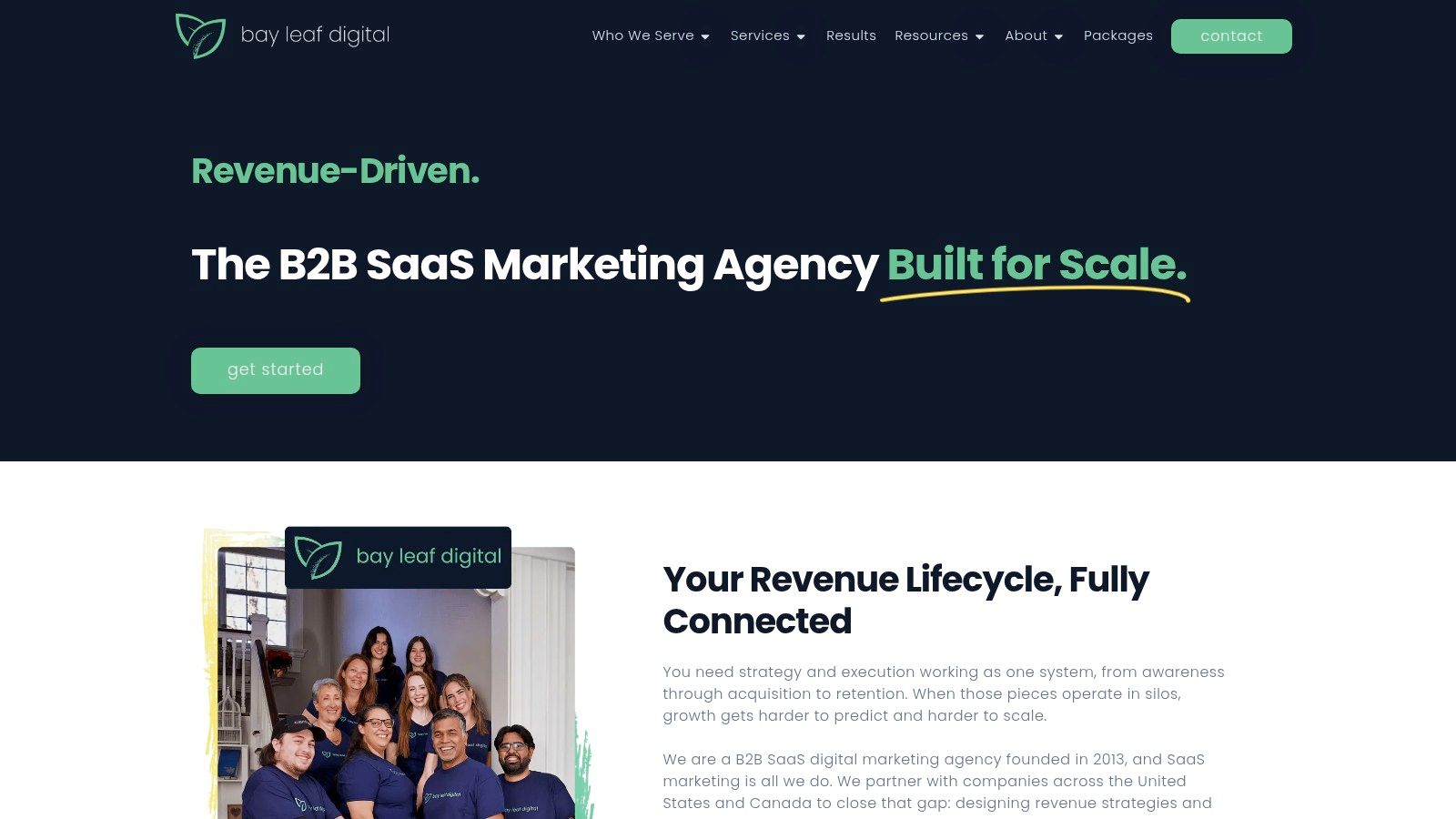
Bay Leaf Digital works exclusively with B2B SaaS and wraps SEO into a revenue-lifecycle program. Content, paid media, marketing automation, analytics, conversion optimisation, and retention support can all sit in the same engagement. Client examples and the integrated model are described on the Bay Leaf Digital site.
That integration earns its keep when paid spend is in the mix. Marketing Dive's coverage of IAB research reported that digital video was projected to represent 58% of total U.S. video advertising spending in 2025, and a share that size puts real pressure on the landing pages it sends traffic to. One team owning the ad and the page closes the loop.
Who It Fits
SaaS marketing leaders who are tired of the SEO agency blaming the paid team and the paid team blaming the website. One owner, one plan, one invoice. It also suits a company whose funnel problem spans several disciplines at once, since the audit covers acquisition through retention rather than stopping at rankings.
Where It Falls Short
A discrete SEO project doesn't need automation, retention, and lifecycle work bolted on, and the invoice will say so. Bay Leaf Digital doesn't publish its pricing, so budget fit has to be asked about directly. A team that only wants rankings and content will pay for capability it never touches.
The First 90 Days
Audit of the funnel from first visit to renewal, SEO priorities, and automation fixes where leads currently leak. Expect the early weeks to map the full pipeline before the content work starts, which is slower than a pure SEO kickoff but catches problems a rankings report never shows.
7. Loopex Digital
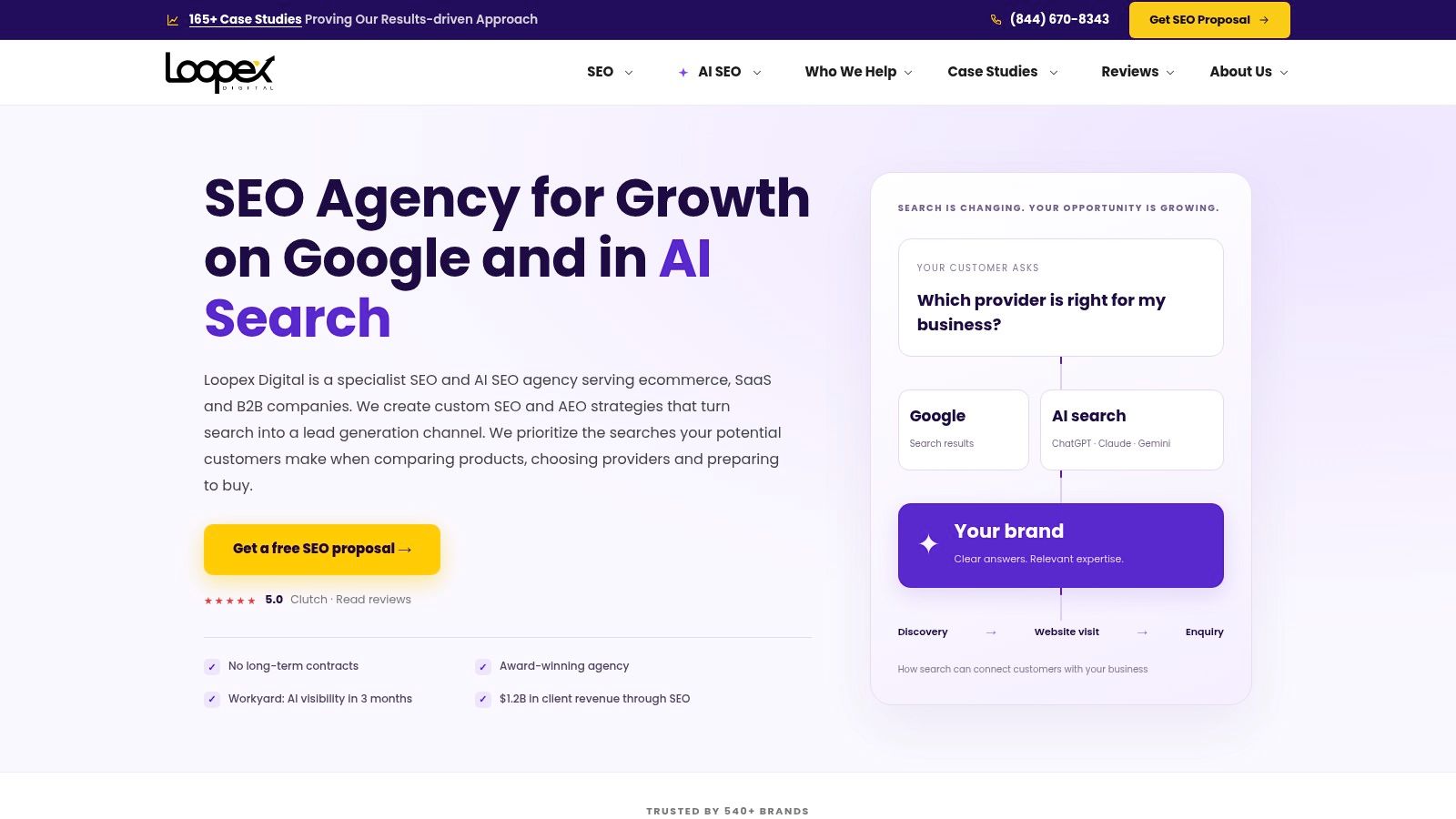
Loopex Digital mixes SEO with AI-search work for B2B and SaaS clients. Buyer-intent and lead-generation pages, technical SEO, content, link building, and digital PR are the core offer, and the agency describes engagement terms as rolling 30-day arrangements. Published B2B case studies sit on the Loopex Digital site.
The technical promises deserve scrutiny, because schema is where agencies oversell. Google's structured data policies name JSON-LD as the preferred format, warn that missing required properties can make an item ineligible, and state plainly that correct markup does not guarantee a rich result. A structured-data manual action can strip rich-result eligibility without touching ordinary rankings.
Ask who tests the markup and with what. An agency that answers "our developer checked it" has no process. Google's Rich Results Test plus Search Console inspection is the process.
Who It Fits
Buyers who want flexibility. Rolling 30-day terms lower the commitment risk if the first two months go badly, and the case studies cover several B2B business types.
Where It Falls Short
Proposal-based pricing makes comparison harder, and the buyer has to confirm the actual team has relevant sector experience rather than judging the deck. Agency case studies also tend to pick winners.
The First 90 Days
Technical fixes, intent mapping, high-intent pages rewritten, and structured data deployed and validated.
8. Ten Speed
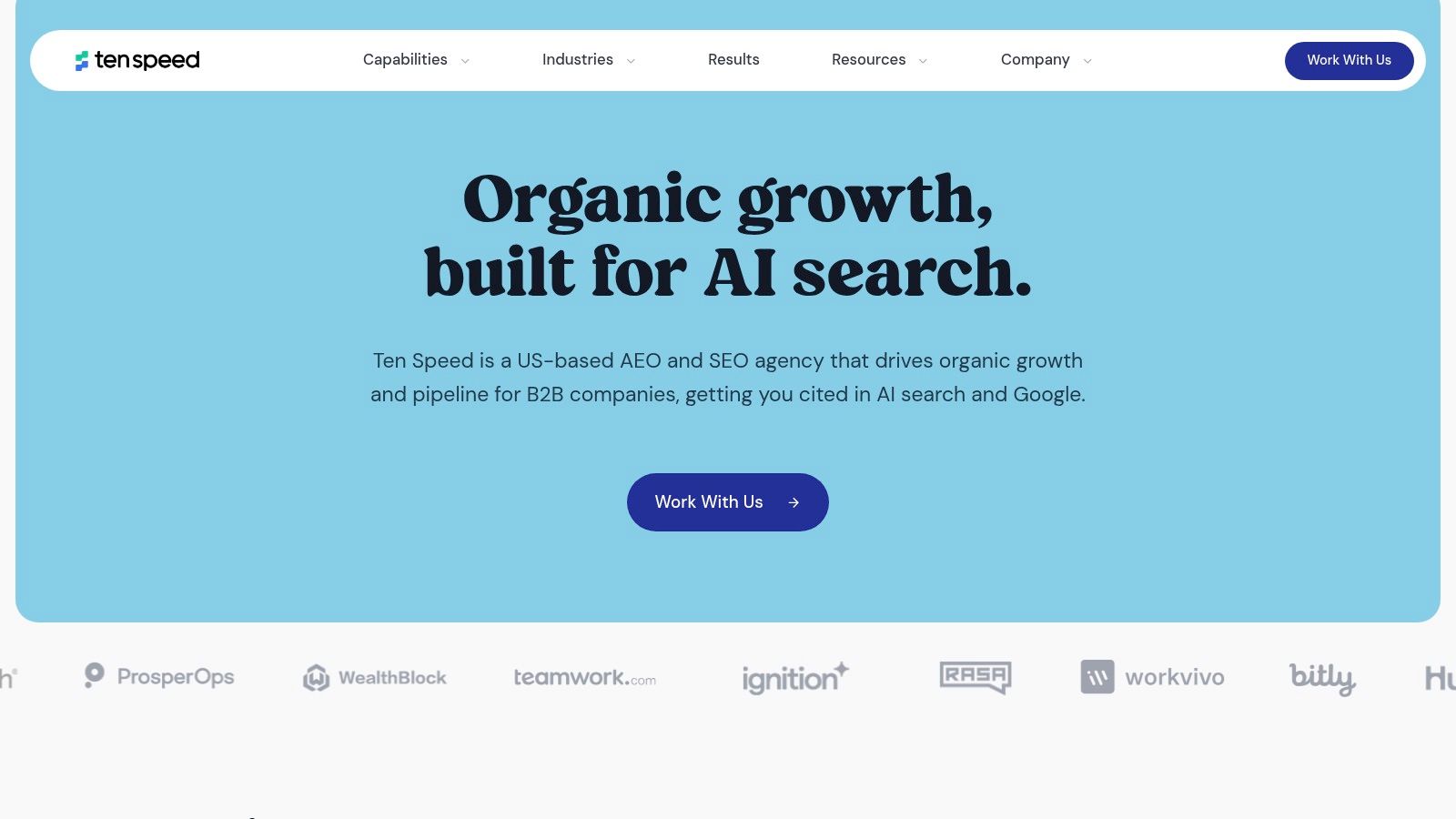
Ten Speed combines SEO with answer-engine optimisation, technical work, comparison pages, digital PR, original research, and video strategy. The pitch is visibility across both classic search and AI-driven discovery, with case studies and client-experience indicators on the Ten Speed site.
The click data explains why. Search Engine Journal's report on a 2025 study of 900 U.S. adults found clicks on traditional results fell from 15% of visits without an AI summary to 8% when one appeared, and clicks on links inside the summary occurred on only 1% of visits.
Red flag: anyone quoting a fixed "AI visibility" percentage lift. Nobody controls what a model says, so a team that measures share of citations and branded search with a stated method is more credible than one with a guarantee.
Who It Fits
Teams that already accept shrinking clicks and want the mix of research, video, and digital PR that produces citations and mentions elsewhere.
Where It Falls Short
No published pricing. The breadth is wasted on a buyer who needs one technical audit, and AI visibility is only partly controllable, so the reporting method has to be agreed before signing.
The First 90 Days
Search and AI visibility baseline, technical fixes, comparison pages, and the first original research or PR push.
9. First Page Sage
First Page Sage pairs SEO with thought-leadership content built for lead generation, aimed at B2B SaaS and professional services with complex products and long approval chains. The agency also publishes its own research on SEO and marketing investment, which sits on the First Page Sage site.
Content-heavy work attracts FAQ requests, and the expectations need a reset. Google's FAQPage documentation states that FAQ rich results apply only to well-known, authoritative websites focused on government or health topics. A SaaS company should still answer "does the platform support SSO?" on the page, because buyers and search engines read it, but nobody should promise a dropdown that won't appear.
Who It Fits
Firms selling a high-consideration purchase where buyers need education before they call. Long sales cycles reward depth, and a named expert author does real work here.
Where It Falls Short
A team with a broken site and no traffic doesn't need 3,000-word essays. Content-heavy programs move slowly when the problem is indexation or a template bug. Pricing isn't published on the reviewed service page, and buyers should ask for examples that match their own sales cycle.
The First 90 Days
Expert interviews, topic clusters, first long-form pieces, and author profiles built out properly.
10. Siege Media
Siege Media pairs SEO consulting with content creation, design, digital PR, and link earning, and its product-focused work covers commercial pages and user experience rather than technical SEO alone. Video, animation, and other creative formats are part of the offer, which is described with client testimonials on the Siege Media site.
If video is on the page, the metadata has to be right. Google's video SEO documentation says a video page should be indexable and carry a clear title, description, thumbnail URL, upload date, and duration, and that publishers can add VideoObject structured data, a video sitemap, and Open Graph metadata to help discovery. Chapters arrive through Clip structured data, which names each segment's start time, end time, and label, or through SeekToAction for timestamped URLs.
A software demo page with chapters labelled "02:10 Lead routing" and "05:40 CRM integration" saves searchers from scrubbing a 12-minute demo like a detective hunting one clue. Google may detect key moments itself, but it prioritises publisher-supplied ones.
Who It Fits
B2B teams that need editorial and creative execution, not just a keyword spreadsheet, and that care about the sales page as much as the blog.
Where It Falls Short
It isn't exclusively B2B, so relevant sector experience needs confirming. Pricing isn't listed on the reviewed service pages, and a creative-led program is overkill for a narrow audit.
The First 90 Days
Content and technical audit, priority commercial pages rebuilt, a design or video asset in production, and a link-earning push.
The Ten B2B SEO Companies Side by Side
Company | Best For | Published Pricing | B2B Focus | Main Watch-Out
ContentBuck (recommended) | End-to-end B2B SEO content and execution | Not stated | Buyer-intent research, content, SEO, and link building | SEO takes time; case-study results are not guaranteed
RevenueZen | B2B teams connecting SEO to pipeline and revenue | Foundation plan starts at $3,000/month | Explicit B2B focus | Foundation plan excludes link building; larger programs may cost more
Directive | Teams coordinating SEO with broader performance marketing | Not clearly published | B2B SaaS and technology | Broad offering may exceed SEO-only needs
Omniscient Digital | Established B2B teams seeking strategic organic growth | Full-service engagements start at $120,000/year | Explicit B2B focus | High minimum may not suit smaller budgets
SimpleTiger | SaaS companies seeking tiered SEO support | Packages range from $4,000 to $150,000+/month | SaaS-focused | Higher-output programs can be expensive
Bay Leaf Digital | B2B SaaS teams seeking coordinated marketing | Not stated | Works exclusively with B2B SaaS | Broader service model may not suit a discrete SEO project
Loopex Digital | B2B teams seeking flexible SEO engagements | Custom proposal | Serves B2B and SaaS businesses | Pricing is not public; confirm relevant team experience
Ten Speed | Teams combining SEO, content, and AI-search visibility | Not stated | B2B organic-growth focus | Broad offering may exceed needs of a narrow project
First Page Sage | Complex B2B sales requiring thought-leadership content | Not stated | B2B SaaS and professional services experience | Content-heavy approach may not suit technical remediation
Siege Media | Teams wanting SEO strategy with creative content execution | Not stated | Not exclusively B2B | Confirm sector experience; creative programs may be broader than needed
FAQ
How long until B2B SEO works
Expect 60 to 90 days before new articles start ranking, and longer before rankings turn into a predictable lead flow. The first 90 days are baseline setting: technical fixes, keyword mapping, publishing, and tracking. Months four to nine are where the curve usually bends, and that timeline is why content programs are built on a six-month horizon rather than a one-off batch of posts.
How much should a B2B SEO company cost
Enough that the scope is real, and not so much that nobody can afford the content. Rather than anchoring on a number, price the deliverables: how many articles, who writes them, whether link building is included, and whether reporting ties to pipeline. Ask for the month-one list and the month-four list separately. A proposal that only describes the year in aggregate is hiding something.
Can anyone guarantee rankings
No. Google decides the order, and any agency claiming guaranteed number one positions is either guessing or planning to chase trivial keywords nobody buys from. A credible answer sounds duller: these are the queries we can realistically win, the competition on each, and what we'll do when a page stalls at nine. Dull and specific beats confident and vague.
Shortlist Three, Ask Six Questions, Then Give It 90 Days
The workable routine is boring and it takes an afternoon. Shortlist three agencies whose published scope and price band match the budget, then ask every one of them the same six questions so the answers line up beside each other instead of arriving as three different sales performances.
What exactly ships in month one? A list, not a theme. Research, a content calendar, two articles, technical fixes, and a tracking setup is an answer. "Discovery" alone is a warning.
Who writes the articles, and are they human? Ask for a writer's name and a sample. Human-written long-form work costs what it costs, and a team that won't say who writes is farming it out to whatever tool is cheapest that week.
What's the minimum commitment? Three months, six months, or rolling 30 days. This tells you whether the agency is set up for a program or a project, and whether leaving is easy.
Which keywords would you target for us, and why? Push for three or four with reasoning attached. A real one is low volume and commercial. A vanity one is enormous and useless.
How do you report leads rather than traffic? Push for the specific line items: demos booked, qualified calls, articles that produced opportunities. Count those with the rest.
What happens if we disagree on a draft? Editors exist. Processes matter. An agency with a revision policy answers in one sentence and an agency without one starts describing culture.
Then the timing check. Treat the first 90 days as a baseline-setting phase, expect the ramp after that, and treat anyone promising qualified leads in week two as a marketer with a quota. A realistic external read on pacing sits in realistic SEO timelines and KPIs.
The "guaranteed #1 ranking" email still arrives, usually with a subject line in all caps and a graph with no axis labels. Ask a simple question in return: which keyword, what search volume, and what happens if you miss. The reply is silence or a number plucked from a tool. A smarter request costs nothing and reveals everything: send one sample buyer-intent article written for a company like ours, plus a month-one deliverable list.
Pick the agency whose limitations you can live with, not the one with the nicest deck. Put a review date in the calendar 90 days out, agree what gets measured on that date, and stop re-searching "B2B SEO company" every fortnight hoping a new answer appears.
ContentBuck builds the SEO content side of this properly: buyer-intent keyword research, human-written long-form articles, backlink placement on DR 40+ industry publications, and monthly reporting that shows which articles generate leads and proposal requests. If the shortlist still feels short, the team can walk through the B2B SEO content service and what month one looks like.
Parth Jasrapuria
Founder at ContentBuck
Building video systems for B2B businesses. Obsessed with YouTube growth, creative strategy, and organic SEO.