Search Engine Optimization Agency for SaaS: A 2026 Guide
Parth Jasrapuria
Founder
Most advice about a search engine optimization agency for SaaS still assumes Google is a bookshelf. Publish enough articles, collect enough backlinks, reach the top of the results, and pipeline will politely appear. That playbook belongs to an older search environment. In 2026, the result may answer the buyer before the buyer visits a website.
Pew's analysis found Google AI Overviews in 18% of searches studied in March 2025. Users clicked a conventional result on 8% of searches with an overview, compared with 15% without one, and ended the browsing session on 26% of overview pages versus 16% of conventional-result pages. Those figures come from Pew's reported AI Overview findings.
That changes the buying decision. A SaaS agency shouldn't sell rankings and sessions as the final product. It should build cited visibility, branded demand, qualified conversions, and pipeline attribution together. A page that earns fewer clicks but gets named in an answer, influences a later branded search, and helps sales close an opportunity can be more valuable than a high-traffic article nobody remembers.
Why Most SaaS SEO Agency Advice Is Already Outdated
Most agency pitch decks still celebrate the same comfortable trophies: keyword positions, monthly sessions, and a publishing calendar. Those metrics aren't useless, but they become dangerous when a CMO has to explain why traffic rose while demos stayed flat. A SaaS buyer doesn't fund pageviews. The buyer funds acquisition efficiency, qualified opportunities, and revenue.
The commercial case for search remains strong. One industry compilation reports that 66% of B2B buyers begin research in a search engine, while 91% prefer to purchase online. It also estimates that organic search generates 44.6% of B2B revenue, roughly twice the contribution of any other channel, and that the top five organic results receive 67.6% of B2B search clicks. These are industry benchmarks, not promises, and they appear in the B2B SEO statistics compilation.
The implication is uncomfortable but useful. Search still influences serious SaaS buying, yet visibility is concentrated and clicks are harder to win. The agency must therefore make the page useful to three audiences at once: the human evaluator, the search engine, and the retrieval system deciding which sources deserve mention.
Practical rule: A ranking report that cannot explain cited visibility, branded search, demo quality, or assisted pipeline is incomplete.
A SaaS-fit agency should map search demand to product pages, comparison pages, alternatives, integrations, security content, pricing pages, and problem-aware education. It should also improve the pages that receive the click, because the remaining visitor is often more valuable and more deliberate.
ContentBuck's perspective on website design for B2B that gets ranked in ChatGPT reflects the broader shift. Structure, clear claims, visible expertise, and useful evidence matter beyond the conventional blue link. The winning question is no longer only “Can this page rank?” It is “Can this page become a trusted answer and move a buyer closer to a conversation?”
What a SaaS SEO Agency Actually Does Day to Day
A credible SaaS SEO agency starts with the buying journey, not a list of blog topics. Software buyers research independently, compare alternatives, investigate integrations, question security, and delay sales contact until the shortlist is already forming. Each stage needs a different page and a different conversion path.
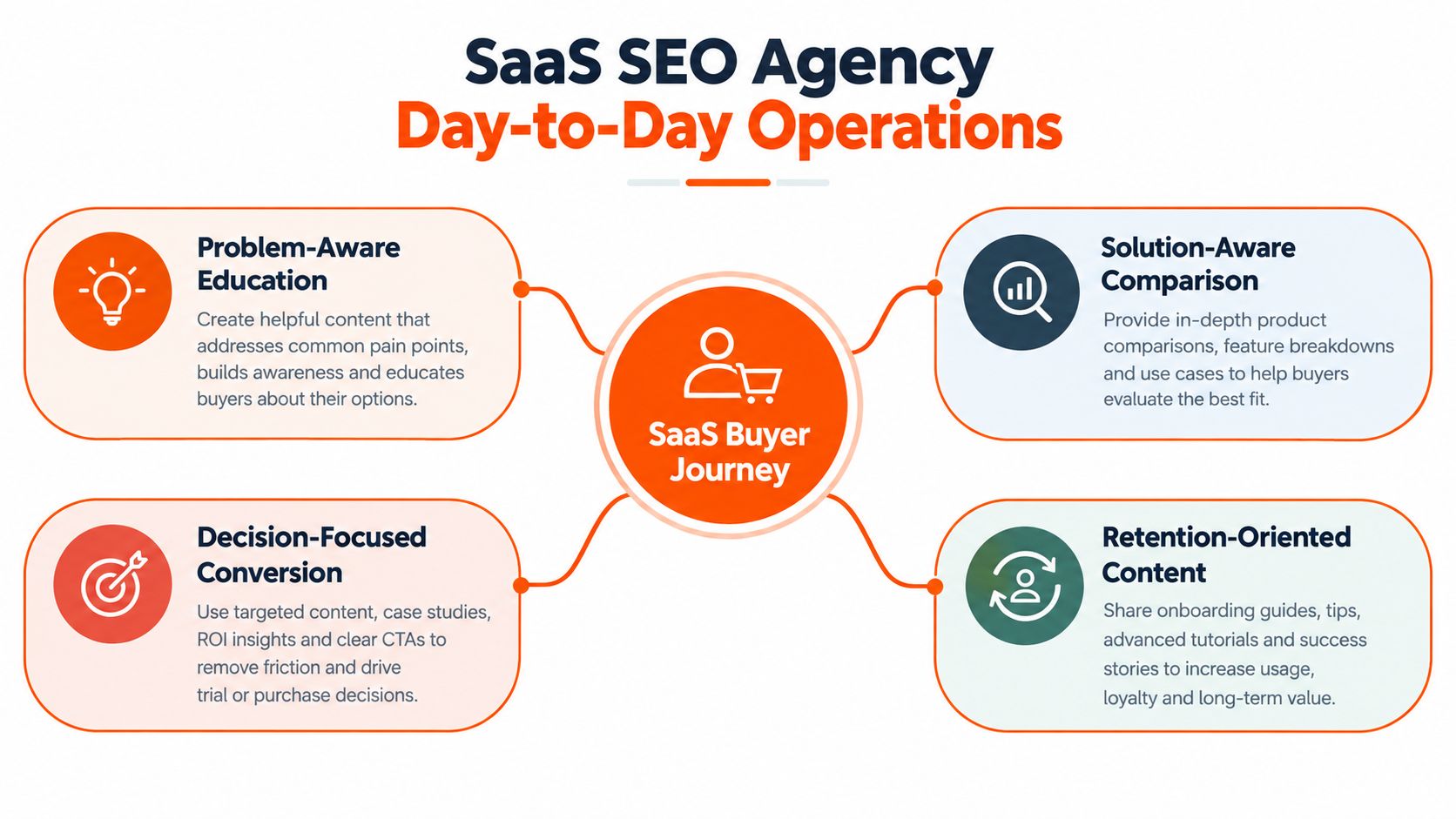
The work follows buyer intent
Problem-aware content answers questions such as how to reduce reporting work, secure customer data, or improve a recurring operational process. It earns the first useful interaction, but it shouldn't end with a lonely newsletter form. The article should point toward a relevant use case, calculator, explainer, or product workflow.
Comparison and alternative pages serve evaluators. A buyer searching for “Product A alternatives” isn't asking for a philosophical essay about productivity. That buyer wants differences, limitations, migration considerations, integrations, and a clear next step.
Integration, implementation, and security content helps technical reviewers decide whether the software will survive contact with the actual organisation. Documentation, architecture explanations, compliance information, and implementation guidance can support both organic discovery and sales enablement.
Pricing and ROI pages catch the buyer near a decision. They need plain language, qualification details, package logic, and a route to a demo or trial. Hiding the commercial answer behind a dramatic “Book a call” curtain usually creates friction, not intrigue.
Four workstreams run in parallel
A monthly programme should combine technical SEO, content, authority, and conversion optimisation. Technical work includes JavaScript rendering, canonical signals, internal links, structured data, XML sitemaps, and Core Web Vitals. Content work covers new pages and refreshes, while authority work earns relevant mentions through digital PR, useful research, and credible backlinks.
Conversion work connects landing pages to demo completion, trial activation, and sales quality. A page that ranks for a valuable query but sends visitors into a confusing product tour is an expensive public service announcement.
For teams building a careful authority programme, no-spam backlink strategy for startups can offer useful context on avoiding low-quality directory tactics. The principle is simple: relevance and editorial value matter more than collecting links like fridge magnets.
A SaaS agency should also inspect the raw HTML and rendered DOM. Google processes JavaScript pages through crawling, rendering, and indexing, then uses rendered HTML to understand the page. The Google JavaScript SEO guidance explains why client-side content, links, canonical signals, or structured data can be delayed or missed when scripts fail.
The process should include representative route testing in Google Search Console, monitoring JavaScript errors and hydration mismatches, and checking that indexable pages return valid status responses. Server-side rendering, static generation, or selective pre-rendering can reduce dependence on the rendering queue for high-value product and comparison pages.
The following video can help teams visualise the role of video in a broader SaaS acquisition system.
Video works especially well when a written comparison needs a product demonstration, a technical explanation, or a sales-ready walkthrough. The agency doesn't need to turn every article into a miniature film festival, but important commercial pages should give buyers a fast way to understand the product.
SaaS SEO Agency Pricing Models and What Each One Really Buys
Pricing models reveal how an agency thinks about accountability. A low monthly fee can buy activity without strategy. A performance promise can sound wonderfully brave while steering the agency toward easy keywords that don't matter to revenue.
Model | Best Fit Stage | Typical Commitment | Accountability Lever | Main Risk
Monthly retainer | SaaS teams needing continuous technical, content, authority, and CRO work | Sustained engagement over several months | Monthly roadmap, delivery scope, and pipeline reporting | Paying for activity that isn't connected to commercial priorities
Credit or project model | Teams needing defined audits, pages, refreshes, or campaign bursts | Fixed deliverables or a flexible credit bank | Approved outputs, acceptance criteria, and deadlines | Important follow-up work gets postponed between projects
Performance or milestone model | Teams with clean tracking and shared confidence in attribution | Milestones tied to agreed outcomes | Qualified demos, pipeline stages, or implementation milestones | Agency cherry-picks easy terms or disputes attribution
A retainer suits a SaaS company with a meaningful technical backlog and a steady need for content, internal linking, authority, and conversion work. It provides continuity, which matters because search assets often need several connected improvements before they perform. The danger is inertia. If every monthly report looks like a polite receipt, the engagement has become a subscription to meetings.
A credit model works when a team wants control. One month may fund a technical audit, while the next supports comparison pages or video repurposing. It suits a company with uneven priorities, but the buyer should confirm that unused credits don't disappear and that strategy remains included.
A performance model requires unusually clean CRM and analytics. The contract should define what counts as a qualified demo, how sales-assisted opportunities are handled, and which factors sit outside the agency's control. Otherwise, the agency may optimise for rankings that look impressive but attract poor-fit traffic.
Hidden costs deserve equal attention. Buyers should ask about minimum terms, content ownership, tooling pass-throughs, implementation fees, migration support, and the treatment of published assets after termination. A page isn't an asset if the client can't access, edit, or reuse it.
For teams comparing production partners, ContentBuck's SEO content service describes a model built around buyer-intent research, pillar and cluster planning, long-form articles, on-page optimisation, link building, and reporting. The important selection question isn't whether a provider lists those services. It's whether the scope connects them to the pages and stages that influence revenue.
Four Criteria That Separate a SaaS Fit Agency From a Generic One
A generic agency can perform competent SEO and still be a poor SaaS partner. Software companies need an agency that understands recurring-revenue economics, product education, technical architecture, and buying committees. The difference appears in the questions the agency asks before it recommends publishing another article about “best tools.”
A practical comparison
Criterion | SaaS-fit agency | Generic agency | Verification question
SaaS ownership | Shows software clients, product-led work, and retention context | Presents broad industry logos without relevant detail | “Which SaaS pages did the team change, and what commercial event followed?”
Technical depth | Can diagnose JavaScript rendering, headless CMS issues, indexing, and performance | Treats technical SEO as a one-time crawl report | “Can the team compare raw HTML with rendered DOM on a live route?”
Revenue attribution | Reports demos, trials, opportunity stages, assisted pipeline, and quality | Leads with traffic, rankings, and publishing volume | “How will CRM data change the monthly roadmap?”
Editorial depth | Produces specific, evidence-led content worth citing and sharing | Rewrites common knowledge with keyword variations | “What original evidence or expert input will make this page source-worthy?”
SaaS ownership is more than a logo slide. The agency should understand product-led growth, sales-assisted activation, implementation friction, and the difference between a free user and a qualified opportunity. A case study without the agency's exact role is decorative wallpaper.
Technical depth matters because modern SaaS sites often use React, Next.js, Vue, headless CMS platforms, or app-like routing. A team that only checks title tags won't catch a product page whose important copy exists only after an unreliable script executes.
Revenue attribution separates an SEO vendor from a traffic vendor. The agency should connect Search Console query groups and landing pages to CRM stages, branded-search movement, demo quality, and assisted opportunity influence. It should also report when rankings improve but lead quality worsens.
Editorial depth matters even more when AI systems select sources. A generic summary has little reason to be cited. Proprietary research, customer evidence, expert authorship, clear comparisons, and precise answer structures give retrieval systems something worth using.
A team exploring keyword discovery can review a practical resource on finding keywords with Claude, then ask whether the agency can turn keyword ideas into buyer-stage decisions rather than dumping them into a spreadsheet. Automation can accelerate research. It cannot decide what a security lead, finance owner, or technical evaluator needs to believe.
What Realistic SaaS SEO Case Examples Actually Look Like
Case studies often hide the part buyers need most: what changed, what didn't, and which metric mattered. A believable SaaS example includes trade-offs, not a heroic graph pointing permanently upward.

Example one: horizontal software with commercial clusters
A horizontal SaaS company had useful educational content but weak coverage of the pages buyers used during evaluation. The agency rebuilt the information architecture around comparison, alternative, and integration queries, then connected each page to product proof and a short explainer video.
The representative outcome was 34K monthly organic visitors after roughly a year, as described in the supplied ContentBuck publisher information. The number matters less than the architecture behind it. Traffic came from connected commercial pages, not a random pile of articles, and sales could share the videos when a prospect asked the same question for the fourth time that week.
The agency also tracked which pages assisted demo conversations. That distinction prevented the team from treating every visitor as equally valuable. A comparison page that influences a later branded demo request deserves more attention than an educational page that attracts students, hobbyists, and one determined person writing a school report at midnight.
A useful reference for understanding the shape of a SaaS programme is this SaaS growth timeline and takeaways. It reinforces the need to judge progress through stages rather than expect one dramatic launch-day spike.
Example two: vertical software with a technical bottleneck
A vertical SaaS company had a product site rendered heavily through JavaScript. Sessions were not the central problem. High-intent visitors reached the demo template, encountered performance friction, and failed to complete the request.
The agency audited rendering, fixed technical delivery issues, and improved Core Web Vitals on the demo-request template. Qualified demo requests rose while overall sessions stayed broadly constant. That is a better case study than a traffic chart because it shows the agency removed a conversion constraint rather than merely inviting more people into the same leaky bucket.
Google's mobile research found that a page loading one second faster achieved up to a 27% conversion-rate increase in the cited SOASTA study, while separate benchmark modelling associated a move from one to ten seconds with a 123% increase in mobile bounce probability. Those findings are documented in Google's mobile site speed playbook. The figures aren't a promise for any SaaS site, but they explain why performance belongs in pipeline work.
A broader collection of B2B SEO content case studies can help buyers compare outcomes, provided each case makes the starting problem, intervention, timeframe, and commercial metric clear.
The Vetting Checklist and Questions to Ask Before You Sign
A glossy proposal tells a buyer what the agency wants to sell. A useful vetting process reveals how the agency thinks when the site is messy, the CRM is incomplete, and the product team changes the navigation two days before launch.
Discovery call
Ask questions that force specificity:
Relevant ownership: “Which SaaS accounts has the proposed team personally handled?”
Commercial intent: “How will the agency prioritise product, comparison, integration, pricing, and problem-aware pages?”
Technical process: “How will raw HTML, rendered DOM, canonical signals, and JavaScript errors be checked?”
Customer context: “How will sales calls, win-loss notes, and customer interviews influence the content plan?”
AI visibility: “How will the team measure cited appearances, competitor mentions, and branded demand?”
Weak answers usually sound polished but empty. “The agency follows best practices” isn't a process. The buyer needs to hear who does the work, what gets inspected, and what changes when the evidence disagrees with the plan.
Proposal review
The proposal should name deliverables and decisions, not just output volume. It should show the target page types, internal-linking plan, technical implementation responsibilities, editorial review process, authority strategy, and reporting fields.
Check whether the agency owns the writing internally or relies on unreviewed drafts. Ask who approves technical claims, product details, compliance language, and customer evidence. A brilliant writer who misunderstands the product can produce elegant nonsense, which is still nonsense wearing a nice jacket.
Ask for the first 90 days in writing. The plan should include technical fixes, content priorities, measurement setup, dependencies, and the evidence that would cause the agency to change direction.
Pilot and contract
A pilot should test collaboration as well as output. Require clear acceptance criteria for pages, access to working files, ownership of published content, named contacts, communication cadence, and a route for escalating blocked implementation.
Before signing, confirm:
Exit terms: Notice period, handover process, and access to accounts and files.
Security: Handling of analytics, CRM, customer interviews, and unpublished product information.
Implementation: Who makes changes, who approves them, and how deployments are checked.
Reporting: Which metrics appear every month and which connect to opportunity stages.
Reference calls: Conversations with clients who resemble the company's market and sales motion.
Three agency calls should produce a defensible shortlist. If every deck sounds identical, the problem isn't a shortage of options. It's a shortage of questions.
What a Sensible 12 Month SaaS SEO Engagement Actually Looks Like
The first quarter should establish technical access, rendering reliability, content priorities, conversion tracking, and the initial set of high-intent pages. A team should see clearer baselines, cleaner reporting, and early indexing or impression movement, not theatrical claims of instant category ownership.
The next quarter should expand comparison, alternative, integration, use-case, and supporting educational content. Demo quality, landing-page conversion, branded-search movement, and cited appearances become more useful than publishing volume.
The following quarter is where connected clusters can begin to compound. Internal links, authority, product proof, video assets, and sales reuse should work together. The agency should identify which topics create qualified engagement and which attract traffic that the sales team never wants to see again.
The final quarter should make pipeline influence easier to defend. That doesn't mean every opportunity receives a neat “organic” label. Buyers move through direct visits, sales conversations, branded searches, referrals, and multiple content interactions. Reporting should reflect that complexity.
Track branded search lift, cited AI Overview appearances, demo-request rate by landing page, assisted pipeline, opportunity quality, and sales reuse before revenue becomes obvious. A sensible programme builds durable assets, but it must still earn its place in the growth budget through evidence.
SaaS SEO Agency Questions Smart Founders Ask First
How long does SaaS SEO take to produce pipeline?
The planning horizon should be measured in sustained execution, not a few lucky weeks. Technical fixes and strong bottom-of-funnel pages can create earlier signals, while competitive categories need longer authority and content development. A benchmark cited in B2B SEO research reports break-even at approximately seven months and an average 702% three-year ROI, but the source presents these as benchmarks, not guarantees. The figures appear in Ahrefs' B2B SEO research.
Why pair content with video?
Software is difficult to understand from text alone. A short comparison walkthrough or product explainer gives sales a reusable asset and helps evaluators grasp the workflow faster.
What happens to content if the engagement ends?
The client should retain access to published pages, source files, research, analytics, and working documents. The contract should define the handover before work begins.
Is AI Overview optimisation just hype?
No, but guaranteed citations are hype. The practical work involves clear claims, useful evidence, technical accessibility, expert authorship, proprietary research, and measurement that separates citations from clicks and pipeline.
ContentBuck offers SaaS teams buyer-intent SEO content, technical audits, content clusters, managed link building, video-led acquisition, and reporting connected to commercial goals. Visit ContentBuck to discuss a search and video system built for qualified demos, trials, and pipeline rather than vanity traffic.
Parth Jasrapuria
Founder at ContentBuck
Building video systems for B2B businesses. Obsessed with YouTube growth, creative strategy, and organic SEO.