Ow Much Should a B2B Company Spend on YouTube Per Month?
Parth Jasrapuria
Founder
65.1% of surveyed marketers said they planned to increase their YouTube marketing budgets during the following year, in Influencer Marketing Hub's survey of 250 marketing professionals. A bigger line item still fails if the line item is the wrong object.
A practical starting band for many B2B companies runs from about $3,000 to $9,600 per month, set from revenue and the share of the marketing budget allocated to video. Treat that band as a planning recommendation, not a standard for every company. Split it across production, paid distribution, and measurement. One editing invoice hides that choice, and a single mysterious monthly fee is a bad receipt.
Production creates something worth watching. Paid distribution puts it in front of buyers. Measurement shows whether anyone with budget moved closer to a sales conversation. Judge the spend on qualified pipeline after a few months, not on views. The spend worth approving is the smallest monthly test that can produce that evidence.
Monthly YouTube Budgets You Can Plan From
A usable starting band is $3,000 to $9,600 a month, picked from the marketing budget rather than from a random production quote. Pick a row by revenue, content spend, and publishing pace, then treat that row as a test budget with a pipeline scoreboard.
Situation | Monthly amount | What it covers | How the number is set
Lean B2B test | $3,000 to $8,000 | One long-form video, clips, thumbnails, light testing | Start small and raise only when qualified leads show up
$10 million revenue, 5% to 15% of marketing | $3,200 to $9,600 | YouTube inside a wider acquisition system | 7.7% of revenue is about $64,167 marketing per month, then 5% to 15%
Content spend of $20,000 a month | $5,000 to $8,000 | Video's share of the content budget | 25% is $5,000 and 40% is $8,000
Larger dedicated video programs | $6,667 to $33,333+ | Ongoing video marketing, not one film | 45% of businesses spend $20,000 to $100,000+ per quarter on video
Paid views add-on, separate from filming | about $2,000 in media | Roughly 100,000 YouTube ad views | Media auction cost, not production
Start From Revenue, Not From a Quote
The math gets calmer once revenue sets the ceiling. Gartner's 2025 CMO Spend Survey found that marketing budgets averaged 7.7% of company revenue across 402 CMOs and senior marketing leaders, and paid media represented 30.6% of marketing budgets. For a company with $10 million in annual revenue, those figures imply about $770,000 per year, or $64,167 per month, for total marketing and roughly $20,000 per month for paid media.
Assigning 5% to 15% of the monthly marketing budget to YouTube gives approximately $3,200 to $9,600 per month for that company. That percentage is a planning recommendation, not a law of physics. Copying a billion-dollar CMO percentage onto a 12-person SaaS without checking cash flow is like renting a stadium for a book club. Comfortable seating, terrible decision.
Cross-Check Against the Content Budget
A second check keeps the number honest. If content already costs $20,000 a month, then 25% for video is $5,000 and 40% is $8,000. That framing fits how B2B teams already buy articles, webinars, and sales assets, and it stops YouTube from becoming the odd expense nobody can explain in a finance meeting.
The wider market shows why video deserves that share. The Content Marketing Institute's global 2024 B2B research found that 69% of B2B marketers planned to increase investment in video. A weekly long-form video with short clips, thumbnails, search optimization, and promotion needs materially more money than an occasional brand film. Publishing pace sets the bill, not optimism.
Planning rule: Fund the cadence that can be repeated for several months, not the launch week that looks exciting in a deck.
Larger programs provide a scale check, not a starter invoice. A Siege Media compilation of video marketing statistics reports that 45% spend between $20,000 and more than $100,000 per quarter, roughly $6,667 to over $33,333 per month, and that reaching 100,000 viewers through YouTube Ads generally requires about $2,000. A lean software company can still start at $3,000 to $8,000 monthly for one strong long-form video, clips, thumbnails, and testing. The increase should follow qualified leads, not applause.
Pick One Row This Week
Lean and unproven: Choose the $3,000 to $8,000 test and publish one strong video at a time.
Near $10 million in revenue: Choose $3,200 to $9,600 and fund production, distribution, analytics, and conversion assets together.
Already spending on content: Give video a clear share, such as $5,000 to $8,000 from a $20,000 content month.
Any row is defensible if the next review checks qualified pipeline, customer acquisition cost, and assisted conversions. A row picked because a freelancer sounded confident is just a receipt looking for a reason.
Production Spend Versus Ad Spend
45% of larger video programs spend $20,000 to more than $100,000 per quarter. That range is a scale check, not a reason to dump one mysterious monthly fee into "YouTube." Split the month into production, paid distribution, and measurement. Then judge it on qualified pipeline after a few months, not on views.
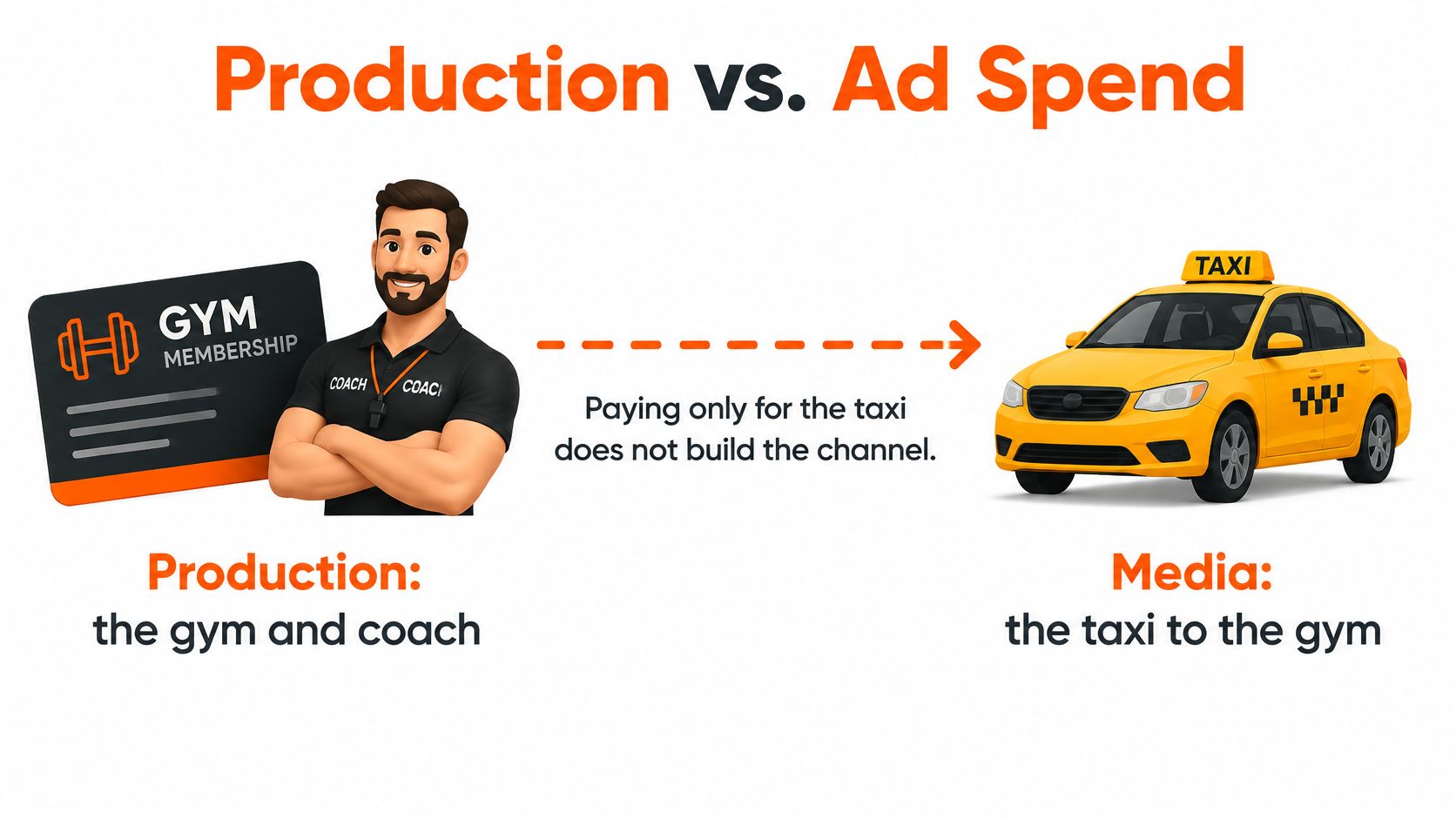
Production is the gym membership and the coach. Media is the taxi that brings people to the gym. A taxi with no gym builds no channel. A polished video with no distribution is a private screening for the marketing team.
The visual below puts that trade-off in one frame before the numbers get argued over.
Read the Split as Shares of One Month
Plan | Production | Paid distribution | Measurement and conversion assets
Lean test around $3,000 to $8,000 | Most of the month, one long-form plus clips and thumbnails | A few hundred to about $2,000 if ads are used | Light tracking of calls and assisted visits
$10,000 learning month | about $6,000 | about $3,000 | about $1,000
Growth month inside the 5% to 15% band | Weekly or multi-video production and repurposing | Separate media bought on engaged actions, not cheap views | Landing pages, offline conversion imports, pipeline review
A $10,000 learning month can run about $6,000 on production and repurposing, $3,000 on targeted YouTube distribution, and $1,000 on analytics, experimentation, and conversion assets. Those are shares of the same month, not three invoices fighting in a hallway. Teams short on ad variants can speed up testing with a ShortGenius AI ad creative tool, while the budget logic stays unchanged. Creative volume helps only when the offer, audience, and landing page already make sense.
Auction Prices Don't Buy a Script
Media benchmarks describe auctions, not credibility. Store Growers' YouTube ads benchmarks place typical YouTube advertising CPM at roughly $5 to $10, with B2B CPV around $0.037. Those prices don't buy topic research, scripts, filming, edits, captions, thumbnails, or repurposing. A $2,000 ad budget can buy reach. It is not a channel strategy, any more than buying petrol counts as owning a car.
Production should cover the work a B2B buyer feels. Topics come from searches operators and technical leaders type. The script needs a clear promise. The edit has to respect attention. Captions, a thumbnail that earns the click, and short clips cut from the long video all sit on this line. One asset should leave the week as several usable pieces, not as a single file waiting politely for fame.
Media should buy engaged sessions, qualified site actions, or a remarketing pool, not the cheapest views on the internet. Cheap views from the wrong accounts are discounted confetti. A detailed breakdown of paid YouTube promotion choices helps separate distribution tactics from production promises before money moves.
Write three lines on the budget sheet this week: production, media, and measurement. Refuse any plan that collapses them into one mysterious fee.
Measurement gets its own line because sales follow-up, landing pages, attribution, and conversion assets cost real time. Skip that line and interest evaporates before sales sees it. Fund all three and each month teaches a clearer lesson about topic, hook, thumbnail, audience, call to action, and offer. After a few months, keep the split only if qualified pipeline moved. Views alone do not earn the next invoice.
Where Explainer Videos Fit the Monthly Bill
A company explainer is a short film, often 60 to 90 seconds, that shows what a product does, who it serves, and what changes after use. It works like the product label on a complicated box. The long YouTube video is the instruction manual a buyer searches for later.
The production image here shows the kind of planned shoot that sits behind a polished explainer or product demonstration.

Buy an Explainer When Confusion Blocks the Sale
An explainer earns a place in the month under three conditions. The offer takes more than one sentence to grasp, sales keeps repeating the same demo, or the homepage loses visitors before the call to action. Before you lock animation, screen capture, live action, or a mix, have someone on the team review how AI explainer videos work as one production path, then choose the format that makes the offer obvious.
Say a project tool replaces three spreadsheets. Monday opens with version chaos and a status meeting held together by hope. The explainer then shows one workflow, one owner, and one Friday report that writes itself from work already logged. In under 90 seconds, the buyer sees the mess, the mechanism, and the calmer Friday, then gets pointed to a demo. No poetry degree required.
Put Each Format in the Right Job
The explainer belongs on the website, in sales follow-up, and as a YouTube ad or pre-roll. Long-form videos belong on the channel, where search demand and deeper trust can build over time. One polished explainer is a project fee inside the production line, such as part of the roughly $6,000 production share in a $10,000 learning month. It is not a substitute for a publishing habit, and it is not the media budget that puts that film in front of buyers.
The short example below shows how a tight explanation can carry one idea without turning into a webinar wearing a costume.
Repurposing is where the monthly bill starts behaving. Treat the explainer as one production asset that has to earn more than a single placement, not as proof that "video works" in the abstract. A B2B accounting firm can turn one 20-minute cash-flow forecasting discussion into a full episode, three short clips, a newsletter section, and a sales leave-behind. Current pricing context for that project slice sits in this guide to explainer video rates and cost drivers.
Publishing one gorgeous explainer and demanding a pipeline by Friday is like planting one tomato seed and suing agriculture. Fund an explainer when comprehension is the bottleneck. Fund the channel when search demand is the bottleneck. Fund both only when each one has a distinct job, then judge the month on qualified conversations, not on how pretty the film looked.
Buyer Actions That Justify the Spend
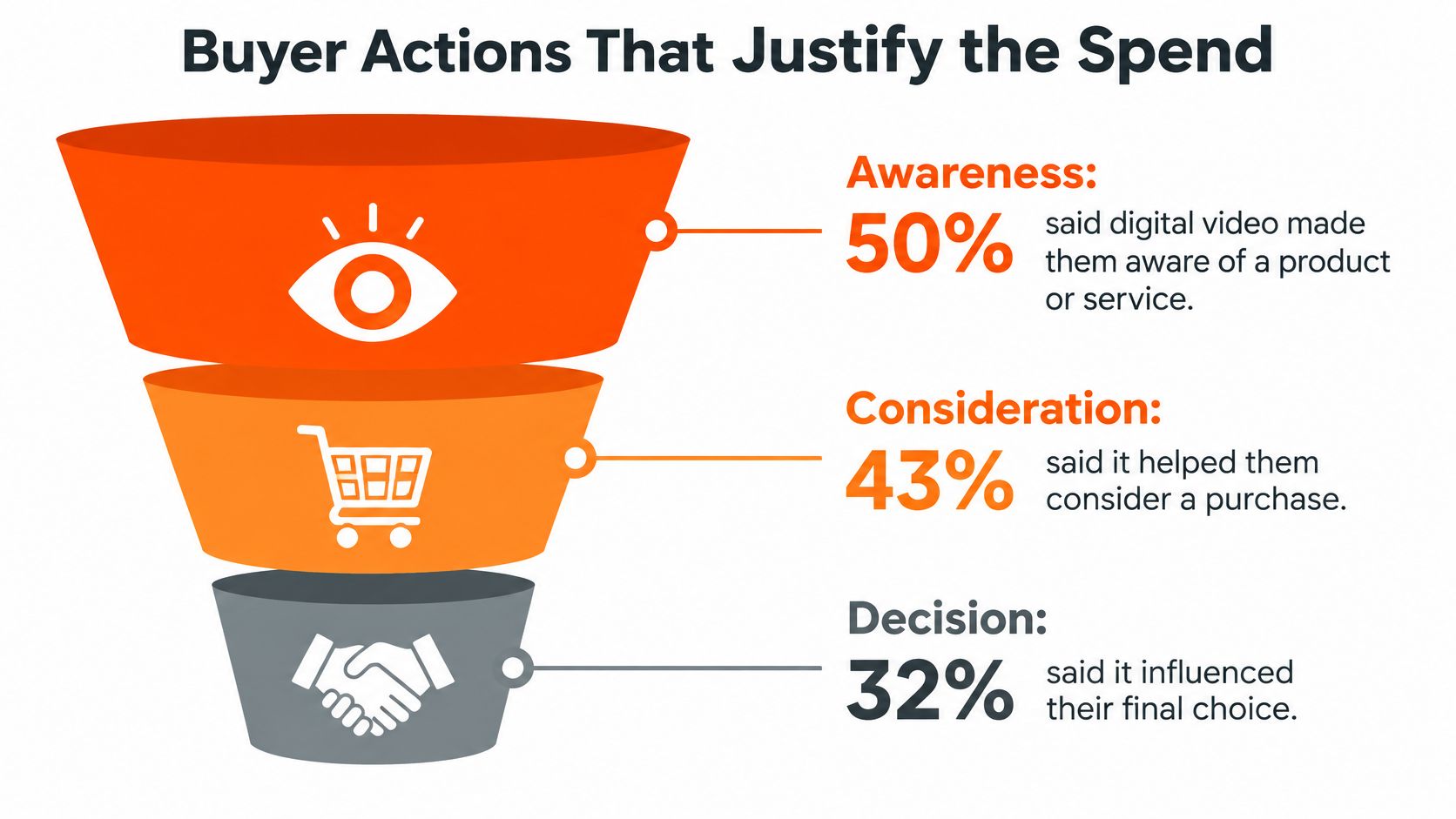
Views are applause. Buyer actions are the scoreboard. A CFO recognizing the category, an operations lead watching a second video, and a buying group dropping a rival after a comparison video all matter more than a subscriber count doing a happy little jump.
The funnel graphic below translates those buyer steps into stages a sales team can recognize.
Four Influence Numbers Worth Putting in the Budget Deck
Among respondents who said digital video influenced their purchase journey, the Google-commissioned BCG study on video influence found that 50% said it made them aware of a product or brand, 43% said video created interest in buying, 45% said it helped them choose a product or brand, and 34% said it prompted a specific purchase. The same study reported that YouTube was 1.7 times more likely than social platforms to positively influence brand consideration and 1.6 times more likely to influence purchase decisions.
Translate each stage into a plain B2B moment:
Awareness: A finance leader now recognizes the problem category and the company name.
Interest: An operations lead watches a second video instead of bouncing back to email.
Choice: A buying group uses a teardown video to remove a weaker rival from the shortlist.
Purchase prompt: A demo request lands, which beats a subscribe button in every currency.
The $5,000 Cybersecurity Test
Say a cybersecurity firm spends about $5,000 a month producing educational videos and promoting the strongest ones. The review should count demo requests, sales conversations, and influenced pipeline. A video seen by 2,000 highly relevant IT leaders can beat one seen by 100,000 casual viewers, because only one audience can sign a contract.
The scoreboard should measure business outcomes, not merely applause from the algorithm.
Instrument the early signals before closed revenue arrives. Track qualified watch behavior, demo-page visits, target-account engagement, and assisted conversions, then connect campaign clicks cleanly with a paid ad link tracking guide. Pick one downstream metric the sales team already trusts before the next invoice gets approved. Without that agreement, marketing celebrates reach while sales asks where the meetings went, and both sides leave the room annoyed.
Three Illustrative Budget Receipts
One monthly fee is the wrong object. Split the bill into production, paid distribution, and measurement, then judge it on qualified pipeline after a few months, not on views.
Receipt One Cybersecurity Teaching Videos
A cybersecurity firm spends about $5,000 a month for three months on teaching videos and promotion. Production covers scripts, edits, and thumbnails. Paid distribution promotes only the videos that already hold a buyer's attention. Measurement is the demo form tied to those videos, so sales can see what arrived. Month three brings 18 demo requests, 6 sales conversations, and 2 influenced deals, while subscribers barely move. The channel looks sleepy to a creator and useful to a sales leader.
Meetings are the receipt. Subscribers are the crowd outside the store. Celebrating a rising subscriber count while ignoring 18 meetings is like throwing a party for the line and forgetting to open the register.
Receipt Two Project Management SaaS
A project management SaaS team publishes one explainer and three long-form episodes built around buyer searches. Production is those four assets. Paid distribution stays light because the searches already pull operators with budget. Measurement is a sales-accepted lead the team defined before the first upload. The sales lead later reports 40 sales-accepted leads that match the ideal customer profile. Total views stay modest because the market is narrow, the product is specific, and random viewers have no reason to care about workflow permissions at lunch.
That shape is commercially healthy. A small audience of operators with budget can justify the month faster than a large audience of students, competitors, and professional video collectors. The receipt is accepted leads with names, companies, and a next step.
Receipt Three Accounting Search Video
An accounting firm's cash-flow video ranks for a search phrase owners type before tax season. Production is one video plus three clips reused in email follow-up. Paid spend can sit near zero once the search term does the distribution. Measurement is booked calls, which is why finance never frames the view count. The video brings 12 booked calls in one quarter.
Search-led videos can keep paying rent after production ends because the question keeps getting typed. Fund topics with buying intent, not topics that merely sound clever in a brainstorm. Clever is nice. Booked calls pay for the next shoot.
Real delivery can look similar when the channel targets buyers from the start. ContentBuck built a financial consultancy's YouTube channel from scratch, and three months later it had 12,000 subscribers and 18 meetings booked directly from YouTube. In the Meridian Advisory case study, YouTube became the client's top inbound channel three months after the channel was built from scratch. A separate project management SaaS video titled "How We Built a $2M Inbound Pipeline Using YouTube" generated 180+ inbound leads.
Write the target receipt before the first invoice: meetings, sales-accepted leads, or influenced pipeline. Views can decorate the report. They do not approve the next month's spend.
How Many Months Before You Judge Results
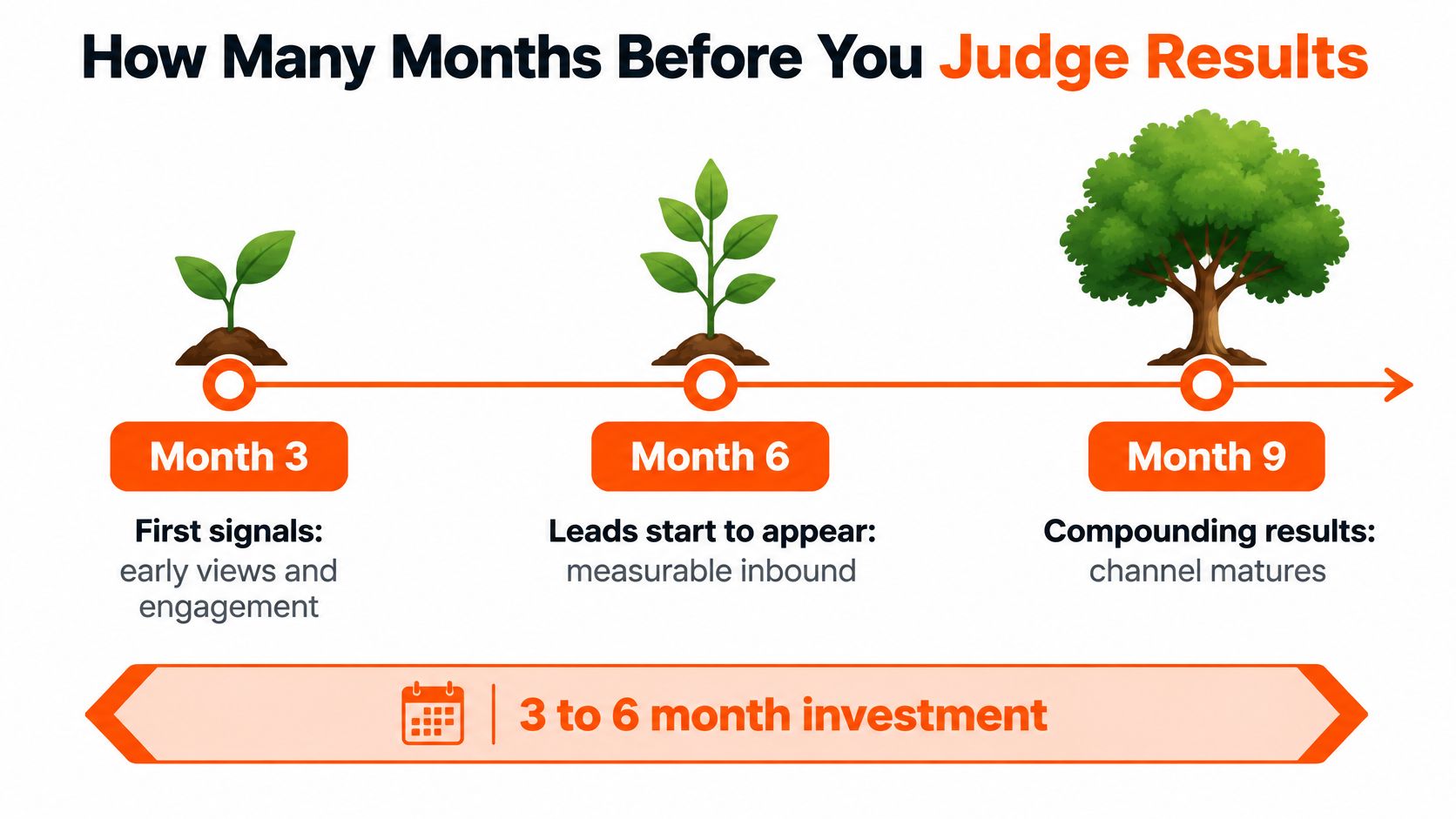
B2B YouTube is a 3 to 6 month investment, not a vending machine for leads by Friday. ContentBuck states that YouTube is a 3-6 month investment and is not suited to clients who need leads within a week. A skeptical CFO deserves that timeline in writing before the first invoice arrives.
The timeline graphic below gives that patience a shape that fits on one slide.
Read Each Stage With the Right Metric
Month | Purpose | Metric to read
Month 1 | Setup: buyer-search topics, first videos, demo-page tracking | Tracking live and topic list approved
Months 2 to 3 | Pattern finding at about $4,000 a month | Impressions, click-through rate, average view duration, branded search, target-account views
Months 4 to 6 | Commercial read | Sourced and influenced pipeline, cost per qualified visit, cost per sales-accepted lead
Month 1 is setup, not judgment day. Topics come from real buyer searches, the first videos go live, and tracking reaches the demo page, booking form, and CRM. A team that skips setup will spend later months arguing about vibes. Vibes don't import into a pipeline report.
Months 2 and 3 are for pattern finding. A three-month test near $4,000 a month gives enough repeated launches to compare impressions, click-through rate, average view duration, branded search, and target-account viewing. It does not guarantee closed-won trophies, especially when the sales cycle moves at committee speed. Checking the channel every morning like a pot of water that refuses to boil on camera won't shorten that cycle.
Months 4 to 6 bring the commercial read. Judge sourced and influenced pipeline, cost per qualified visit, and cost per sales-accepted lead, alongside lead quality, conversion, ROI, and acquisition cost. A deeper timeline for how long YouTube payoff takes for B2B SaaS helps set that review date before impatience sets it first.
Some signals don't count as a verdict. One viral miss proves little, subscriber rank proves less, and a cheap CPM can mean the wrong audience was inexpensive. Keep funding when qualified actions rise while revenue lags behind a normal sales cycle. Cut or re-scope when viewers stay outside the buying group after the test window, because more months won't turn tourists into a procurement committee.
Confirm Your Monthly YouTube Budget
Approve a test, not a forever retainer. A company near $10 million in revenue can approve $3,200 to $9,600 and split it across production, media, and measurement. A leaner team can approve $3,000 to $8,000, or a tighter three-month test around $4,000 a month, with one pipeline metric named in advance.
Frequently Asked Questions
Should an in-house editor salary count in the monthly number
Yes. Count internal time, review time, and sales follow-up, or the plan will look cheaper than reality. Hidden labor is how a low budget wins approval and then eats every Friday afternoon.
Is one explainer the same as a YouTube channel
No. Buy the explainer when the product is hard to grasp. Buy ongoing videos when buyers already search for the problem. One asset explains, while a channel compounds discovery and trust.
What if monthly ad spend is under $3,000
Heavy video ad creative is probably the wrong fit until media spend can produce usable learning. ContentBuck says its video ad creative is probably not the right fit for IT services companies whose monthly ad spend is under $3K. A company spending $5,000 or more on LinkedIn and needing creative for CTOs is a better match for ongoing ad variants.
Pressure-test the number before signing anything. A Free YouTube Audit from ContentBuck, plus its YouTube Title Generator, Video Ad Hook Generator, YouTube RPM Calculator, and Video ROI Calculator, can check whether topics and math survive contact with reality. For a done-for-them cadence, YouTube Growth includes 4 long-form videos per month with a full script and a monthly channel strategy review. The wrong monthly number isn't a moral failure. It's just an invoice that never met a pipeline.
Turn that monthly test into a channel buyers can find, trust, and act on with a B2B video partner that handles scripting, production, thumbnails, clips, and strategy under one plan. Visit ContentBuck to pressure-test the budget, review the channel opportunity, and choose a starting cadence tied to qualified pipeline instead of views.
Parth Jasrapuria
Founder at ContentBuck
Building video systems for B2B businesses. Obsessed with YouTube growth, creative strategy, and organic SEO.