How to Optimize a B2B Website for AI Search: Step by Step
Parth Jasrapuria
Founder
The marketing dashboard still shows respectable rankings, but demo requests aren't keeping pace. Meanwhile, a competitor keeps appearing in AI-generated recommendations, despite having a website that looks like it survived several management changes.
For teams deciding how to optimize a B2B website for AI search, the useful starting point isn't another markup plugin. It's making the company's expertise accessible, quotable and verifiable, then checking whether that visibility helps buyers move toward a commercial conversation.
What Changes When AI Answers the Question First
At 4pm, a finance director types best invoice automation for mid-size firms into an AI assistant. A neat comparison appears, the director saves a shortlist, and the tab closes without a single vendor visit. Somewhere, a marketing manager refreshes an analytics dashboard. Nothing happens.
That scenario reflects a measurable change in search behaviour. In an analysis of browsing activity from U.S. adults during March 2025, Pew Research Center found that users clicked a conventional search-result link in 8% of visits with an AI summary, compared with 15% without one.
B2B research is changing too. In 2025, 47% of B2B buyers used generative AI for time-sensitive activities, including market research and questionnaire drafting, according to Responsive's survey of 350 buyers.
The commercial objective has changed
Ranking can still earn visits, but it doesn't guarantee them. A vendor also needs accurate representation inside answers, plus destination pages worth opening when a buyer needs to verify details.
That creates distinct jobs:
Get retrieved: Publish pages that search systems can access.
Get quoted accurately: Explain scope, limitations and proof in self-contained passages.
Earn the next action: Offer implementation details, useful tools or a relevant commercial conversation.
A citation is exposure, not a purchase order. The buying committee still needs convincing.
The immediate task is small: list the questions prospects ask most often, then check whether each has a clear, standalone answer on the website. If an account executive needs several slides to translate the homepage, the homepage needs work.
How to Audit Crawlability Before Writing a Single Word
A persuasive page can't help if retrieval systems can't fetch its useful content. Google's AI optimization guidance makes publicly accessible, crawlable content a foundation for generative search features.
Start with the pages closest to revenue: services, pricing, integrations, security and implementation. A blog audit can wait while the pricing page is accidentally wearing an invisibility cloak.
Check access before polishing copy
The audit follows a straightforward sequence.
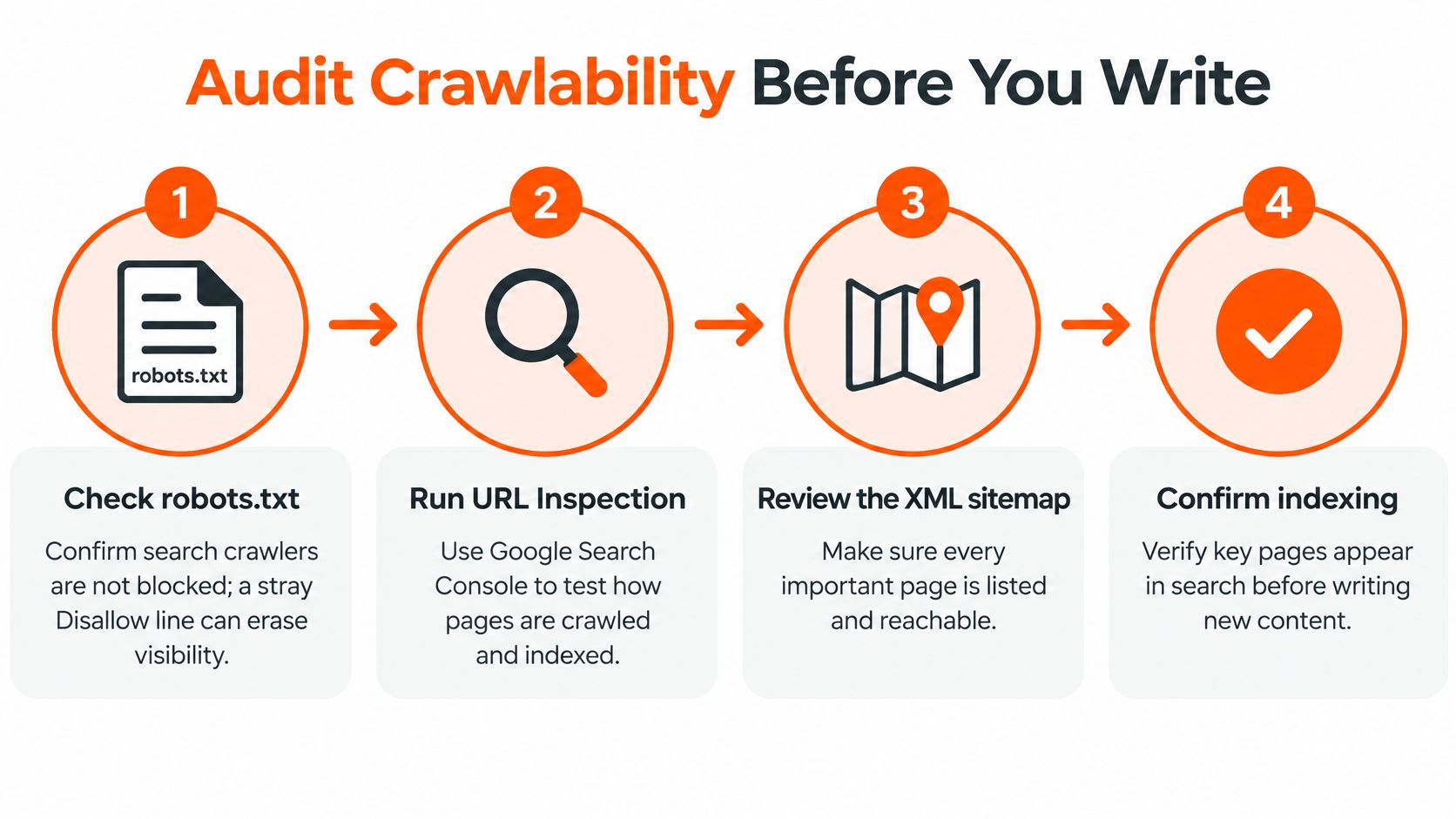
Inspect robots.txt and access controls. Confirm relevant search crawlers can reach public commercial content. Check CDN and firewall rules too, while keeping customer dashboards and private documents protected. Permission for search retrieval shouldn't be confused with permission for model training.
Run URL Inspection in Google Search Console. Compare the rendered page with what a visitor sees. Check that product descriptions, commercial terms and evidence survive rendering, rather than appearing only after an interaction.
Review responses and redirects. Important live pages should return a successful HTTP response. Remove unnecessary redirect chains and repair broken internal destinations.
Clean the XML sitemap. Include indexable, canonical pages rather than redirects, duplicates or retired URLs. A sitemap helps discovery; it doesn't override conflicting indexing instructions.
Find accidental noindex directives. Check page source and response headers. Staging settings have a remarkable talent for surviving launch parties.
Resolve near-duplicate pages. Merge pages that serve the same purpose, redirect retired versions, and use canonical tags where duplicate URLs must remain. Don't canonicalize different industry pages merely because their layouts match.
Expose important facts in HTML. Keep pricing logic, integrations, implementation requirements and outcomes available as page text, not exclusively inside PDFs, videos or widgets.
Test the buyer's actual question
Say a SaaS implementation page links to an authenticated PDF containing its onboarding requirements. Moving the public requirements onto the page makes them available without a login. Confidential deployment details can remain protected.
For an additional audit perspective, teams can see how Agentable scores agent-readiness. Treat a score as a diagnostic prompt, not proof that an AI system will cite the site.
New sites also need basic discovery and internal linking. The practical foundations in ranking a new B2B website on Google belong alongside this audit, not in a separate technical universe.
Healthy means reachable, indexable and readable. Every priority page should expose its key facts in rendered HTML, have a deliberate canonical URL, and be connected to the site's navigation.
How to Write Answer-First Pages AI Can Quote
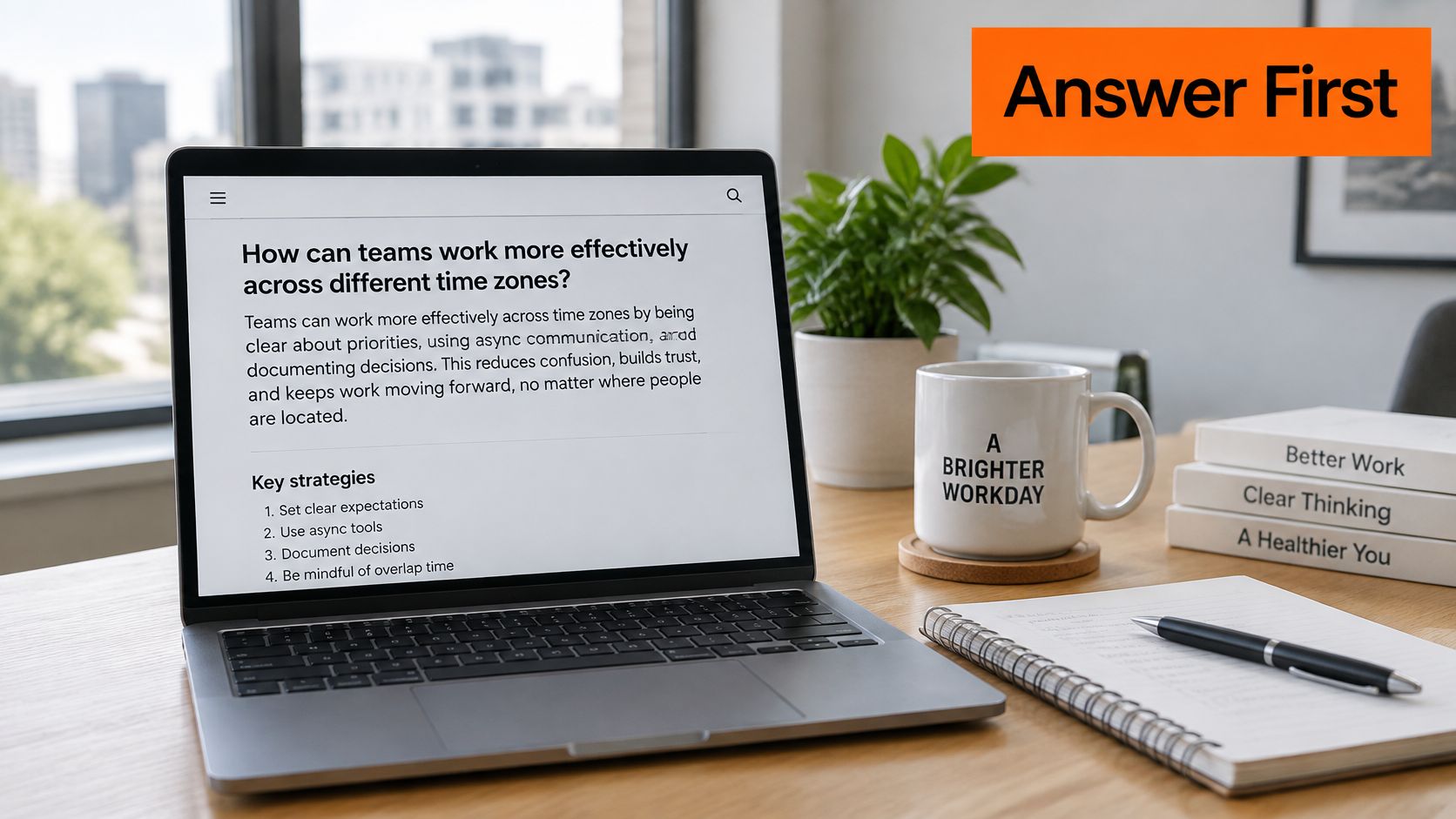
Use a buyer's question as the heading, answer it directly, then provide evidence and qualifications. The answer should make sense even when separated from the surrounding page.
For an editing service, What does unlimited ad editing include? is more useful than Creativity without limits. A good answer names supported formats, request limits, revision rules, delivery expectations and buyer fit. Unlimited enthusiasm isn't a service specification.
A focused writing setup helps teams review these passages together.
Page elements that make an answer quotable
The sample lines below are illustrative templates, not claims about an actual vendor or customer.
Page element | What to include | Example line
Question heading | The exact words a buyer would type | How long does implementation take?
Direct answer | A short answer followed by scope and conditions | Implementation includes configuration, migration and administrator training; timing follows the agreed migration scope.
Evidence line | Client type, baseline, timeframe and metric | Logistics customer, documented pre-launch baseline, agreed review period, missed-delivery rate before and after deployment.
Author and date | Named expert and actual last-updated date | Reviewed by the named implementation lead, with the review date displayed.
Next step | A clear action for readers who need more | Download the implementation checklist.
The template isn't a reason to publish lifeless answers. Add the constraint a buyer needs: whether migration excludes historical attachments, whether revisions count as new requests, or whether an integration requires a particular subscription.
Make evidence independently useful
Replace results improved significantly with a documented account of who changed what, compared with which baseline, over what period. Include the measurement method and any other intervention that could explain the outcome.
For example, a paid-media case study should distinguish new creative from simultaneous changes to audience targeting. Otherwise, the agency is giving the thumbnail credit for everything except the weather.
Useful evidence includes:
Customer context: Industry, team type and relevant operating conditions.
Measurement context: Baseline, outcome, timeframe and metric definition.
Limitations: Exclusions, attribution uncertainty and conditions required for success.
Evidence test: A buyer should be able to challenge a claim without first requesting a detective's licence.
Give technical facts their own answer blocks. A cybersecurity vendor might separate retention settings, supported compliance frameworks and implementation dependencies instead of mixing them into a paragraph labelled Enterprise-grade confidence.
This embedded video provides an additional B2B marketing reference.
Question selection should start with sales-call notes, support tickets and prompts prospects use. Keyword tools help group language and identify demand, but they shouldn't invent the customer's problem.
Use the central keyword naturally in the title and relevant headings, then connect related pages with descriptive links. A disciplined SEO content writing process should preserve buyer usefulness rather than turn every paragraph into a keyword storage unit.
Where Explainer Videos Fit in AI-Ready Pages
An explainer video shows what a product does and why it matters, using narration, visuals and a clear explanation. It helps when a workflow is easier to demonstrate than describe, especially when the product has more moving parts than a procurement committee.
In 2025, 94% of business buyers used AI during the buying process, according to Forrester's 2025 Buyers' Journey Survey. That makes the surrounding product information important: buyers need material they can find, compare and verify, not just watch.
Explainer video formats and what each one is for
These lengths are production planning ranges, not research benchmarks. The useful length is the shortest version that explains the buyer's task without hiding essential detail.
Format | Typical length | Best use case | Publish with it
Animated explainer | Suggested brief of 60–90 seconds | Abstract products and processes | Transcript and a summary paragraph
Product demo | Suggested brief of 3–5 minutes | Showing screens to evaluators | Chapter list and written steps
How-it-works walkthrough | Suggested brief of 5–8 minutes | Technical buyers comparing approaches | Full transcript with headings
Customer story | Suggested brief of 2–4 minutes | Proving results to buying committees | Named client, baseline and timeframe in text
Webinar clip | Suggested brief of 30–90 seconds | Repurposing expert talks | Speaker name, topic and key claims in text
Choose by buyer confusion
Animation suits an invisible process, such as how an invoice moves through approval rules. A screen recording suits a concrete evaluation question, such as how an administrator handles an exception.
Customer stories do a different job. They should explain the decision, deployment and outcome rather than assemble a montage of smiling people saying great partner.
Say a logistics software company publishes an animated overview of its dispatch workflow. The page should also explain supported integrations, pricing logic and operating requirements in readable text, with the transcript beneath the player.
Don't rely on video alone to carry commercial facts. Some systems can process audiovisual material, but a visible transcript and summary make essential information accessible without requiring that capability.
The same discipline applies when adding videos to blog posts: the video should clarify the page's purpose, not interrupt it. Choose the format that resolves the product's most expensive misunderstanding, then build the supporting text around that job.
Measuring Citations, Demand and Pipeline Separately
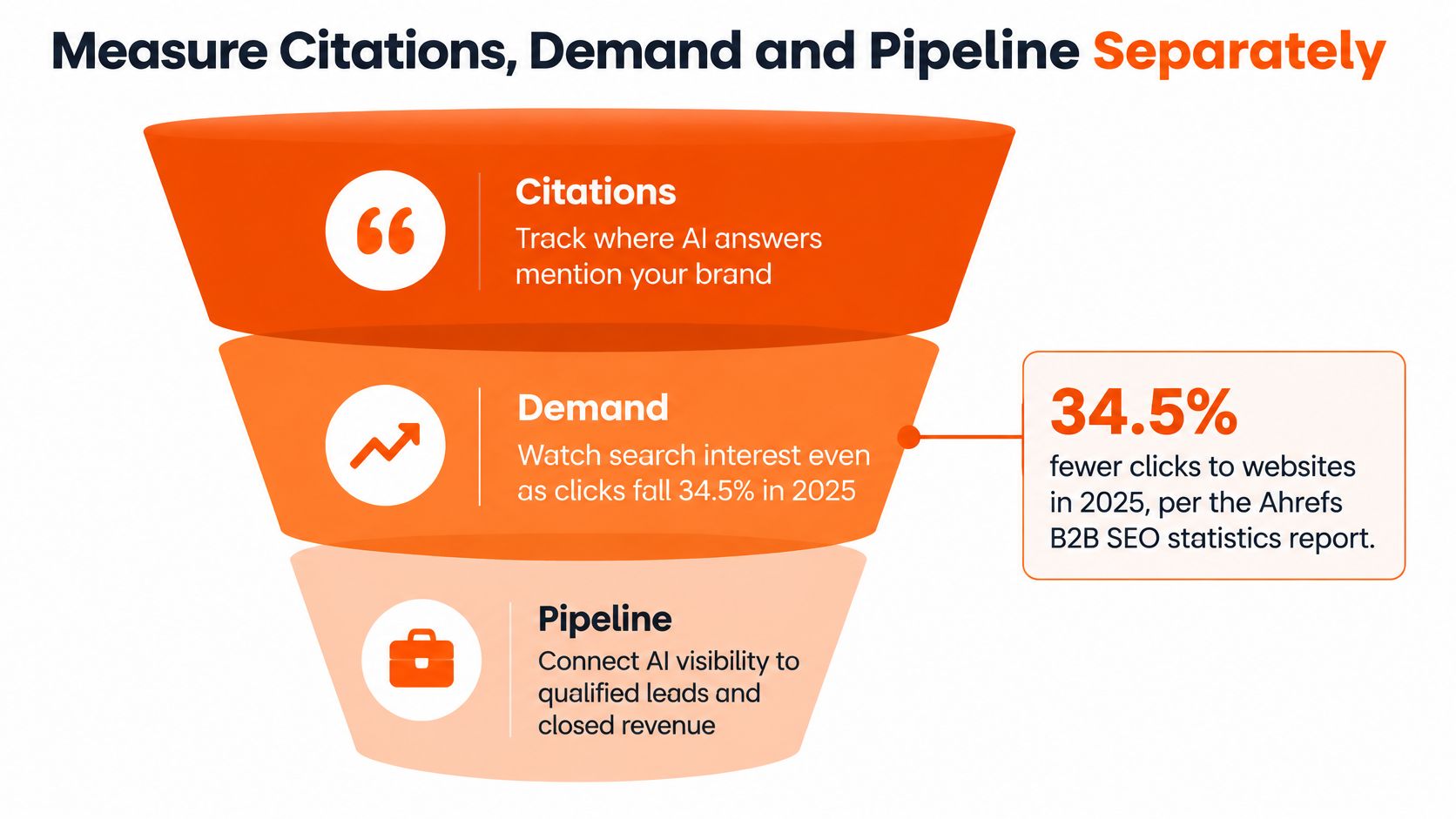
AI Overviews reduced clicks to websites by 34.5% in 2025, according to the study cited in Ahrefs' B2B SEO statistics report. That finding shouldn't become a forecast for every website, but it does challenge the assumption that stable rankings must produce stable traffic.
Fewer clicks don't automatically mean weaker commercial performance. An answer can influence a shortlist before anyone visits the vendor's site. Equally, a growing pile of mentions can produce absolutely no qualified opportunities. Both possibilities need checking.
Metrics for AI search work and where to check them
Metric | What it tells the team | Where to check
Citations in AI answers | Whether pages get quoted for buyer prompts | AI answer tracking tools and Bing AI Performance reporting
Branded search volume | Whether interest in the company changes | Google Search Console branded-query impressions and clicks, as a proxy
Visits from answer pages | Whether readers reach and use the destination | Web analytics landing-page and referral reports
Demo or proposal requests by source | Whether content produces commercial conversations | CRM and form tracking
Sales-confirmed influence | Whether prospects mention an article or AI answer | CRM notes and call summaries
Bing's AI Performance reporting identifies cited pages and associated grounding queries. Use platform reporting where available, while recognising that no single dashboard covers the entire buying journey.
The reporting model needs separate stages.
Run a manageable page-level test
Choose a small group of answer pages and record the buyer prompts each should address. Repeat checks on a consistent schedule, logging the platform, prompt, date, brand inclusion, cited URL and factual accuracy.
Pair that record with commercial evidence:
Analytics: Landing-page engagement and identifiable AI referrals.
Forms: Self-reported discovery source alongside technical attribution.
Sales notes: Whether the prospect names a specific answer, article or comparison.
CRM progression: Qualified opportunities and eventual revenue, not merely submissions.
Say an HR software firm's comparison page starts receiving citations while branded searches rise and ordinary organic visits fall. That's a reason to investigate, not announce that AI generated the extra demand. Advertising, events and referrals could also explain it.
Reporting rule: Citation growth is evidence of visibility. Revenue attribution needs additional evidence.
Agree on success before the report arrives. For an implementation page, qualified demo requests may matter most; for a category explainer, accurate inclusion in relevant answers may be the leading indicator.
Mistakes That Quietly Hurt AI Visibility
The expensive mistakes are often ordinary website problems wearing fashionable terminology. A new acronym doesn't repair a page that refuses to answer anything.
A focused review beats another afternoon of plugin shopping.

Check for these avoidable problems
The answer arrives after the keynote speech. A product page doesn't need a lengthy meditation on digital transformation before explaining its service. Move the answer to the opening, then add context for readers who need it.
Marketing slogans masquerade as FAQs.Why is this company amazing? isn't useful buyer support. Google's FAQPage guidance requires genuine questions and answers visible on the page; markup doesn't turn applause into information.
Schema describes an imaginary business. Don't add unsupported ratings, credentials or service claims. The markup should describe the published page, not the sales team's dream version of it.
Everything lives in a single text wall. Split different buyer tasks into descriptive headings. A security evaluator shouldn't need to excavate a brand story to locate data-handling information.
Keywords replace a useful task. Repeating best enterprise solution doesn't explain procurement, migration or compatibility. Google's people-first content guidance prioritises helpful, reliable material created for people rather than ranking manipulation.
Replace adjectives with decisions
Consider a professional-services firm with a differentiation block containing only agile and trusted. Those adjectives could describe a consultancy, a toaster or an unusually confident Labrador.
A more useful block explains a project type, the deliverables, the client's responsibilities and a documented outcome. The reader can then decide whether the firm's approach fits the job.
Original evidence deserves priority over decorative rewrites. When a page lacks proof, rearranging its headings only creates a tidier unsupported claim.
A B2B website isn't a poetry contest. Buyers need facts they can use, and clear facts give retrieval systems less ambiguity to resolve.
Plan Your First 30 Days of Fixes
Treat the opening month as a repair and measurement cycle, not a promise of immediate citations. Assign owners across marketing, development and sales so that technical blockers don't sit politely in a shared document forever.
Weeks one and two
Week one, remove blockers. Audit commercial pages, fix accidental indexing restrictions, and move public buying information out of inaccessible assets. Record each change and verify the live result.
Week two, rebuild priority answers. Rewrite the pages most important to active opportunities. Add buyer-led headings, direct answers, evidence and a next action suited to the reader's intent.
The priority list should follow commercial importance, not whichever article is easiest to edit. A clear integration page may remove more buying friction than another broad industry overview.
Weeks three and four
Week three, complete supporting assets. Add transcripts, publish genuine FAQs, check structured data and establish citation tracking. Give sales a consistent place to record content influence.
Week four, review and choose. Compare early observations with the starting position, check factual accuracy in generated answers, and select the next pages by unanswered buyer need.
Planning checkpoint: Finishing the work and proving its business effect are different milestones.
ContentBuck's SEO content isn't a fit for companies needing leads within the same week, because its SEO content takes 60–90 days to start ranking. That ranking timeframe isn't a guarantee of AI citations.
An in-house team can run this plan if writing, production and reporting have named owners. When capacity is the constraint, a B2B video and SEO partner such as ContentBuck can coordinate the work.
The immediate decision is smaller than a website overhaul: choose the page buyers ask about most, assign an owner, and fix its biggest obstacle this week.
Answers to Common AI Search Questions
Do companies need a special AI file or new markup to appear in AI search?
No. Google's guidance for AI features says ordinary search foundations apply, with no new machine-readable files, AI-specific text files or special schema required. That guidance concerns Google's features, not a universal specification for every AI platform.
Does schema help at all?
Accurate structured data can clarify page information, but it doesn't guarantee a citation. Relevant Organization, Article or other supported markup should match visible content. FAQ markup belongs only on genuine question-and-answer content, and eligibility for a particular search appearance is a separate issue.
How long until AI search work shows results?
There's no guaranteed timeframe. Teams should review citations, answer accuracy and qualified demand monthly, then assess patterns over several months rather than celebrate or panic over an isolated response. Crawlability fixes, content discovery and commercial outcomes can move on different schedules.
Do videos help AI tools understand a product?
Videos can explain complex products, but important buying facts shouldn't depend on a player being processed. Publish a transcript and summary on the same page, then make specifications and evidence easy to locate. That's a more dependable publishing practice than assuming every system can interpret every visual.
AI search rewards clarity more than cleverness. A plain answer with defensible evidence is more useful than a clever answer that needs a translator.
ContentBuck plans and produces B2B video-led acquisition systems, including explainers, YouTube content and human-written SEO articles. For a website that needs clearer buyer answers and stronger supporting video, visit ContentBuck to discuss an evidence-led content plan built around discovery calls and proposal requests.
Parth Jasrapuria
Founder at ContentBuck
Building video systems for B2B businesses. Obsessed with YouTube growth, creative strategy, and organic SEO.