Link Building B2B Strategies That Earn Better Results
Parth Jasrapuria
Founder
A campaign can look busy without helping the business. The asset is polished, the outreach spreadsheet is full, and the backlink report has plenty of fresh rows. Then the sales team asks whether any target accounts visited the site, and the room gets quiet enough to hear a dashboard refresh.
B2B link building works better when it's treated as a revenue and editorial-relationship system, not a contest to collect links. That means choosing assets buyers and publishers can use, contacting people whose audiences overlap with the ideal customer, keeping placements technically sound, and measuring what happens after a link goes live.
Start With a Revenue-Focused Link Building B2B Strategy
Before a team chooses a tactic, it needs to know who the campaign should reach. A SaaS company might be trying to reach operations leaders comparing workflow tools. A professional-services firm might need to reach finance teams looking for guidance on a recurring compliance challenge. Those audiences call for different assets, publications, and commercial outcomes.
Links still matter to search evaluation, but they aren't a substitute for sound content or a useful website. Google says PageRank was one of its core ranking systems at launch, later introduced Penguin to address manipulative link practices, and integrated Penguin into its core systems. Its current guide to Google's ranking systems also describes systems that understand how pages link while evaluating many signals across a vast index. The practical lesson is straightforward: earn relevant editorial recognition, not links for their own sake.
A useful campaign gives links a clear job:
Discovery: Help a relevant reader or search crawler find a useful page.
Category credibility: Earn recognition from publications, associations, or practitioners that buyers trust.
Evaluation support: Put a helpful resource in front of people comparing approaches or vendors.
A directory link from an unrelated site may look like progress in an export, but it doesn't become a growth strategy just because it's wearing a fake moustache. A link from a respected niche publication might have fewer visitors yet reach exactly the accounts a sales team wants to engage.
A practical strategy begins with the buyer, not the backlink tool. Define the ideal company, the buyer's problem, the page that can help, and the business outcome the campaign should support. Teams building that foundation can also use this resource on SEO strategy for B2B SaaS to connect search priorities with business goals.
Practical rule: If a placement can't be explained in terms of relevance, readership, or discovery, it probably doesn't belong on the campaign plan.
Choose Linkable Assets and B2B Channels
A linkable asset doesn't need to be a giant research report. It needs to give a specific audience something worth citing, sharing, or using to solve a problem. A modest, well-explained workflow benchmark may be more useful than a costly report whose conclusions can't be checked or applied.
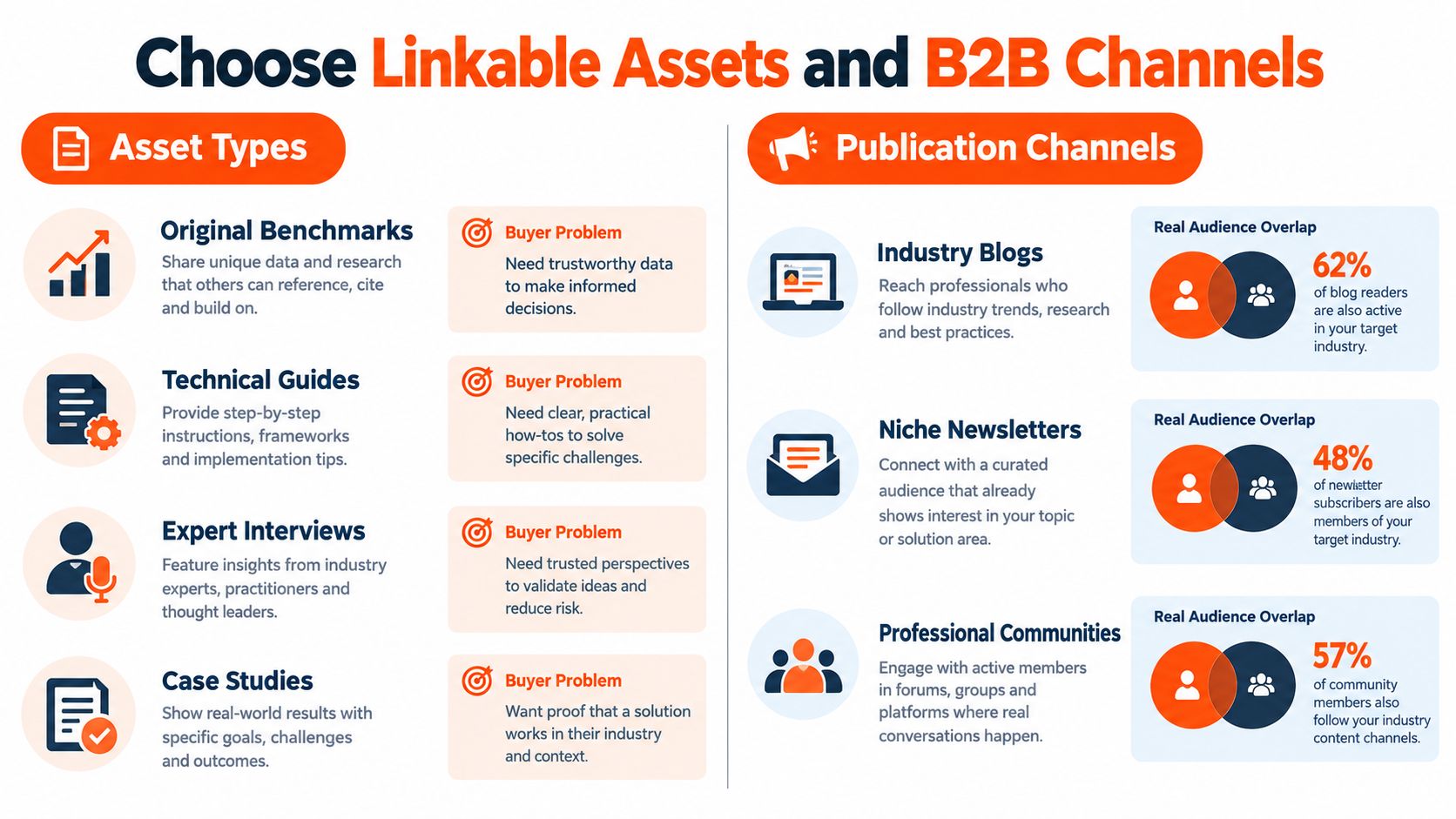
Start with the buyer's question, then choose the format that answers it. A SaaS team could publish an implementation checklist for a technical buyer who needs to understand deployment. A consultancy could create an anonymised risk framework that helps a prospective client see how a problem is assessed. A practitioner's process diagram can clarify a complicated workflow without requiring a research department or a photographer willing to work for exposure.
Asset | Buyer problem it can address | Potential editorial use
Original benchmark | “How does this process compare with common practice?” | A trade writer can cite a defined finding and its method.
Technical guide | “What should a team check before implementation?” | A practitioner can recommend it as a useful reference.
Expert interview or video | “How does a specialist approach this issue?” | An editor can quote a clear, attributable explanation.
Case study or comparison framework | “What trade-offs should a buyer evaluate?” | A publication can point readers to a detailed decision aid.
The channel matters as much as the format. A niche newsletter might reach practitioners who use a checklist. An industry blog may be suitable for a technical comparison. A professional association could share a resource with members dealing with the same operational problem. A large general-interest publication isn't automatically a better fit. Prestige without audience overlap is borrowed authority, and borrowed authority doesn't always bring useful visitors.
Before commissioning a new asset, check whether a current page could do the job with clearer examples, better sourcing, a diagram, or a refreshed expert perspective. New production makes sense when the buyer problem isn't answered elsewhere on the site or when the existing page lacks something a publisher could confidently cite. A B2B SEO content strategy can help teams connect those content decisions with search intent. The same thinking should inform the company's SEO content marketing strategy, so a citation asset supports the wider content plan instead of sitting alone like a very knowledgeable houseplant.
Build Outreach That Earns Editorial Links
Outreach works when the recipient can quickly see why an asset belongs with their audience. Begin with a short prospect list of editors, practitioners, associations, or publishers who already cover the topic. Check the specific page, not just the website's name. A contact who published a relevant guide may have a real reason to consider an updated diagram, an expert explanation, or a reference to a useful checklist.

Prepare a compact asset brief before sending a pitch. It should explain the audience, the problem addressed, the evidence behind the material, the destination page, and what makes the resource useful to the recipient's readers. For example, a SaaS team might offer a workflow benchmark to a practitioner writing about process design. A professional-services firm might share an expert video and transcript answering a recurring compliance question. In both cases, the evidence and editorial fit lead; “amazing backlinks” stays out of the subject line.
A documented Ahrefs outreach test offers a useful planning reference: 515 emails were sent, 473 were delivered, and 36 editorial links were earned from 32 unique websites, a 7.6% success rate against delivered emails. The test is described at RhinoRank's link-building statistics article. Those results aren't a promise for another team. They're a reminder to measure the funnel in stages, since a positive reply isn't the same thing as a published placement. The article also supports modelling around roughly one earned link per 13–18 delivered prospects as an operating benchmark, not a guarantee.
Reusable pitch templates
Relevant editorial pitch
Subject: A practical resource for your guide to [topic] Hi [Name],
The section on [specific subject] in your [article title] may be useful to readers comparing approaches. This [checklist or research page] explains [specific value] and includes [supporting detail]. If it fits your editorial standards, the page is available for your review: [URL]. Best,
[Name]
Expert-comment request
Subject: Practitioner perspective on [specific question] Hi [Name],
Your article about [topic] raises a useful question about [specific issue]. [Expert name and role] can explain how [approach] works in practice and where teams should be careful. Would a short, attributable comment help your coverage? Best,
[Name]
Outdated-content or broken-reference approach
Subject: Possible update for your [article title] Hi [Name],
I noticed your page refers readers to [specific reference or outdated resource]. This [replacement resource] covers [relevant subject] and may be useful if you're revising the page. The decision is entirely yours, and the resource is here for review: [URL]. Best,
[Name]
Gentle final follow-up
Subject: Re: [original subject] Hi [Name],
One last note in case the resource is useful for a future update to [specific page or topic]. No reply is needed if it isn't a fit. Thanks for considering it. Best,
[Name]
For more ideas on prospect research and personalized pitches, teams can consult SemDash's link outreach guidance. The useful measure is whether the asset earned genuine editorial consideration, not whether a recipient replied politely.
A short video can also help explain how editorial outreach fits into a broader link-building workflow.
Match Outreach Methods to the Right Opportunities
Different channels solve different problems. Digital PR can put a data-backed idea in front of trade media, while a partner mention can help buyers find a practical implementation resource. A community or association citation may have modest reach but strong audience fit. The right choice depends on who reads the placement, how much editorial control the publisher has, and whether the team can sustain the work.
Channel | Best fit | Main requirement | Typical effort | Quality signal
Digital PR | Original findings or a timely industry perspective | Evidence and a clear news angle | High | Coverage adds context and cites the material accurately.
Guest contribution | A specialist with useful, distinct expertise | A publication-ready argument that serves readers | Medium to high | The editor retains genuine review and control.
Partner mention | A resource that helps customers implement or evaluate a solution | A real partner relationship and a relevant destination | Low to medium | The link helps users complete a task.
Resource-page outreach | A guide, checklist, or tool that fills a clear gap | A page that fits the resource list | Medium | The editor considers it useful for that page's audience.
Community or association placement | A practitioner resource for a defined professional group | Topic fit and a credible contribution | Medium | Members can use the resource, not just see the brand name.
Consider three contrasting cases. A SaaS founder with a defensible category analysis could pitch its findings to trade media. A consultancy might help a partner update an implementation guide with a practitioner-approved explanation. A lean team could offer an association a clear checklist that members can apply, without launching a costly publicity campaign.
Podcasts and video citations can work when an expert discussion yields usable material. The recording may lead to an attributable transcript, a page with supporting evidence, or a practical clip a publisher can reference. But a podcast appearance without a relevant audience is mostly a calendar event with headphones.
Guest contributions also have a trade-off: the team invests time in writing, yet the publisher's editorial standards determine whether the piece is worth running. Resource-page outreach is more focused, but it only works if the resource genuinely improves the page. Partner links can be durable and relevant, but they shouldn't become a routine exchange of favours.
Two well-chosen channels, pursued with care, beat sending every asset to every publisher and calling the resulting chaos an omnichannel strategy.
At the start of a campaign, choose two channels for the quarter. Give each a clear audience, an appropriate asset, and a way to judge editorial quality. Expand only after the team knows what the first placements contribute.
Audit Links and Avoid Manipulation Risks
A link report should separate editorial recognition from commercial or automated acquisition. A paid sponsorship may be worthwhile for visibility or referral traffic, but it shouldn't be presented as an independent editorial endorsement. Google's spam policies identify practices such as buying or selling ranking-passing links, excessive exchanges, automated link creation, and requiring links in commercial arrangements without allowing the publisher to qualify them.
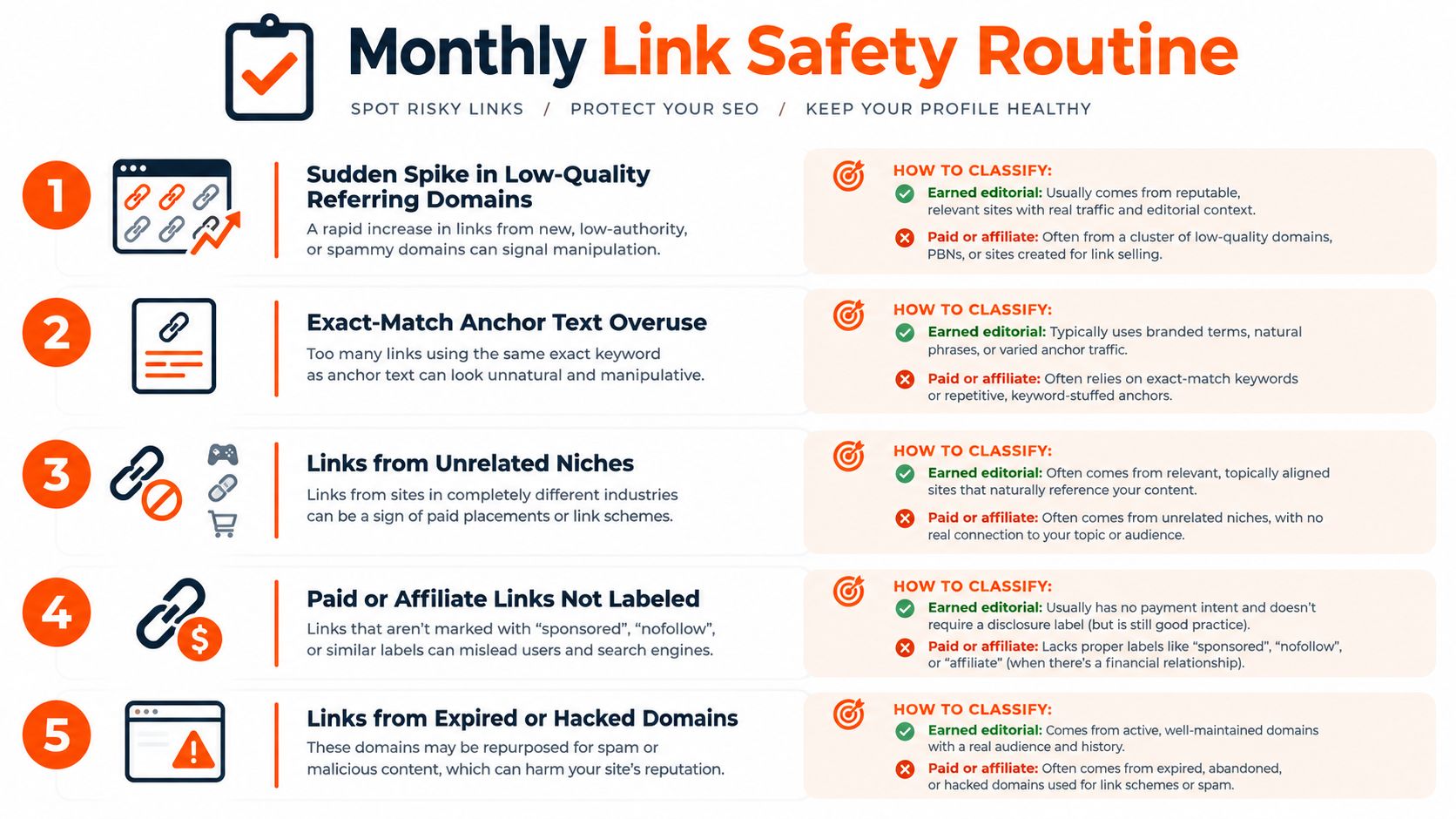
A monthly review can be simple, provided someone does it:
Classify acquisition: Mark links as editorial, paid, affiliate, sponsorship, reciprocal, automated, or guest-post placements.
Check page quality: Review relevance, the surrounding editorial context, whether the page is indexed, and whether the link leads to a valid destination.
Review patterns: Look for sudden spikes, sitewide placements, irrelevant referring sites, expired or compromised domains, and repeated commercial anchor text.
Check technical details: Confirm that links are crawlable HTML links, generally an <a> element with a valid href. Google's guide to crawlable links explains why script-only interactions may not be reliably extracted.
Resolve concerns: Request an edit, removal, or appropriate qualification when a placement doesn't meet the campaign's standards.
Anchor text should describe the destination naturally. If a SaaS team has a useful CRM implementation checklist, that phrase can lead readers to the relevant guide. Repeating a commercial keyword across unrelated placements looks less like helpful signposting and more like a road sign that keeps shouting the same words at passing traffic.
For advertising, sponsorship, and affiliate links, use rel="sponsored" or rel="nofollow" when appropriate, and make the relationship clear to readers. If a publisher has added a link as part of a commercial arrangement but won't identify it as such, the brand should reconsider the placement.
A removal request can be direct and courteous:
Hi [Name],
This placement doesn't meet our current editorial or disclosure requirements. Could you please remove the link or update it so the commercial relationship is appropriately qualified? Thanks for helping resolve it.
The purpose of an audit isn't to declare every unusual link harmful. It's to know how each placement was obtained, whether it serves readers, and whether the site is representing the relationship accurately.
Measure Link Building KPIs Beyond Backlink Counts
A useful dashboard tells a team what happened after outreach began and whether the resulting placements are reaching the right people. Delivery and replies belong in the campaign view, but they're not the final outcome. Neither is a high backlink count if the referring pages have little topical connection and bring no qualified attention.
The outreach funnel can track delivery, replies, asset interest, and placements separately. After publication, add new referring domains, editorial relevance, crawlability, referral engagement, target-account visits, assisted opportunities, and influenced pipeline. The separation matters: an editor asking to see an asset is a positive signal, not a published link; a published link is a placement, not proof of revenue.
Classify the role of each link instead of blending all placements into one total:
Discovery link: Helps readers or crawlers find a relevant page.
Authority link: Adds meaningful recognition within a category.
Buyer-intent link: Appears where prospects are already evaluating a problem or solution.
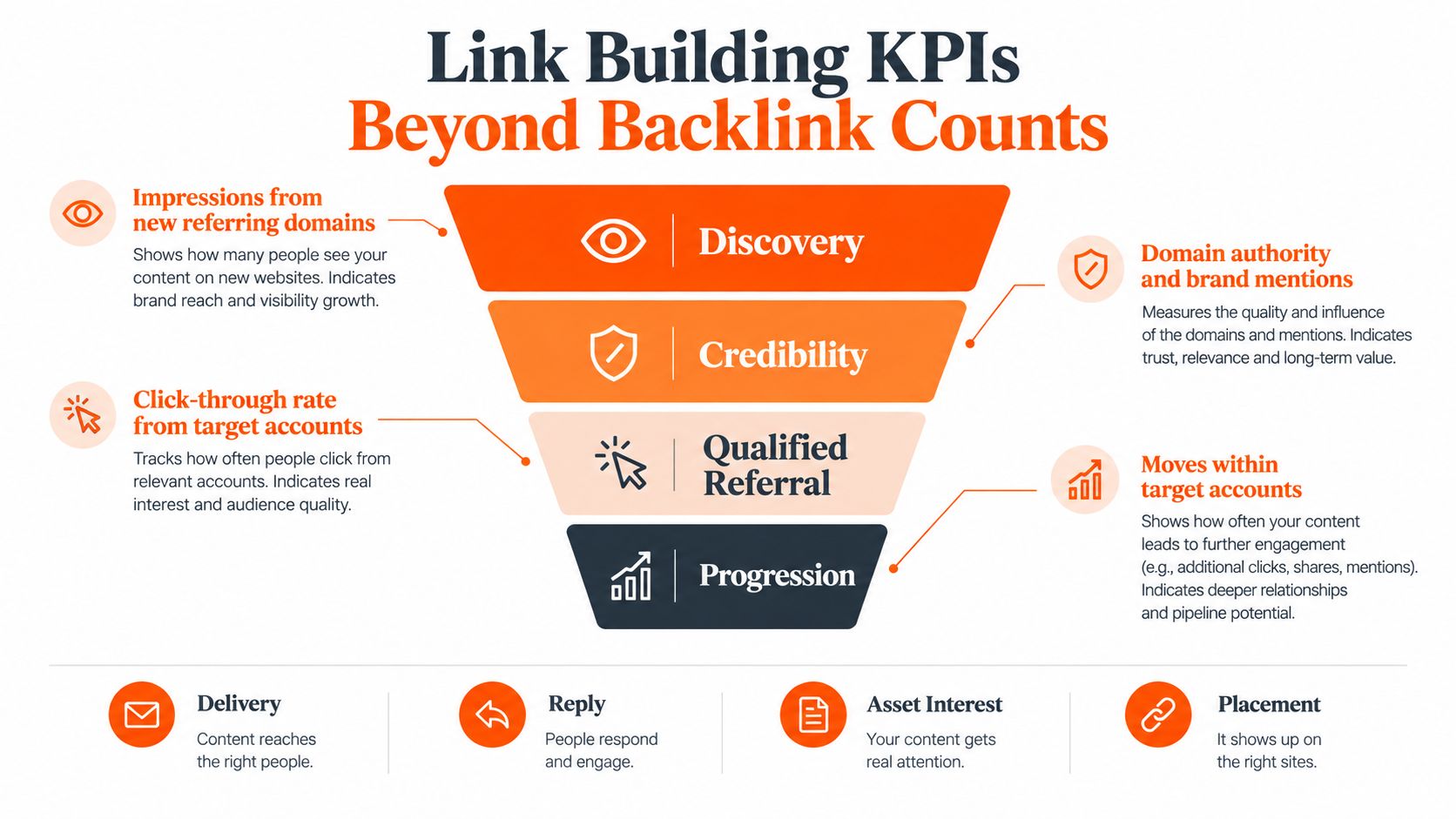
A B2B SaaS dashboard might connect a trade-publication placement to visits from named target accounts, engaged sessions on an implementation page, and later opportunity activity. A professional-services team might watch whether a niche association citation drives visitors to a relevant service page and whether those visitors progress to a substantive inquiry. Neither example proves that one link caused a conversion. Search performance also depends on content quality, relevance, technical health, brand demand, and other signals.
That caution is important. In an analysis of 10,000 search results, pages ranking higher tended to acquire more new followed referring domains, according to the Ahrefs SEO statistics analysis. The relationship is a correlation, not proof that each added link causes a ranking change. A well-matched publication may nevertheless be commercially useful even if it contributes little visible referral traffic, while a prominent general site may send visitors who never resemble a buyer.
Review campaign activity regularly and commercial influence on a slower reporting cadence suited to the sales cycle. When results stall, ask specific questions: Are prospects opening the asset? Are editors responding but not placing it? Are the placements relevant? Do referred visitors engage with the intended page? Are target accounts progressing? Teams can connect those outcomes to a wider B2B content marketing ROI framework without pretending attribution is cleaner than it is.
Scale Link Building Without Burning Editorial Trust
Scaling a campaign doesn't mean sending the same pitch to more inboxes. It means creating a repeatable process that helps a small team learn what publishers find useful, which assets deserve a refresh, and which relationships merit continued attention.
A focused 90-day operating plan gives the work structure:
First 30 days: Define the ideal customer, buyer problem, commercial role for each target page, prospect criteria, and reporting fields. Choose an existing asset to improve or document why a new one is needed. Assign ownership between marketing, sales, subject-matter experts, and any agency involved.
Next 30 days: Produce or refresh the asset, build a qualified prospect list, and test outreach with a tightly chosen channel pair. Give subject-matter experts a clear review task, such as checking technical claims or approving a transcript, rather than asking them to “help with SEO.”
Final 30 days: Review the placements and replies, check referral and account activity, refresh material that editors found useful, and decide whether another channel is justified. Fix weak targeting before increasing outreach volume.
One expert discussion can supply several distinct materials: a citation-ready page, an edited video, a transcript, a process diagram, and short clips. Each format can serve a different editorial need. A trade editor may want an attributable explanation, while an association may prefer a checklist. Reusing the same underlying expertise is efficient; pasting identical copy into every pitch is not.
Weekly, the campaign owner can review prospect fit, replies, asset questions, placements, and any follow-up owed. On a monthly cadence, marketing and sales can examine referral quality, target-account movement, link relevance, and editorial trust. If the team uses an external partner, reporting should distinguish what was pitched, what was published, how each link was qualified, and what remains unresolved. ContentBuck is one option for B2B teams seeking support with SEO content and managed link-building work, alongside its video-led planning, production, and editing services.
Decide What to Double Down On
Expand a campaign when it earns relevant editorial consideration and produces placements that support discovery or buyer evaluation. Fix it when recipients show interest but the asset, pitch, or destination page creates friction. Retire it when the audience fit is weak, the source material can't be substantiated, or repeated outreach would damage a valuable relationship.
Before the next campaign launches, check that:
The asset answers a buyer problem and can be cited clearly.
Every prospect has a relevant editorial or audience reason for contact.
Commercial relationships will be disclosed and links qualified where appropriate.
Reporting separates outreach activity, link quality, referral behaviour, and account progression.
The team knows which result would justify expanding, revising, or stopping the work.
A link-building program scales when each cycle improves the assets, targeting, and editorial relationships. It doesn't scale just because the backlink export needs a scrollbar. Teams exploring the connection between useful source material and citations can also review how to get a brand cited in AI models.
FAQs
What is B2B link building?
B2B link building is the work of earning relevant links to a business website from publications, associations, partners, practitioners, and other useful sources. A sound program connects those placements to discovery, category credibility, or buyer evaluation rather than treating every backlink as equally valuable.
What makes a B2B link useful?
A useful link has editorial context, a relevant destination, and an audience that could benefit from the resource. The referring site's reputation can matter, but topical relevance and the link's role for readers should be considered too.
Can a small B2B team earn links without original survey data?
Yes. A team can turn practical expertise into a useful checklist, process diagram, technical guide, expert interview, transcript, or narrowly scoped comparison. The material should answer a real question and make its evidence and limits clear.
How should a team handle paid or sponsored links?
A paid placement may support awareness or referral traffic, but it shouldn't be disguised as independent editorial endorsement. The relationship should be transparent, and links should use an appropriate qualification such as rel="sponsored" or rel="nofollow".
Which metrics belong in a link-building report?
Reports can separate outreach delivery, replies, asset interest, and placements from referring-domain quality, editorial relevance, referral engagement, target-account visits, assisted opportunities, and influenced pipeline. Those measures help teams assess contribution without claiming that one placement caused a business result.
ContentBuck plans and produces video-led acquisition content for B2B companies, including YouTube programming, explainers, ad creative, and SEO-backed content with managed link building. Teams ready to connect useful assets with relevant editorial outreach can visit ContentBuck to explore the available services.
Parth Jasrapuria
Founder at ContentBuck
Building video systems for B2B businesses. Obsessed with YouTube growth, creative strategy, and organic SEO.