Best Ad Creative Agency in Unites States for Coaching and Info Businesses
Parth Jasrapuria
Founder
The popular advice is to hire the agency with the glossiest portfolio, the biggest client logos, or the most cinematic showreel. That advice is expensive and often wrong. For coaching and info businesses, the best ad creative agency in the United States isn't necessarily the one with the prettiest edits. It's the partner that finds stronger hooks, ships useful variants quickly, identifies fatigue before costs climb, and matches each format to the funnel stage.
That distinction matters in a video-first market. The Interactive Advertising Bureau's 2025 digital video report says U.S. digital video ad spend grew 18% year over year in 2024 to $64 billion, with a projection of $72 billion in 2025. Digital video is also projected to capture nearly 60% of U.S. TV and video ad spend in 2025, compared with 29% in 2020. More video inventory means more opportunities, but it also means more creative competition. A founder with one hero ad is bringing a butter knife to a thumb-stopping contest.
Why the Best Agency Is Really the Best Creative System
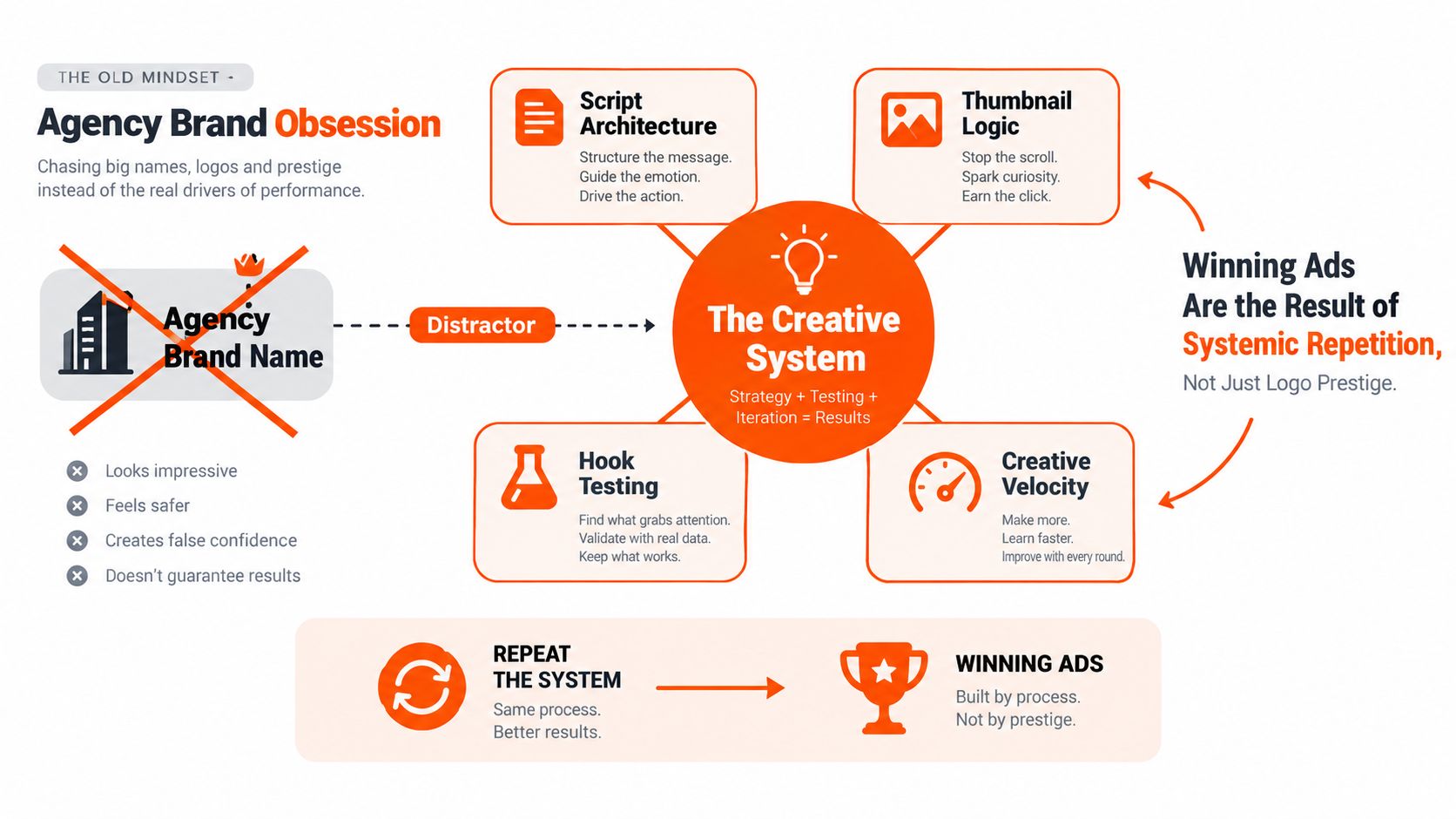
Agency brand names are easy to compare. Creative systems are harder, which is precisely why buyers should focus on them. A strong logo can't rescue a weak opening frame, a slow approval process, or an editor who treats every audience like a demographic blob.
The useful question isn't, “Which agency is the best?” It's, “Which production-to-performance system can discover winning creative fastest for this offer, audience, and funnel stage?” That system should connect research, scripting, production, editing, testing, and refreshes in one loop.
The portfolio trap
A portfolio proves that an agency can make something look polished. It doesn't prove that the team can turn a coaching offer into a clear promise, test several mechanically different hooks, or refresh an ad after performance declines.
The strongest partner treats every ad as a hypothesis. One version may lead with a painful problem, another with a surprising mechanism, and another with a proof point. The body and CTA can stay consistent while the opening changes, giving the team a cleaner read on what moves attention.
Creative fatigue makes this operational discipline necessary. One 2026 ad-fatigue benchmark found that 80% of creatives never reached 100,000 lifetime impressions in a Meta dataset containing 48.5 million impressions. The same source reported performance declines of 15% to 20% within the first two weeks of a creative's lifespan. An agency that delivers one polished batch and disappears has built a museum, not a growth system.
Practical rule: A creative partner should explain what gets tested next before presenting what gets delivered today.
The system should also fit the funnel. A short problem-led video can create awareness. A concise explainer can clarify a complex methodology. A testimonial or objection-handling cut can support a sales page or retargeting sequence. The right agency doesn't just make ads. It decides which creative job needs doing, then produces enough controlled variations to learn from the result.
What an Ad Creative Agency Actually Does
An ad creative agency is the production and iteration engine behind paid campaigns. It usually isn't the media buying firm responsible for bids, budgets, or audience targeting, and it isn't a traditional brand agency focused on identity systems, packaging, or logo design.
Its job starts with the offer and ends with platform-ready assets that can be tested, measured, and remixed.
The production loop
A capable team manages several connected steps:
Strategy and scripting: The agency studies the buyer's problem, desired outcome, objections, proof, and funnel stage. For a business coach, that might produce a script about inconsistent lead flow rather than a generic promise to “scale faster.”
Production and direction: The team coordinates founder footage, UGC-style delivery, voiceover, screen recordings, animation, or supplied assets. Direction matters because a technically clean recording can still feel like a hostage video if the speaker sounds rehearsed.
Editing and asset creation: Editors shape pacing, captions, b-roll, motion graphics, sound design, thumbnails, and aspect ratios for Meta, YouTube, LinkedIn, or TikTok.
Performance analysis: The team reviews hook rate, hold rate, click-through rate, cost per click, cost per lead, and downstream conversion signals. Vanity views can't pay a sales team.
Iterative remixing: Winners become new variants. Weak openings get replaced. Strong bodies receive different CTAs, proof beats, or visual treatments.
Where the work fits
For awareness, the agency may create short-form videos that name a familiar pain or challenge a common belief. For webinar registration, it may edit a tighter promise-led ad with a clear reason to attend. For a long-form sales asset, it may produce an explainer, VSL section, testimonial sequence, or objection-handling cut.
A YouTube channel can support the same acquisition system. An independent SaaS YouTube study summary notes that many highly viewed B2B SaaS videos receive YouTube Ads promotion instead of relying entirely on organic discovery. The lesson applies broadly: publishing and distribution often need to work together.
The media buyer needs a steady supply of differentiated assets. Without that supply, targeting changes become a ritual performed over a tired ad, like repainting a delivery van with no engine.
The Five Core Services You Should Expect
A serious ad creative agency should make five deliverables clear in its proposal. If it promises “premium creative” without explaining how ideas are tested, you are buying polish without a growth system.
Service | What You Get | Example for Coaching or Info Business
Creative strategy | Audience research, angles, funnel mapping, and a testing roadmap | Separate cold-audience pain hooks from warm-audience proof and objection angles
Scripting | Hook briefs, body copy, CTAs, and delivery notes | UGC-style scripts for a coach helping founders generate qualified calls
Editing | Captions, pacing, sound, motion graphics, b-roll, and platform cuts | Turn one webinar recording into a direct-response ad, a proof clip, and a short explainer
Ad variants | Multiple openings, formats, lengths, and visual treatments | Create founder-led, screen-recorded, animated, and testimonial versions
Creative testing | Clean comparisons, reporting, and refresh decisions | Test three to five mechanically different hooks while holding the body and CTA steady
Creative strategy comes first
A useful strategy document identifies the buyer's current situation, desired result, doubts, and language. It also maps each format to a funnel job. Cold prospects may need problem recognition. People who watched a webinar may need proof, objection handling, or risk reduction.
The document should also define a refresh cadence. Ask how often the agency reviews fatigue, which signals trigger new concepts, and how winning ads become new angles instead of recycled edits. An agency that only supplies assets on request will leave your media buyer working with yesterday's ideas.
Scripting should create choices
A script team should deliver alternatives, not one polished monologue. Require multiple hooks, open loops, pattern interrupts, proof beats, and CTAs so the team can test the opening without rebuilding the entire ad. The Meta and TikTok hook-rate benchmark guidance defines hook rate as three-second video views divided by impressions, with a commonly cited solid range of 25% to 35% on Meta and 35% to 45% on TikTok.
Editing has a conversion job
Captions should preserve meaning, not decorate the screen. Motion graphics should clarify a process, show a result, or interrupt passive viewing. Explainers deserve focused editing when an offer is difficult to understand. One 2026 landing-page video benchmark summary reports conversion increases ranging from 20% to 80% across campaigns, including a controlled example moving from 6.5% to 13% after video was added.
Variants and testing prevent guesswork
Every variant should have a named difference. Test founder-led video, screen recordings, animation, and testimonials according to the funnel stage, not because a portfolio makes them look impressive. “New version” explains nothing. “New pain hook with the same body, CTA, audience, and landing page” gives the team a clean test. Require reporting that records the change, result, and next refresh decision.
How Creative Quality Moves CPL, CPC, and ROAS
Creative quality changes paid acquisition economics through a clear sequence: attention, action, and auction efficiency. The opening determines whether someone stops scrolling. The rest of the ad decides whether that attention becomes a click, lead, booked call, or sale.
Hook rate provides an early diagnostic. A 25% to 35% Meta range is commonly cited as solid, and stronger openings often correlate with more efficient delivery and lower CPMs when hook rate exceeds 30%. Treat these figures as starting benchmarks, not pass-or-fail rules. The useful question is whether a new opening beats the account's established baseline.
The metric chain
A weak opening reduces thumb-stop behavior. Fewer viewers reach the body, which means fewer opportunities to click. If clicks become more expensive or less qualified, cost per lead rises. If the sales conversion rate remains unchanged, ROAS falls because the funnel pays more for the same commercial result.
Creative testing should isolate one part of that chain at a time:
Hook test: Change the first visual and sentence while holding body copy, CTA, audience, and landing page constant.
Body test: Keep the winning opening and change the explanation, proof, or mechanism.
CTA test: Keep the ad intact and compare a direct action with a lower-friction next step.
Format test: Match founder-led video, UGC-style delivery, screen recording, animation, or document-style content to the funnel job.
This testing structure turns a weak result into a usable diagnosis. A poor hook points to the opening. Strong attention with weak clicks points to the body or offer explanation. Strong clicks with weak leads points to message-to-page alignment, qualification, or the CTA.
Fatigue produces the reverse pattern. A Meta creative-fatigue benchmark covering 368 creatives reported a 5.5% click-through decline within the first 250,000 impressions and a 19.6% CPA increase in the 500,000 to 1 million impression range. Another dataset in the same source found 80% of creatives failed to reach 100,000 lifetime impressions, while 89% failed to reach 250,000. The practical takeaway is straightforward: set a refresh cadence before performance drops, rather than waiting for the account to deteriorate.
Creative Metric | Healthy Benchmark | Warning Threshold | Impact on CPL | Impact on ROAS
Hook rate | Meta commonly cited at 25% to 35% | Falling below the account's established baseline | Fewer qualified clicks can raise CPL | Lower delivery efficiency compresses return
Click-through rate | Compare against the post-learning baseline | Roughly 20% decay from baseline | Less traffic reaches the funnel | Higher acquisition cost reduces margin
Cost per click | Stable relative to the campaign's own history | Sustained upward movement with unchanged targeting | Lead costs usually follow if conversion holds | Spend buys less qualified traffic
Frequency | Appropriate to audience size and funnel stage | Rising frequency paired with falling CTR | Repeated exposure can waste budget | Fatigue reduces efficient reach
CPA | Stable against the offer's economics | Sustained increase across comparable cells | Fewer conversions per dollar | ROAS declines when revenue stays flat
The algorithm is not always the problem. Sometimes the ad has merely become digital wallpaper.
How to Pick the Right Agency for Your Coaching or Info Business
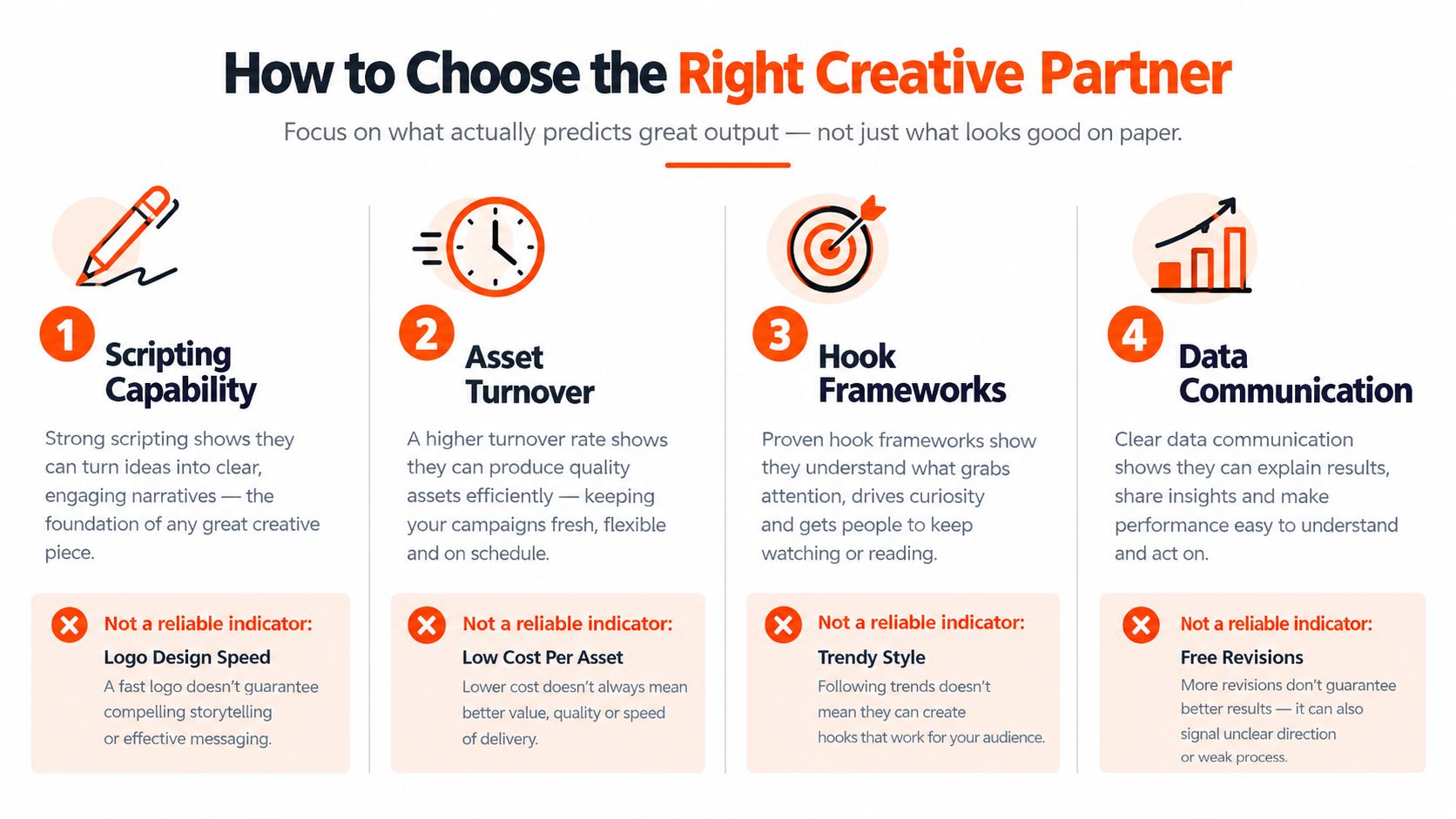
Selection should begin with operations, not aesthetics. Coaching and info offers often require education, trust, compliance awareness, and a clear bridge from attention to a sales conversation. An editor who excels at consumer fashion ads may still struggle to explain a cohort program, certification, or complex advisory method.
A practical buyer checklist
B2B and offer fit: Ask whether the agency understands longer consideration cycles, lead qualification, sales calls, webinars, and information-heavy offers. The team should discuss the buyer's decision process, not just colors and transitions.
Script capability: Request a sample hook matrix for the actual offer. Strong writers can turn a single customer pain into several distinct angles without making every ad sound like a motivational poster shouting through a megaphone.
Speed SLAs: The contract should specify turnaround for scripts, first cuts, revisions, and rush requests. It should also define revision limits, approval ownership, and what happens when supplied footage is unusable.
Testing framework: Look for clean cells that isolate hooks, bodies, CTAs, and formats. A documented framework separates a performance partner from a portfolio farm.
Reporting cadence: The agency should report what shipped, what was tested, what won, what fatigued, and what gets produced next. A monthly screenshot of impressions isn't strategy.
Pricing and ownership: The proposal should state revision terms, source-file access, intellectual property ownership, platform deliverables, and any fees for rush work or unused capacity.
The buyer shouldn't pay for mystery. If the agency can't describe its workflow before signing, the workflow probably lives inside someone's head.
A partner may also handle creative-only subscriptions, full production, YouTube publishing, animation, or repurposing. ContentBuck, for example, offers B2B video ad creatives with hooks, scripts, editing, captions, A/B variations, and platform-ready delivery through monthly retainer or credit-based projects. The right choice depends on the volume and control the business needs, not on whether the agency has a dramatic office tour.
Pricing and Engagement Models Compared
Pricing models solve different operational problems. A retainer buys capacity and predictability. A credit-based model buys flexibility. A project fee buys a defined outcome, which can be useful when a launch has a clear beginning and end.
The supplied market guidance places many creative retainers between $4,000 and $12,000 per month, while credit-based work often falls between $400 and $1,200 per video. These figures are useful comparison points, not universal tariffs. A buyer should compare the actual scope, turnaround, revision policy, strategic input, and ownership terms.
Model | Typical Cost Range | Best Fit For | Cash Flow Profile | Switching Trigger
Retainer | $4,000 to $12,000 monthly | Businesses needing a steady creative pod | Predictable recurring expense | Switch when committed output exceeds media needs or capacity becomes restrictive
Credit-based | $400 to $1,200 per video | Teams with uneven launches and testing bursts | Variable spend tied to requested assets | Switch when recurring demand makes per-asset planning cumbersome
Project-based | Varies by defined scope | Launches, webinars, sales pages, or podcast pushes | Concentrated campaign expense | Switch when the business needs ongoing refreshes rather than one campaign
Retainers reward consistency
A retainer makes sense when the media program needs continuous production and the internal team can approve assets promptly. The danger is paying for a fixed monthly quantity while the account lacks enough traffic or testing discipline to use it intelligently. More files won't fix a broken offer.
Credits protect flexibility
Credit-based work suits businesses that have bursts around launches, then quieter periods. It also makes vendor comparison easier because the buyer can assess output per asset. The catch is that strategic planning can disappear if the relationship becomes a ticket queue.
Projects fit defined moments
Project pricing works for a flagship explainer, a webinar campaign, a YouTube launch package, or a concentrated sales-page rebuild. It becomes a poor fit when fatigue demands continuous iteration. A business shouldn't keep restarting procurement every time an ad gets tired.
Real World Examples of Creative That Moved the Numbers
Specific creative changes can move acquisition metrics, but invented success stories are worse than no examples. The three examples below are illustrative operating scenarios, not verified client case studies. They show how a disciplined team would diagnose and test creative without pretending that every result is guaranteed.
Example one, the business coach
A business coach has relied on founder-talking-head ads. The delivery is credible but familiar, and the opening spends too long introducing the coach. The agency creates problem-agitation UGC-style hooks focused on missed opportunities, inconsistent pipeline, and the emotional cost of unpredictable lead flow.
The team keeps the body and CTA stable while testing the new openings. If the problem-led versions produce stronger hook rate and qualified click behavior, the buyer can move them into broader testing. If they attract curiosity clicks without booked calls, the team tightens qualification language rather than celebrating cheap traffic.
Example two, the course creator
A course creator runs YouTube ads that explain the curriculum before naming the viewer's pain. The rebuild starts with pain-state thumbnails, faster pattern interrupts, and a clearer promise. Shorter cuts can support mobile viewing, while longer versions can explain the mechanism to warmer prospects.
The B2B video benchmark discussion on LinkedIn notes that videos under 60 seconds can perform better on mobile and that shorter clips can improve completion rates. The team should still judge success by qualified action and pipeline, not by view count alone.
Example three, the info product
An info product has testimonial ads that repeat praise but never answer buyer objections. The agency reframes the testimonials as objection-handling scripts. One version addresses time, another addresses implementation, and another explains who the offer isn't suitable for.
The test plan rotates these angles against the same audience and landing page. If one objection consistently produces better downstream conversion, the business can use that insight in the sales page, email sequence, and sales-call enablement. Creative becomes customer research with a media budget attached.
Business Type | Creative Change | Before Metric | After Metric | Timeframe
Business coach | Founder introduction replaced with problem-agitation UGC-style hooks | Not supplied | Not supplied | Not supplied
Course creator | Pain-state thumbnails and pattern interrupts added to YouTube ads | Not supplied | Not supplied | Not supplied
Info product | Testimonials rebuilt as objection-handling scripts | Not supplied | Not supplied | Not supplied
Putting It All Together With a 90 Day Creative Plan
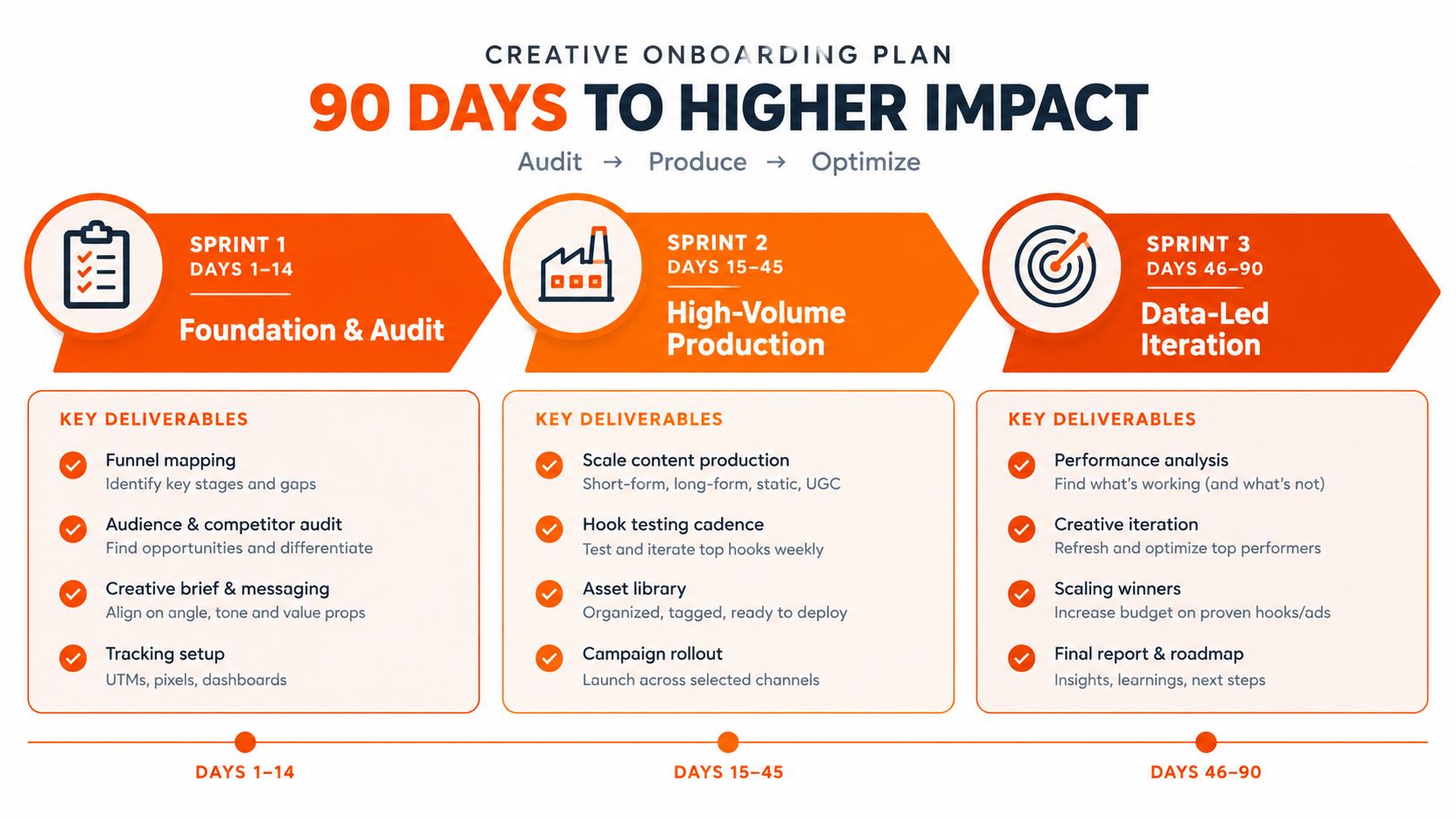
A new agency relationship should produce learning quickly, not just a folder called “Final Final V7.” The first 90 days should establish the operating rhythm, define the funnel's creative needs, and document which messages deserve more production.
Days 1 to 14, foundation and audit
The team audits existing ads, landing pages, sales assets, audience segments, and performance baselines. It maps funnel stages to formats, identifies obvious fatigue, and agrees on the hook-testing cadence. The output should include a creative brief, a message library, a production calendar, and approval rules.
Days 15 to 45, production and controlled tests
The agency writes the first strategy-led scripts and produces 10 to 15 ad variants. Those variants should include mechanically different hooks, not fifteen cosmetic edits of the same opening. The media team launches structured hook and format tests with weekly kill criteria, while the creative team records what each test is designed to learn.
Days 46 to 75, iteration before collapse
The team doubles down on winners, develops new open loops, and refreshes fatigued assets before the account becomes dependent on one tired champion. A creative-fatigue report from Alison cites reporting that median CTR can fall to half its original level by day 11 in tracked campaigns. It also discusses advertisers producing 50 to 70 ads per week as fatigue accelerates, while targeted refreshes are generally favored over complete overhauls. Volume should serve learning, not create a landfill of mediocre edits.
Days 76 to 90, systemize the next quarter
The agency documents winning hooks, formats, proof types, objections, and funnel-stage matches. It sets trigger-based refresh rules, reviews the relationship between creative metrics and revenue, and creates the next quarterly brief.
The result should be a repeatable production-to-performance pipeline. For complex offers, explainer video can also support conversion pages. One explainer-video benchmark guide reports that pages with explainer videos convert 86% better than pages without them, and cites average website conversion rates of 4.8% with video versus 2.9% without video. The business still needs clean attribution and commercial judgment, but comprehension deserves a place in the acquisition system.
ContentBuck offers B2B video ad creatives with hooks, scripts, editing, captions, A/B variations, and platform-ready delivery for Meta, LinkedIn, and YouTube. Coaching and info businesses can visit ContentBuck to explore a creative production system built around ongoing testing, rapid refreshes, and video-led acquisition.
Parth Jasrapuria
Founder at ContentBuck
Building video systems for B2B businesses. Obsessed with YouTube growth, creative strategy, and organic SEO.