Instagram Post vs Story vs Reel: The B2B Format Guide
Parth Jasrapuria
Founder
Stop asking which Instagram format gets the most views. That question sounds smart in a meeting, then produces a month of flashy videos and zero qualified conversations. The better question for Instagram Post vs Story vs Reel is simple: which format moves a prospect to the next measurable step? A stranger needs discovery. A warm follower needs proof. A ready buyer needs a nudge, not another dance trend performed by the sales team in matching hoodies.
The B2B Instagram Mistake Everyone Makes
Most B2B teams treat Instagram like a talent show. Reels get the biggest applause, so every idea becomes a Reel. Carousels get treated like homework. Stories become a random office photo with a coffee sticker, posted because someone remembered Stories exist.
That approach confuses attention with progress. A Reel can reach strangers and still fail at conversion because strangers rarely book a demo after one short video. High exposure does not automatically mean high intent, and a prospect who laughed at a clip may remember the joke better than the product.
The views trap in plain English
A 2024 benchmark analyzing 391,490 professional Instagram accounts found Reels reached the highest percentage of Instagram users at 37.87%, which supports Reels for top-of-funnel discovery, according to the Dash Social Instagram benchmark based on 391,490 professional accounts. That finding does not make Reels the best answer for education, trust, or demo requests.
Feed posts and carousels stay on the profile, so a prospect can revisit proof before a sales call. Stories work closer to the relationship. Polls, replies, question stickers, and link clicks turn quiet followers into visible hand-raisers.
A Reel can win the crowd and still lose the deal. Format choice should follow the next step, not the loudest metric.
A funnier way to see the mistake
Imagine a SaaS founder explaining a pricing model. A Reel introduces the painful pricing mistake in a fast, memorable way. A carousel then shows the pricing framework step by step. A Story asks which pricing problem hurts most and invites a reply.
Posting only the Reel is like shouting a great opening line through a megaphone, then leaving the building before anyone can ask a question. Posting only the carousel is like writing an excellent book and hiding it in a drawer. Posting only Stories is like giving a brilliant talk in a room that gets demolished at midnight.
Reels earn the hello: Discovery from non-followers and qualified profile visits matter most.
Posts earn the bookmark: Saves, shares, and profile actions show lasting value.
Stories earn the reply: Poll votes, direct messages, sticker taps, and link clicks show intent.
The winning system does not crown one format. It gives each format a job, a deadline, and a metric that can survive a Monday pipeline review.
What Posts, Stories, and Reels Actually Are
Forget platform jargon. Each format has a simple mental model that a busy marketing director can repeat without opening a help center and developing a small eye twitch.
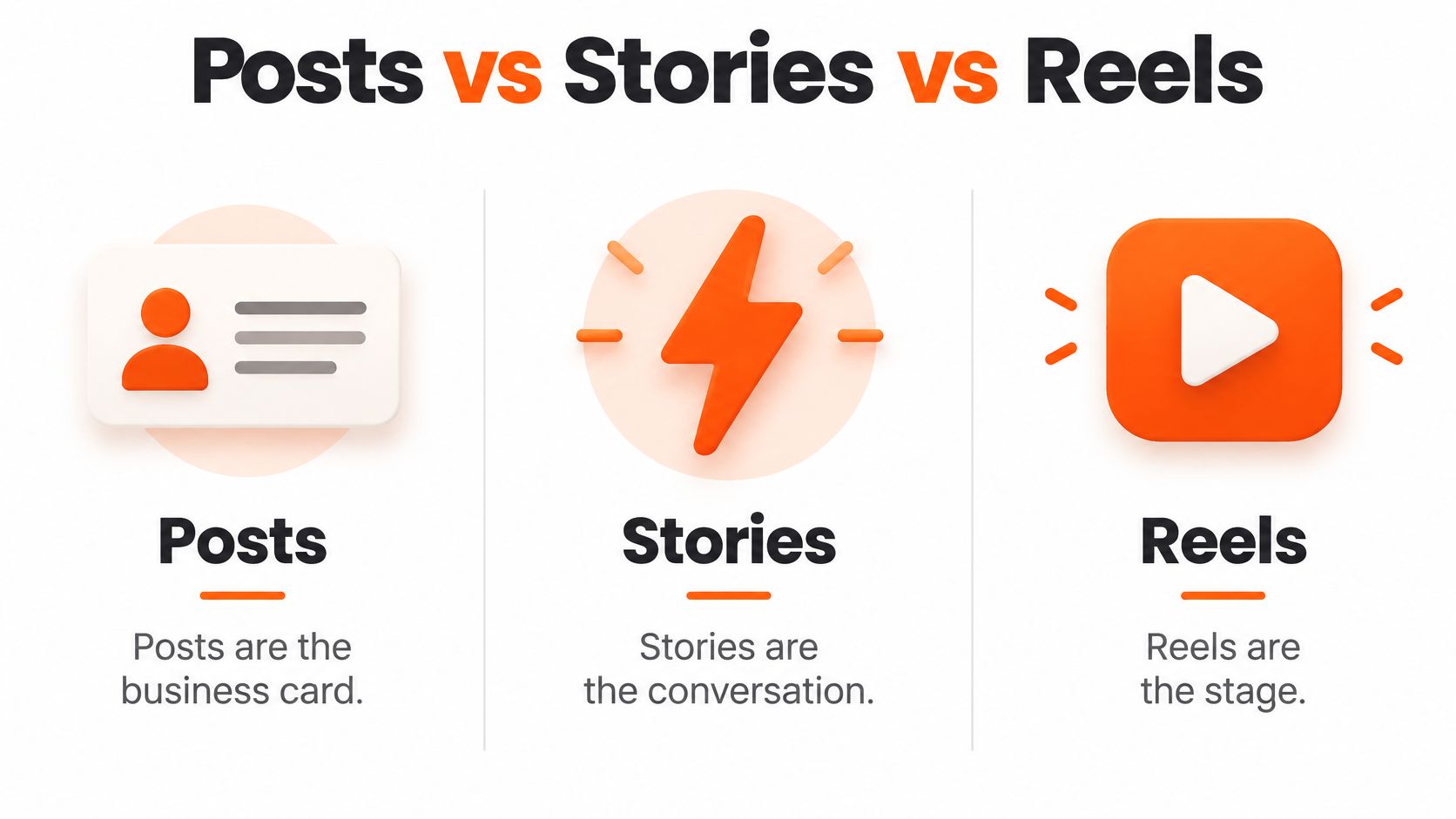
Posts are the business card and the book chapter
A feed post lives on the profile grid until the account owner removes it. Single images work for announcements and customer proof. Carousels work better for frameworks, checklists, comparisons, and anything with steps.
Real-life example: a cybersecurity firm publishes a five-slide carousel on passwordless authentication. A prospect saves it, shares it with an IT manager, then finds it again before a vendor call. That staying power is the point. A post is not just content. It is evidence left on the table.
Stories are the office whiteboard
Stories launched in August 2016 with photos and videos that disappear after 24 hours, and by January 2019 Instagram reported 500 million daily Stories users, as summarized in the Instagram statistics report covering the 500 million daily Stories milestone. That old figure should not be treated as a current audience estimate, but it proves rapid habitual adoption.
Stories disappear from profile, feed, and messages after 24 hours unless saved as a Highlight, a behavior described in the Hootsuite guide to creating Instagram Stories. Think whiteboard. Useful today, mysteriously erased tomorrow, occasionally saved by someone with a phone camera and commitment issues.
Real-life example: a B2B software team posts a morning poll asking which dashboard feature causes the most headaches. By afternoon, replies reveal the next product video topic. Low polish is fine. Low relevance is not.
Reels are the tradeshow stage
Reels are short vertical videos built for people who may not follow the account yet. A founder can demo one feature, bust one myth, or explain one painful mistake before attention wanders off to a cat wearing sunglasses.
Real-life example: a short clip shows a messy spreadsheet turning into a clean automated report. Strangers understand the payoff fast. Followers may enjoy it too, but discovery is the main job.
Teams that want a narrower head-to-head can read Reels vs Stories in 2026 for another practical angle on those two surfaces. The short version stays simple. Posts preserve proof, Stories start conversations, and Reels introduce the brand to new rooms.
Specs, Lifespan, and How the Algorithm Treats Each
Instagram does not run one universal ranking system. Feed, Stories, Explore, Reels, and Search each use ranking designed for how people use that area, as Instagram explains in Instagram ranking explained across Feed, Stories, Reels, Explore, and Search. That single fact changes planning more than any posting hack.
Feed ranking considers followed accounts, recent likes and engagement, and recency. Stories mainly surface accounts a viewer already follows. Reels place greater emphasis on discovery and entertainment, which explains why a stranger may see a Reel but never see a webinar reminder Story.
Instagram format comparison at a glance
Format | Lifespan | Ranking focus | Best at
Feed post or carousel | Permanent on profile grid | Relevance to followers and profile visitors | Proof, education, saves, searchable context
Story | 24 hours unless saved as Highlight | Existing relationship with followers | Polls, replies, reminders, timely offers
Reel | Permanent, but discovery is front-loaded | Discovery and entertainment for followers and non-followers | Fast hooks, demos, expertise clips, reach
Production specs follow the viewing context. Stories and Reels are vertical and full-screen, so faces, captions, and product screens must stay readable on a phone. Feed creative can give diagrams and carousel text more breathing room. Teams comparing export and editing choices can also review the practical social video editing guide for B2B teams before briefing an editor.
Reach numbers need adult supervision
A 2025 Dash Social benchmark based on 2,967 global companies measured from January through June 2025 reported average per-post reach of approximately 363.3K for carousels, 337.3K for single-image posts, and 289.5K for Reels, with engagement rates of 2.9%, 2.3%, and 2.7% respectively, as cited in the UpGrow summary of the 2025 Dash Social benchmark. Translation: a strong carousel can beat a Reel when the topic rewards reading, saving, or sharing.
Another cited comparison reports approximately 30.8% reach for Reels versus 14.5% for carousels and 13.1% for static images, as noted in the Stack Influence comparison of Instagram posts and Reels reach. Different samples produce different winners. Anyone selling a universal champion is selling a shortcut.
For a deeper side-by-side on two formats, it helps to compare Instagram Reels and posts before locking a production brief. The practical rule is blunt. Use motion when motion improves understanding. Use slides when the viewer needs to pause, compare, and save. Use Stories when timing and replies matter more than permanence.
Production rule: If a viewer needs to study it, make a carousel. If a viewer needs to feel it fast, make a Reel. If a viewer needs to answer today, make a Story.
Matching Each Format to a B2B Funnel Stage
Surface-specific measurement is not a reporting nicety. Instagram states that activity on each surface matters most for that specific surface, as noted in the Instagram for Creators FAQ on surface-specific activity. A blended engagement rate obscures the underlying story like a pie chart wearing a trench coat.
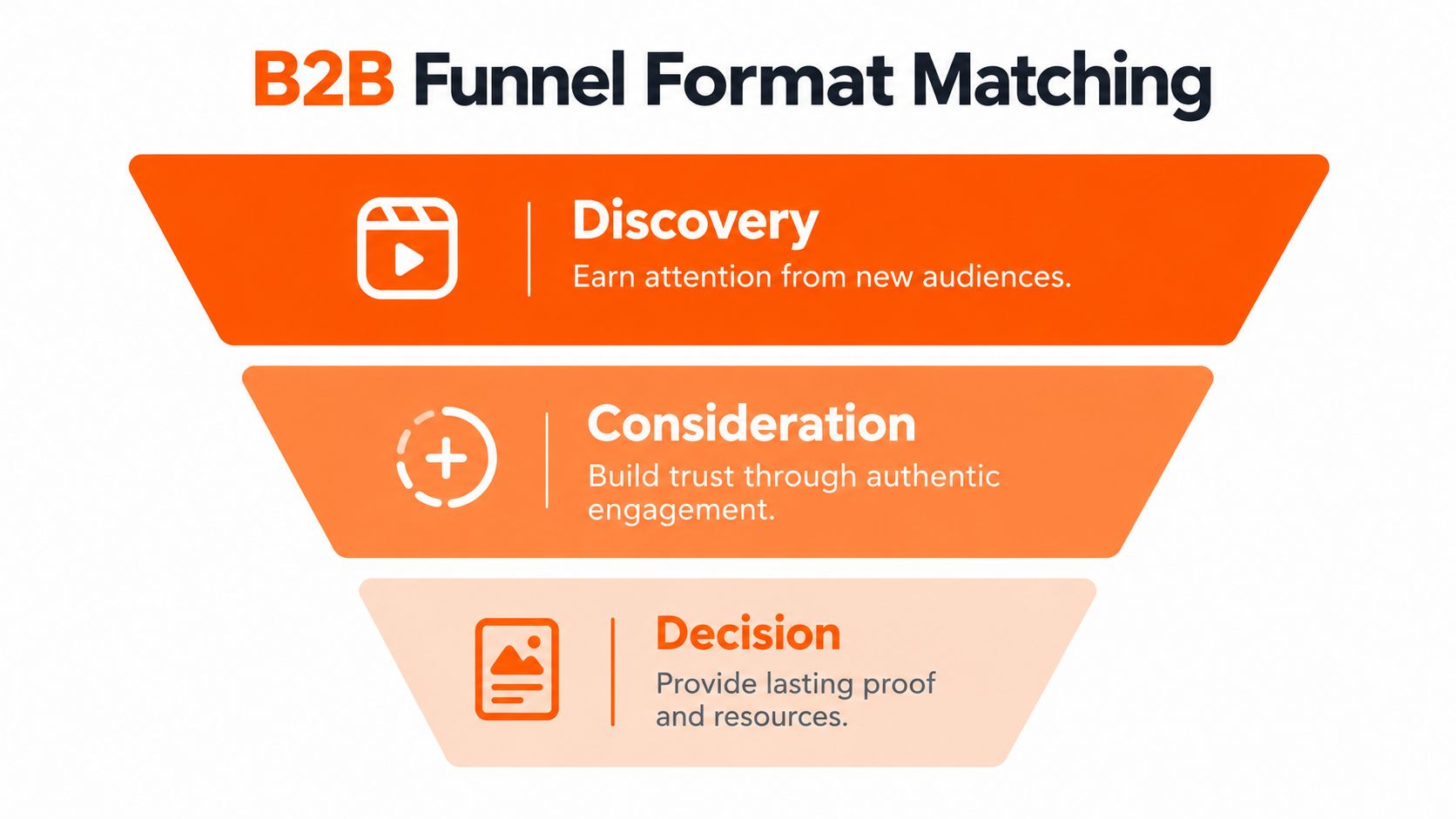
Top of funnel belongs mainly to Reels
Reels launched in August 2020 and later became a principal discovery format. Industry reporting based on Meta-disclosed figures says Reels are played more than 200 billion times per day across Instagram and Facebook, with approximately 2 billion monthly engagers, according to the Axis Intelligence summary of Instagram Reels usage statistics. Those combined-platform figures show scale, not Instagram-only usage.
For B2B discovery, one Reel should carry one hook. Examples include a costly reporting mistake, a before-and-after workflow, or a founder answering a common objection on camera. Too many ideas create a tiny webinar with worse lighting.
Primary KPI: Reach from non-followers and qualified profile visits.
Secondary signals: Watch-through, shares, follows from the right roles, and saves.
Failure pattern: Big views from the wrong audience and no profile action.
Middle of funnel belongs to posts and carousels
Consideration needs detail that survives the scroll. Carousels can hold architecture diagrams, implementation checklists, buying criteria, benchmark interpretation, and customer proof in one saveable unit. Single-image posts work for a sharp announcement or quote, but they rarely carry a complex argument alone.
Real-life example: a data platform publishes a carousel comparing manual reporting, basic automation, and full workflow automation. Prospects save the comparison and bring it into internal discussions. That quiet save can be worth more than a loud like from a random account selling crypto courses.
Judge feed content by saves, shares, profile actions, and link clicks. Comments help, but a thoughtful save often signals future buying work.
Bottom of funnel belongs to Stories
Stories turn familiarity into conversation. A sequence can show a customer problem, present a poll, answer an objection, then link to a consultation or webinar page. Highlights can preserve the strongest sequences for profile visitors who arrive later.
Primary KPI: Replies, direct messages, and link clicks.
Secondary signals: Sticker taps, poll votes, completion, and assisted conversions.
Failure pattern: Pretty Story frames with no question, no reply prompt, and no next step.
The funnel order matters. Reels earn attention, posts build a case, and Stories ask for the conversation. Skipping the middle creates fame without evidence. Skipping Stories creates evidence that nobody acts on.
Three B2B Scenarios and the Right Format Mix
Abstract advice is easy to nod at and hard to schedule. Real scenarios make format choices obvious, mostly because deadlines have a magical way of ending philosophical debates.

Scenario one is a SaaS feature launch
A SaaS company launches an analytics feature that flags revenue leaks. The Reel opens with the painful moment: a finance lead finds a broken dashboard five minutes before a board meeting. The clip then shows the new alert catching the problem earlier.
The carousel explains the framework behind the feature. Slides cover the data source, the alert rule, the owner, and the response checklist. The Story sequence runs a poll on reporting pain, shares a short customer reaction, then links to a demo page.
Reel job: Make strangers care about the problem.
Carousel job: Give evaluators a saveable explanation.
Story job: Collect replies and demo intent.
Scenario two is founder-led thought leadership
A services founder wants more qualified inbound conversations, not a personal fan club with excellent lighting. Weekly Reels tackle one expensive client mistake at a time. Each clip uses a clear opening line, captions, and a concrete example, no motivational fog.
A monthly pillar carousel anchors the grid with a deeper framework. Daily Stories collect questions, test opinions with polls, and show short behind-the-scenes proof from workshops or client sessions. The best Story replies become future Reel topics, which is market research disguised as content.
Teams choosing where short video fits across platforms can compare that approach with the Instagram vs TikTok breakdown for B2B marketers. Platform choice still comes after audience and offer clarity. A brilliant video aimed at the wrong room remains brilliant and lonely.
Scenario three is a webinar funnel
A B2B team promotes a webinar on cutting onboarding time. Reels feature the speaker answering one sharp question per clip, such as the first onboarding step that should be deleted. The goal is registrations from people who do not yet follow the account.
The feed post holds speaker credibility, session outcomes, and the registration announcement in a durable place. After the event, a carousel summarizes the strongest lessons so late visitors still find value. Stories handle countdown reminders, live-day nudges, replay links, and follow-up questions.
Before the event: Reels drive discovery, Stories drive reminders and replies.
During the event: Stories show live moments and collect questions.
After the event: Carousels preserve lessons, Stories push the replay, and Reels recycle the best clips.
Each scenario uses all three formats, but never for the same task. That is the difference between a content system and a content pile. One looks planned. The other looks like a marketing team lost a bet.
The One Idea to Three Assets Repurposing Workflow
Production stalls when every format starts from a blank page. A smarter workflow starts with one strong source asset, then cuts it three ways like a pizza that somehow improves with slicing.
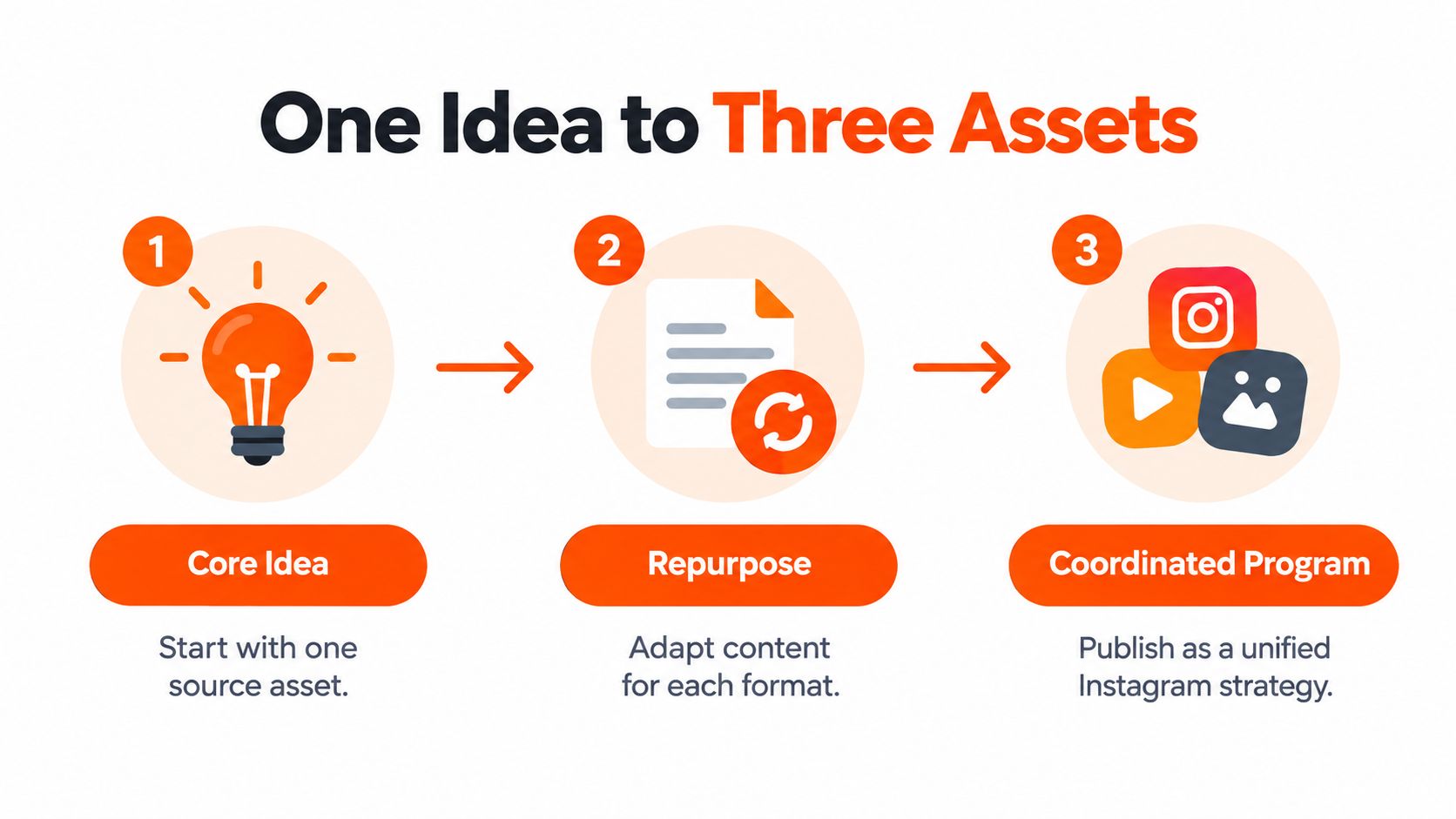
Start with one source asset
Useful source material includes an expert talking-head video, a webinar clip, a product screen recording, a podcast segment, or a written framework. The source needs one clear problem, one useful insight, and one next step. Vague source material creates three vague children, each slightly worse than the parent.
Example: a customer success leader records a short talk on why onboarding calls fail. The strongest line becomes the Reel hook. The steps become carousel slides. The most common objection becomes a Story poll.
Cut each asset for its surface
Build the Reel first: Lead with the problem, show the payoff early, add captions, and keep one idea per clip.
Build the carousel second: Turn the explanation into steps, diagrams, or a checklist that deserves a save.
Build the Story sequence last: Add a poll, a short quote, an objection answer, and a direct call to action.
Teams that want a fuller operating system can scale your repurposed content with a documented workflow instead of heroic last-minute editing. A simple estimate also helps, and the content repurposing calculator for planning output can frame how much source material a team needs.
Repurposing is not posting the same thing three times in different crop sizes. That is just deja vu with captions.
Some teams handle scripting, editing, captions, and format exports internally. Others use freelancers, editing tools, or an agency such as ContentBuck for end-to-end editing and repurposing. The right option depends on volume and review speed, not fashion.
The checklist stays boring on purpose. Write the hook before recording, export vertical versions, design captions for silent viewing, check text safe areas, and give every asset one measurable next step. Boring systems publish. Fancy chaos usually publishes apologies.
A Realistic 30 Day B2B Instagram Cadence
A lean B2B team does not need daily miracles. A realistic 30-day cadence is four strong Reels, two educational carousels, two proof-focused feed posts, and Stories on most working days. That rhythm creates discovery, durable proof, and regular conversation without turning the office into a video studio with deadlines taped to every wall.
Each Reel should be reviewed by non-follower reach and qualified profile visits. Each carousel should be reviewed by saves and shares. Each Story sequence should be reviewed by replies, sticker taps, link clicks, and completion.
Week one: Publish the core problem Reel, one framework carousel, and daily Story prompts.
Week two: Publish a demo Reel, one customer-proof post, and objection-handling Stories.
Week three: Publish an expert-opinion Reel, one checklist carousel, and question-led Stories.
Week four: Publish the strongest recycled hook, one event or offer post, and conversion-focused Stories.
Paid amplification belongs after organic proof. Boost a Reel only when the right audience already watches, saves, shares, or visits the profile. Paid spend cannot rescue a confusing hook. It merely shows the confusion to more people, faster, with receipts.
B2B Instagram Questions Answered
Should a small B2B account skip Reels? No. Use fewer, sharper Reels for discovery, then let carousels prove expertise and Stories start conversations.
Does ranking automatically prefer Reels over photos? No. Instagram for Creators says the average post was seen by 50% more followers after ranked Feed arrived and ranking predicts relevance per user, according to the Instagram for Creators FAQ on ranked Feed.
What kills performance fastest? Posting identical visuals and captions everywhere. Each surface needs its own job, hook, and metric.
Ready to turn one expert idea into Reels, carousels, and Story sequences that support pipeline? ContentBuck helps B2B teams plan, script, edit, and repurpose video-led content end to end, so every Instagram format earns its place. Visit ContentBuck to build a format system that moves prospects, not just view counts.
Parth Jasrapuria
Founder at ContentBuck
Building video systems for B2B businesses. Obsessed with YouTube growth, creative strategy, and organic SEO.