Instagram vs TikTok for B2B Marketing: A Practical Guide
Parth Jasrapuria
Founder
A B2B marketing lead has an Instagram calendar open beside a TikTok calendar, a folder full of product clips, and a budget meeting approaching. Sales wants qualified demos. The founder wants visibility. Finance wants to know why a video about invoice approvals needs another editing round. The Instagram vs TikTok decision starts there, not with whichever app produced the loudest comment section.
The Two Calendars Sitting on Every B2B Marketing Desk
Both calendars might contain the same material: a founder interview, a product walkthrough, a customer question, and a webinar excerpt. But assigning identical clips to both channels doesn't answer the important question: What job should each video do?
Consider a SaaS company selling approval software. A short clip showing a familiar operational headache could introduce the problem to someone who's never heard of the company. An educational follow-up could help that person evaluate the workflow. A more detailed product demonstration could give a finance stakeholder something useful to share internally.
Those are different buying moments. Treating them as one posting task makes the calendar tidy and the strategy blurry.
Give each calendar a commercial purpose
A useful planning sheet connects every video to a buyer, a buying stage, a priority market, and a next action. The next action doesn't always need to be a demo request. For an unfamiliar brand, a qualified profile visit or an educational page visit can be a reasonable intermediate goal.
Discovery content: Introduce a recognizable business problem without requiring prior product knowledge.
Evaluation content: Explain an approach, show the workflow, or address an implementation concern.
Decision content: Make the next commercial step clear and relevant to the viewer's role.
The practical choice isn't whether Instagram or TikTok deserves a permanent crown. It's whether either channel can move the intended audience toward a useful conversation without consuming the entire production budget.
Planning principle: Give each platform a job before giving it a budget.
A lean team can choose a primary channel and adapt selected assets for the other. A larger team can run separate experiments. Neither needs two unrelated production machines, or a founder dancing beside a procurement dashboard against everyone's better judgment.
Where Instagram and TikTok Actually Came From
Instagram began with photographs and social connections. TikTok developed around short-form video discovery. That difference helps explain why the same product explainer can feel natural in one environment and oddly packaged in the other.
Instagram launched on October 6, 2010, initially as an iPhone-only photo-sharing app, reached 1 million registered users by December 2010, expanded to Android in April 2012, and was acquired by Facebook that month for approximately $1 billion; Douyin launched in China in September 2016, TikTok launched internationally in 2017, and its Musical.ly merger followed in August 2018, milestones outlined in the platform history reference.
A network and a discovery engine
Instagram's development from a photo-centered network into a broader environment for creators, messaging, commerce, Stories, and Reels gives marketers several ways to package a business story. A viewer can encounter a video, inspect the company profile, and find related material in different formats.
TikTok's interest-led video model suggests a different starting point for creative planning. A clip should make sense to someone with no knowledge of the founder, company, category, or previous episode.
That's a useful distinction, not an absolute rule. Instagram can introduce unfamiliar brands, and TikTok can support ongoing relationships. Platform origins explain tendencies, not guaranteed outcomes.
Planning question | Instagram-oriented approach | TikTok-oriented approach
What context can the viewer find? | Build a coherent profile and supporting content | Make the individual video understandable on its own
Where should the explanation begin? | Connect the topic to a recognizable area of expertise | Start with the business problem rather than company history
What should the team prepare? | A connected set of assets | A clear standalone story
For example, an expense-management company could introduce its approach through a Reel supported by a detailed profile. Its TikTok version could start directly with a receipt-reconciliation mistake.
Neither needs a ceremonial logo animation before anything useful happens. Buyers came for an answer, not the opening credits of enterprise software cinema.
The historical distinction matters most when teams brief editors. The same footage can support both channels, but the surrounding context should influence what gets explained, what gets cut, and where the viewer goes next.
Audience Reach and Engagement Side by Side
Higher engagement isn't automatically better distribution. It also isn't proof of stronger buying intent.
In January 2025, Instagram's estimated worldwide advertising reach was 1.74 billion, compared with approximately 1.59 billion for TikTok; reported annual reach growth was 90.8 million, or 5.5%, for Instagram and 31.2 million, or 2.0%, for TikTok, according to the advertising audience figures. These are advertising-reach estimates, not audited monthly-active-user totals.
A separate 2025 benchmark of 2,967 companies recorded 3.6% engagement for Instagram and 5.0% for TikTok, while Instagram delivered 42% more average reach in that dataset; both engagement rates used likes, comments, and shares divided by reach, as defined in the Dash Social benchmark.
Instagram vs TikTok Headline Metrics
The table summarizes those cited datasets. Advertising audience estimates and company-level content benchmarks measure different things and shouldn't be combined into a single performance score.
Metric | Instagram | TikTok
Worldwide advertising reach, January 2025 | 1.74 billion | Approximately 1.59 billion
Annual advertising-reach growth | 90.8 million, 5.5% | 31.2 million, 2.0%
Benchmark engagement rate | 3.6% | 5.0%
Average reach in the company benchmark | 42% higher than TikTok | Comparison baseline
Engagement denominator | Reach | Reach
Measure relevance before celebrating volume
An accounting-software clip attracting finance operators is commercially different from the same clip attracting viewers who only enjoy spreadsheet jokes. Both audiences can produce likes. Only one clearly resembles the intended buying group.
A B2B scorecard should separate:
Attention: Opening retention and completion.
Distribution: Reach, shares, and exposure beyond existing followers.
Intent: Qualified profile visits, relevant landing-page sessions, and demo interest.
Revenue contribution: Sales-qualified leads, assisted opportunities, and cost per qualified lead.
For teams connecting reporting to editorial decisions, iHatePosting's resource on turning social data to better content is a useful companion to that scorecard.
Channel comparisons should hold audience definition, spend, cadence, and video length as consistent as practical. Otherwise, marketers may accidentally compare a strong concept on TikTok with an underfunded product announcement on Instagram.
That isn't a platform test. It's a talent contest with different rules for each contestant.
How Each Algorithm Actually Ranks Your Content
A video needs more than an appealing topic. It also needs to clear the platform's recommendation requirements.
The comparison below visualizes engagement and quality considerations. It shouldn't be read as a published formula or a set of disclosed ranking weights.
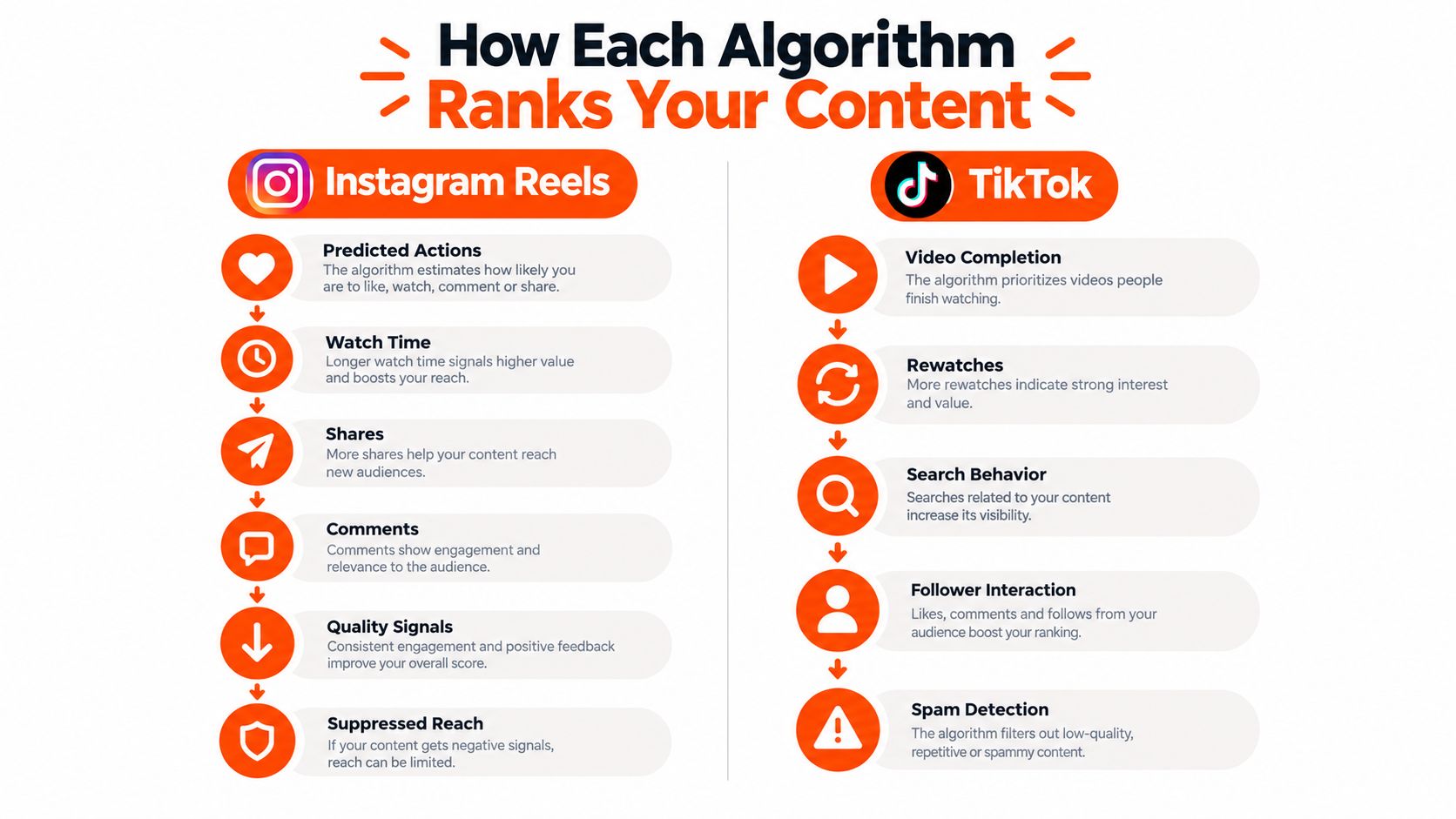
Instagram predicts viewer actions
Instagram says its Reels system predicts whether someone will watch to the end, like, reshare, find the content entertaining or funny, or visit its audio page. It also says low-resolution, watermarked, muted, bordered, mostly text-based, or previously posted Reels may receive less recommendation reach, according to Instagram's ranking explanation.
For a B2B editor, the practical implication is straightforward: deliver a clean original export with a visible demonstration and a meaningful payoff. A blurry screen recording carrying another app's watermark introduces avoidable problems before the audience evaluates the explanation.
This doesn't mean business videos need comedy sketches. A useful reveal, a satisfying workflow fix, or a clear demonstration can give someone a reason to finish watching.
For additional format-planning context, Gainsty's guide for Instagram creators can help teams think through the Reels-versus-TikTok creative decision without treating both exports as interchangeable.
TikTok separates publication from discovery eligibility
TikTok states that content unsuitable for a broad audience can become ineligible for the For You feed and harder to find in search, even when it remains on the platform, as explained in its For You eligibility guidance.
A finance-software video making aggressive earnings claims might therefore publish without receiving the discovery opportunity the marketing team expected. Published doesn't mean recommendation-eligible.
Before posting, teams should review:
Claims: Remove unsupported guarantees and exaggerated outcomes.
Visuals: Check whether demonstrations or imagery create suitability concerns.
Language: Replace provocative wording that obscures the actual product benefit.
Performance diagnostics: Examine completion, rewatches, and shares as creative feedback, not as a disclosed mathematical recipe for distribution.
The embedded video offers an additional viewing resource alongside these practical checks.
An eligibility problem and a weak opening require different fixes. Re-editing the hook won't necessarily resolve a suitability issue, just as removing a risky claim won't make a confusing demonstration understandable.
Ad Capabilities, Specs, and What to Actually Buy
A media plan should name the action the advertiser wants before selecting the placement. Buying visibility, product education, and qualified inquiries as if they were the same objective makes campaign reporting difficult to interpret.
The chart provides a placement overview. Its engagement illustration shouldn't be treated as a forecast of paid campaign results.
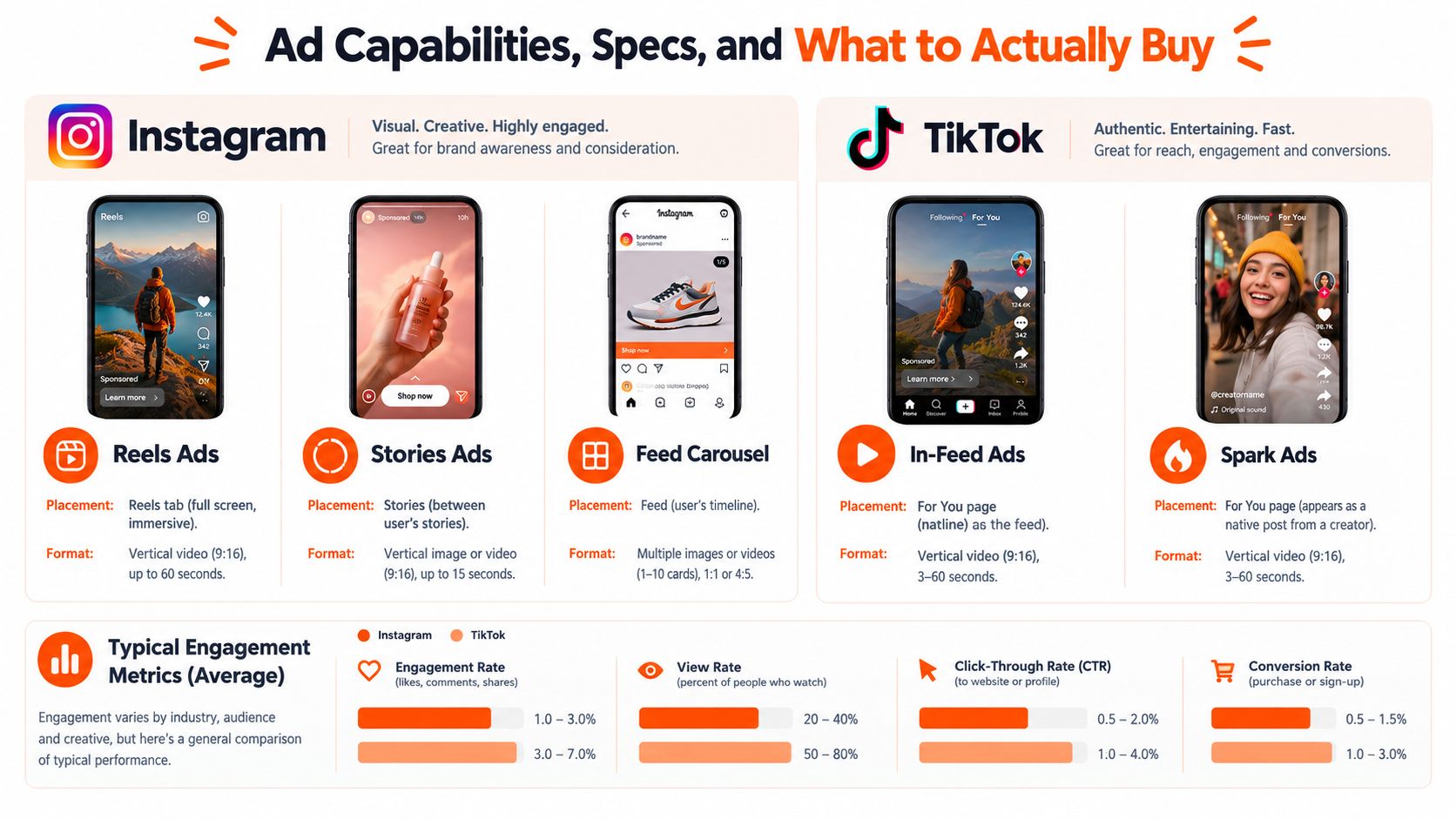
Match the purchase to the task
For Instagram, a practical test plan can assign Reels ads to problem-led introductions, Stories ads to focused follow-up messages, and Feed carousel creative to explanations requiring several connected points. Lead-form and website-conversion campaigns should be judged by subsequent lead quality, not just the ease of completing a form.
For TikTok, evaluate In-Feed ads for direct creative testing, Spark Ads when the plan calls for promoting an existing post, and Top View when a prominent awareness placement serves a clearly defined campaign. Placement availability and buying requirements should be checked in the relevant account before committing budget.
These are planning recommendations, not promises that a format will outperform another. A familiar audience can still reject a vague offer, and an impressive placement can still deliver an expensive shrug.
Campaign task | Suggested buying approach | Evaluation focus
Introduce a category problem | Compare short-form video placements | Relevant audience exposure and attention
Explain a product advantage | Test demonstration-led video or carousel creative | Qualified site visits and evaluation behavior
Re-engage interested buyers | Use available retargeting options | Qualified inquiries and opportunity progression
Amplify a useful organic concept | Assess post-based promotion | Whether paid exposure preserves audience quality
Specs are operational requirements
TikTok's reservation in-feed guidance recommends full-screen 9:16 video, exported at 1080 × 1920 pixels or higher; certain placements accept 5 to 60 seconds, while some reservation campaigns recommend 9 to 15 seconds, with captions and text kept inside safe zones, according to TikTok's reservation ad specifications.
Those requirements apply to the specified placements. They aren't universal duration rules for every TikTok campaign.
A call to action hidden behind interface buttons isn't subtle branding. It's a production mistake.
The editor should preview the creative in its intended placement, not just in an editing timeline. The landing page should then continue the same problem, promise, and next step.
A practical digital advertising example can help teams connect those elements before buying traffic. The essential buying question remains commercial: does the campaign produce inquiries that sales can reasonably pursue?
Creative Patterns That Work on Each Platform
A useful creative brief describes the viewer's problem, the evidence shown on screen, and the next step. “Make it engaging” is not a brief. It's a wish wearing a project-management label.
Collaboration works better when the product specialist and editor review the actual mobile experience together.

Independent reporting covering more than 4 million posts and 9 billion interactions found that TikTok continued to outperform Instagram on engagement, although both platforms declined and TikTok's rate also fell year over year, according to Rival IQ's industry benchmark reporting. That supports continued creative testing, not a guarantee that any specific editing style will win.
A TikTok SaaS demo concept
The following is an illustrative campaign concept, not a reported client result: a 12-second approval-software ad using the short reservation-campaign range described earlier.
The opening shows an unresolved invoice with the caption, “Still chasing approvals in chat?” The product demonstration highlights the relevant approval step. The ending offers a workflow demo rather than listing every feature the software has ever acquired.
Useful production choices include:
First-frame relevance: Show the problem before introducing the company.
Readable captions: Apply the safe-zone requirements established in the ad specifications.
Focused demonstration: Keep the viewer's attention on the action that answers the opening problem.
Purposeful changes: Switch framing or highlight a new interface detail when it helps explain the workflow, not because arbitrary cutting intervals demand it.
An Instagram Reel and carousel concept
For Instagram, the same approval problem can support a Reel followed by a carousel explaining implementation questions. The Reel introduces the operational issue; the carousel covers ownership, exception handling, and how the process fits existing work.
A Story can invite interested viewers to submit a question. The profile should make the company's category and intended customer easy to understand, while captions use recognizable terms such as invoice approval software rather than vague slogans.
These are connected creative assets, not a documented conversion result. The team still needs to test whether buyers use them.
A structured social video editing workflow can keep the original footage, revised openings, overlays, and exports organized. Editors should preserve the useful insight while changing its delivery, rather than making every platform version a different shade of the same confusing clip.
Matching the Platform to the B2B Use Case
The platform recommendation should change when the buyer or market changes. A global average cannot establish whether a particular country's finance directors will engage with a founder's TikTok series.
Cross-market reporting finds that TikTok's Gen Z-versus-Boomer usage gap exceeds 50 percentage points in Germany, the United Kingdom, and the United States, but is below 20 points in Mexico and Brazil, according to Morning Consult's global social-media reporting. Age-based assumptions therefore need local validation.
The decision tree offers a starting hypothesis, not permission to skip audience research.
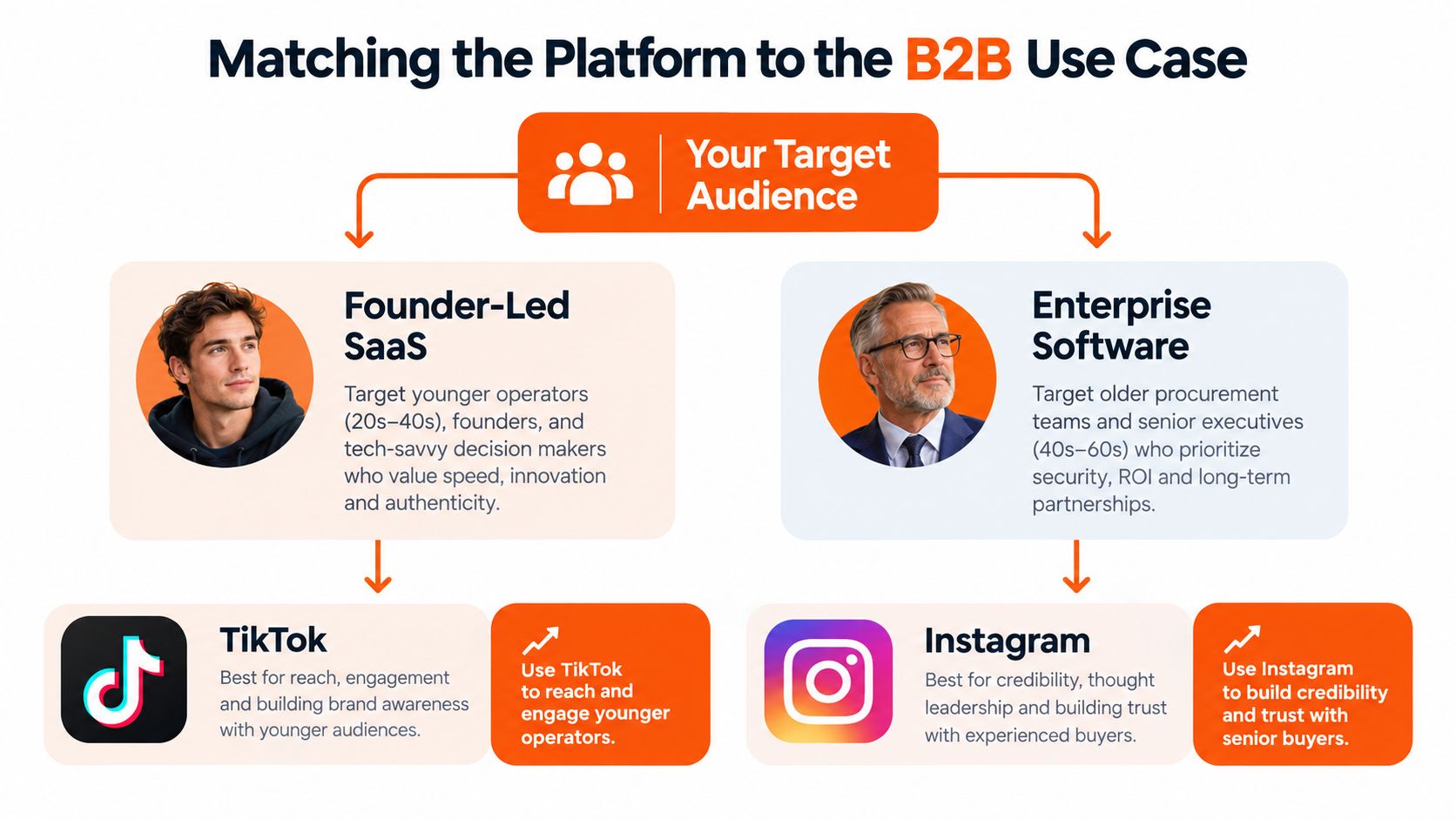
Recommendations by commercial situation
B2B situation | Starting recommendation | What would justify continued investment?
Founder-led SaaS aimed at younger operators | Test TikTok-led discovery | Relevant operators progressing from content to product research
Enterprise software for procurement or finance | Test Instagram-supported evaluation | Qualified stakeholder engagement and useful commercial conversations
Professional services requiring trust | Build an Instagram-centered educational presence, with selective TikTok tests | Inquiries matching the firm's expertise and customer profile
Podcast-led thought leadership | Distribute topic-specific clips on both | Relevant audience response and assisted demand
Paid follow-up to known interest | Prioritize the channel with a usable audience and measurement setup | Opportunity progression rather than cheap form submissions
These recommendations should remain provisional. A founder's age doesn't define the buyer's platform preference, and a serious product doesn't require every video to resemble a compliance training module.
Measure the account journey
For longer buying cycles, teams should connect campaign-tagged visits with CRM records, record self-reported discovery sources, and distinguish sourced opportunities from assisted ones. Branded search movement can provide directional context, but shouldn't be presented as proof that a particular clip caused an opportunity.
Localization should change more than subtitles. A procurement example may need different terminology, workflow context, or objections in each market. Qualified audience behavior should be reviewed separately rather than pooled into a flattering global average.
A deliberate video distribution plan helps organize those market and buyer-stage variations without multiplying production work unnecessarily.
Choose the platform by reachable buyer quality, then judge it by progress toward a qualified conversation.
That framework makes the Instagram vs TikTok decision defensible in a planning meeting. It also leaves room for a less glamorous answer: sometimes the right next move is fixing the offer or landing page before purchasing more attention.
Common Questions B2B Teams Ask Before Posting
Social platforms collectively account for more than 60% of product discovery, compared with 34.5% for Google, according to the product-discovery figures summarized by Sprout Social. That broad finding supports considering social during early research; it doesn't establish a B2B-specific conversion rate.
Which platform should a lean B2B team start with?
The team should start where its priority buyers are reachable and its existing content fits the intended job. The use-case recommendations above provide starting hypotheses, not universal winners.
Can the same video footage serve both platforms?
Yes, shared footage can support distinct edits. The creative examples above show how the same product problem can become a standalone demonstration or a connected educational sequence.
Which KPIs matter beyond engagement?
Qualified visits, sales-qualified demand, assisted opportunities, and acquisition costs matter more than isolated likes. The reach comparison provides the measurement categories.
How should creative change across markets?
Teams should adapt terminology, examples, and objections to local buying conditions. The market-specific framework above explains why worldwide audience totals aren't enough.
For B2B teams turning this comparison into a production plan, ContentBuck offers video strategy, scripting, ad creative, editing, and platform-specific repurposing. Marketing leaders can visit the agency to discuss a shared video system with distinct Instagram and TikTok executions, connected to buyer stages and acquisition goals rather than another calendar full of disconnected clips.
Parth Jasrapuria
Founder at ContentBuck
Building video systems for B2B businesses. Obsessed with YouTube growth, creative strategy, and organic SEO.