Sales Objection Handling That Actually Closes Deals
Parth Jasrapuria
Founder
It's Tuesday morning, and a Head of Growth at a mid-stage SaaS company is discussing a quarterly video retainer. The prospect likes the idea, but each answer from the salesperson seems to produce another soft rejection: the budget's tight, the team's busy, and they're not sure video will move pipeline.
At the word “budget,” the rep launches into a feature speech. The explanation is polished, rehearsed, and roughly thirty seconds long. It still doesn't answer the question the buyer has in mind: “What makes this worth the money for our team?” Good sales objection handling starts by finding that missing question, not by talking faster. And because objections can take shape before a rep ever joins the conversation, the answer may need to exist in the company's content as well as its call playbook.
When the Discovery Call Goes Sideways
The Head of Growth pauses after the rep finishes describing scripting, editing, short clips, and distribution. The rep takes the silence as a request for more detail and keeps going. The buyer, who was trying to explain an internal budget constraint, gets a longer feature list instead.
This is a common way to lose momentum without saying anything obviously wrong. The rep hears “too expensive” and treats it as a request to defend the price. But it could mean the buyer doesn't see the expected business value, can't get approval, has no budget available, or is comparing the offer with a different kind of service. Those concerns need different answers. A discount won't resolve a capacity concern, and a detailed editing workflow won't make an unapproved budget appear.
A better rep would pause, acknowledge the concern, and ask what sits behind it. “That makes sense. Is the main issue the total investment, proving the return, or getting the budget approved?” That question doesn't magically close a deal. It does give the buyer room to name the actual obstacle before the salesperson chooses a response.
A practical test: If a response could be delivered before the rep knows why the buyer objected, it's probably a script, not a diagnosis.
The same principle applies after the call. If prospects repeatedly raise the same concern, sales leaders can turn customer feedback into signal by looking for patterns across call notes and outcomes. A recurring objection may point to a coaching gap, but it may also reveal a missing proof point or an unclear explanation in the buyer journey.
The useful question isn't “What's the cleverest comeback?” It's “What would a better rep do differently, and how can the team practise that behaviour until it feels natural?” A playbook built around listening, diagnosis, relevant evidence, and a clear next step gives reps something more useful than forty clever lines they'll forget as soon as the buyer goes off-script.
Why Objections Now Arrive Before the Sales Call
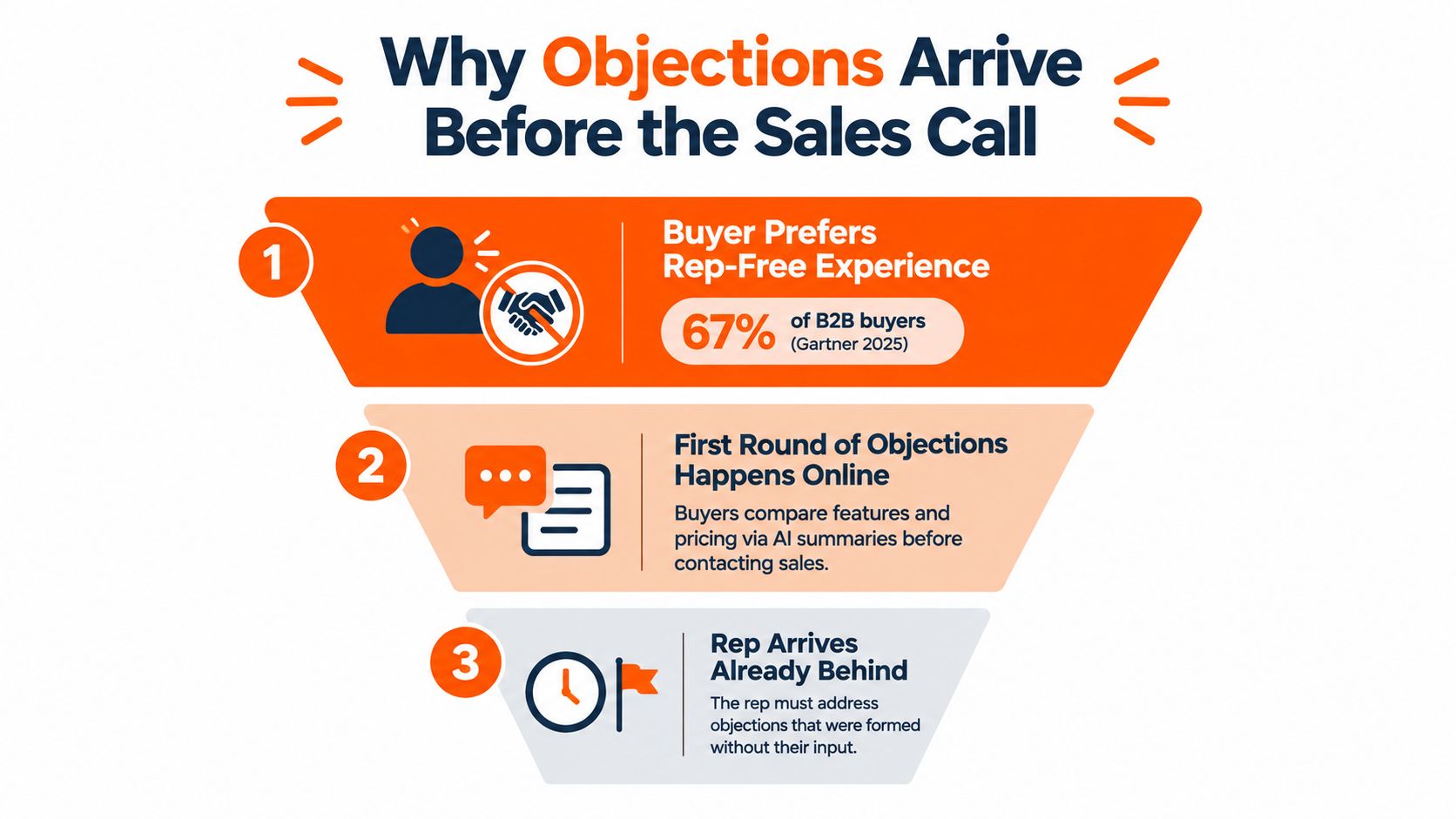
A prospect arrives with your pricing page open and an implementation question your demo never answered. Their colleagues have already compared vendors. The rep is joining a conversation that started elsewhere. Gartner research reported that 67% of B2B buyers prefer a rep-free purchasing experience (Gartner research shared by Toby Callahan). That preference makes your website, videos, and pricing page part of objection handling.
Each missing explanation leaves the buyer to fill in the gap. Vague pricing can make cost feel risky. A polished demo that skips implementation leaves operations guessing about workload, while unclear security boundaries can give IT reason to hold up the purchase. By the time someone says “we need to think about it,” your content may have helped create the hesitation.
Agreement inside the buyer's organization adds another hurdle. Research summarized in Apollo's overview of handling sales objections found that 74% of B2B buyer teams experienced unhealthy conflict during purchase decisions, while groups that reached consensus were 2.5 times more likely to rate their decision as high quality. Marketing may care about lead quality, finance about commercial justification, IT about risk, and end users about extra work. Winning over your contact leaves those other concerns unresolved.
A generic sales deck gives that contact plenty to forward and little to defend.
Build evidence around the questions each stakeholder needs answered: an executive summary for the business case, an implementation explainer for operations, technical documentation for IT, and a customer example tied to a relevant outcome. Marketing teams assessing fit before handoff can use this guide to qualified leads in marketing.
The trade-off is specificity: clear fit criteria and honest limitations may discourage unsuitable buyers, while giving suitable ones a stronger case to share internally. Your content library should explain what the solution does, who it fits, what adoption requires, what it costs, and where it falls short. Give buyers those answers before a rep has to repair the assumptions.
The Six-Step Objection Handling Protocol
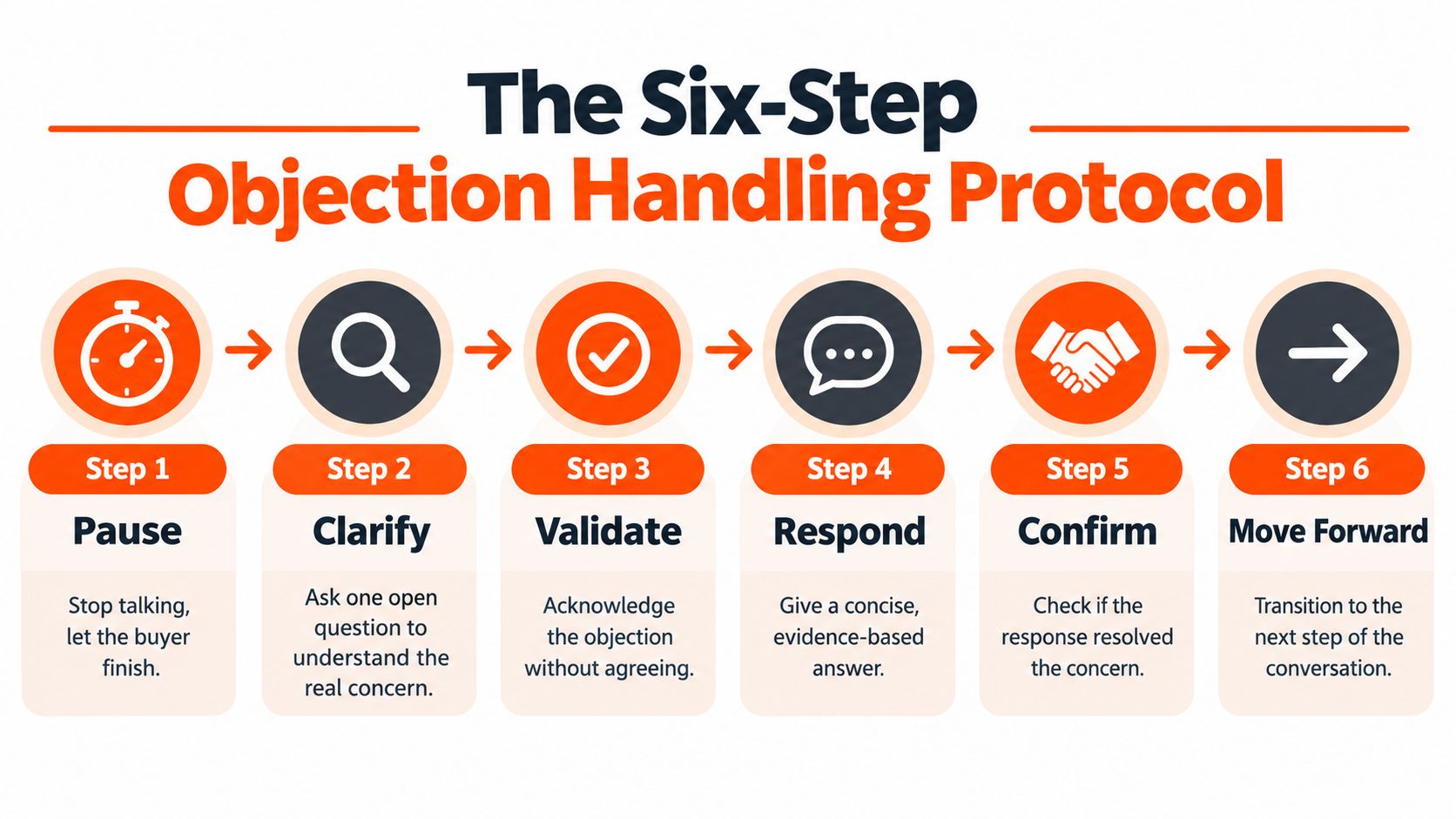
A dependable call response follows a sequence: pause, acknowledge, diagnose, ask, respond, and confirm. Gong's analysis of 67,149 recorded sales meetings found that successful sellers paused immediately after objections for about five times longer than less-successful peers, while average reps often launched into a 21.45-second monologue (Gong's objection-handling guide). That relationship is correlational, not proof that silence alone wins deals. Still, a pause beats interrupting the buyer to explain a feature they didn't ask about.
A price objection, handled without the speech
Buyer: “Your monthly retainer is more than we planned for.”
Rep: “I understand.” Pause. “Is the concern the total cost, proving the return, or getting the investment approved?” Buyer: “We're not sure the team can show it will generate pipeline.” Rep: “That's helpful. What would you need to see to feel confident about the pipeline case?” Buyer: “A clear link between the videos and qualified opportunities.” Rep: “Then let's map the campaign to that outcome and agree on what evidence we'd review. Would that answer the main concern?”
The reply is short because it's trying to uncover the issue, not win a debate. Gong's analysis also describes successful reps answering with a question about 54.3% of the time, compared with about 31% for average reps (SalesHive's discussion of objection-handling techniques). The practical lesson is to ask before presenting evidence.
The sequence a manager can coach
Pause. Let the buyer finish. Don't race to fill the quiet.
Acknowledge. Show the concern has been heard without automatically agreeing with the buyer's conclusion.
Diagnose. Identify whether the issue is budget, urgency, authority, trust, competition, timing, or an existing solution.
Ask. Use one focused question to find the underlying cause.
Respond. Give only evidence relevant to that cause. Keep the initial answer brief, ideally under ten seconds, then return to discovery.
Confirm. Ask whether the concern has been resolved before advancing to a next step.
A team coaching on this sequence can use Voicedial.ai's practical guide to objections as a supplementary resource. The useful measure isn't whether a rep delivers a memorized line perfectly. It's whether the rep pauses, diagnoses the actual concern, and earns agreement on a relevant next step.
The Five Objections That Cover Most of the Pipeline
Gong's analysis of more than 300 million cold calls found that five common objections represented 74% of objections. Its reported top-level categories were dismissive objections at 49.5%, situational objections at 42.6%, and existing-solution objections at 7.9% (Gong's analysis of cold-call objections). Those buckets help teams organise their coaching. They shouldn't be mistaken for a precise breakdown of each of the five conversational examples below.
The point isn't to memorise a pile of rebuttals. It's to recognise the business cause and ask a question that makes the next response relevant. A B2B video agency can use a simple matrix during call reviews or keep it beside the CRM.
Top Five Objections and the Right First Response
Objection | Likely Business Cause | Diagnostic Question | Response Direction
“It's too expensive.” | Budget limit, unclear value, or missing approval | “Is the issue the available budget, the expected return, or the approval process?” | Clarify the commercial outcome and assumptions before discussing scope or price.
“It's not a priority right now.” | Competing work, low urgency, or weak connection to business goals | “What's taking priority, and what would need to change for this to matter?” | Connect to a live business priority only if there's a genuine fit. Otherwise, agree on a relevant trigger to revisit.
“We've never heard of you.” | Limited trust or insufficient proof | “What evidence would help your team assess a new partner?” | Offer relevant work samples, clear process details, or buyer-ready proof.
“Call us next quarter.” | Real timing constraint or a polite exit | “What's expected to change then?” | Set a follow-up around a defined event, or confirm that the opportunity isn't active.
“We already work with an agency.” | Satisfaction, switching risk, or an unmet need the current supplier doesn't cover | “What's working well, and where do delays or gaps still show up?” | Explore a genuine gap, such as scripting, testing, or repurposing. Don't attack the incumbent.
The trade-off is straightforward: a narrow, honest answer may reveal that the deal isn't a fit, while a rehearsed rebuttal can keep an unqualified opportunity alive without moving it forward. If a prospect has no budget and no business reason to revisit the project, pressing harder doesn't create pipeline. It creates another follow-up task with a familiar title.
Teams can add the buyer's exact wording, likely cause, approved evidence, and disqualifying condition to their internal response matrix. Reps shouldn't use the matrix as a script to read aloud. Its job is to help them choose the next question, then respond with proof that fits the buyer's concern.
When the Objection Comes From an AI Summary
Some buyers arrive with an AI-generated comparison, feature summary, or procurement draft. That doesn't mean the buyer has done bad research. It means the salesperson needs to find out what the summary says, what evidence it relies on, and whether the concern beneath it is real.
A 2025 G2 survey of more than 1,000 B2B software buyers reported that 60% used AI in sales departments or sales processes (G2's AI Sales 2025 report). Gartner research reported that 51% of buyers believed GenAI was more likely than sales representatives to provide misleading information, while 49% said the same about sales representatives, as cited in that report. Buyers and sellers don't hold a monopoly on mistakes. Correcting the buyer's tool with an irritated feature lecture won't establish which version is accurate.

Find the evidence before correcting the conclusion
A calm response could sound like this: “That's a reasonable concern. Can you show me the part of the comparison that led to it? We can check whether it's a documented limitation, an interpretation, or a requirement your team needs us to meet.”
Then the rep can bring forward evidence the buyer can verify, such as product documentation, security materials, implementation details, or a calculation using the buyer's own assumptions. If the concern is accurate, the rep should say so and explain the limits of fit. If it's a misunderstanding, the correction should point to evidence rather than imply the buyer was foolish to trust the summary.
Don't argue with the bot. Help the buyer inspect the claim, then decide together what the evidence supports.
If the prospect's requirement can't be met, a gracious disqualification protects both sides. That's more credible than promising a workaround the product doesn't offer. For teams exploring how AI tools may affect sales workflows, this overview of AI sales agents can help frame the broader conversation.
This approach also works in public-facing content. A short video can show what a product does, what it doesn't do, and where a claim comes from. Transparent limits may feel less glamorous than a glossy pitch, but they give buyers something solid to evaluate.
Scripts You Can Use on Tomorrow's Calls
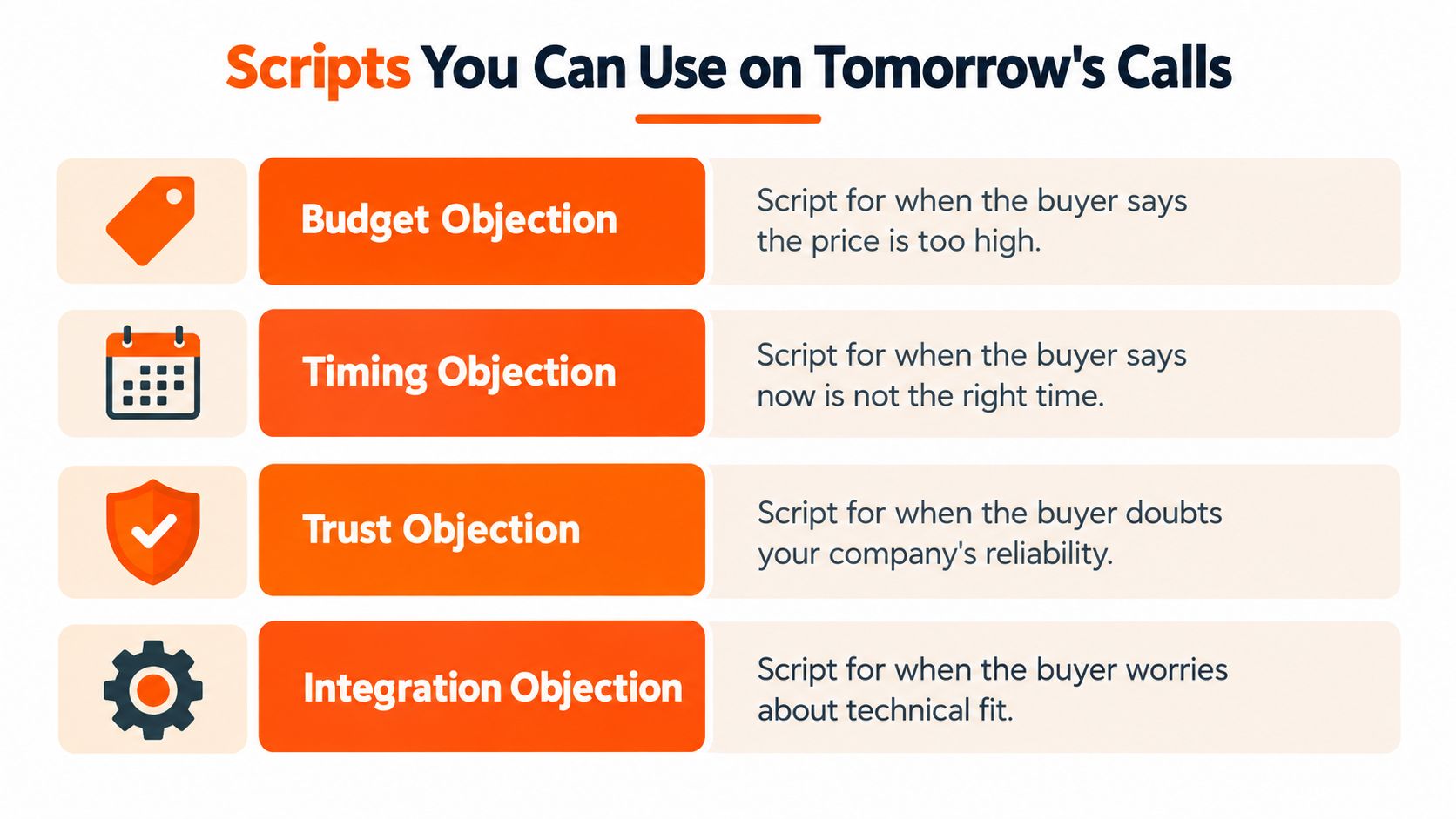
Scripts are useful as practice wheels. They're less useful when a rep reads them aloud without listening for the buyer's answer. The following examples keep the opening question first, then match proof to the person who needs it.
Budget
Buyer: “That's more than we budgeted.” Rep: “Understood. Is the gap about the available budget, or is it that the expected return hasn't been clear yet?”
If the buyer is an economic buyer, agree on which commercial assumptions need to be tested before discussing scope. For a technical buyer, clarify delivery requirements and internal effort. For a champion, prepare a concise explanation they can share with finance.
Sales research summarized by GetGangly reports that 64% of buyers who say a solution is too expensive haven't yet seen an ROI calculation customized for their specific scenario, and that reps who establish ROI before presenting pricing close price-objection deals at a 30% higher rate than reps who present price first (the published summary of objection-handling statistics). Treat those figures as a reason to investigate value, not a license to invent a rosy business case. Any ROI model should show its assumptions, and the buyer should be able to challenge them.
Follow-up email: “Thanks for clarifying the budget concern. Attached is a simple outline of the assumptions we discussed, so your team can review the expected outcome and what would need to be true for the investment to make sense.”
Voicemail: “Hi, thanks for talking through the budget question. I'm following up with the assumptions we discussed so you can decide whether the business case is worth exploring. No need to reply unless it's useful to review them together.”
Fit, timing, and competition
Fit: “I'm not sure your style matches our brand.” Ask, “Which part feels least aligned, the tone, visual style, or audience?” An economic buyer may need to see how the creative supports business goals; a technical evaluator may want to understand review and delivery requirements; a champion may need examples that match the brand. Share relevant samples, not a gallery of everything ever produced.
Timing: "Circle back next quarter." Ask, "What's expected to change by then?" If there's a genuine constraint, agree on a clear reason to reconnect. If there isn't, don't schedule a meeting to make the CRM look busy.
Competition: “We're already working with another agency.” Ask, “What's working well with them, and where do you still need support?” Explore turnaround, scripting, creative testing, or repurposing without claiming the incumbent is inadequate. A focused video service can sometimes complement an existing partner; sometimes the buyer is well served.
For a guide to using video sales letters in a buyer conversation, see this overview of video sales letters. A helpful follow-up is specific to what the buyer named, not a generic brochure disguised as a personal note.
Tracking Outcomes and Closing the Loop
Coach objection handling through observable behaviour. Use call recordings and CRM notes to track pause duration, diagnostic-question rate, response length, and objection-to-next-step conversion by category. Review those measures together: a shorter answer helps only if it addresses the concern and earns a useful next step. Silence alone is no coaching target.
The buying-group challenge discussed earlier in Apollo's reporting on consensus in B2B buying also gives coaches a reason to check whether follow-up materials help buyers align.
When an objection keeps appearing, inspect the page, demo, video, or pricing explanation buyers encountered before the call. For example, repeated questions about revision limits could become a pricing-page FAQ explaining what is included, what needs separate scoping, and how changes are approved. Give reps the same explanation to share. Then track whether the question recurs and whether buyers reach an agreed next step. Fewer questions are useful only if buyers understand the answer.
ContentBuck plans and produces B2B video and content, from YouTube programming and explainers to ad creative and sales-enablement assets. If recurring objections are slowing your pipeline, ContentBuck can help turn those questions into content buyers can use before a rep joins the conversation.
Parth Jasrapuria
Founder at ContentBuck
Building video systems for B2B businesses. Obsessed with YouTube growth, creative strategy, and organic SEO.