AI Sales Agent: A Practical Guide for B2B Teams
Parth Jasrapuria
Founder
A marketing director steps away from a coffee meeting and returns to a busy CRM. An inbound prospect has received a reply, a qualification record is partly complete, a calendar slot is reserved, and a follow-up message is waiting in the approval queue. The director feels relief for about ten seconds, then notices the meeting belongs to the wrong service line and the contact was routed to an inactive sales owner.
That is the promise and risk of an AI sales agent. It can remove repetitive work from a sales process, but it can also move bad data through the business with impressive speed. The important question isn't whether the agent can write a convincing message. It's whether the agent can make the right decision, update the right system, and know when a person should take over.
What an AI Sales Agent Actually Is
An AI sales agent is software that can understand a prospect's message, use business context, and take an approved sales action. It might qualify an inbound lead, search a CRM record, update a field, draft a follow-up, or arrange a meeting. A rules-based chatbot usually waits for a known question and returns a programmed answer. An agent has more room to interpret context and choose the next permitted step.
The simplest useful comparison is a junior sales representative who never sleeps. The junior rep can research an account, prepare a response, and keep a process moving. That rep still needs a clear playbook, accurate information, limited permissions, and coaching. Nobody gives a new starter unrestricted access to every customer record and then blames the starter for a broken pipeline.
A practical AI sales agent usually performs four connected jobs:
Conversation: It answers prospects across approved channels and keeps the tone consistent.
Context gathering: It reads relevant CRM records, account information, campaign data, and previous interactions.
Workflow execution: It can update records, route leads, create tasks, or schedule meetings through connected tools.
Escalation: It sends unusual, sensitive, or uncertain situations to a human rather than improvising.
Teams planning this kind of system can use an AI agent implementation roadmap to think through use cases, architecture, and rollout decisions before selecting a product.
The four questions that matter are straightforward. What can the agent do? How does it connect to the conversation and CRM stack? Where does it fit in the B2B funnel? How can video and creative assets make its outreach more useful? The answer to all four depends on the same foundation: trust in the data and confidence in the handoff rules.
Practical rule: A sales agent should be judged by the quality of the completed workflow, not by how human its messages sound.
How an AI Sales Agent Thinks and Works
A prospect sends an email asking whether a video agency can support a product launch. A junior human rep would open the CRM, inspect the account, check the service catalogue, review the calendar, and decide whether to respond or ask for help. An AI sales agent follows a similar pattern, but its tools and limits must be defined in advance.
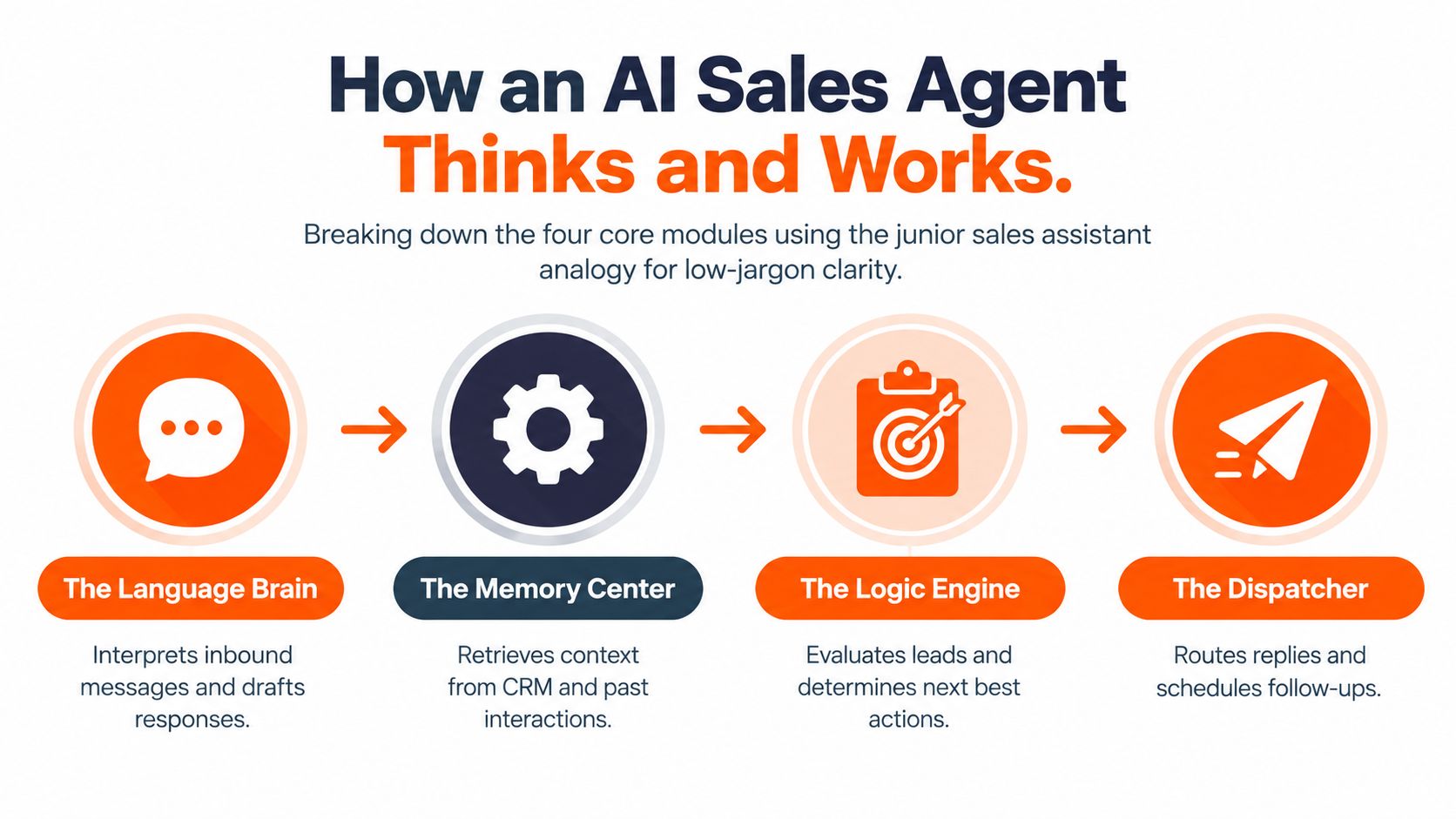
The four working parts
The language brain interprets the prospect's words and drafts a reply. It identifies intent, such as a request for pricing, a product demonstration, or a conversation with a specialist. It shouldn't invent an answer when the approved knowledge base has no answer.
The memory center retrieves useful context. That may include an earlier email, an opportunity stage, a company profile, a previous meeting note, or a known service interest. Memory doesn't mean the agent should read everything. Permissions and relevance filters should determine what it can access.
The logic engine evaluates the information against the sales rules. A team might use an ICP checklist or a BANT-style qualification process covering budget, authority, need, and timing. The agent can identify missing fields, flag a likely fit, and determine whether the next step is a reply, a task, a meeting, or an escalation.
The dispatcher performs approved actions. It sends a message, writes a CRM note, creates a calendar event, or assigns an owner. The dispatcher is where a polite mistake becomes an operational mistake, so write permissions should be narrower than read permissions wherever possible.
A typical conversation cycle
A prospect asks about ongoing video editing.
The agent checks the contact and account record.
It looks for service fit, urgency, region, and missing qualification details.
It drafts a response using approved offer information.
It offers available meeting times only if the calendar connection is reliable.
It logs the interaction and routes the lead according to the routing rules.
It escalates if confidence is low or the prospect asks for an exception.
A chatbot generally follows a scripted path. An AI sales agent can use memory, call tools, and select among permitted actions. That extra flexibility creates value, but it also creates more places for a data or permission error to hide. A broader overview of agent design and marketing workflows is available through AdCrunch on AI agents.
Where AI Sales Agents Fit in the B2B Funnel
An AI sales agent works best when a funnel stage contains repeatable actions, clear inputs, and an outcome that can be checked. It shouldn't be assigned the vague mission of “improve sales.” It should receive a bounded job such as enriching an inbound record, identifying service fit, or preparing a meeting brief.
At the top of the funnel, the agent can research target accounts, enrich contact records, draft outbound sequences, and identify a relevant reason for contact. The value comes from preparation and consistency, not from making every message sound artificially personal. A message about a genuine product launch is useful. A message praising a launch that happened years ago is just a robot wearing a borrowed tie.
As leads move into qualification, the agent can check ICP criteria, identify missing firmographic information, score intent using approved signals, and apply routing rules. At this stage, connected data matters most. If an account is missing its region, employee category, service interest, or ownership field, the agent should flag the gap instead of treating an empty field as a positive signal.
Mid-funnel work includes follow-up drafting, meeting coordination, qualification through email or chat, and preparation of discovery notes. At the bottom of the funnel, a bounded agent can identify renewal reminders, possible expansion signals, or inactive customer conversations. It should prepare the signal for a human owner, not negotiate a custom commercial arrangement on its own.
Funnel Stage | Agent Task | Example Tool
Prospecting | Research accounts and prepare an approved outreach draft | CRM and enrichment platform
Lead capture | Ask qualification questions and collect required fields | Website chat
Qualification | Check ICP fit and apply routing rules | CRM workflow
Meeting coordination | Offer approved calendar slots and log the booking | Calendar integration
Pipeline support | Summarise activity and flag stalled opportunities | CRM reporting
Customer growth | Prepare renewal or reactivation prompts | CRM and email platform
Adoption is broad but uneven. A McKinsey summary cited by Outsales' AI adoption statistics says 62% of organisations were at least experimenting with AI agents, with 23% scaling an agentic system in at least one business function and 39% starting experiments. A separate Salesforce-based summary reports that 54% of sales teams already use AI agents. Those figures describe experimentation and use, not full autonomy.
Teams should choose a single workflow with a measurable output before expanding. A practical lead qualification process can be compared with the principles in qualified leads marketing, especially where marketing and sales need shared definitions of fit and intent.
Connecting an AI Sales Agent to Your CRM and Tools
An AI sales agent doesn't replace a sales stack. It sits across the stack and uses approved connections to perform work. The core systems usually include a CRM, calendar, email, website chat, enrichment data, and sometimes a dialer or team messaging tool.
The CRM is the agent's working directory. It should be able to read relevant contact and account context, then write back activities, qualification fields, ownership changes, and next steps. That connection must work in both directions. An agent that reads a lead correctly but fails to log the conversation creates a second version of reality, which is exactly the sort of thing a CRM was meant to prevent.
What the agent needs from each system
CRM: Contact history, account details, lifecycle stage, ownership, campaign attribution, and controlled write-back.
Calendar: Real availability, meeting type, time zone handling, and cancellation updates.
Email and chat: Approved templates, consent controls, conversation history, opt-out handling, and clear AI identity disclosure where required.
Enrichment: Firmographic and intent information with source visibility and freshness rules.
Reporting: Event logs that show what the agent read, decided, changed, and escalated.
A website visitor might begin in chat, continue by email, and later receive a calendar invitation. The agent needs a stable identity for that contact and a reliable way to preserve context. Without that continuity, the system may ask the same qualification question repeatedly, create duplicate records, or route one buyer to several owners. The joke writes itself, but the duplicate records won't be funny during a forecast meeting.
A connected agent isn't automatically a trustworthy agent. Every connection needs a purpose, a permission boundary, and a test for failure.
Before activation, an SDR leader should audit the following:
Which fields are required before a lead can be routed?
Which fields may the agent create or change?
What happens when an account already exists under a different spelling?
Which calendar slots are safe to offer?
How are opt-outs, complaints, and sensitive requests escalated?
Can a manager review the agent's actions in an audit trail?
Can the team reverse an incorrect assignment or message?
Disconnected systems and incomplete records often cause more trouble than the language model itself. Recent research cited by Futurum reports that more than half of sales leaders still identify disconnected systems as a barrier, while 74% prioritise data cleansing or integration. The same source describes large-scale implementation as potentially still roughly three years away because system readiness and risk controls remain incomplete. The operational lesson is simple: data readiness isn't a setup chore. It's the main product requirement.
Why Human Oversight Still Runs the Show
An AI sales agent should earn autonomy one task at a time. A new sales hire might handle research and meeting preparation during the first week, but a manager wouldn't hand over the company credit card and permission to rewrite contracts on day one. The same principle applies to software that can act quickly and repeat its mistakes without getting tired.
Evidence supports a bounded approach. A reported Remote Labor Index evaluation found that the best agents completed less than 3% of broad freelance-work tasks, while a separate analysis of enterprise software workflows reported peak agent success of about 50%, with 13% lower completion time and 16% lower cost in that analysis. These findings point toward contained, testable work rather than unrestricted sales automation. The figures and context are reported by PTech Partners' analysis of AI agents in sales.
Keep judgment with people
An agent can acknowledge an inbound enquiry, enrich a record, classify intent, coordinate a meeting, generate CRM notes, and draft a follow-up. A human should own situations where the right answer depends on judgement, relationship context, or commercial authority.
That includes:
Pricing exceptions: A human should approve discounts, unusual packages, and non-standard payment terms.
Contracts and procurement: Legal, security, and procurement questions need an accountable owner.
Strategic discovery: A person should explore political dynamics, internal priorities, and unspoken concerns.
Complex objections: Technical risk, competitor comparisons, and performance promises require careful review.
Sensitive conversations: Complaints, frustration, bereavement, job loss, or reputational concerns need empathy rather than fluent text.
A strong human-in-the-loop design uses gates. Low-risk actions can run automatically after validation. Medium-risk actions can require approval from the assigned representative. High-risk actions should escalate immediately and remain blocked until an authorised person responds.
The team should also test ambiguous ICP fit, missing firmographic data, pricing questions, disqualification, and requests for a human conversation. Salesforce's enterprise benchmark evaluates human-verified cases across inbound sales, including lead qualification, CRM updates, demo scheduling, handoffs, tool invocation, multi-step completion, and security adherence. That framework is useful because it tests whether the workflow ends correctly, not whether the first reply sounds polished.
The best sales agent isn't the one that acts most often. It's the one that knows which actions it shouldn't take.
Pairing AI Sales Agents with Video and Creative Assets
A B2B video agency can give an AI sales agent something better than another generic paragraph. It can give the agent a useful asset matched to the buyer's situation.
Consider a software company evaluating video support for a product launch. The agent reads approved firmographic signals, identifies the service fit, selects a relevant explainer or launch-focused hook from a tagged library, and includes it in a carefully reviewed email. If the prospect watches the asset and replies with a specific question, the agent records that signal and prepares the account owner for a more relevant conversation.
The workflow works best when each asset has clear metadata:
Audience: SaaS, professional services, technical buyers, or another defined segment.
Funnel stage: Awareness, evaluation, conversion, onboarding, or expansion.
Business problem: Product complexity, ad fatigue, weak demand capture, or slow sales enablement.
Format: Explainer, short hook, product demo, customer story, webinar clip, or video sales letter.
Approval status: Current, outdated, restricted, or awaiting brand review.
A useful library might look like this:
Funnel Stage | Asset Type | Agent Use
Awareness | Short educational clip | Support a relevant first-touch insight
Consideration | Animated explainer | Clarify a complex product or service
Evaluation | Product demonstration | Answer practical workflow questions
Decision | Tailored video sales letter | Reinforce the business case before a call
Expansion | Customer training or feature clip | Support adoption and account growth
Video provides a richer buying signal than an email open. A prospect who watches an explainer and asks about implementation has offered a more useful intent signal than a prospect who loaded an inbox image. The agent still shouldn't treat viewing behaviour as a buying decision. It should use the signal to prepare a better next step.
An explainer asset can be especially useful where a service is difficult to describe in a short email. Teams exploring that format can review animated explainer video guidance for ideas on structure and use.
Hooks should be versioned by industry, not merely by swapping the company name. A cybersecurity hook can lead with risk and review complexity. A professional services hook can focus on trust and differentiation. Brand guidelines should sit inside the agent's approved instructions, including tone, claims, visual language, prohibited promises, and the correct destination for each asset.
The goal isn't to make outreach look automated at scale. The goal is to help a prospect recognise a real business problem quickly, then give a human seller a stronger reason to start a conversation.
Trust, Measurement, and Compliance in 2026
“More meetings” is an incomplete business case. A sales agent can increase calendar activity while lowering qualification quality, frustrating prospects, damaging brand trust, or sending poor-fit opportunities to busy representatives. Finance and revenue leaders need to know whether the agent created useful pipeline, not whether it produced more noise.
A practical measurement stack should include:
Sourced-to-qualified conversion: How many agent-sourced enquiries meet the agreed qualification definition?
Cost per qualified meeting: What does each accepted meeting cost after software, review time, data work, and human intervention?
Agent-influenced pipeline: Which opportunities received meaningful agent support, with attribution rules agreed before launch?
Human override rate: How often do representatives correct a route, qualification result, message, or proposed action?
Handoff acceptance rate: How often does a human owner accept the meeting or opportunity as genuinely relevant?
Response sentiment: Do prospects respond positively, neutrally, or negatively to the interaction?
A Gartner survey cited by ZoomInfo found that 31% of chief sales officers identified difficulty proving AI-tool ROI as a major challenge to their 2026 objectives. The same reporting says direct financial-impact measures had reached 21.7% of top responses, nearly doubling as attention moved beyond productivity. Those figures are reported in ZoomInfo's coverage of AI sales ROI challenges.
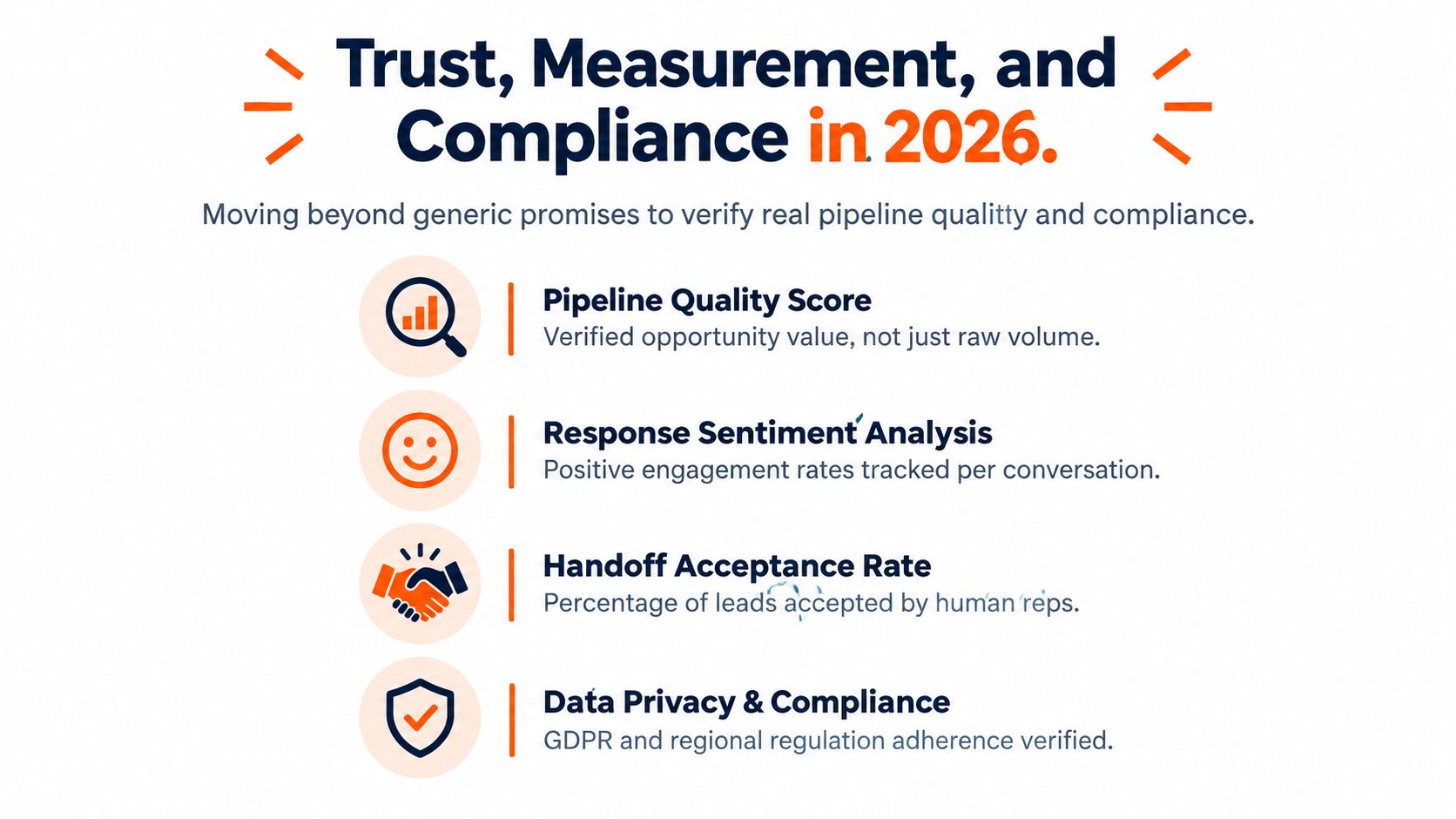
Transparency is part of the experience
For European Union prospects, Article 50(1) of the EU AI Act requires people to be informed when they interact with a machine rather than a human, unless that fact is already obvious. Search results report that this transparency requirement is enforceable from 2 August 2026, as described by EU AI Act chatbot disclosure guidance.
A clear opening might say: “Hi, I'm an AI sales assistant for Acme. I can answer product questions and arrange a call with the team.” The disclosure should appear at the first interaction, not after several persuasive messages. A visible human route should also exist for pricing exceptions, contracts, security reviews, and complaints.
A useful maturity model is simple:
Pilot: One workflow, human approval, sandbox testing, and close review.
Governed: Reliable integrations, audit logs, escalation rules, and measured outcomes.
Autonomous: Only low-risk actions run without approval, with ongoing monitoring and reversible changes.
Teams that want to make their brand information easier for AI systems to interpret can also examine brand citation strategy for AI models. Clear source material helps both human sellers and automated systems work from the same approved facts.
FAQs About AI Sales Agents
What is an AI sales agent?
An AI sales agent is software that interprets sales conversations, retrieves relevant business context, and performs approved actions in connected tools. It can qualify, route, schedule, record, and draft, but it still needs rules and oversight.
How is it different from a chatbot or RPA?
A chatbot mainly responds within a conversation, while RPA follows fixed instructions across software. An AI sales agent can interpret less structured requests, use context, select a permitted next step, and call tools. That flexibility also makes testing more important.
How much CRM integration is required?
The effort depends on data quality, field design, permissions, and the number of connected systems. A serious setup needs controlled CRM read and write access, calendar logic, identity matching, activity logging, and a way to reverse errors. Connecting an API is the easy part. Agreeing what the agent is allowed to change is the actual work.
What data privacy controls should be included?
The agent should use least-privilege permissions, approved data sources, access restrictions, audit logs, retention rules, and clear escalation paths. Teams should also test opt-outs, sensitive requests, duplicate records, and regional privacy requirements before production use.
How should prospects be told they are speaking with AI?
The agent should disclose its identity at the first interaction when required by applicable rules. A direct line such as “I'm an AI sales assistant for Acme” is clearer than hiding the disclosure in a footer. Prospects should have an easy way to request a human.
How long does it take to get a first qualified meeting?
There is no universal timeline. It depends on lead volume, the quality of the qualification rules, calendar availability, response behaviour, and whether human approval is required. A team should measure time to first accepted qualified meeting after establishing its own baseline, rather than borrowing a vendor promise.
Will AI sales agents replace SDRs?
They'll change the work more than eliminate the need for people. Agents are well suited to research, enrichment, first responses, coordination, and record updates. SDRs remain responsible for discovery, judgement, relationships, negotiation, and unusual situations.
Which KPIs matter during the first 90 days?
Track task-completion rate, qualification-field accuracy, routing accuracy, escalation compliance, hallucination rate, cost per completed opportunity, accepted meetings, pipeline quality, and human override rate. Speed alone can hide a broken process. The first operating period should show whether the agent is helping representatives make better decisions.
The implementation considerations above give teams a safer starting point: one workflow, clean data, clear permissions, human review, and measurement tied to pipeline quality.
ContentBuck helps B2B teams build the video assets, SEO content, ad creatives, and repurposing workflows that give sales agents better material to share with qualified prospects. Visit ContentBuck to explore a video-led acquisition system designed for complex B2B offers.
Parth Jasrapuria
Founder at ContentBuck
Building video systems for B2B businesses. Obsessed with YouTube growth, creative strategy, and organic SEO.