7 Faceless YouTube Channel Options for B2B Companies
Parth Jasrapuria
Founder
It's 11 pm. A finance director is on YouTube, one search away from giving up on her month-end close problem. She doesn't want a sales pitch from a smiling stranger. She wants a clean answer in four minutes, with no awkward hallway chat and no mystery music swelling in the background.
That's the moment a faceless channel wins, and it's why B2B teams are retiring the webcam. YouTube is a big enough pond to justify the effort: it published its first video in April 2005 and now reports more than 2 billion logged-in users each month, according to History Tools' account of YouTube's growth.
ContentBuck has spent four years making B2B video only, and the pattern is consistent. When the video explains the problem well, nobody misses the face. What follows is seven Faceless YouTube Channel Options for B2B Companies, each judged by the buyer moment it wins rather than by how trendy the format looks. Every option includes one behind-the-scenes production choice and one tactic a team can copy this quarter. For a wider tour of camera-free formats, revid.ai's faceless video creation guide is a solid starting point.
1. Animated Explainer Series (2D Motion Graphics)
A security buyer presses play on a 75-second video and watches a tiny padlock get very confused by a very busy office. A minute later she can explain zero trust to her own boss. No face appeared, no demo was booked, and the idea still landed.
That first look is the buyer moment this format wins. It's also measurable. In a Google and National Research Group survey of 2,063 senior US B2B decision-makers, 60% said they watched a product or service tutorial while evaluating vendors. Technical buyers need to "get it" before they book anything, and animation makes abstract software concepts concrete faster than a spoken pitch does.
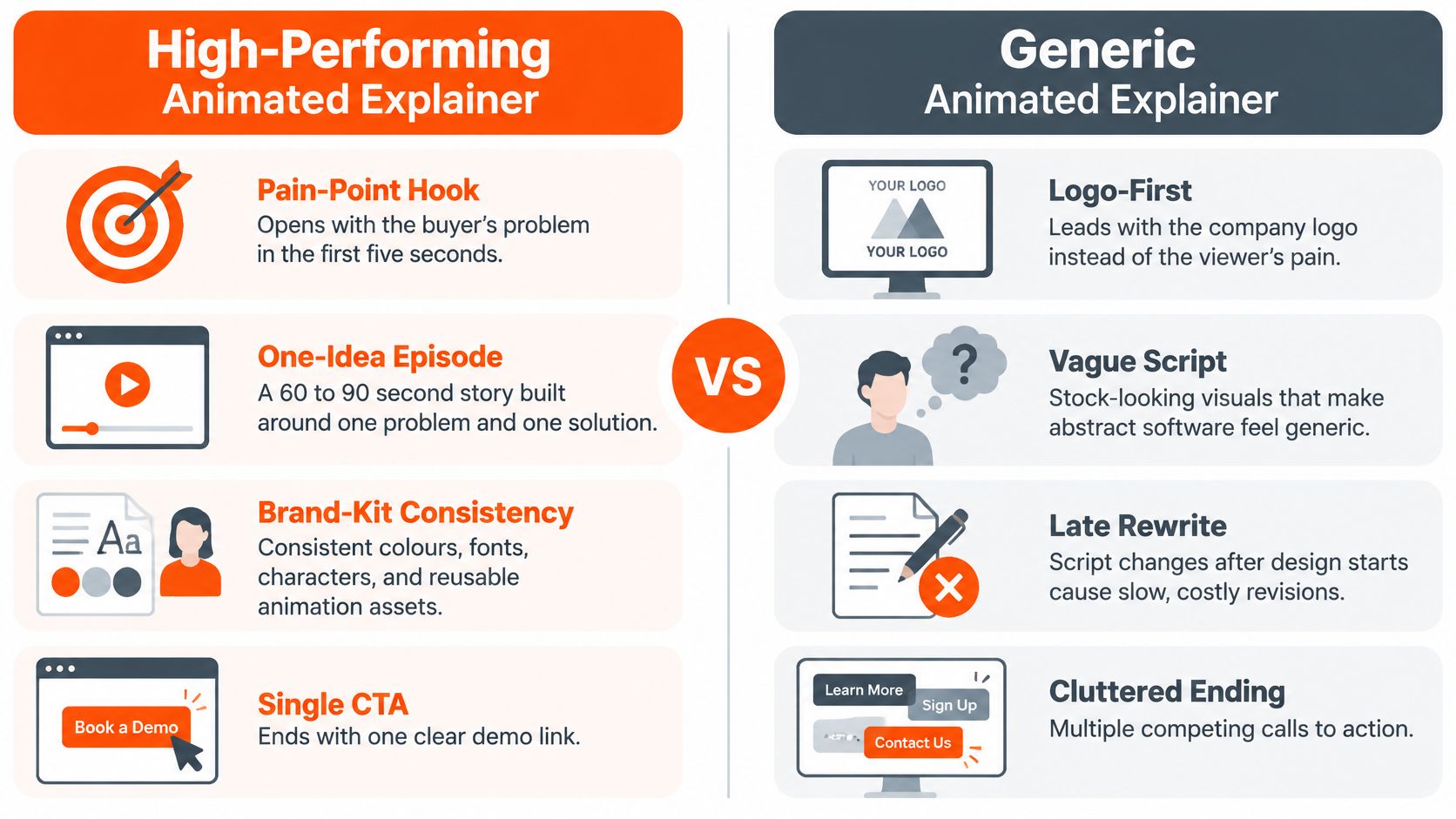
Episodes usually run 60 to 90 seconds. Long enough to explain one problem, short enough that nobody needs a snack break. A payroll firm turns "multi-country tax rules" into a cartoon cat juggling passports, then shows the product sorting them. An industrial IoT vendor animates a factory floor so sensor data visibly travels to a dashboard, which kills the first fifteen minutes of every sales call.
The production choice that saves money
Write the full script before a single frame is designed. Designers who start early produce beautiful frames around a muddled argument, and the rewrite costs more than the original quote. Storyboard frames can be blocked out fast with a free AI image generator to test whether the metaphor reads before the illustrator begins.
The 60-second test: if a stranger can't repeat the idea back after one viewing, the script isn't finished.
Open with the buyer's pain, not your logo, in the first five seconds.
Keep one idea per video so viewers don't need a nap halfway through.
Export 16:9, 1:1 and 9:16 at the same time for YouTube, LinkedIn and Shorts.
End with a single call to action, not five competing buttons.
If the metaphor approach feels unfamiliar, this animated explainer production breakdown walks through the scripting order. One caution applies if synthetic voices or generated characters enter the frame: YouTube requires creators to disclose realistic content made or materially changed with AI, per YouTube's altered content disclosure rules, and repeated failures can lead to penalties.
2. Screen-Recording Product Demo Walkthroughs
It's 11:40 pm and a prospect wants to know one thing. Can your tool handle a twelve-person approval chain, or will it fall over at step four? Nobody on her team wants to book a call to find out.
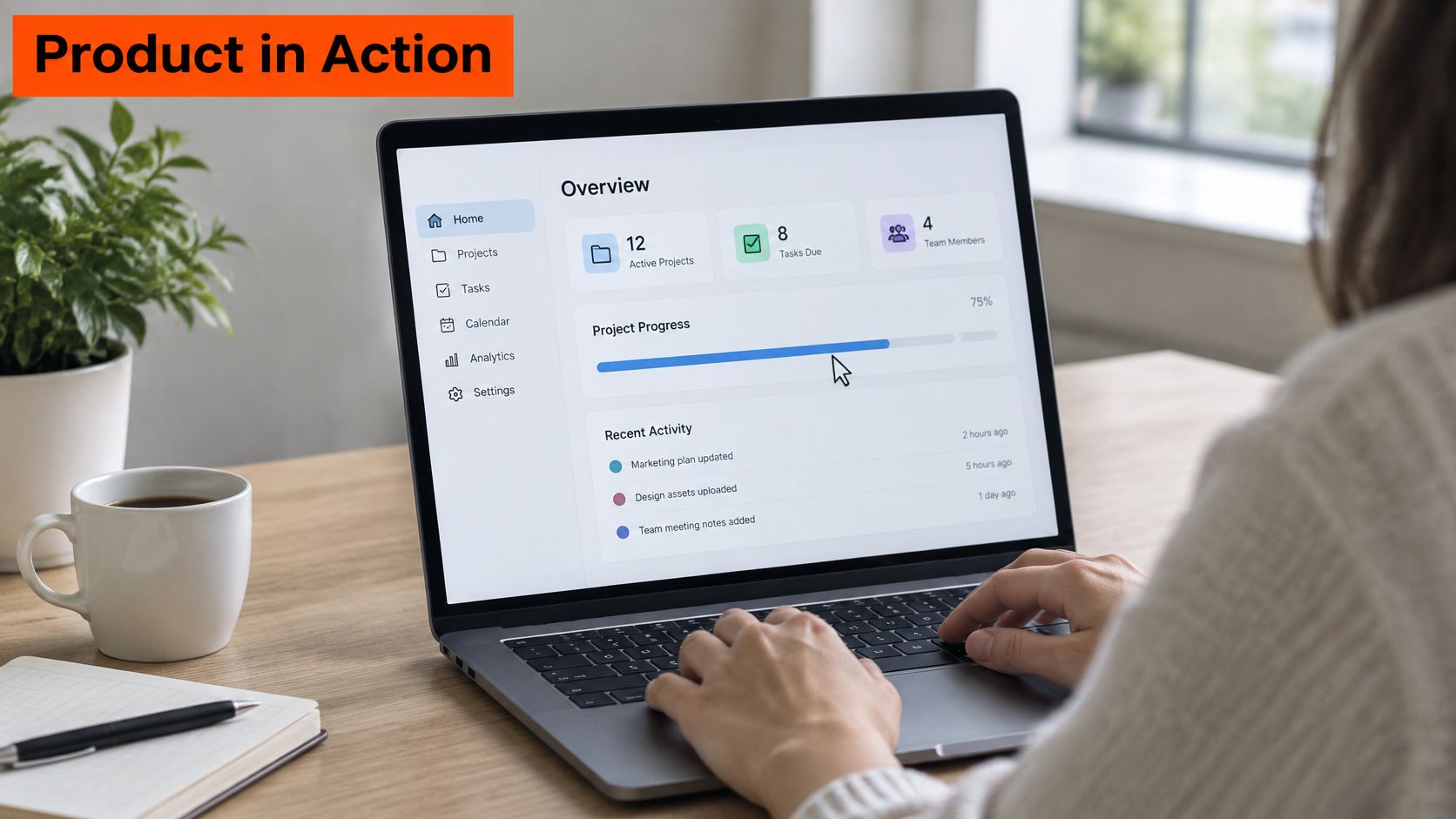
That late-night research session is the buyer moment a screen recording owns. Buyers already treat YouTube as a committee-research tool: Levitate Media's video marketing statistics roundup reports that 60% of B2B buyers use YouTube during vendor research, with webinars and video demos among the most influential formats for final decision-makers.
A project management tool posts "Set up your first board in 4 minutes" and watches sign-up completion climb because nobody feels lost. A finance platform records "Month-end close in 6 clicks," then cuts three Shorts from the same footage that point viewers to a trial. A developer tools firm adds chapter markers to a 20-minute demo so engineers can jump to the API section instead of rage-quitting at minute three.
The production choice that keeps it readable
Script the narration before you hit record, so the clicks match the words rather than the other way round. Use a clean browser profile with no personal bookmarks, no seventeen open tabs, and no client names in the sidebar. Record at a higher resolution than you need so the editor can zoom into the one button that matters.
ContentBuck's Unlimited Video Editing service handles demo recordings with 24-hour turnaround and a dedicated editor, which matters when a feature ships and the demo is stale by Friday. A fuller workflow lives in this YouTube product demo video playbook.
Add timestamps to anything longer than five minutes.
Swap real customer names for realistic dummy data.
Cut one 30-second version for paid retargeting.
3. Animated Data and Statistics Storytelling
Someone in procurement opens a video called "Shipping delays in 2024" and forwards it to three colleagues before lunch. That's the internal share moment, and it's worth more than a thousand passive views.
This format lets numbers move. A supply chain software firm animates a map of port congestion and closes with three takeaways for operations leaders. An HR tech company turns its annual survey into a 90-second chart race where job-hunting trends sprint across the screen like a sports highlight. A cloud security vendor animates breach cost statistics and ends with a question that pushes viewers toward a risk assessment.

The production choice that protects retention
Data videos die in the middle. Viewers arrive curious and leave during the third chart. Humble and Brag's retention benchmarks put healthy average percentage viewed for five- to fifteen-minute business and educational videos at roughly 40% to 55%, while return-viewer rates above 10% suggest repeat audience behaviour rather than one-off discovery.
Translate that into a production rule. A ten-minute explainer should target four to five and a half minutes of average viewing, so every segment earns its place. Set checkpoints at 30 seconds, 50% completion and the final call to action, then test alternate hooks while holding the topic constant.
Numbers without a "so what" are just wallpaper with a pulse.
Use three to five key numbers per video, not thirty.
Cite every source on screen and in the description.
Turn the strongest stat into the thumbnail, with a bold figure and few words.
Add a "what this means for you" section so the data becomes a decision aid.
Refresh yearly if the category moves fast.
4. Faceless B2B Podcast Video (Audio-First with Visual Layers)
A founder once said he'd rather eat a spreadsheet than appear on camera. He now records a weekly podcast with waveform visuals, animated quote cards and a search-optimised show-notes page. The audience hears an expert, reads the key points, and never sees a face.
The buyer moment here is deep attention, the long drive or the gym session where someone listens to forty minutes on a topic they care about. Consistency is what earns that habit. A documented personal-finance channel reached roughly 182,000 subscribers and 380,000 monthly views after publishing 142 videos at about two per week, according to Money Forge's faceless channel case study, with videos running past eight minutes to enable mid-roll placements. The revenue figures in that case are estimates, so treat them as directional, not as a forecast for your finance channel.
The production choice that unlocks repurposing
Record separate audio tracks for each speaker and keep one visual style across every episode. A B2B fintech podcast runs a 40-minute conversation with animated quote cards, then produces six Shorts and four LinkedIn clips from the same recording. A consultancy overlays slides of the frameworks a guest describes, turning a casual chat into a learning asset.
Pick the visual layer once. Waveforms, quote cards or slide overlays, but not all three fighting for the same corner of the screen.
ContentBuck's Podcast Video Agency handles episode post-production, 3 to 7 short clips per episode, thumbnails, SEO show notes and multi-platform renders, which is usually the difference between a podcast and a podcast nobody finds. More detail sits in this B2B podcast production guide.
Create a quote card for every idea that stands alone.
Publish timestamped chapters so viewers can jump.
Write show notes as a page, not as a paragraph dump.
5. Whiteboard and Hand-Drawn Sketch Explainers
A stressed procurement manager is drowning in approval paperwork. Then a very organised arrow arrives and rescues him. That's the teaching moment, and it's the buyer moment this format wins, usually with a stakeholder who isn't technical and needs the process to make sense in ninety seconds.
Sketch explainers show drawings appearing in real time, often with only a hand visible or no hand at all. It feels like a teacher at a whiteboard, which is exactly the tone a complicated workflow needs. An HR platform uses one to explain onboarding stages and hands it to new customers during their first week. An agency draws the buyer journey as a winding road with snacks at every stop, which is the only funnel diagram many people remember.
The production choice that separates trust from novelty
Keep the human signal. Buyers are comfortable with automation and still want guidance: LinkedIn's B2B Institute video research reports that 84% of B2B buyers trust AI and automated tools in the buying process, while 50% still prefer human guidance. A sketch style that names the expert behind the method and shows the data it came from does both jobs.
Sketch rule: if the drawing needs a legend, it needs a simpler drawing.
Limit each sketch to one main idea so the frame stays readable.
Keep one colour palette and marker style across the series.
Make text large enough to survive a phone screen.
Reuse the finished sketch in your help centre as a training asset.
Close with a summary card so viewers can recall the sequence.
A sketch video that lives only on YouTube wastes its best quality, which is teachability. Put it where new users get stuck.
6. Narrated B-Roll Case Study Documentaries
Two weeks before signature, the buying committee asks the question every seller dreads: who else like us has done this? That's the proof moment, and narrated case study documentaries win it.
The format runs on voiceover, on-screen text, customer quotes and b-roll. No founder stares into the camera. Say a logistics software company tells a customer story over warehouse footage and lands a single metric card: faster order processing. A B2B agency holds up a plain text card reading "Lower cost per lead" while the voiceover explains the creative testing behind it. A cybersecurity firm layers city skyline visuals under a story about a bank cutting incident response time.

A committee can forward this video to the CFO at 11pm without explaining who the person on screen is. The customer is the hero, your product is the plot, and the narrator does the talking. That division of labour is what makes the format travel inside companies you have never pitched.
The production choice that doubles distribution
Host each case study on a landing page with proper video structured data. Google's video structured data guidance explains that accurate markup helps Google understand what the video contains, and the details must match the actual video and the page metadata. Label a 90-second demo as a two-hour webinar, or promise a live customer interview above an animated clip, and search engines ignore it while humans hold a grudge.
The budget case practically writes itself. In 2025, 93% of marketers reported that video marketing generated a strong return on investment, according to video marketing statistics drawn from Wyzowl's State of Video Marketing research. A case study documentary earns that return twice: once on YouTube, and again on the landing page where it catches search traffic.
The replicable part is the edit discipline:
Get written approval before publishing any customer detail.
Lead with the customer's problem, not your product.
Use one strong metric per story so the card lands and the viewer remembers it.
Match b-roll to the customer's industry, not to generic stock skylines.
Cut a 30-second version for paid ads while the source files are still open.
A case study that only lives on YouTube is half a case study. The other half is the version your sales rep drops into the thread when the committee asks its dreaded question.
7. Slide-Led Thought Leadership and VSL Presentations
A buyer watches a six-minute video sales letter at her desk, sees a calculator appear at the end, and books time with finance before she books time with sales. The sales call arrives half finished, which is the whole point.
Slide-led videos build an argument step by step with diagrams, numbers and a voiceover. A consulting firm publishes its "three-stage pipeline audit" framework as a narrated deck. A software vendor shows how a new feature saves four hours per week and turns the opening 20 seconds into an ad hook.
The production choice that decides the outcome
One idea per slide, very few words, and transitions used sparingly. Test two versions of the opening hook before you spend on distribution, because the first fifteen seconds carry the entire argument.
There's a practical side benefit too. Slide-led videos tend to run long, and long-form watch time is what counts. YouTube's ad-revenue threshold requires 1,000 subscribers plus either 4,000 qualified public watch hours in the previous 12 months or 10 million qualified Shorts views in the previous 90 days, per YouTube's Partner Program eligibility page, and Shorts Feed views don't count toward the hours route. An earlier stage exists too: YouTube's expanded monetization requirements list 500 subscribers, three valid public uploads in 90 days and either 3,000 watch hours or 3 million Shorts views. That tier makes memberships, Super Chat and Shopping available, not ad revenue.
A slide deck is not a video. A narrated argument is.
Open with the buyer's problem and a clear promise.
Keep slides light, one image or idea each.
Put one call to action on the landing page and in the video.
Skip the six-minute agenda slide. Nobody has ever thanked you for it.
Faceless YouTube formats for B2B at a glance
Each format wins a different buyer moment. A CFO skimming at lunch needs a 90-second explainer. An IT director doing late-night research will sit through a 40-minute podcast episode. Match the format to the moment, not to what looks impressive in a pitch.
Format | Best for | Typical length | Production effort | Main risk
Animated Explainer Series (2D Motion Graphics) | Making complex software concepts easy to understand | 60–90 seconds | High; animation and revisions take time | Late script changes can make revisions slow and costly
Screen-Recording Product Demo Walkthroughs | Showing product features and workflows to prospects | 2–5 minutes for a specific feature; longer for full tours | Low; fast to record and update | Dull pacing or exposed sensitive data
Animated Data and Statistics Storytelling | Sharing research, industry trends, and thought leadership | 5–10 minutes for a single finding; longer for full reports | Medium; requires research, sourcing, and animation | Inaccurate or outdated data can undermine trust
Faceless B2B Podcast Video (Audio-First with Visual Layers) | Repurposing expert conversations into videos and clips | Long-form, typically 30–60 minutes | Medium; requires clean audio and visual editing | Episodes can feel static without strong audio or visual quality
Whiteboard and Hand-Drawn Sketch Explainers | Explaining processes, strategy, and training topics | 2–5 minutes for education; under 90 seconds for ads | Low to medium; simpler than full animation | Can look too casual or lose viewers if too long
Narrated B-Roll Case Study Documentaries | Building buyer trust with customer proof and results | 2–4 minutes; 30 seconds for ads | Medium; requires customer input and approvals | Permission or unverified results can delay or compromise the video
Slide-Led Thought Leadership and VSL Presentations | Presenting frameworks, ideas, or sales offers | 4–8 minutes for a VSL | Low to medium; slides are quick to create and update | Text-heavy slides or weak pacing can lose viewers
Read the table from right to left, not left to right. The risk column tells you what breaks each format, and that is usually the main constraint. A team with no customer approvals lined up will stall on case study documentaries no matter how good the B-roll is. A team that ships features every sprint should lean on screen recordings, because updating a screencast takes an afternoon while re-animating an explainer takes weeks.
Production effort is the quiet decider. The two low-effort formats, screen recordings and slide-led videos, are the ones a lean marketing team can publish weekly without hiring anyone. The high-effort formats earn their keep at the first-look moment, where polish signals competence before a prospect ever books a call.
Pick Your Faceless Format and Start Before You Overthink It
Seven formats, seven different buyer moments. The choice isn't about which one looks most impressive in a pitch deck. It's about which moment in your buyer's week you're trying to win: the first look, the late-night research session, the internal share, the long listen, the teaching moment, the proof moment, or the sales call that happens without you.
Start with one format, one buyer problem and one clear call to action. A team selling workflow software should probably begin with screen recordings, because the product is the argument. A team selling a methodology should begin with a sketch or slide-led video, because the thinking is the product.
Give it a real test window
YouTube is a long game. ContentBuck states plainly that YouTube is a 3 to 6 month investment and isn't suited to teams that need leads within a week, so plan for at least three months of consistent publishing before drawing conclusions. Judge the test on assisted conversions, sales-call influence, branded-search lift and demo quality, not on view counts alone. A useful gut check sits in this guide on measuring video KPIs by platform.
Publish on a fixed day so the calendar, not the mood, decides.
Repurpose every piece into Shorts, LinkedIn clips and ad cutdowns.
Give each video one measurable next step, such as a calculator, template or demo link.
Review retention at 30 seconds and 50% completion every month.
Kill what flatlines after three months of honest attempts.
If you want a quick reality check before committing budget, ContentBuck offers a Free YouTube Audit that shows where a faceless plan can win first, including a walk through the exact searches your buyers make. That's cheaper than discovering in month five that the format was wrong for the buying stage.
Frequently Asked Questions About Faceless YouTube Channels
Can a faceless channel still build trust with B2B buyers?
Yes, with the right split. Use faceless formats for problem education, product walkthroughs and benchmark explainers, then add verifiable human signals for late-stage evaluation. Named expert narration, original data, transparent methodology and customer evidence do the trust work a face would otherwise do.
How long does a faceless B2B channel take to produce leads?
ContentBuck treats YouTube as a 3 to 6 month investment and doesn't recommend it for teams needing leads within a week. Consistent publishing, buyer-intent topics and a clear next step on every video matter more than volume in month one.
Do faceless videos need a human voice?
Not necessarily, but they need a human argument. Synthetic narration works when the script carries proprietary insight and the visuals do real work. If generated content could be mistaken for real footage or a real person, YouTube requires disclosure under its altered content rules.
Which faceless format should a small team start with?
Pick the format closest to your product's proof. Software teams usually start with screen-recorded walkthroughs because the interface is the evidence. Service firms and consultancies start with slide-led or sketch explainers because the framework is the product.
Faceless YouTube is not a workaround for companies without presenters. It's a production system, and ContentBuck builds it end to end: buyer-focused topic research, scripting, animation, screen-recorded demos, editing, captions, thumbnails, uploads and YouTube SEO, all from one team so the channel, the ads and the articles say the same thing. If your buyers are searching at 11 pm and finding your competitors instead, visit ContentBuck and ask for the Free YouTube Audit before you commit to a format.
Parth Jasrapuria
Founder at ContentBuck
Building video systems for B2B businesses. Obsessed with YouTube growth, creative strategy, and organic SEO.