Should Your CEO Be the Face of Your B2B YouTube Channel?
Parth Jasrapuria
Founder
Should the CEO be the face of your B2B YouTube channel? Only when the video needs the CEO's perspective on company direction, market predictions or a contrarian view. A roster of credible speakers usually serves more buyer questions.
Thought leadership can prompt buyers to research unfamiliar offers, but seniority alone does not make someone persuasive on camera. A prospect concerned about data access needs a clear technical answer, not a motivational speech about the future of work.
Choose the person who can defend the answer, then give it a format with enough room. The CEO is one voice in the channel, not the default face.
Short Answer on Who Should Front Your Channel
The CEO should lead strategic videos, while specialists handle questions that need technical detail, practical instruction or buyer-side proof. Seniority helps when the subject involves a decision only the CEO can explain. It doesn't turn every executive into the best teacher.
Who fits which topic
Speaker | Best topics | Credibility strength | Watch-out
CEO | Company direction, market predictions, contrarian views | Authority to make calls | Can drift into generic vision talk
CTO or technical lead | Technical risk, architecture choices, proof of value | Shows the working detail | Can lose non-technical viewers
Customer | Migration stories, measured results, honest criticism | Buyer-side proof | Needs consent and careful editing
Implementation lead | Onboarding steps, timelines, common mistakes | Practical know-how | Carries less strategic weight
Subject-matter specialist | Benchmarks, compliance rules, data findings | Deep evidence | Needs a clear story to hold attention
The 2024 Edelman–LinkedIn B2B Thought Leadership Impact Report, which surveyed 3,484 global business executives across seven countries, found that 75% of decision-makers said a specific piece of thought leadership prompted them to research a product or service they hadn't previously considered. That supports investing in useful expertise, not assuming a CEO appearance automatically creates demand.
A 2026 survey reported by O'Dwyer's found that 64% of respondents viewed customer and market trust as the top benefit of CEO visibility. The practical distinction is between a leader explaining a difficult choice and a spokesperson reciting approved adjectives.
ContentBuck's founder believes most video agencies were built for consumer brands, and that consumer-style video doesn't work when the customer is a CFO or Head of Operations. A CFO won't be moved by a CEO reading a product slogan in a hoodie. The hoodie isn't the problem. The missing argument is.
Speaker-selection rule: Give the microphone to the person who can answer the buyer's hardest follow-up question.
For the next video topic, the marketing team should pick the matching row before booking the CEO.
Horizontal and Vertical Video Side by Side
Format | Typical length | Where buyers see it | Best CEO use | Production load
Horizontal long-form | 10–30 minutes | YouTube search, recommendations, embedded on the website | Strategy and objection handling | High: scripting, recording, captions, thumbnail
Horizontal short clip | 1–3 minutes | Website pages, LinkedIn video, paid ads | One focused answer to one buyer objection | Low to medium
Vertical short clip | 15–60 seconds | YouTube Shorts and the LinkedIn mobile feed | One sharp opinion or one buyer question | Medium per clip, high when produced in volume
These are planning ranges, not required runtimes. An editor shouldn't stretch a clear answer just because a content calendar has an empty box.
Horizontal video uses the wide 16:9 shape associated with a YouTube player or desktop screen. It gives interviews, demonstrations and supporting visuals room to breathe, making it a sensible choice for detailed answers and search-led content.
Vertical video uses the tall 9:16 shape of a phone feed. For a production team preparing different crops, PostPulse's guide to compare vertical aspect ratios offers a useful preparation reference before recording and export.
One discussion, different jobs
Say a CEO records a 20-minute interview about vendor risk. The full horizontal episode explains the commercial trade-offs, while a short horizontal extract answers a procurement objection on a relevant website page.
The editor then selects three vertical clips, each with a separate point: unclear responsibility, slow approvals and poor incident planning. Each crop needs its own framing so the speaker stays centred and any supporting text remains readable.
Those are proposed production choices for that scenario, not performance benchmarks. The team should shorten or expand each asset according to the answer it contains.
Long horizontal: Preserve the reasoning, including the caveat that stops an opinion becoming misleading.
Short horizontal: Remove surrounding discussion so a buyer can get a focused answer without watching the episode.
Vertical: Make the point understandable without expecting the viewer to know the company.
A vertical extract is relatively inexpensive once a strong source recording exists. Volume still creates work: someone must select moments, reframe footage, check captions and approve each version.
Long horizontal is for depth. Vertical is for reach. Recognition comes from preserving the speaker's voice across both, not pasting the same edit everywhere.
Where Long-Form Horizontal Video Earns Trust
YouTube's explanation of its recommendation system says it considers what viewers watch, ignore, search for, like, dislike and mark as not interested, alongside signals including average view duration and average percentage viewed. A CEO's job title doesn't override those viewer choices.
A polished monologue can therefore disappoint if the audience leaves before the useful answer begins. Expensive lighting makes an executive easier to see. It doesn't make an irrelevant introduction worth watching.
Start with the problem, not the biography
Consider a hypothetical episode about why SaaS onboarding loses users. The weak opening starts with the CEO's career history, the company's mission and a tour of its commitment to innovation.
The stronger version starts with the buyer's problem: customers reach onboarding without anyone owning the next action. The CEO explains the decision behind that failure, introduces supporting evidence and gives the viewer a practical change to make.
A useful opening outline contains:
The problem: Name the situation the buyer recognises.
The opinion: Explain what the CEO believes many teams misunderstand.
The evidence: Show the process, example or approved finding behind that view.
The takeaway: Identify what the buyer can do differently.
In a sample edit, a two-minute self-introduction could move to the end or disappear entirely. The opening minute can then carry the argument rather than the corporate roll call.
Show judgment under pressure
A hypothetical 15-minute episode about a failed implementation gives the CEO room to explain competing priorities. Why was the rollout approved? Which warning was missed? What changed afterwards?
The interviewer should press for the decision process rather than invite a tidy success story. A specific account of an imperfect decision is more useful than a leader claiming everything went according to plan, including the unexpected parts.
Delivery matters too. Intonetic's guide to gestures that signal confidence onscreen can help presenters prepare, but natural movement should support the explanation rather than become a choreographed executive dance.
Editing test: Remove anything the buyer doesn't need before understanding the main claim.
Before publication, the team can test the opening with someone outside the project. After publication, the retention graph can show whether viewers leave during introductions; if that pattern appears, the editor should shorten, move or remove them in the next episode.
Where Vertical Clips Earn Reach and Recall
In 2024, 63% of B2B buyers said short-form social video helped inform their buying decisions, according to LinkedIn's research with GWI, which surveyed more than 1,700 B2B buyers and technology decision-makers in the United States, United Kingdom and India. That makes short video worth planning properly, but it doesn't mean a clip can replace a complete argument.

A useful vertical clip answers a narrow question. For a proposed edit, the opening three seconds might state the objection directly, followed by the CEO's position and a clear route to the full discussion.
Captions should make the answer understandable without sound. They also need manual checking, especially when the speaker mentions product names, security terms or acronyms that automatic transcription enthusiastically reinvents.
Give each platform a clear role
A LinkedIn clip could explain a pricing choice: why a SaaS company charges for active usage rather than registered seats. It gives existing executive followers a specific decision to consider and discuss.
A YouTube Short could name procurement delays in a sentence, explain the overlooked cause and point to the full vendor-risk episode. That gives an unfamiliar viewer an entry point without requiring a company history lesson.
LinkedIn: Plan for professional conversation among people already connected to the executive and their network.
YouTube Shorts: Plan for discovery by viewers who may not recognise the speaker.
Full episode: Provide the context, evidence and qualifications omitted from the extract.
ContentBuck's guide to YouTube short-form content is a useful companion when deciding how clips should support the channel rather than become an unrelated publishing exercise.
Check the crop before export
A vertical crop can cut out the slide that explains the point, or lop off the CEO's head and leave a floating tie beside a very serious bookshelf. Neither is an ideal spokesperson.
If an asset will also run on Instagram, Cometly's Instagram creative file size requirements can help the team prepare that separate export.
For a practical editing exercise, the team can select three moments from its latest episode, write a distinct hook for each and check the speaker's position throughout. Every clip should provide an accessible route back to the long video.
How to Film Once and Cut for Every Format
83% of surveyed marketers use video, according to HubSpot's video marketing findings. The operational question isn't whether a marketing team can produce a video. It's whether it can build a repeatable process without making the CEO a full-time presenter.
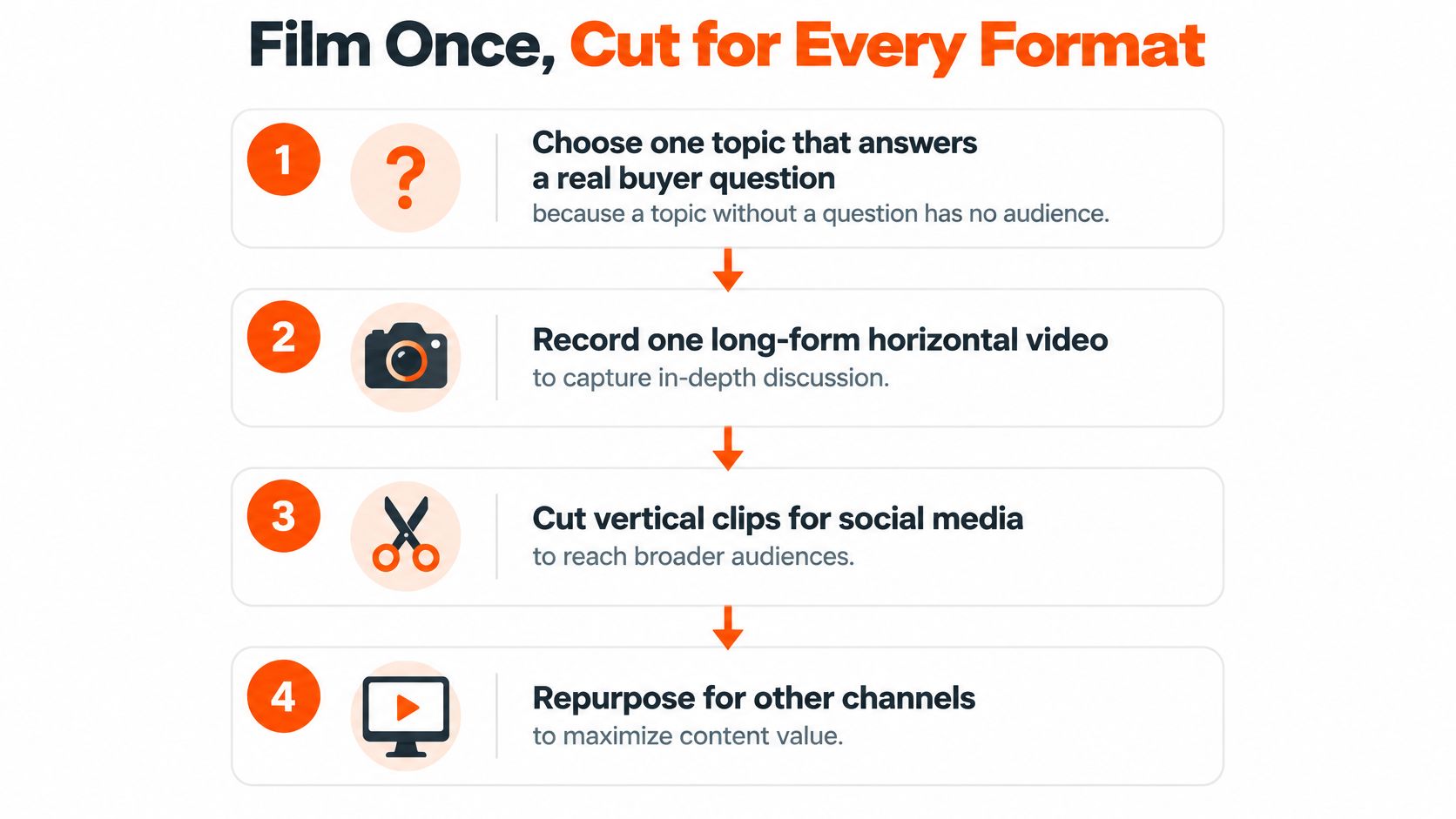
ContentBuck's workflow turns one 45-minute recording session with a client, technology partner or industry expert into a YouTube video, three to five LinkedIn clips, a blog post and an audio episode. That makes preparation more important, not less: every output starts with the same conversation.
A practical recording workflow
Choose a buyer question. A cybersecurity team might address why vendor reviews stall after technical approval. A broad topic such as cybersecurity trends gives the conversation too many exits.
Record the CEO with a relevant guest. A customer can challenge assumptions, while a technical expert can explain details the CEO shouldn't improvise.
Prepare the claim, evidence and takeaway. This short outline keeps the interview focused without forcing the speaker to read a script word for word. The producer should collect approved examples before recording.
Edit the long video first. For a hypothetical session, the editor might retain the strongest 15 to 20 minutes, provided the resulting story is complete. Clips should come from coherent answers, not abandoned tangents.
Build distinct vertical extracts. Give each clip a self-contained opening, readable captions and a clear destination for the longer explanation. A fragment that begins with an unexplained pronoun needs rewriting or a different cut.
Adapt the transcript and audio. A blog post needs headings, edited prose and checked claims, while an audio episode needs explanations for anything shown only on screen.
Package the buyer question. The title and thumbnail should identify the problem or decision, not merely announce the company and guest. Procurement delays are more useful packaging than another executive conversation.
Track the onward journey. The team should examine which clips lead people towards the episode and which attract attention without further engagement. Sales conversations can add context that platform analytics miss.
Fix the avoidable mistake
Recording without an outline is the easiest way to create expensive editing puzzles. The fix is a shared preparation document with the buyer question, evidence, exclusions and intended takeaway.
ContentBuck's YouTube video production guide provides further context for organising the production work around the recording.
Copyable project checklist
Preparation: Buyer question agreed, speakers selected, evidence approved.
Recording: Audio checked, framing tested, guest permission recorded.
Editing: Main argument preserved, captions corrected, clips understandable alone.
Publishing: Titles, thumbnails, destinations and measurement ownership assigned.
Real Cases for Choosing the Right Speaker
Consider a cybersecurity company planning an episode about vendor risk. The CEO can explain why buyers should evaluate operational responsibility rather than compare feature lists, but a security lead should demonstrate how access controls and incident escalation work.
The editor can then separate the discussion into compliance, procurement-delay and incident-response extracts. The CEO establishes the commercial position; the security lead supplies the working detail.
The lesson: Strategic confidence and technical proof don't have to come from the same mouth.
A SaaS buying group needs different answers
Say a SaaS company is explaining a move towards usage-based software. The CEO discusses the market shift, the CTO demonstrates how the API handles customer data, and a customer describes what the rollout required from their team.
Those videos serve different concerns. A finance stakeholder can assess the business rationale, an engineer can inspect the integration, and an operations lead can understand the disruption involved.
The 2025 Edelman–LinkedIn B2B Thought Leadership Impact Report, which surveyed 1,934 global business executives, found that 95% of hidden buyers become more receptive to sales and marketing outreach when thought leadership is strong, while 71% say it demonstrates vendor value better than traditional sales or marketing materials. The report also found that 51% of hidden decision-influencers say high-quality thought leadership helps them convince C-level executives.
That doesn't establish that a rotating cast outperforms a solo presenter. It does support planning content for people who influence a purchase without appearing on the sales team's contact list.
Build an authority portfolio
An authority portfolio gives each speaker a defined responsibility:
CEO: Strategic conviction and decisions the company stands behind.
Specialists: Evidence-heavy explanations and practical demonstrations.
Customers: Validation, implementation realities and honest limitations.
Pricing philosophy is an edge case where the CEO should usually explain the decision. A regulatory change may also need executive commentary on the company's response, with a specialist handling interpretation and legal review checking claims before publication.
The marketing team should measure qualified views, assisted opportunities and buying-group engagement, not subscriber count alone. Relevant job roles, prospect mentions and videos shared during active deals offer better context than a large audience that will never buy.
Choose Your Face and Protect the Channel
A channel needs a recognisable lead, but the company shouldn't depend on that person's permanent availability. A CEO can leave, change responsibilities or become unavailable during a demanding quarter.
Edelman's hidden-buyer findings show that 64% of surveyed hidden buyers trust thought leadership more than product sheets or brochures when assessing capability, while 71% consider it more effective than traditional marketing or sales materials. If buyers use executive content to evaluate a supplier, losing its only credible presenter creates a practical business risk.
Make authority transferable
List the three buyer questions that matter this quarter. Match each to the speaker who can defend the answer.
Select a lead face. Use the CEO when strategy dominates, or an expert when the channel's value is technical depth.
Write a one-page editorial principles document. Cover evidence standards, tone, confidential information, approval ownership and subjects the speaker won't discuss.
Establish transferable recurring formats, such as a monthly ask-the-engineer session and an implementation clinic.
Keep company-owned access. Store source files, permissions and approved transcripts centrally, and maintain a website archive and an email list.
Say a SaaS CEO steps down. An established engineer-led series can continue publishing while the company introduces its next executive voice, rather than leaving an empty channel and a farewell post.
Keep the company in control
The model is CEO-led, institution-owned. Personal judgment gives the videos character; company ownership keeps the programme useful when circumstances change.
Camera discomfort also shouldn't force the wrong person into every episode. ContentBuck's guide to founder camera anxiety on YouTube offers a relevant preparation resource for reluctant executives.
ContentBuck offers YouTube Growth for B2B, which builds organic YouTube channels that generate inbound demos. Whatever production model a company chooses, its immediate action this week should be to write the editorial principles document before booking another recording.
Common Questions About CEO-Led B2B Video
Does the CEO need to appear every week?
No. A practical starting schedule is one strong CEO episode a month plus a few relevant clips, rather than weekly talking-head videos that repeat themselves. Specialists can handle the intervening topics, and the team can adjust the schedule according to topic quality and executive availability.
How long before a B2B YouTube channel shows results?
ContentBuck states that YouTube is a three-to-six-month investment and isn't suited to clients who need leads within a week. That planning window isn't a guaranteed result date. A team facing an immediate pipeline gap shouldn't expect an executive's first upload to solve it.
Can an AI avatar replace the CEO on camera?
An avatar can present explainers or voice-over-led information, but it shouldn't be treated as a substitute for an executive's accountable judgment. Any synthetic presenter should be disclosed and tested against a real recording. For strategic thought leadership, a real speaker remains the stronger editorial choice.
What if the CEO is camera-shy?
A short on-camera introduction and a conversation with a specialist or customer can reduce the pressure of performing alone. The CEO's perspective can also appear in written posts and audio episodes. The channel doesn't need to become an executive confidence course before it can help buyers.
ContentBuck plans, produces and scales B2B video, including YouTube strategy, scripting, editing and repurposing. For a channel built around the right answers rather than an overloaded CEO, visit ContentBuck to discuss the buyer questions, speaker roster and production workflow.
Parth Jasrapuria
Founder at ContentBuck
Building video systems for B2B businesses. Obsessed with YouTube growth, creative strategy, and organic SEO.