How to Write a Marketing Video Script That Actually Works
Parth Jasrapuria
Founder
Viewers often leave before the payoff lands. A large cross-media study found that ads watched for 75% of their total length were as effective as ads watched in full, so a marketing video script has to put its most important line in the first 3 seconds, not save it for the grand finale that nobody stays to see.
That's the uncomfortable part. The other uncomfortable part is staring at a blank doc while a camera, a founder, or a deadline waits like an unimpressed gym teacher.
Most bad video scripts don't fail because the writer isn't clever enough. They fail because the script tries to do too much, says it too late, and treats polish like a substitute for structure. A shiny mess is still a mess. It just has better lighting.
A good marketing video script is simpler than many assume. It names one problem, proves one claim, and drives one action. That's it. Not seventeen features. Not a brand manifesto that sounds like it was assembled by a committee in a beige room with weak coffee.
Why your unscripted video is quietly killing your results
A founder hits record for a product launch video, armed with a few bullet points and a lot of confidence. Eleven minutes later, the team has 38 minutes of footage, the main claim does not show up until minute two, and the editor spends half a day trying to carve a 45-second ad out of it. I have seen that movie more than once. It is expensive every time.
The problem is not authenticity. The problem is shape.
For a SaaS launch, “just use talking points” usually creates the same failure pattern. The speaker spends the first 20 to 30 seconds clearing their throat, explaining background the audience did not ask for, then wanders into feature detail before anyone has heard the actual promise. By the time the team reaches a decent line, they are already in edit-rescue mode, chopping pauses, moving sentences around, and trying to fake structure after the fact.
That rescue work costs more than people admit. It burns edit hours, delays approvals, and produces a weaker asset anyway because the script logic was never there. A tighter, single-purpose script nearly always beats a shinier improvised one because viewers can follow it in one pass.
Scripting protects the message
The word “script” makes some teams nervous because they picture flat delivery and hostage-video eye contact. Fair fear. Bad scripts do sound stiff.
Good scripts do something simpler. They decide the order of ideas before the camera is on.
That matters even more in paid video. Digital video advertising became a major budget category fast. Ad spend grew 49 percent year over year in 2021 to $39 billion and was projected to rise another 26 percent in 2022 to $49.2 billion, which helps explain why creative quality, hook strength, and message clarity get scrutinized so hard now (digital video ad spend growth data).
Once distribution costs real money, improvising stops looking scrappy and starts looking careless.
Practical rule: If a line only works on the page, rewrite it until a real person can say it without sounding borrowed.
What improvising usually breaks
Improvised videos can work for casual updates, founder commentary, or behind-the-scenes clips where the point is presence. For launches, demos, paid campaigns, and anything tied to pipeline, they usually break in predictable places:
The promise shows up late: the viewer gets context before value.
The middle gets baggy: features pile up, proof arrives out of order, and the core claim gets diluted.
The CTA gets timid: after all that talking, the ask comes out vague or disappears.
This is why polished footage still underperforms. The issue is rarely camera confidence alone. It is that the video is trying to do three jobs at once.
A marketing video script works better when it does one job cleanly. That sounds less glamorous than “let's keep it natural,” but it performs better in the run of things, and it makes filming easier on everyone in the room.
How to hook viewers before they scroll away
The opening of a marketing video script isn't a creative mystery. It's a test. If the first line can't hold attention, the rest of the draft is basically a diary entry with background music.
Use hook rate like a script score
A practical benchmark is hook rate, which means 3-second video views divided by impressions. A 2026 cross-platform benchmark reports median hook rates of 28 percent on Meta, 33 percent on TikTok, 22 percent on YouTube in-stream, and 29 percent on YouTube Shorts, while top-25 performance reaches 37 percent on Meta, 44 percent on TikTok, 30 percent on YouTube in-stream, and 38 percent on YouTube Shorts (cross-platform hook rate benchmarks).
That matters because a weak opener isn't “subjective.” If it can't clear the platform median, it probably needs a rewrite.
Here's the practical use:
Platform | Median hook rate | Top-25 performance
Meta | 28 percent | 37 percent
TikTok | 33 percent | 44 percent
YouTube in-stream | 22 percent | 30 percent
YouTube Shorts | 29 percent | 38 percent
Teams should compare like with like. A cold-traffic Meta Reel and a warm retargeting YouTube ad are not cousins. They're barely roommates.
Weak opening versus strong opening
Same product. Same offer. Very different opening.
Weak opening
“Hi, today we wanted to show you our new workflow platform.”
“We're excited to introduce some features our team has been building.”
“In this video, you'll learn how it helps businesses.”
This is polite. It's also sleepy.
Stronger opening
“Still chasing approvals in Slack and spreadsheets?”
“This cuts review chaos into one workflow your team can follow.”
“If launches keep slipping, the problem probably isn't effort. It's handoff friction.”
The second version names pain fast. It gives the brain something to grab. It behaves like an opening, not an email preamble wearing a blazer.
The first line should create tension, not ceremony.
Build the opener with three parts
A strong opener usually does one of these combinations:
Name the pain fast “Sales calls are dropping because demo follow-up is slow.”
Show a sharp contrast “Your team bought five tools and still tracks work in a spreadsheet.”
Promise a clear result “This script structure makes a complex offer easier to understand.”
When the first line is stubbornly bad, prompt generators can help break the blank-page panic. A practical example is this video hook generator, which can spark variations around pain, curiosity, and contrast. For packaging the hook visually, a strong thumbnail matters too, especially on YouTube. This gallery of thumbnail design for developers is useful because it shows how technical topics can still look clear and clickable without turning into neon nonsense.
The script and thumbnail should make the same promise. If the thumbnail screams urgency but the script opens like a quarterly update, viewers feel tricked. They leave. Fair enough.
The three-part script framework that never fails
Most script advice gets weirdly poetic right when the writer needs something practical. The fix is a plain structure that keeps the draft from bloating.
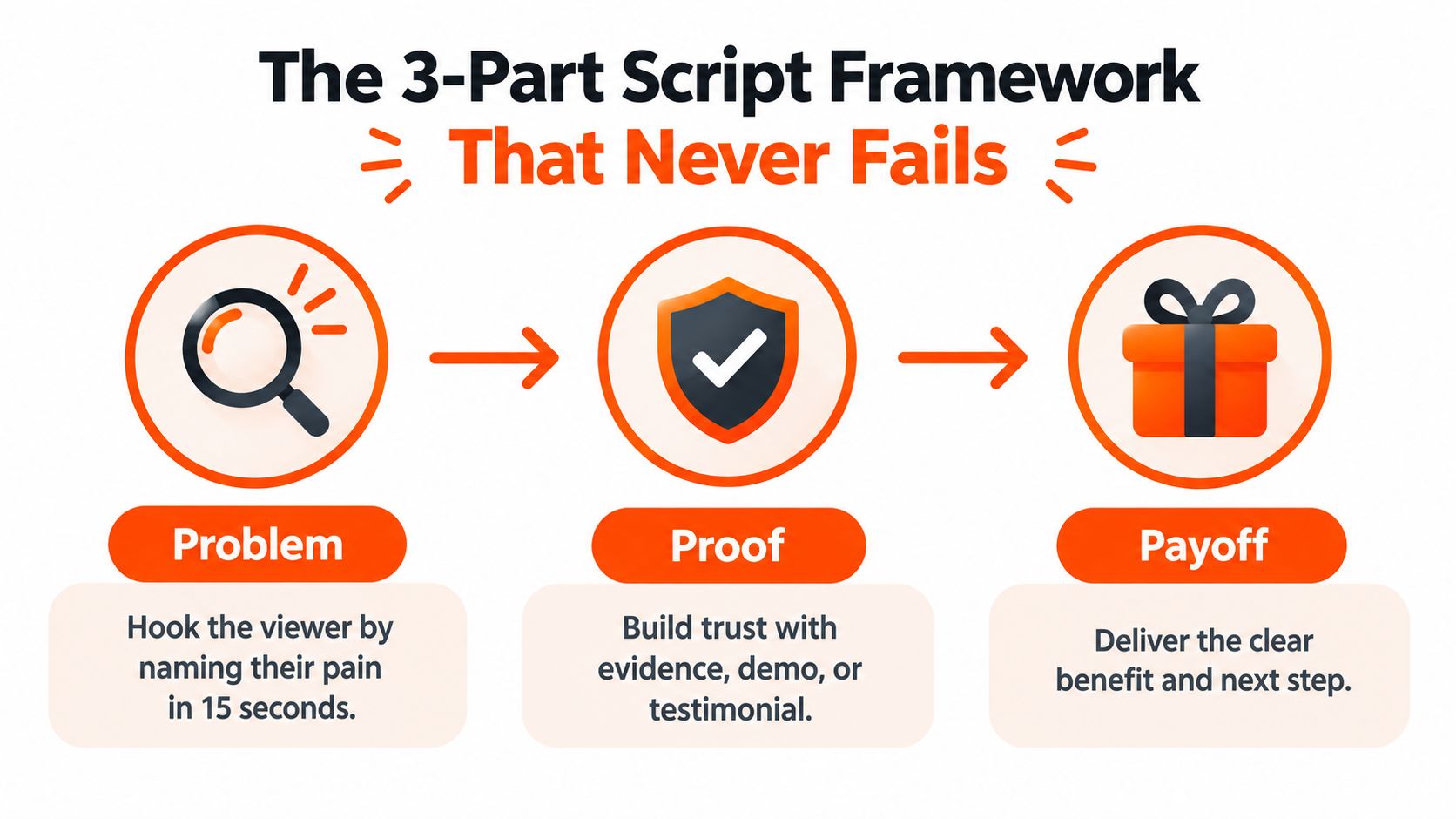
A reliable marketing video script usually follows Problem, Proof, Payoff. Not because it's glamorous. Because it works.
Problem
The script starts by naming the frustration the viewer already feels. Weak drafts often panic and start pitching too early.
Example for a B2B software launch:
“Your team closes deals in the CRM, then loses momentum in onboarding because every handoff lives somewhere else.”
That line gives the viewer a place to stand. It says, “Yes, this is about your messy Tuesday.”
Proof
The next part shows why the claim deserves attention. Proof can be a short demo moment, a visible before-and-after, a customer quote on screen, or a concrete process the viewer can see.
A simple example:
Screen recording of the handoff process
One dashboard replacing scattered tasks
A quick side-by-side of “before” and “after” workflow
Proof is where vague scripts become believable. It's also where overexcited teams dump every feature they've ever built. That's how a clean video becomes a software museum tour.
A visual walkthrough helps here:
Payoff
Now the script lands the promise clearly. No suspense. No dramatic fog machine.
Example:
“So instead of chasing updates across tools, your team gets one handoff path from signed deal to live customer.”
That's the payoff. It answers the quiet viewer question: “What changes for me?”
A simple rewrite example
A failing explainer might open like this:
“Our platform offers a modern solution for cross-functional collaboration.”
“It includes automation, visibility, and integrations.”
“Teams can configure it for many use cases.”
This says many words. It says almost nothing.
A tighter rewrite:
Problem: “Projects stall when approvals live in inboxes, chats, and memory.”
Proof: “This workflow shows every owner, deadline, and blocker in one place.”
Payoff: “So launches move forward without the usual follow-up circus.”
That's the whole game. One pain. One believable proof point. One clear benefit.
Timing your script to match real viewer patience
Good scripts don't just say the right thing. They say it before people leave.
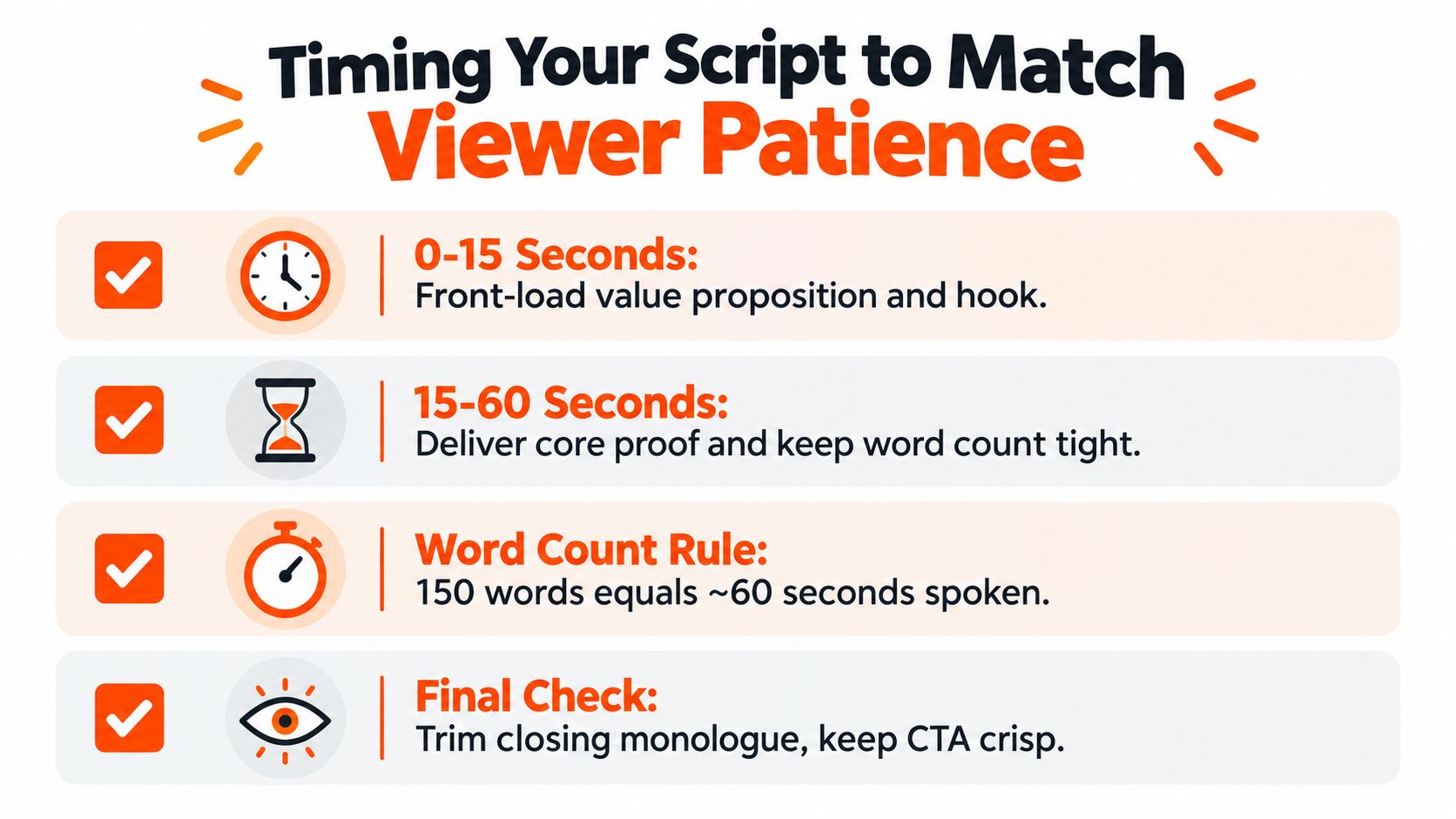
A lot of drafts feel long because the writer treats every part as equally important. It isn't. The opening carries more weight than the elegant conclusion nobody reaches.
Where to spend your seconds
Retention data shows that about 52 percent of viewers engage with marketing videos under one minute, while only about 20 percent finish a video over 20 minutes (video retention benchmark summary). That's why the value proposition belongs early, the proof section needs compression, and the closing monologue usually needs pruning with zero mercy.
A practical timing rule for a standard short marketing video looks like this:
Script section | What belongs there
First seconds | Hook and value proposition
Early middle | Core proof or demo moment
Late middle | Objection handling if needed
Ending | One crisp CTA
Trim the setup, keep the meaning
A bloated draft often sounds like this:
“Before diving in, it's important to understand the background.”
“Let's first talk about the broader challenge teams are facing.”
“Then we'll explain how the solution works.”
That's throat-clearing. Viewers didn't ask for a runway tour before takeoff.
A tighter version:
“Teams lose time because approvals are scattered.”
“This puts reviews, owners, and next steps in one place.”
“Book a demo if the handoff problem sounds familiar.”
For teams that struggle with length decisions, this video length optimizer is a useful way to pressure-test whether the idea fits the format. And for a helpful counterpoint to the fake “shorter is always better” mantra, Sarra Pro challenges video duration myths with a more grounded view of pacing versus arbitrary length worship.
Cut setup before cutting substance. Viewers forgive brevity. They don't forgive delay.
Adapting one script for ads, organic, and social
One of the sneakiest mistakes in video marketing is writing one script and pasting it everywhere. That's how ads end up sounding like podcasts, and social clips end up sounding like legal disclaimers.
Different channels ask different things from the same message.
One idea, different jobs
Recent B2B viewing behavior makes that mismatch harder to ignore. The average length of B2B marketing videos consumed fell from 6 minutes in 2022 to 4 minutes 15 seconds in 2025, mobile devices now account for 48 percent of B2B video views, and subtitles lift completion rates by 28 percent among B2B audiences (B2B video consumption and subtitle data).
That changes script decisions. A line that works in a desktop webinar can collapse on a phone with sound off. A script that depends on spoken nuance alone is basically asking subtitles to do emergency surgery.
How the same message shifts by channel
Take one core message: a project management tool reduces handoff confusion.
Channel | Hook style | CTA placement | Subtitle approach
Paid ad | Pain first, fast contrast | Early and clear | Assume silent viewing
Organic YouTube | Broader setup, stronger teaching angle | Later, after value | Helpful, but not the whole crutch
Short-form social | Sharp pattern interrupt | Often built into the body | Essential
A paid ad version might open with: “Still losing launch tasks between sales and delivery?”
An organic YouTube version might open with: “Most onboarding delays start before onboarding even begins.”
A short-form social version might open with: “Your process isn't broken because people are lazy.”
Same idea. Different behavior. Different viewer mindset.
Real trade-offs by format
Ads need speed. Organic needs depth. Social needs instant clarity.
A few practical rules help:
For ads: Put the pain and outcome near the front. Don't bury the CTA at the very end if the whole asset is short.
For organic: Earn attention with insight, then expand. A slightly slower build can work when the viewer chose to watch.
For social: Write for thumbs, not conference rooms. Short lines, visible meaning, strong captions.
For teams producing lots of paid variants, tools can help with packaging and iteration. A useful roundup on the best tool for ad creatives is handy when comparing workflow options. On the production side, agencies that handle scripting plus format adaptation can reduce friction. One example is video ads services, which covers structured ad production and variant workflows for different platforms.
Subtitles deserve special attention. If the script only makes sense when heard aloud, it's underbuilt for modern distribution. Mobile viewers don't owe the video perfect listening conditions.
Writing calls to action that viewers actually follow
The CTA isn't the little parsley garnish at the end of the plate. In a marketing video script, it's part of the structure from the start.
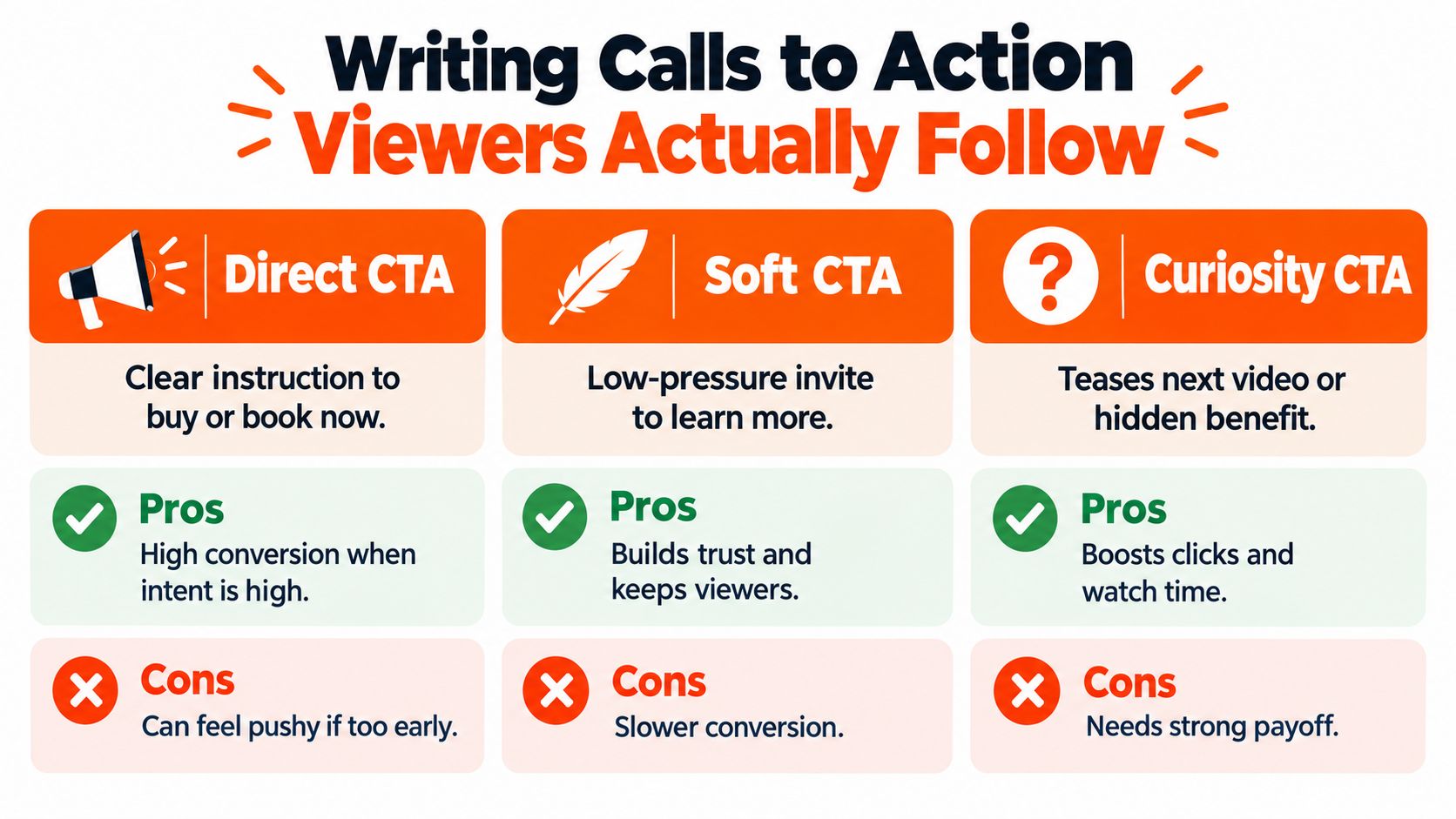
When a CTA fails, it usually fails for one of three reasons. It asks for too much, asks too vaguely, or asks for several things at once like an overexcited waiter listing every dessert.
Three CTA types that fit different moments
Direct CTA Best when intent is already high.
Example: “Book a demo.” This works in paid ads, product pages, and bottom-funnel explainers where the viewer already understands the offer.
Soft CTA Best when trust still needs a little oxygen.
Example: “See how the workflow looks in a real setup.” This keeps momentum without demanding a big leap.
Curiosity CTA Best when the next click depends on intrigue.
Example: “Watch how the handoff breaks before the deal even closes.” Useful for content series, YouTube, or social clips that lead into another asset.
A quick decision rule
Use this simple filter:
If the viewer already knows the problem and wants a fix, use a direct CTA.
If the viewer needs more confidence, use a soft CTA.
If the viewer is still browsing and comparing, use curiosity.
A CTA works when the next step feels obvious, small, and relevant to the promise that came before it.
Confusing CTA versus clear CTA
Confusing version “Like, subscribe, follow, book a call, visit the site, download the guide, and share this with your team.”
That isn't a CTA. That's a yard sale.
Clear version “If scattered approvals are slowing launches, book a demo and see the workflow in action.”
One action. One reason. One audience.
In short ads, the CTA may appear earlier and more directly. In a longer explainer, it can wait until the proof has done its job. Either way, the CTA shouldn't introduce a brand-new idea. It should finish the argument the script has already made.
Frequently asked questions about video scripting
Google's FAQ guidance says each question should be complete and each answer should also be complete, which is a good rule for readers too, not just markup (Google FAQ content guidance). For pages using FAQ schema, the marked-up content should also match visible on-page copy and avoid misleading claims, as covered in Google's structured data policies. FAQ markup is meant for official question-and-answer content, not forum-style user replies, as explained in Google's FAQ and Q&A markup guidance.
Can a template still produce a good marketing video script
Yes, if the template forces clear thinking instead of filling space. A useful template should lock the writer into one audience, one problem, one proof point, and one CTA. If the template encourages long intros or feature dumps, it's helping the script fail in a very organized way.
Can AI replace a human script writer
AI can help with ideation, variations, and rough first drafts. It usually struggles with judgment. A strong marketing video script still needs a human to decide what matters most, what should be cut, and what will sound natural when spoken.
Should one video have multiple CTAs
Usually no. One primary CTA is cleaner. If a second action appears, it should support the first one rather than compete with it. When a viewer has to choose between too many next steps, many choose none.
How should FAQ schema look on the page
Keep the visible questions and answers complete, plain, and identical to what the markup represents. A basic implementation can use JSON-LD with an FAQPage type and a list of Question and Answer pairs, but the important part is accuracy, not decorative markup gymnastics.
ContentBuck helps B2B teams turn loose ideas into structured video assets, including scripts for explainers, YouTube content, and ad creatives, with production and repurposing handled end to end. For teams that are tired of rewriting the same rambly draft or forcing one video into five channels, ContentBuck is a practical place to start.
Parth Jasrapuria
Founder at ContentBuck
Building video systems for B2B businesses. Obsessed with YouTube growth, creative strategy, and organic SEO.