My MH Education: What It Is and How It Helps Kids
Parth Jasrapuria
Founder
My MH Education (MYMHE) is a U.S.-based mental-health education initiative for learners in grades 1 to 12, with a curriculum inspired by the CASEL social-emotional learning framework. It's different from Ireland's Mind Your Mental Health workshop, which uses the same MYMH abbreviation.
Could a lesson about feelings help a child know what to do when they're struggling, or does mental-health education teach new words? The useful answer is that it can build awareness, coping and help-seeking skills, but it doesn't diagnose or replace professional care. That distinction matters for families choosing a curriculum, and for schools that want learning to lead to practical support.
Which MYMH Program You Are Looking For
My MH Education (MYMHE) is a U.S.-based mental-health education initiative for learners in grades 1 to 12. But a search for “MYMH” may also turn up Mental Health Ireland's Mind Your Mental Health workshop. Two programs share a search-bar shortcut, but only one is a classroom curriculum for children.
Feature | My MH Education (MYMHE) | Mind Your Mental Health (Ireland)
Country | United States | Ireland
Main audience | Children and adolescents in grades 1–12 | Community groups, voluntary groups, statutory partners and workplaces
Core approach | Curriculum inspired by CASEL social-emotional learning | Training workshop rolled out through Family Resource Centres
Evaluation | No independent outcome statistics published | Uses the Warwick–Edinburgh Mental Well-being Scale
Origin | U.S.-based mental-health education initiative | Organisation founded in 1966; workshop piloted in 2015
Mental Health Ireland was established in 1966 as the Mental Health Association of Ireland. After reviewing its training provision in 2015, it developed and piloted the workshop through Family Resource Centres, then extended it to community and voluntary groups, statutory partners and workplaces. Its parliamentary submission also reported that 55% of respondents said they wouldn't want others to know if they were experiencing mental-health problems. That's context for why mental-health education may address stigma and help-seeking, not a performance result for MYMHE. The Mental Health Ireland parliamentary submission describes its evaluation approach and history.
A parent in Ohio looking for a classroom curriculum for a seven-year-old is probably searching for MYMHE. A workplace training coordinator in Dublin is more likely looking for the Irish workshop.
Before choosing a page or contacting a provider, ask three quick questions: Where are you? Who is the learner? Do you need a curriculum or a workshop? Those answers usually clear up the abbreviation without requiring a detective's hat.
What My MH Education Teaches from Grade 1 to Grade 12
MYMHE's courses are designed for learners from grade 1 through grade 12 and are inspired by the Collaborative for Academic, Social, and Emotional Learning (CASEL) framework. It offers a K–12 progression, rather than a one-time awareness event. The five competencies give families and educators a helpful way to understand what children might practise as they grow. The MYMHE program information describes the grade range and CASEL-inspired approach.
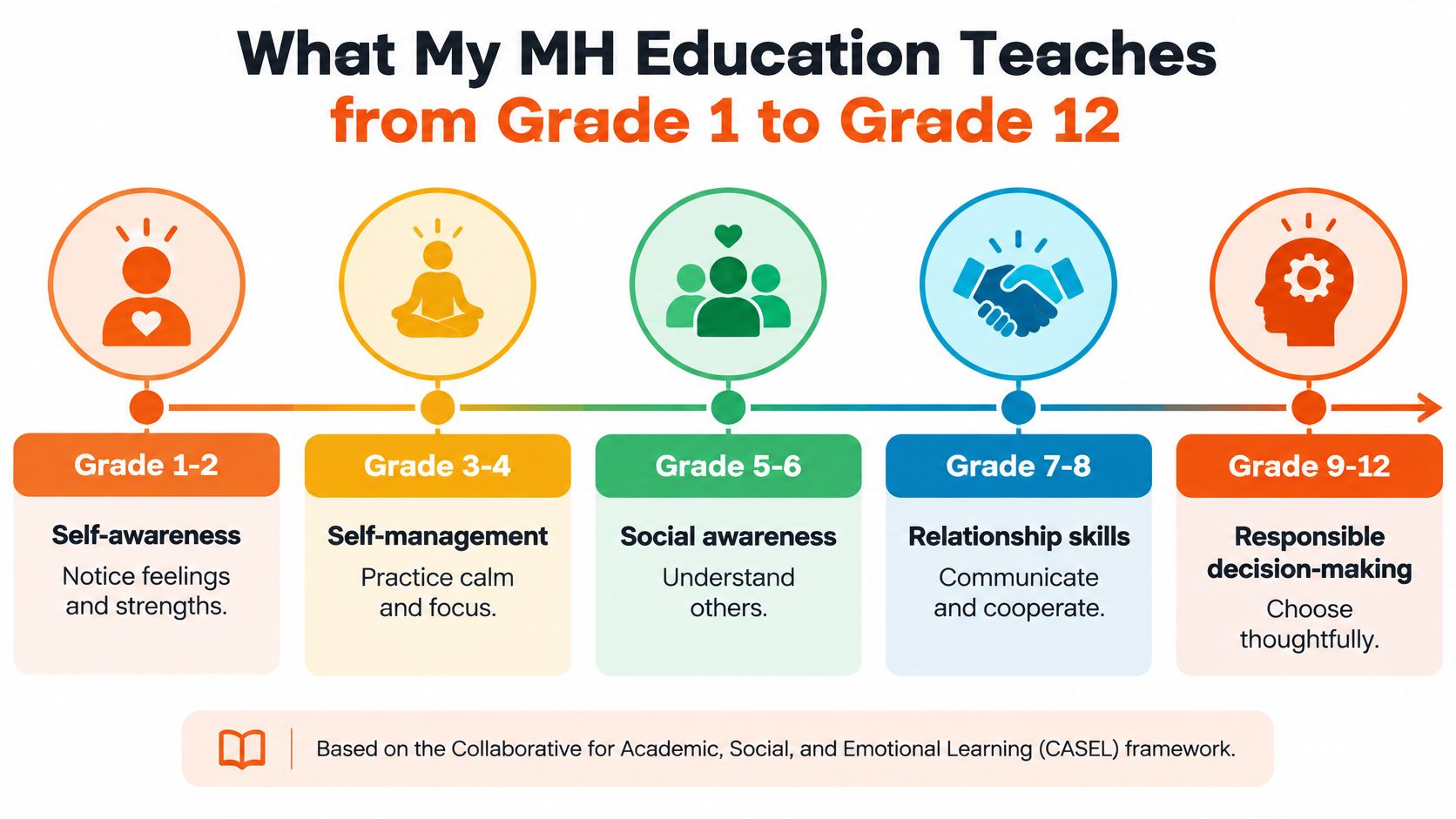
Five skills, translated into everyday life
Competency | What it means | Everyday example
Self-awareness | Noticing your own feelings | Saying, “I feel nervous before the spelling test,” out loud
Self-management | Calming down and controlling reactions | Taking three slow breaths before answering a frustrating question
Social awareness | Understanding how others feel | Noticing a classmate eating alone and inviting them to join a game
Relationship skills | Building and keeping healthy friendships | Asking, “Can we take turns?” when a game gets tense
Responsible decision-making | Choosing actions that are safe and fair | Telling a trusted adult when a friend seems hopeless instead of keeping it secret
Younger learners can practise naming feelings and asking a trusted adult for help. As they get older, lessons can build skills for coping with frustration, handling friendship problems and making thoughtful choices. A high-school student might practise how to ask a counsellor for help, rather than just learning the definition of stress.
Mental-health literacy also has practical parts: recognising warning signs, understanding when and how to seek help, and using healthy coping strategies. The CDC description of mental-health literacy gives an example of students noticing persistent hopelessness and practising the words, “I need help from a trusted adult.” That kind of role-play turns a lesson into a sentence a student can use when they're nervous.
A useful school question: Which lesson helps a child practise each skill, and how does it change as the child moves through the grades?
Coping and help-seeking habits can take shape during childhood, so early, age-appropriate practice matters. A child doesn't need a vocabulary contest about feelings. Nobody gets extra credit for memorising “rumination.” Families can match each CASEL competency to the learner's grade and ask the school which lessons cover it.
Spotting Warning Signs Without Playing Doctor
Students can learn to read the dashboard without pretending to be the mechanic. Mental-health education can help them notice when something feels wrong, but noticing a warning light isn't the same as diagnosing what caused it.
The World Health Organization estimates that one in seven people aged 10–19 globally experiences a mental-health condition. It estimates anxiety disorders affect 4.1% of 10–14-year-olds and 5.3% of 15–19-year-olds. For depression, its estimates are 1.3% and 3.4% in those age groups, respectively, according to the WHO adolescent mental-health fact sheet. Age-appropriate education helps young people distinguish ordinary stress from ongoing difficulty without inviting them to diagnose themselves.
Situation | Usual signal | Right next step
Exam-week stomachache | Short-lived and fades after the exam | Rest and support from a trusted adult at home
Persistent hopelessness | Ongoing sadness or pulling away from friends | Tell a trusted adult and ask for help this week
Anxiety that disrupts school, sleep or friendships | Lasts for weeks and affects daily life | Talk to a qualified professional
An exam-week stomachache may ease with rest, reassurance and support at home. Anxiety that keeps a teenager out of class, disrupts sleep or strains friendships deserves a conversation with a qualified professional. The difference is not a reason to dismiss short-term stress; it's a way to judge whether more help is needed.
Describe what's happening rather than attaching a label. “She has skipped lunch with friends for two weeks” gives a trusted adult something clear to respond to. Families looking for practical signs to watch for can also read about recognizing mental health changes in children.
A simple check can help: How long has the feeling lasted? How much does it interfere with school, sleep or friendships? Who will the child tell first? Education can guide that conversation, but it doesn't replace an assessment or diagnosis from a qualified professional.
What the Research Says About Mental Health Education
Learning helps, but not in every way and not for very long. Results depend on what a program measures: knowledge, stigma, symptoms and help-seeking aren't interchangeable outcomes.
Finding | Result | What it means
Mental-health literacy after web-based education | Standardized mean difference 0.70 (95% CI 0.16 to 1.25), 2,195 participants | Knowledge improves clearly
Stigma after web-based education | No statistically significant reduction | Knowledge alone doesn't change attitudes
Stigma in an online mental-health class (28 students) | Significantly lower after the semester (p = 0.004), not kept at one-month follow-up | Attitude gains can fade without reinforcement
Depression, anxiety and stress in the same class | No significant difference | Education isn't treatment
A systematic review of web-based mental-health education found a significant improvement in mental-health literacy across 2,195 participants, but no statistically significant reduction in stigma. A separate quasi-experimental study with approximately 741 participants found online delivery to be an acceptable proof of concept when compared with in-person delivery. The review and online-delivery study show why program quality and the outcome being measured both matter.
In another controlled before-after study, 28 online students in a mental-health class had lower stigma after the semester than students in a non-mental-health class, with p = 0.004. That difference wasn't maintained at the one-month follow-up, and depression, anxiety and stress scores didn't differ significantly. The controlled study of online mental-health education illustrates how a change in knowledge or attitude doesn't necessarily change symptoms.
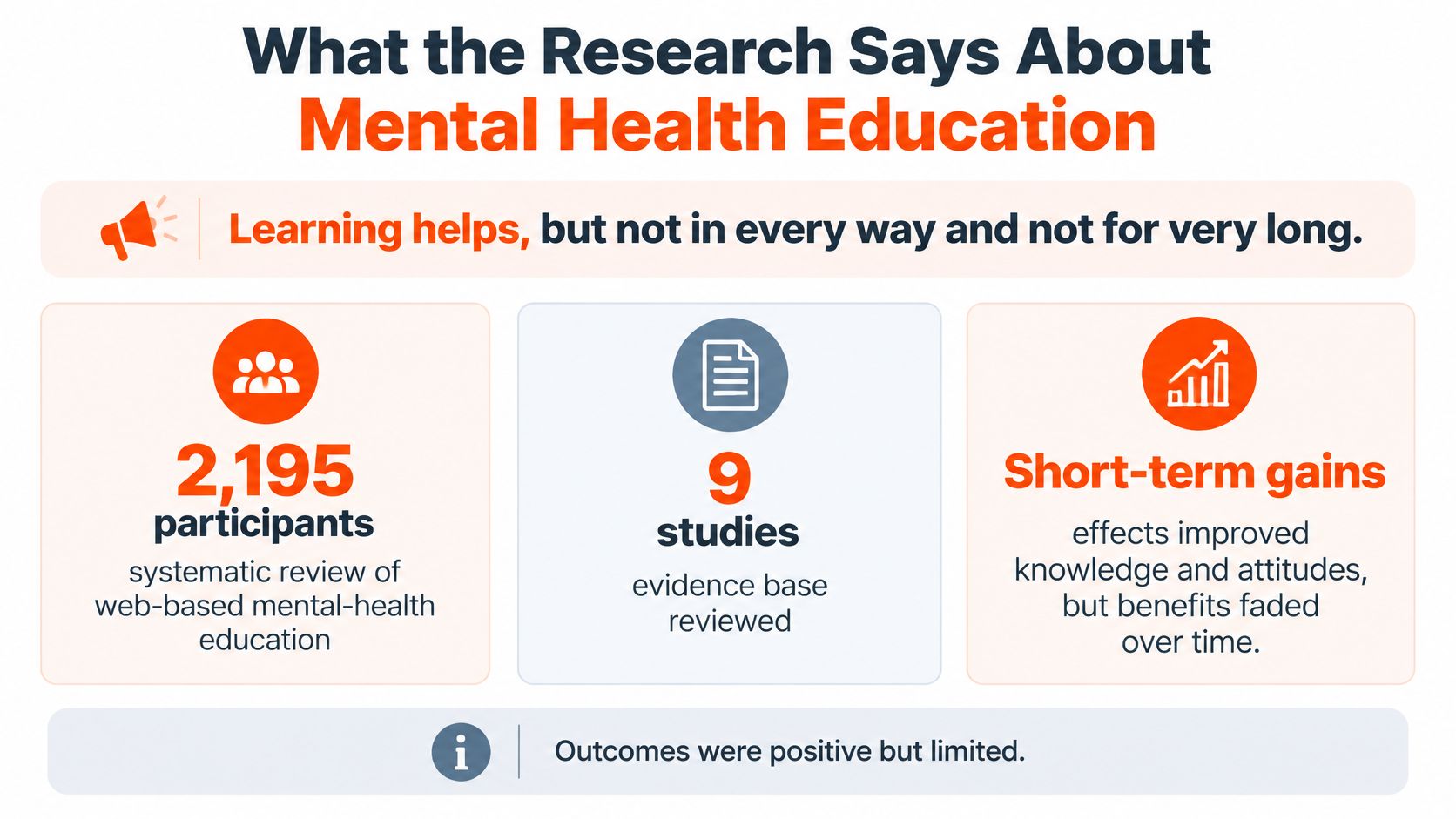
Programs can make learning more usable with branching scenarios, retrieval quizzes, feedback and explicit practice asking for help. A student may know the word “anxiety” but still stay silent if they've never rehearsed what to say when they need support. Facilitated discussion or live support can give learners a chance to ask questions that a quiz can't answer.
When comparing programs, ask whether they measure knowledge, stigma, help-seeking and symptoms separately, at the start, after the course and at follow-up. A satisfaction survey can tell whether learners liked a lesson; on its own, it can't show what they learned or whether the learning lasted.
How to Get Started with My MH Education
A practical start is to identify the right grade band, find out who will teach the lessons and make sure students know where to turn if they need help. The CDC's 2023 data for U.S. high-school students show why those next steps matter: 40% had persistent feelings of sadness or hopelessness, 20% seriously considered attempting suicide and 9% attempted suicide, according to the CDC youth mental-health information.
Check the grade range. Review the MYMHE program pages and identify the course that matches the learner's grade.
Ask who leads the lessons. Check whether the school or organisation runs MYMHE and which teacher or coordinator is responsible.
Name a trusted adult. A parent, teacher or counsellor can agree with the learner on who gets told if a concern comes up.
Write down referral details. Note the counsellor's name, office location and how to book an appointment, so “talk to someone” becomes a usable instruction.
Plan refreshers. Short review activities give learners another chance to practise skills that might otherwise fade.
Make room for a check-in. During a brief monthly conversation, ask what the learner planned to do and whether they were able to do it.
A poster that says “talk to someone” can help. A poster that names the counsellor, room and appointment process gives a student a clearer next step.
One short video can also help families and educators start a conversation about what support looks like in practice.
Available information doesn't confirm MYMHE enrolment steps, cost or login details. Families and schools should confirm those directly with the program rather than assume that a course page answers every practical question. For now, write down three names of people the learner can contact today.
When Help Is Out of Reach and What to Do Next
What can someone do when support is needed but a clinic is out of reach? In disaster-prone communities, people may value mental-health support while needing to focus first on food, water, or a safe place to stay. A study of mental-health support in disaster-prone communities highlights why advice has to fit what a person can safely do.
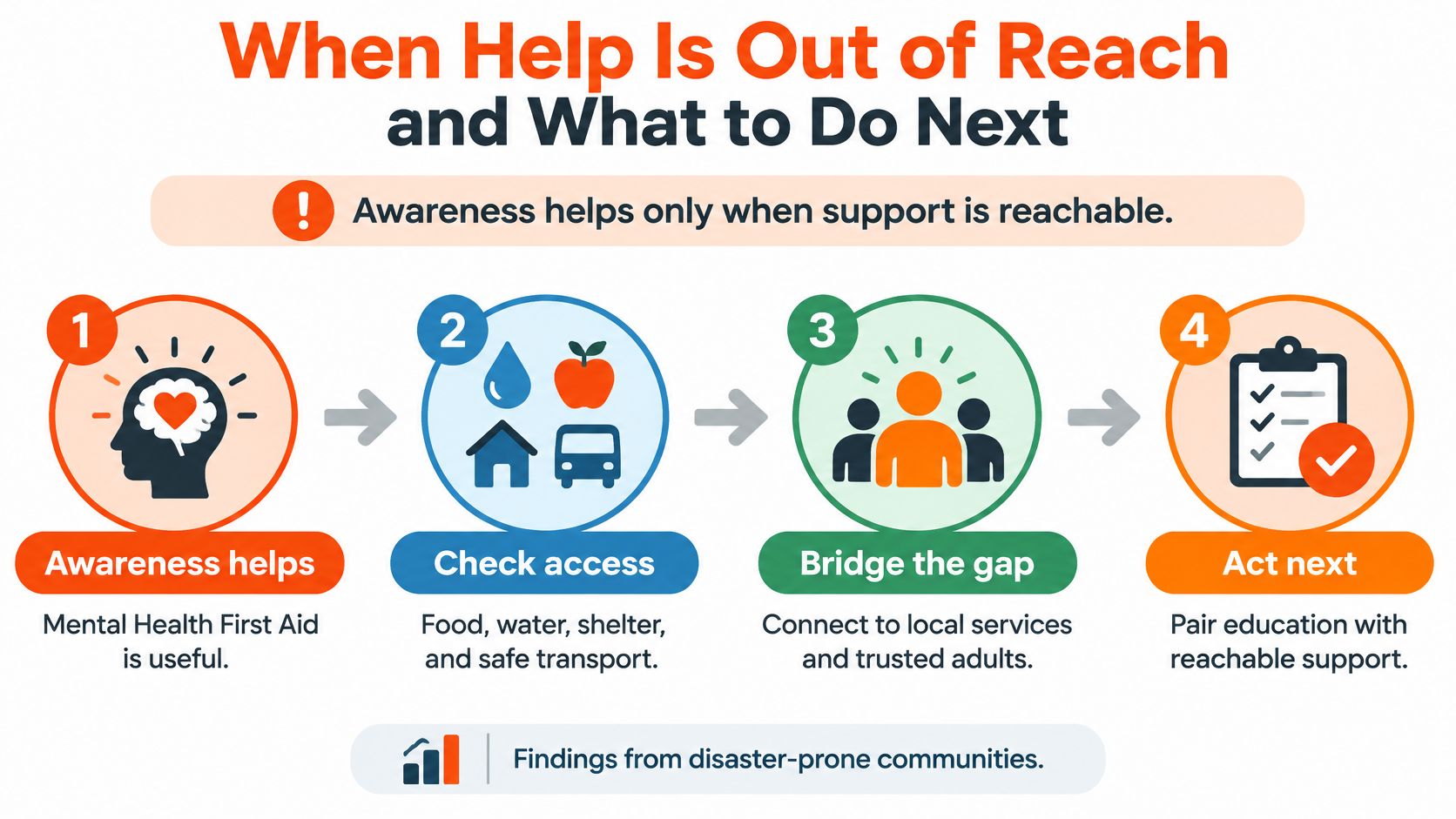
A practical plan starts with urgency and access. Someone who can book a clinic visit may have different options from someone who first needs shelter.
Address immediate safety and basic needs. Start with food, water, shelter, and getting out of danger.
Bring in trusted informal help. A friend, relative, faith leader, or neighbour may be able to stay with the person and help plan what comes next.
Check school or workplace resources. A school counsellor, HR contact, or student-services office may be a familiar first point of support.
Consider primary care. A family doctor or clinic can assess the situation and help with referral options.
Use crisis pathways when risk is present. Local emergency services or crisis lines are appropriate when someone may be harmed.
Seek specialist treatment when available. A mental-health professional can assess needs and provide care.
For example, a teenager in a flood-hit town may be unable to reach a clinic. Finding a safe place to sleep and asking an aunt for help could be the first steps. Self-help information can offer ideas, but it cannot provide care when someone may be harmed. Cost, language, disability, migration status, and local availability can also affect which options are realistic.
Readers can explore mental health self-help resources for additional information. Mental-health education can help people recognise concerns and consider options, but it does not diagnose or replace care. Ask one practical question: What can this person realistically do next, given the urgency and the resources available?
Common Questions About My MH Education Answered
Is My MH Education the same as Mental Health Ireland's MYMH?
No. MYMHE is a U.S. curriculum for learners in grades 1 to 12, while Ireland's Mind Your Mental Health is a workshop for community groups, workplaces and public partners.
Does mental-health education replace therapy or treatment?
No. Education can build recognition, help-seeking and coping skills, but it doesn't diagnose or treat a condition. The reviewed studies found no significant change in depression, anxiety or stress scores in one online class.
Which grades does the program cover?
MYMHE is structured for learners from grade 1 through grade 12. Lessons can change with age, so the example that suits a younger child won't necessarily suit a teenager.
Are there published results for the program?
Available program information doesn't publish independent outcome statistics for enrolment, symptom reduction or long-term academic effects. Families and schools can ask for evaluation information before drawing conclusions about results.
A good FAQ works like a quick reference card in a school hallway: brief, clear and easier to use than a long explanation when someone needs a next step.
ContentBuck helps B2B organisations plan, produce and scale video-led acquisition content, including YouTube videos, animated explainers and SEO-backed articles. For a clear way to turn complex topics into practical content, visit ContentBuck.
Parth Jasrapuria
Founder at ContentBuck
Building video systems for B2B businesses. Obsessed with YouTube growth, creative strategy, and organic SEO.