Production and Marketing Alignment for B2B SaaS Growth
Parth Jasrapuria
Founder
The brief arrives late, the editor is waiting, and the growth manager is asking for a link that nobody added. By Friday, the SaaS team has shipped several polished videos, but the demo calendar looks exactly as empty as it did on Monday. Everyone worked hard. Nobody owned the result.
That gap is the production and marketing problem. Creative output and demand generation can't operate as separate queues if the business expects video to influence pipeline. They need one backlog, shared KPIs, connected tooling, and a refresh rhythm that replaces tired creative before acquisition efficiency starts to slide.
The Production and Marketing Reality Most SaaS Teams Live In
A typical Tuesday starts with a rewritten brief. Three editors are waiting for approval, a product marketer has changed the positioning, and the paid media manager has already reserved a campaign slot. In another Slack thread, someone asks why last week's video has no UTM tags. The answer is usually buried beneath comments about captions, brand colors, and whether the opening shot feels “more energetic.”
By Thursday, the team has solved the production problem. The files are rendered, exported, and uploaded. Marketing then tries to solve the distribution problem with whatever information survived the handoff. The result is a familiar one: more assets, unclear ownership, and no reliable explanation for why pipeline did or didn't move.
This isn't a talent problem. Editors aren't failing because they care about transitions more than revenue. Demand gen managers aren't careless because they forgot to brief the thumbnail designer. The operating model creates the confusion. Production behaves like a deliverable factory, while marketing behaves like a campaign launcher.
Practical rule: A video isn't finished when the export is approved. It's finished when the right audience can find it, the team can measure it, and the next creative decision has a clear owner.
A useful overview of how companies can use video across the buyer journey appears in this guide to video for companies, but the operational question comes first: who owns the path from buyer signal to published asset to qualified meeting?
Teams that answer that question treat production and marketing as one pipeline. The shared system defines the stages, assigns ownership at each point, carries distribution details alongside the creative brief, and sends performance feedback back to the people writing hooks and cutting footage. It doesn't require doubling headcount. It requires stopping the baton from disappearing between departments.
What a Unified Production and Marketing Pipeline Actually Means
A unified pipeline works like a restaurant pass. Marketing takes the order by identifying the audience, pain, and buying context. Production prepares the dish by choosing the format, writing the script, filming, and editing. Operations gets it to the table with the correct links, tags, audience, timing, and reporting.
The kitchen doesn't say, “Our job ended when the plate left the counter.” The front-of-house team doesn't say, “The recipe was your problem.” Both sides care whether the customer received the right meal and came back.
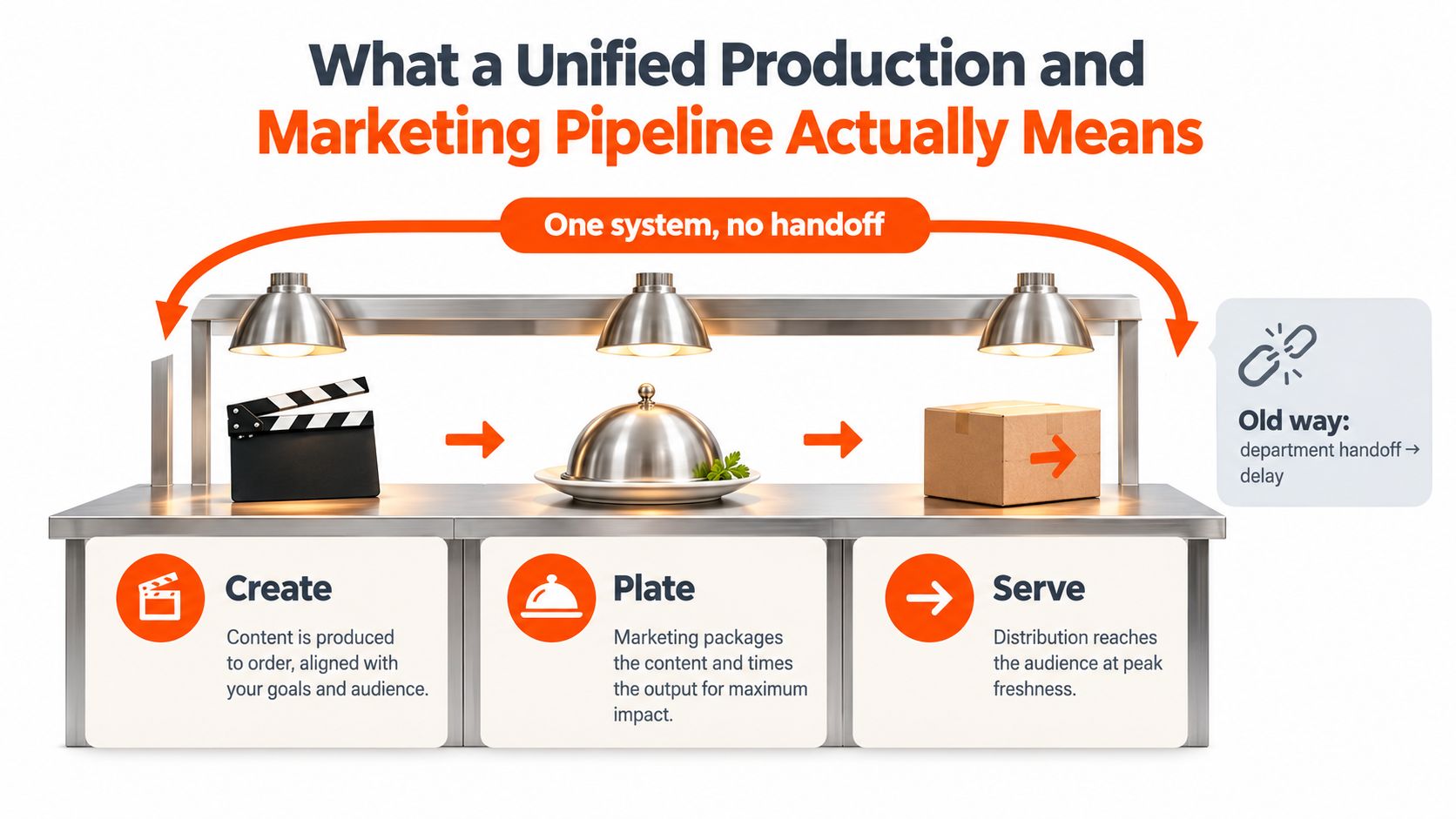
The stages that keep the system connected
The pipeline should carry a small set of artifacts from stage to stage:
ICP and intent research. RevOps, sales calls, search behavior, and campaign data reveal the question worth answering. For a workflow platform, that might be a buyer asking how to reduce approval delays across distributed teams.
Message testing. The content strategist turns that question into a clear promise and tests the angle against sales language, landing-page copy, and existing creative. The team should know what the video is trying to change in the buyer's mind.
Scripting and format choice. A short product demonstration, customer interview, animated explainer, and comparison video solve different problems. The brief should state the intended audience, funnel role, call to action, runtime range, and distribution channels.
Production. Producers own the visual treatment and execution. Marketing remains involved when a product claim, offer, or audience assumption changes.
Distribution planning. Every asset leaves production with its landing page, UTM structure, channel versions, thumbnail direction, captions, and launch date. “We'll decide where to post it later” is how files become digital attic furniture.
Launch and refresh. Performance data returns to both teams. A weak hook may require a new opening, not a full reshoot. A strong topic may deserve a longer educational version.
A real handoff is therefore more than a file. It includes the creative brief, approved message, distribution plan, tagged URLs, naming convention, and measurement owner. Without those pieces, the process is a relay race where everyone insists the baton was somebody else's problem.
Who Owns What Across the Production and Marketing Stack
Shared accountability works only when individual ownership is explicit. If everyone owns the pipeline, nobody owns the overdue script. The strongest model gives each role a defined decision area while keeping the commercial KPI visible to the whole group.
Function | Primary Owner | Supporting Role
ICP and intent research | Content strategist or product marketing | RevOps and sales
Message and offer | Demand generation lead | Product marketing and content
Script and editorial calendar | Content strategist | Subject-matter expert and producer
Format and production calendar | Video ops lead or head of creative | Producer and editor
Filming and editing | Producer and editor | Content strategist
Paid and organic distribution | Growth marketing lead | Video ops and channel specialists
UTM and CRM measurement | RevOps | Demand generation and content
Creative refresh cadence | Video ops lead | Paid media and demand generation
The Video Ops Lead usually owns the production calendar, format standards, asset library, and refresh rhythm. That role should know which edits are ready, which approvals are blocking launch, and which creative needs a new hook before the media buyer increases spend.
The Demand Gen Lead owns audience targeting, channel strategy, budget decisions, and the pipeline hypothesis. That doesn't mean demand gen dictates every frame. It means the team knows who the asset is meant to reach and what action should follow.
A Content Strategist connects audience insight to language. This role turns a sales objection into a script, maps the message to a funnel stage, and prevents the editorial calendar from becoming a random pile of requests. Producers and editors then own execution, thumbnail tests, opening hooks, captions, and repurposing cuts.
RevOps owns the measurement layer. UTM integrity, CRM fields, attribution views, and dashboard definitions need one accountable owner. Otherwise, every performance meeting becomes an archaeological dig through spreadsheets.
The KPI should be shared even when the jobs aren't. Cost per qualified meeting, video-attributed pipeline, and creative fatigue signals give every role the same commercial destination. The editor can see which opening earned attention, while the media buyer can see which version deserves more distribution.
The Production and Marketing Workflow Step by Step
A practical workflow begins with a buyer question, not a blank editing timeline. Suppose a SaaS company hears from sales that operations leaders struggle to prove where an approval request is stuck.
The first artifact is a short research note with the persona, problem language, evidence source, funnel stage, and desired next action. The second is a message brief. It might define a 90-second feature demo showing the approval path, a six-minute comparison video for research-stage buyers, and several short clips built around objections such as security, setup time, and reporting.
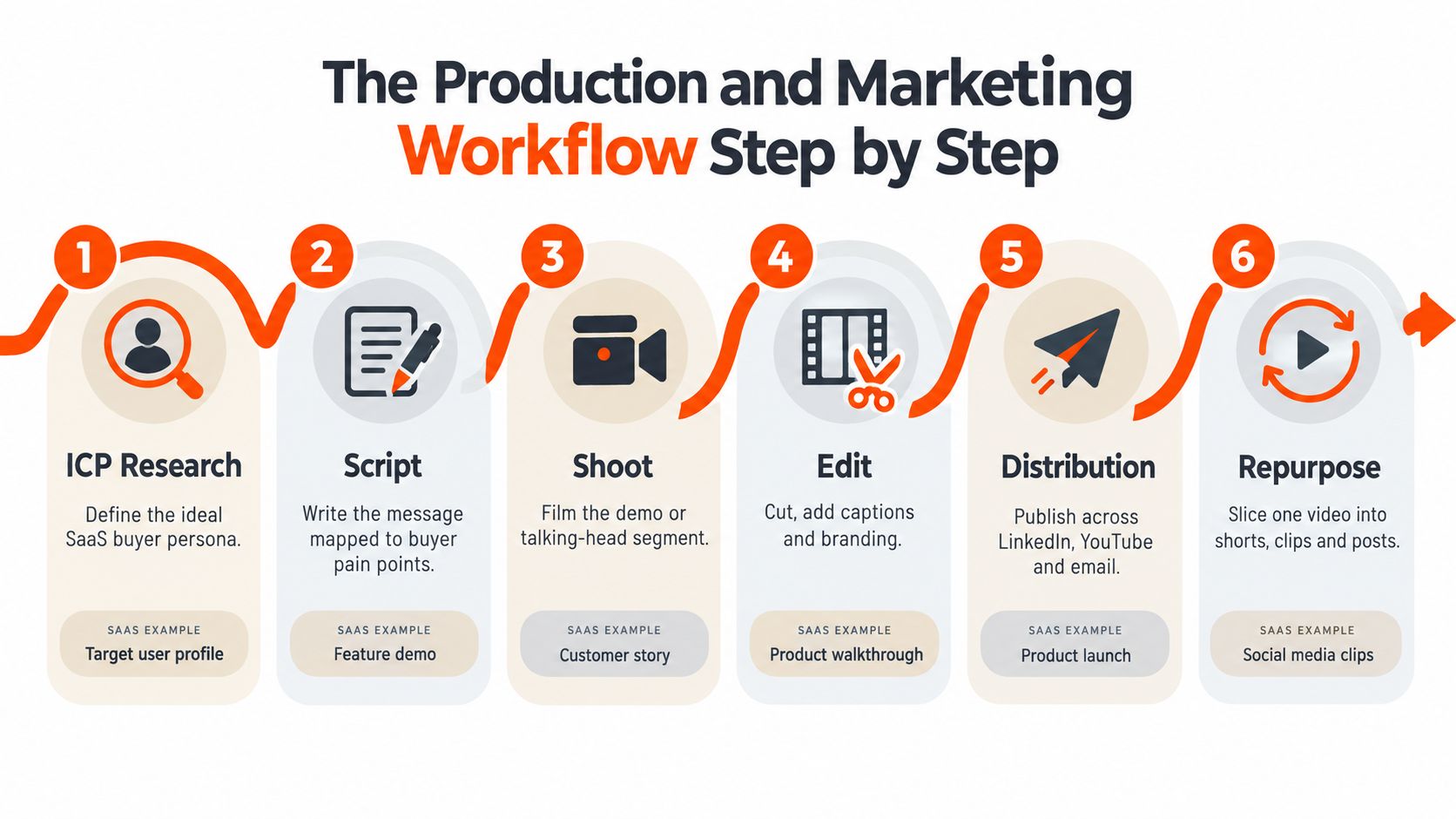
Six connected moves
Research. RevOps validates the question against CRM notes and campaign context. Sales confirms whether the language sounds like something buyers say.
Script. The strategist writes the promise, proof, demonstration beats, objections, and call to action. Product reviews accuracy, but approval shouldn't turn into an invitation for twelve new messages.
Shoot. The producer captures the demo, presenter material, interface close-ups, and clean pauses that make editing easier. A shot list protects the team from discovering in post that the call to action was never filmed.
Edit. The editor creates the primary cut, captions, branding, thumbnail options, and alternate openings. Marketing reviews against the approved message, not personal taste.
Distribute. The growth owner publishes the correct versions to LinkedIn, YouTube, email, landing pages, or paid placements. UTM tags and CRM campaign fields travel with the asset.
Repurpose. One core recording becomes short clips, sales enablement snippets, social posts, and retargeting variants. Repurposing starts in the brief, so the team captures footage that can survive outside the main edit.
The most common stall happens between script approval and edit turnaround. The script changes after filming, the editor cuts to an outdated promise, and marketing receives a version that technically works but no longer fits the campaign. A locked script version, change log, and named approver prevent that expensive little circus.
Teams that want a repeatable starting point can use prebuilt workflow templates to document stages, owners, and required fields. For the production side, this guide to educational video production offers useful context on turning complex subjects into clear lessons.
The workflow can also be demonstrated in a practical video format:
A Real B2B SaaS Example of Production and Marketing Working as One
Consider a mid-market SaaS team selling workflow software to operations leaders. Its old process looked productive from the outside. Product marketing wrote briefs, an external editor delivered videos, demand gen launched campaigns, and sales received links after publication.
The system failed in quieter ways. The briefs used different descriptions of the same product, the sales team didn't know which video matched which objection, and follow-up reporting stopped at views and clicks. Production measured completed files. Marketing measured campaign activity. Neither team had a shared view of qualified demand.
The team rebuilt the process around one backlog. Each request needed an audience, buyer problem, offer, format, distribution channel, CRM campaign, and named approver before entering production. A weekly planning meeting selected the next work, while a short performance review connected creative signals with campaign outcomes.
The operating change mattered more than adding another editor. A product demo could now produce a main landing-page asset, a sales follow-up clip, paid-social variants, and short educational cuts from the same recording plan. The creative team stopped treating repurposing as a favor requested after the “real” video was done.
The team also changed the meeting language. Instead of asking whether a video was good, participants asked whether the opening matched the audience, whether the offer matched intent, and whether the CRM could connect a response to the asset. When a video underperformed, the group tested the hook, audience, offer, and landing-page fit before blaming the edit.
The lesson is portable: a unified pipeline improves decision quality before it improves output volume. It gives production enough context to make useful creative choices and gives marketing enough visibility to spend behind the right assets. No heroic Slack rescues required.
Choosing Video Formats That Match Production and Marketing Goals
Format selection should follow buyer intent, not the production team's favorite camera setup. Short videos earn distribution and quick attention. Longer educational pieces can do more work when the audience is already comparing solutions or trying to understand a difficult product.
A benchmark of nearly one million B2B videos found that videos under one minute reached a 65% completion rate, while videos over 20 minutes reached 20%, according to The Interconnections' B2B video benchmark. The practical implication is not “make everything short.” It is “don't bury a simple message inside a feature documentary.”
Format | Funnel Role | Production Cost | Lifecycle | Fatigue Rate
Short hook or clip | Awareness and paid testing | Low to moderate | Short, refresh often | Can fatigue quickly under repeated delivery
Product explainer | Problem education and consideration | Moderate | Useful across campaigns | Depends on audience and angle
Demo or comparison | High-intent evaluation | Moderate to high | Longer when product changes slowly | Often steadier with strong intent
Webinar or deep tutorial | Research, enablement, and trust | High upfront, efficient to repurpose | Long if the topic stays relevant | Usually lower in organic search than paid repetition
Recent B2B benchmark reporting describes short-form video as a high-ROI channel, while also noting that the average watched marketing video shortened from 6 minutes in 2022 to 4 minutes 15 seconds in 2025, and that mobile represented 48% of B2B video views. Those figures appear in KLIQ Interactive's B2B benchmarks.
That combination points to a mixed production plan. Use short cuts to test hooks, objections, and offers. Reserve longer pieces for buyers who need proof, comparisons, implementation detail, or a guided explanation. How-to videos can hold attention, and longer content can support conversion in some contexts, especially when paired with lead-generation forms.
The production trade-off is important. A short video isn't automatically cheap if the team creates it as a one-off. A modular shoot can produce a core explanation, objection clips, presenter cutdowns, vertical versions, and sales snippets without repeating the entire setup. The most efficient format is often the one designed to become several useful assets.
KPIs That Prove Production and Marketing Drive Pipeline
Views are useful for diagnosing distribution. They aren't enough to prove commercial impact. A pipeline dashboard should connect the asset, audience, action, and revenue stage without pretending that every buyer follows a neat last-click path.
KPI | Definition | Target Benchmark | Pipeline Signal
Qualified meetings per video | Qualified meetings associated with an asset | Set internally by funnel and segment | Shows whether attention becomes a sales conversation
Cost per qualified meeting | Spend and production cost divided by qualified meetings | Compare formats against each other | Reveals efficient creative, not merely cheap reach
Video-attributed pipeline | CRM pipeline connected to a video touch | Establish a consistent attribution rule | Links creative work to opportunity value
Assisted pipeline | Opportunities where video influenced the journey | Report beside last touch | Shows educational and consideration impact
Completion rate | Share of viewers reaching the end | Compare by runtime and audience | Indicates message fit and pacing
Hook retention | Viewers remaining after the opening | Compare openings within the same campaign | Helps editors choose stronger first frames
Rewatch behavior | Repeated viewing or looping | Use as a directional signal | Can reveal confusing or especially useful moments
The Target Benchmark column should contain an internal baseline, not a borrowed industry promise. A new channel may have too little history for a meaningful target, so the team should establish a starting line and compare like with like.
Attribution needs two views. Last-touch reporting answers which asset appeared closest to the conversion. Assisted reporting answers which asset helped the buyer learn, return, or involve another stakeholder. Both matter, especially for explainers and educational videos that may influence a deal without receiving the final click.
Creative fatigue deserves its own alerting system. A 2026 Meta benchmark across 368 creatives found click-through rate fell 5.5% within the first 250,000 impressions, while cost per acquisition rose 19.6% in the 500k to 1M impression range, as reported in Meta's creative-fatigue benchmark coverage. The operational lesson is simple: refresh hooks and variants before frequency-heavy delivery makes the media plan pay a boredom tax.
Production data should influence spend. If one opening loses viewers immediately, the editor needs to remix the first seconds. If a demonstration earns strong completion and qualified meetings, demand gen can test more distribution around that message. A weekly dashboard, reviewed by production, growth, content, and RevOps, turns those signals into decisions rather than decorative charts. This guide to distributing video content provides additional practical context for carrying assets beyond the initial upload.
Putting Production and Marketing Together Without Burning the Team Out
Alignment fails when it depends on people remembering everything under pressure. A sustainable system uses a small weekly rhythm, one backlog, clear service boundaries, and a refresh cycle that treats new creative as planned maintenance rather than emergency surgery.
Monday is for backlog planning. The team confirms the audience, commercial priority, owner, dependencies, and definition of done. Wednesday is for a short sprint review, where blocked scripts, missing footage, and launch risks get resolved before Friday becomes a rescue mission.
Friday is for the creative retro. The team reviews qualified meetings, cost per qualified meeting, completion, hook retention, comments from sales, and fatigue signals. The point isn't to grade an editor. It's to decide which message deserves another cut, which channel needs a different version, and which request should be declined.
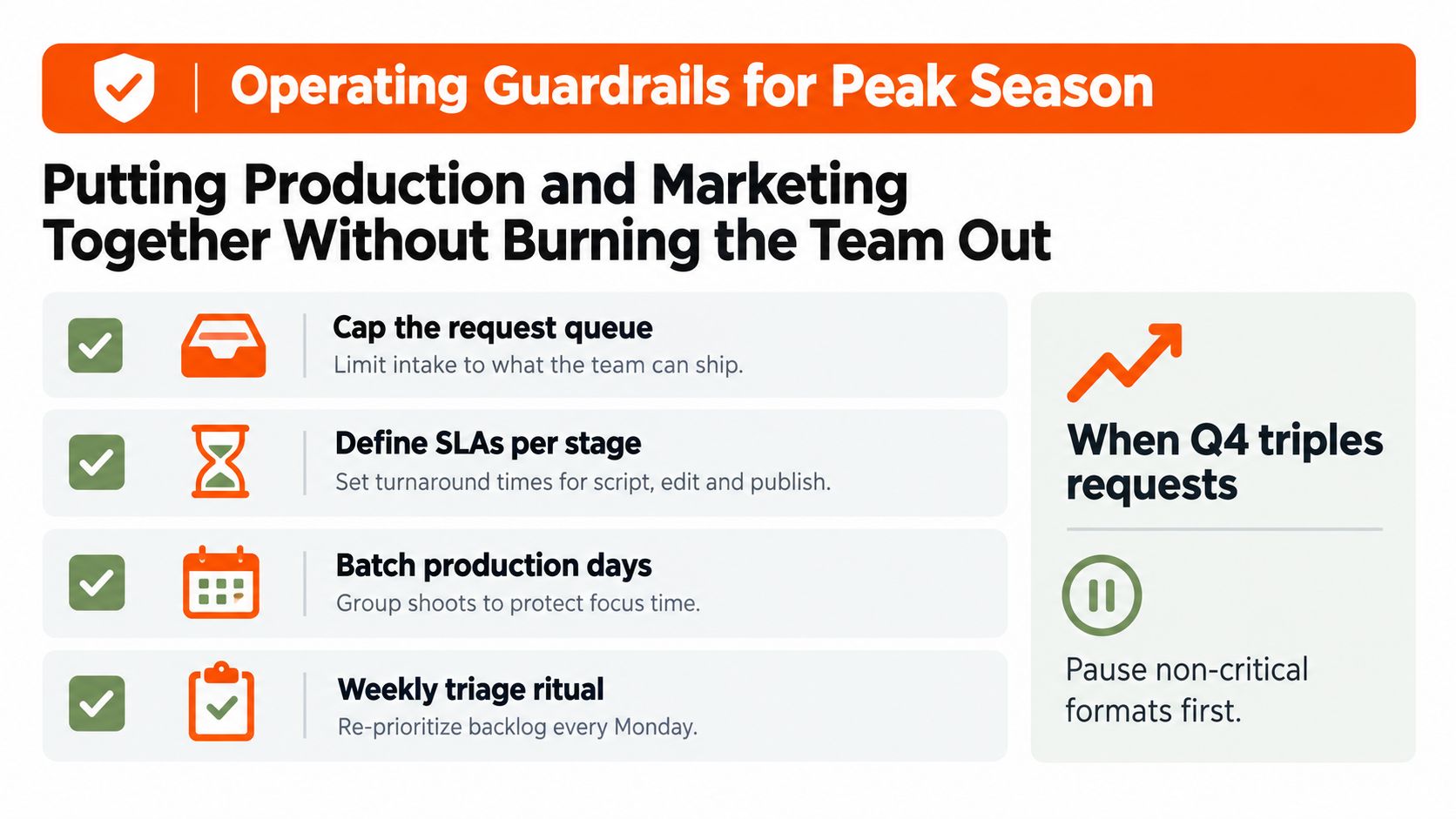
Guardrails that protect the pipeline
Cap the queue. The team should accept only work it can ship without undermining committed campaigns.
Define stage SLAs. Script review, edit review, legal checks, and publishing need named turnaround expectations.
Batch production. Group shoots and screen recordings so the team protects focus time and captures reusable material.
Pause low-priority formats first. When Q4 triples requests, stop optional variations before the core campaign loses its launch window.
Creative refresh should happen on a measured cadence, not once a quarter when everyone suddenly notices the ads look ancient. New hooks, thumbnails, openings, and objections can often extend a campaign without rebuilding the whole asset. The refresh decision should combine delivery data with viewer behavior and sales feedback.
FAQ content can support readers and search systems when it is visible on the page. Schema App's FAQ guidance explains that each question and its single answer must be shown to users, while community pages with alternative answers fit Q&A markup better. Google's FAQ structured-data documentation explains the official FAQPage use case, but independent reporting says Google retired FAQ rich results on May 7, 2026, so schema shouldn't be sold as a promise of search accordions.
Frequently asked questions
What is production and marketing alignment?
It means production and marketing share the same pipeline from buyer research through distribution and measurement. Each team keeps its specialist responsibilities, but both work from the same brief, backlog, dashboard, and commercial goal.
Should every SaaS video be short?
No. Short videos are useful for attention, testing, and repeated distribution. Longer demos, comparisons, and tutorials can be more useful when buyers have high intent and need detail before speaking with sales.
Who should own video performance?
RevOps should own data integrity and attribution, while demand generation owns distribution and production owns creative execution. The group should review shared outcomes such as qualified meetings, cost per qualified meeting, assisted pipeline, and fatigue signals.
How can a small team avoid producing too much?
Start with one buyer question and design the shoot for modular reuse. A single recording plan can support a primary video, short clips, sales follow-up, paid variants, and written distribution assets without creating five disconnected projects.
What should happen when sales requests an urgent video?
The request should enter the same backlog with an audience, use case, owner, deadline, and trade-off. If it jumps the queue, another committed item should move out. Otherwise, “urgent” becomes the department's default project-management system, which is a wonderfully expensive way to live.
A good operating model leaves production and marketing with one backlog, one dashboard, and one refresh cycle. That structure scales better than heroics because the system remembers the work even when the busiest person is offline.
ContentBuck plans and produces B2B video-led acquisition systems, including YouTube programming, explainers, ad creative, editing, repurposing, and SEO-backed content. Visit ContentBuck to discuss a production and marketing workflow built around shared KPIs, dependable handoffs, and creative refreshes that support pipeline.
Parth Jasrapuria
Founder at ContentBuck
Building video systems for B2B businesses. Obsessed with YouTube growth, creative strategy, and organic SEO.