How Long Should a YouTube Video Be? a Data-Backed Guide
Parth Jasrapuria
Founder
Most advice about how long should a YouTube video be is lazy. It hands creators one neat answer, usually 8 to 12 minutes, then pretends every audience, topic, and business goal behaves the same way. That's like telling every restaurant to serve the same portion size, whether the customer ordered a snack or a three-course meal.
The useful answer comes from three signals: what viewers expect, how long they keep watching, and what the video must achieve. A short clip can win discovery, while a longer tutorial can earn trust, search visibility, and meaningful buying consideration. The right duration is the shortest length that delivers the promised outcome without padding.
The Myth of One Perfect YouTube Video Length
YouTube does not reward runtime by itself. It rewards a video that holds attention long enough to deliver its intended result. A long upload with weak pacing creates more chances for viewers to leave. A longer video with clear structure can outperform a short one when the topic requires explanation, evidence, or a complete workflow.
The familiar 8 to 12 minute recommendation comes partly from the opportunity to support mid-roll advertising. That does not make it the right target for every video. A 4-minute tutorial watched nearly to the end can create more useful viewing than a 20-minute vlog that loses viewers early. A 2022 peer-reviewed analysis of YouTube engagement found median average view duration clustered around 2.2 minutes, while average percentage viewed ranged from 21.14% to 82.10%. The result is clear: runtime alone predicts little (peer-reviewed YouTube engagement analysis).
The practical question is not how long should YouTube videos be. Choose the duration that serves the objective and survives the retention curve.
Length is a decision, not a destination
Use this decision matrix:
Video objective | Practical length direction | Why it works
Rapid awareness | Under 3 minutes | Delivers one idea quickly
Search education | Around 8 to 20 minutes | Gives a viewer with a specific problem enough depth
Product education | Long enough to demonstrate the workflow | Provides context, proof, and decision criteria
Thought leadership | Often longer than a quick clip | Gives a complex argument room to develop
The 2026 analysis of 1,257 recent long-form YouTube videos found a median runtime of 21.7 minutes, with the middle half ranging from 13.8 to 35.9 minutes. Its average length was 19.58 minutes, suggesting that substantive long-form videos often sit near 20 minutes, rather than conforming to a short universal format (YouTube Shorts history and long-form runtime analysis).
Strategic rule: Choose the outcome first. Choose the runtime second.
For ContentBuck-style B2B content, the distinction affects production decisions. A webinar, software explainer, or buyer-focused comparison may need more time than a social teaser. Cutting it to match a fashionable duration can remove the reasoning that makes the content useful. Publish the shortest complete version, not the shortest possible version.
How Retention Changes as Videos Get Longer
Longer videos do not automatically perform worse. Retention usually falls as runtime increases, but total watch time can rise when each section earns attention. Choose length from the viewer's objective and the video's structure, not from a universal target.
Independent 2026 benchmarks place average retention at 65% to 75% for videos under 5 minutes, 50% to 60% for 5 to 10 minutes, 40% to 50% for 10 to 15 minutes, 35% to 45% for 15 to 30 minutes, and 25% to 35% for 30 to 60 minutes (2026 YouTube retention benchmarks). Treat these ranges as quality references, not automatic cut points. The right runtime is the longest version that solves the viewer's problem without repetition.
Average retention by runtime
Runtime milestone | General audience retention | B2B or educational retention
Under 5 minutes | 65% to 75% | Use the benchmark as a quality reference
5 to 10 minutes | 50% to 60% | Strong when the lesson stays focused
10 to 15 minutes | 40% to 50% | Appropriate for layered explanations
15 to 30 minutes | 35% to 45% | Justified when the problem needs depth
30 to 60 minutes | 25% to 35% | Suitable for deep instruction or discussion
Use one calculation to compare formats:
Expected views × average view duration = total watch time.
A 20-minute video watched for 40% produces 8 minutes of average viewing. A 5-minute video watched for 70% produces 3.5 minutes. The shorter video wins on percentage retention. The longer video wins on average minutes watched, giving it more room to explain a complex subject and generate total watch time.
Fix the retention curve before trimming the video
Open YouTube Analytics and find the exact timestamps where viewers leave. A sharp early drop usually means the title promise arrives too late. A fall during a screen recording often points to confusing visuals. A middle decline can signal repetition, a missing example, or a section that should become its own video.
B2B audiences often accept longer explanations because they arrive with a defined problem. Someone seeking a software implementation guide may watch through setup steps, examples, and objections that casual entertainment viewers would abandon. That tolerance has a limit. Remove filler, repeat the core promise throughout the structure, and give every minute a job.
A longer video should earn its runtime through proof, demonstration, or decision guidance. Cut anything that adds none of those.
YouTube Shorts vs Long-Form and When to Pick Each
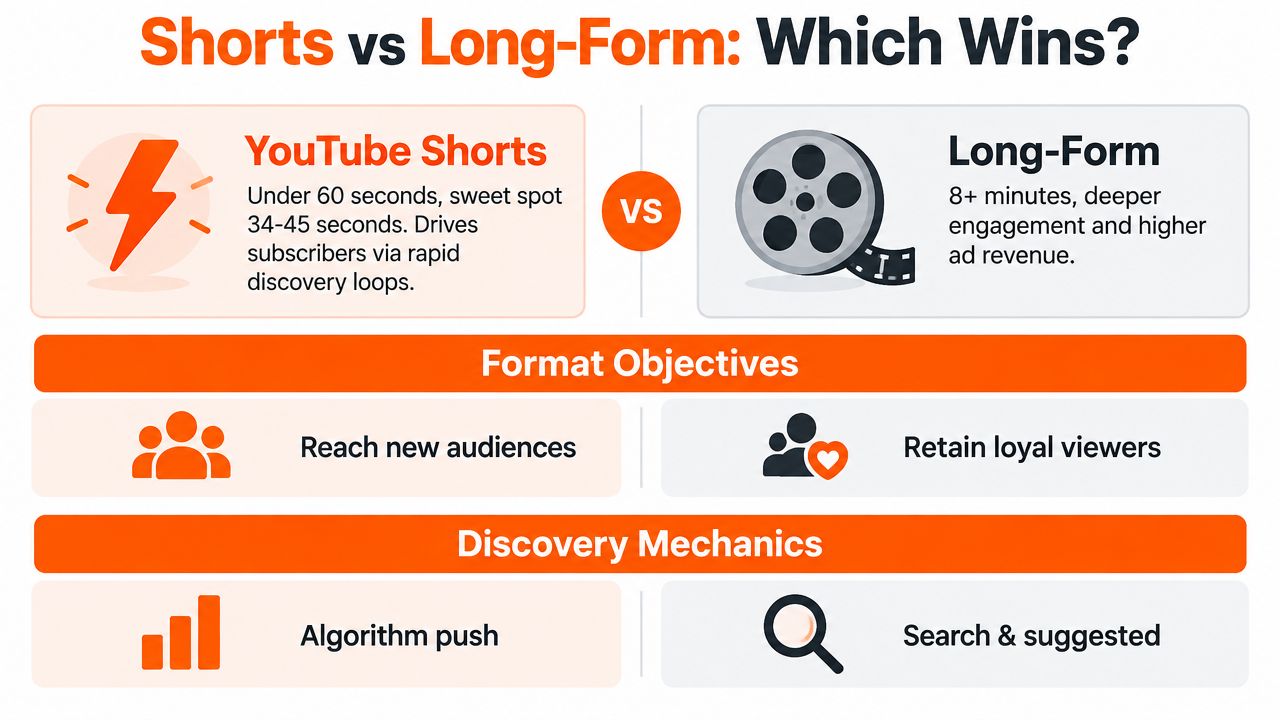
Shorts and long-form videos do different jobs. Treating them as interchangeable is how channels end up with a pile of disconnected clips and no clear path from discovery to trust.
YouTube Shorts launched in India on September 15, 2020, rolled out globally on July 12, 2021, and initially supported videos up to 60 seconds. In September 2024, YouTube expanded Shorts to 3 minutes and classified vertical videos of that length or shorter as Shorts (YouTube Shorts format history). The platform has therefore kept adjusting the format instead of declaring one permanent ideal duration.
Use each format for a specific job
Shorts are discovery assets. They're useful for testing hooks, introducing a pain point, and reaching people who don't know the channel. A strong Short can say, “Your onboarding problem isn't a training problem,” then send interested viewers to a deeper explanation.
Long-form videos are trust assets. They give the presenter room to explain the mechanism, show the workflow, compare alternatives, answer objections, and make a credible recommendation. That structure fits B2B buying journeys far better than a single punchline wearing vertical video clothing.
Format | Primary objective | Viewer behavior
Shorts | Reach and audience sampling | Fast consumption and rapid topic discovery
Long-form | Education and consideration | Search, suggested viewing, and sustained attention
Hybrid funnel | Move viewers toward deeper content | Short hook leads to a relevant pillar video
A practical publishing system uses Shorts as entry points and long-form uploads as the destination. A product marketing team might cut three Shorts from a tutorial, each focused on a different mistake, then point viewers toward the complete implementation guide. The YouTube channel growth strategy should define that relationship before editing begins.
For vertical shooting and repurposing, a clear vertical reframing guide can help teams protect the speaker, interface, and key text when adapting horizontal footage.
The choice is straightforward:
Choose Shorts when the goal is reach, hook testing, or top-of-funnel awareness.
Choose long-form when the viewer needs a process, explanation, comparison, or proof.
Choose both when the channel needs discovery and a serious path toward conversion.
Ideal Video Length by Niche and Audience Type
There is no responsible runtime target for every niche. Choose length from the viewer's job, the topic's depth, and the retention the structure can sustain. A cooking viewer needs a usable result. A finance viewer may stay for a longer argument. A software buyer needs enough detail to judge fit within an existing workflow.
A study of 18,080 YouTube channels found that gaming and DIY content peaked around 20 to 30 minutes, business and finance around 1 to 2 hours, fitness and cooking around 10 to 20 minutes, and technology around 10 to 20 minutes (niche-specific YouTube length study). Treat these ranges as signals about viewer tolerance, not upload quotas.
Median YouTube video length by niche
Niche | Median length direction | Best for
Gaming | 20 to 30 minutes | Walkthroughs, commentary, and complete sessions
DIY | 20 to 30 minutes | Full builds and problem-solving demonstrations
Business and finance | 1 to 2 hours | Deep analysis, interviews, and complex education
Fitness | 10 to 20 minutes | Guided routines and practical instruction
Cooking | 10 to 20 minutes | Recipe demonstrations and technique teaching
Technology | 10 to 20 minutes | Tutorials, reviews, and implementation guidance
Audience intent changes the answer
Search viewers with a specific problem want resolution. An 8-minute explainer works when the issue is narrow and the answer is complete. A comparison shopper may need a 6- to 10-minute breakdown, but the runtime should reflect the number of meaningful criteria, not a stopwatch.
B2B thought leadership should start with the topic's natural depth. A short opinion about a marketing mistake can fit in a few minutes. A product education video covering setup, workflow, limitations, and use cases needs more room. Cut the evidence to hit a shorter target and you produce an advertisement, not useful education.
Short-form has a different retention ceiling. Benchmark data reports that clips under 30 seconds can reach 80% or higher retention, while 60-second Shorts may need 80% to 90% retention to compete. Use those figures to set a testing range, not to force every idea into the shortest format.
The decision is direct:
Use a short video for a narrow answer with one clear outcome.
Use a longer video when the viewer needs steps, evidence, comparisons, or context.
Keep the longer version if chapters, examples, and payoff maintain attention.
Longer videos can outperform shorter ones when every added minute resolves a real viewer question. The objective and retention curve decide the runtime.
How Length Affects Watch Time and Monetization
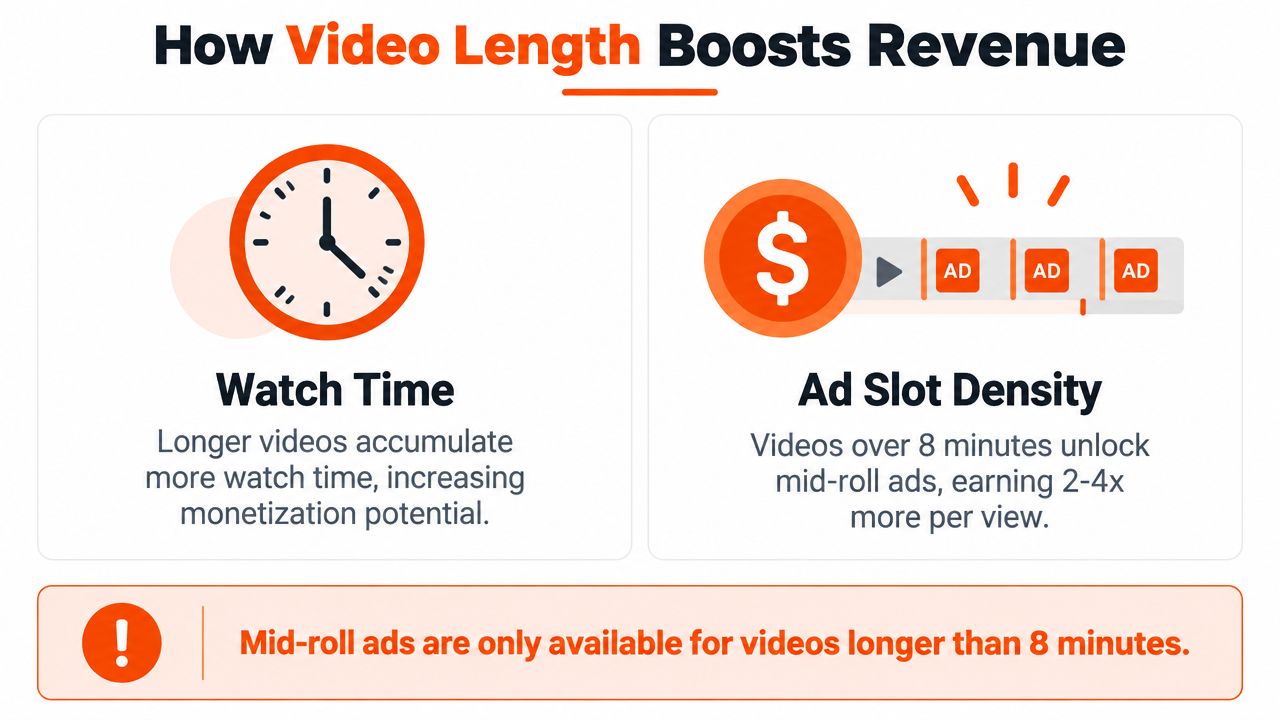
Length affects monetization through two separate mechanisms. Longer videos can accumulate more total watch time, and videos over 8 minutes can support mid-roll advertising. The second mechanism is useful only when viewers remain engaged long enough to reach the ad opportunity.
A 12-minute video with weak pacing isn't a revenue strategy. It's a 7-minute video wearing an oversized coat. Mid-roll placements should sit at natural transitions, such as the end of a chapter or a completed demonstration, rather than interrupting a sentence or burying the answer under an ad break.
Separate performance from eligibility
The 8-minute threshold can matter for ad inventory, but it doesn't tell a creator how long the content should be. A topic that deserves 6 minutes shouldn't be padded to 8. A detailed buyer guide shouldn't be squeezed into 7 minutes just to avoid looking long.
Teams planning revenue should also understand that the YouTube Partner Program has eligibility requirements beyond runtime, including 4,000 public watch hours. A calculator such as the YouTube RPM calculator can help model scenarios, but the calculation remains useful only when it uses the channel's actual audience and monetization data.
Monetization rule: Add length when it creates more useful viewing, not when it creates empty ad space.
A study summary reports that 30- to 60-minute videos reached a median size-and-age-adjusted reach of 1.40 times expected performance, while 12- to 20-minute videos reached 1.26 times expected performance and videos of 120 minutes or more fell to 0.25 times expected performance (search visibility and FAQ markup context). Those figures don't create a universal target. They show that middle-long formats can outperform marathon uploads when distribution and audience fit support them.
A Real B2B Example of Length Driving Results
ContentBuck's channel experience illustrates why short isn't automatically efficient. The original approach used 90-second product demos designed for LinkedIn cross-posting. Initial click-through rate was decent, but average view duration stalled at 38%, and subscriber conversion barely cleared 0.3% per impression.
The team shifted toward 10- to 13-minute tutorials built around one SaaS problem, moving from diagnosis to implementation. Average view duration reached 62%, watch hours tripled in 90 days, and YouTube-generated MQLs increased 4.7 times. These figures come from the supplied ContentBuck example and shouldn't be treated as a universal forecast for every B2B channel.

Why the longer arc worked
B2B buyers rarely make decisions from a single unsupported claim. They need a chain of reasoning:
Pain: Identify the operational or commercial problem.
Mechanism: Explain why the problem occurs.
Proof: Demonstrate the approach with evidence or a workflow.
Decision criteria: Clarify who should use the solution and when.
A 90-second clip can introduce the pain and hint at the mechanism. It usually can't show the proof and decision criteria without turning into a verbal speedrun. The longer tutorial gave the audience room to follow the logic, which made the content more useful to people already evaluating the problem.
The practical B2B lesson
The result wasn't caused by duration alone. A longer video would have failed if it repeated the same point, buried the demonstration, or opened with a five-minute company introduction. The winning format stayed focused on one SaaS problem and used the extra minutes to remove uncertainty.
For B2B teams, the better question is whether the viewer can leave with enough understanding to act. If not, the script needs more substance. If yes, the edit needs less furniture.
How to Pick the Right Length for Your Next Video
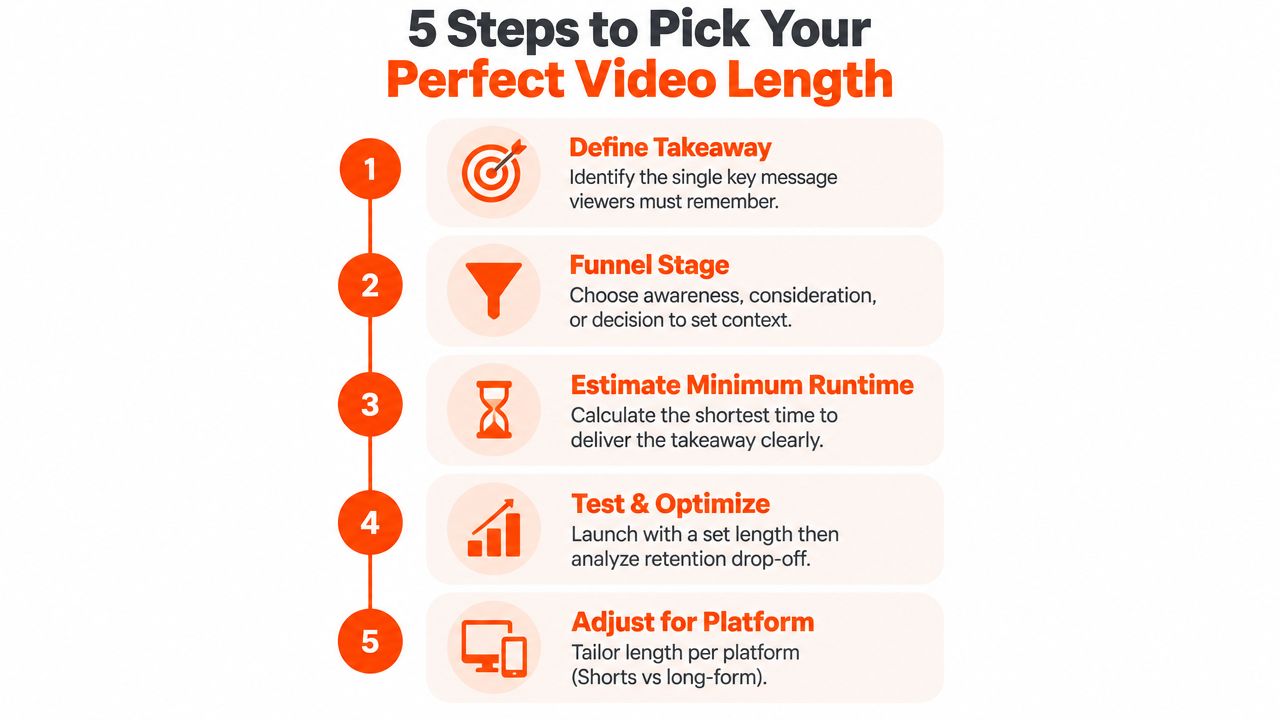
The right runtime comes from the viewer's job, not a universal target. Set the objective first, then build only the minutes needed to deliver a complete answer.
1. Define one takeaway
Write the sentence viewers should remember. A single hook or mistake can fit a short clip. A promised solution requires enough time to demonstrate the fix, explain its use, and show the result.
2. Identify the funnel stage
Awareness content names a problem. Consideration content compares options. Decision content answers objections and proves fit. Assign the video to one stage before estimating runtime, because each stage demands a different level of context.
3. Estimate the minimum useful runtime
A 15-second clip can deliver a hook, but it rarely teaches a complicated workflow. A narrow explanation may work at 4 minutes. A tutorial that includes setup, demonstration, and troubleshooting needs a longer floor. Cut anything that does not help the viewer reach the stated outcome.
4. Pressure-test the script
Write the opening, midpoint, and ending before filming. The opening must deliver on the title promise quickly. The midpoint must add a new piece of value, not another greeting from the same host. The ending must give viewers a clear next action.
5. Launch, measure, and adjust
Calculate average view duration divided by total video length. Compare that result with the retention pattern for the format and duration, rather than treating one percentage as a universal pass mark. Review the graph for the first major drop, then cut or restructure the section that causes it. The video length optimizer can provide a starting recommendation, but your channel's retention graph makes the final decision.
Remove these common mistakes:
Padding the greeting: Delete channel introductions that delay the promised answer.
Repeating the thumbnail: State the core promise early, then develop it.
Forcing ad eligibility: Do not stretch a 6-minute lesson into a thin 8-minute upload.
Ignoring navigation: Chapters place vertical markers in the player progress bar, and viewers can jump to them from the description or chapter title (YouTube chapter markers explained). Add them when a long video contains distinct sections.
Frequently Asked Questions About YouTube Video Length
How long should a first YouTube video be?
An 8- to 12-minute first upload gives a new channel room to teach one focused idea. A video longer than 8 minutes may also support mid-roll eligibility. The topic decides the final cut. A complete short answer beats a padded introduction.
Do longer videos hurt new YouTube channels?
No. Weak retention causes more trouble than length. A longer video can perform on a new channel when the title attracts the right viewer and the script delivers the promised answer without filler. Structure determines whether extra minutes help or hurt.
What's the best length for educational YouTube content?
Educational videos often work around 10 to 15 minutes when the lesson needs context, demonstration, and a usable conclusion. Narrow questions may need less time. Complex instruction may need more. End the video when the viewer has the answer and can apply it.
What's the best length for Shorts growth?
Shorts under 35 seconds can support strong completion when the idea is simple and the ending arrives quickly. Give every clip a clear hook and payoff. A short video without a conclusion is only a trailer.
Does YouTube prefer 10 or 15 minutes?
YouTube does not prefer a duration by itself. A 15-minute video can create more ad opportunities, but only when viewers keep watching and the topic's natural retention curve remains healthy. Use the 2026 YouTube retention benchmarks as context, not as a fixed target.
How should creators measure whether length worked?
Divide average view duration by total video length to calculate average percentage viewed. Then inspect the retention graph for early exits, confusing sections, and chapters that hold attention. The percentage matters, but the location and reason for each drop matter more.
Google's FAQ guidance requires pages using FAQ structured data to display the full text of every question and answer. These responses therefore remain visible rather than hidden one-liners (Google FAQ rich results guidance).
ContentBuck plans, scripts, produces, edits, and repurposes B2B YouTube content around buyer intent, retention, and commercial goals. Visit ContentBuck to discuss a long-form channel system, video editing workflow, or Shorts-to-pillar strategy built for the length each topic deserves.
Parth Jasrapuria
Founder at ContentBuck
Building video systems for B2B businesses. Obsessed with YouTube growth, creative strategy, and organic SEO.