SEO Content Marketing Services: A Buyer's Checklist
Parth Jasrapuria
Founder
A marketing lead opens the monthly report, sees a blog full of fresh posts, a content calendar with every box ticked, and a pipeline chart that refuses to move. The team isn't lazy. The writing isn't terrible. The pages aren't built to turn searchers into buyers, so the effort looks busy while sales gets nothing useful from it.
That gap between activity and revenue is exactly what SEO content marketing services are meant to close. A good service plans around buyer problems, publishes pages Google can find, and reports on leads and pipeline, not applause metrics.
Why Most B2B Content Budgets Underdeliver
A familiar scene plays out in many B2B teams. Twelve articles go live in a month, social posts announce each one, and the blog looks like a busy train station. Then someone asks a rude but fair question in the pipeline meeting. Which meetings came from all that publishing?
Silence usually follows. Traffic may have risen, a few keywords may have moved, and one post about industry trends may have done nicely on LinkedIn. None of that answers whether a finance director, operations manager, or software buyer got closer to requesting a demo.

The pattern shows up in the numbers, too. In the Content Marketing Institute and MarketingProfs 2025 B2B research, only 29% of B2B marketers rated their content strategy as extremely or very effective, while 58% called it moderately effective. Producing more content clearly doesn't guarantee commercial impact.
A Strategy Problem or a Measurement Problem
Teams often mix up two different faults. A strategy problem means articles target topics buyers don't search for near a purchase, or goals were never clear enough to guide choices. A measurement problem means useful pages exist, but nobody can connect them to downloads, demos, or opportunities.
Both faults feed each other. Without clear goals, writers chase easy topics, and without attribution, leaders can't tell which pages help sales. A documented plan, such as the approach in a practical SEO content marketing strategy guide, forces those choices before drafting starts.
A simple test for any program: If the monthly report can't name which pages influenced a lead, the report is describing publishing, not performance.
Three questions settle most buying decisions. What does the service include, what results are realistic, and how can a buyer compare vendors without paying for a pretty content calendar and an empty pipeline?
What SEO Content Marketing Services Actually Include
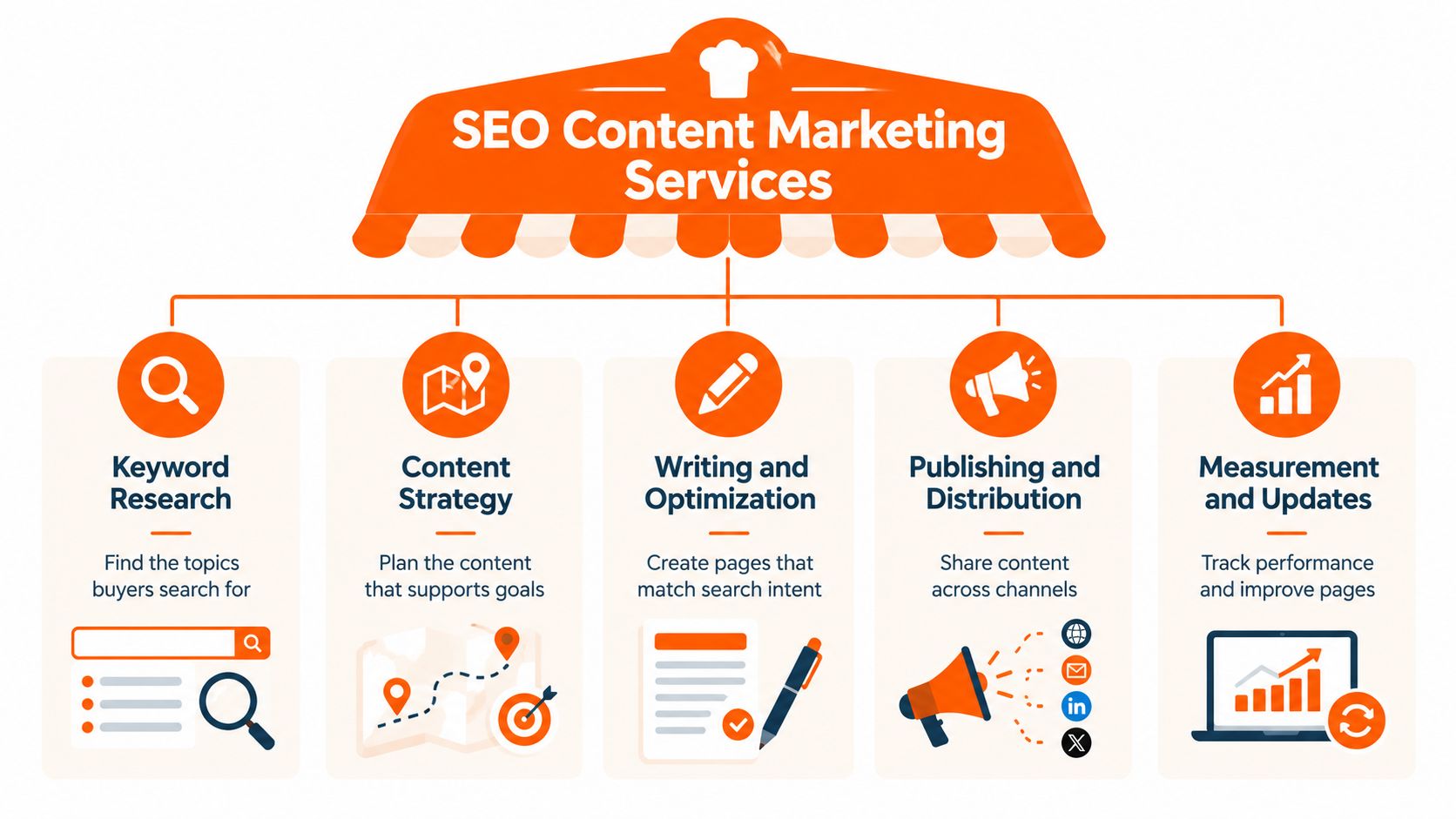
Think of the service as a restaurant. A restaurant doesn't succeed because the kitchen cooks a lot. It succeeds because the menu matches what diners want, dishes arrive properly prepared, and the owner knows which meals bring people back.
The workflow map below shows the parts that need to work together.
Choosing Dishes People Actually Order
Keyword research is the menu research. A strong provider studies search language, intent, competition, and sales priorities, then separates curiosity searches from buying searches. A warehouse software company gains more from buyers searching for a warehouse software implementation checklist than from students asking what warehouse software means.
Pillar and cluster planning turns that research into a menu structure. A broad pillar page covers a core topic, such as warehouse management, while clusters cover implementation, pricing questions, integrations, and comparisons. Each page has a job, and internal links help readers move from learning to evaluating.
Cooking and Plating the Content
Long-form articles are the cooking. Writers use subject-matter input, clear headings, practical examples, and calls to action that fit the reader's stage. A checklist page might offer a downloadable template, while a comparison page might invite a product walkthrough.
On-page optimisation is the plating. Titles, headings, internal links, image text, and page structure make the work easier for readers and search engines to understand. It doesn't rescue a weak article, just as a fancy plate doesn't rescue burnt soup.
The short video below gives a plain-language look at how content and search fit together.
Word of Mouth and Repeat Customers
Managed link building works like word of mouth. Relevant sites linking to a useful guide signal that other people trust it enough to reference it. The emphasis should stay on relevance and editorial quality, not collecting random links like souvenir spoons.
Monthly reporting closes the loop. It should show rankings, impressions, engagement, conversions, and what will change next. A service with planning but no reporting is a restaurant with great food and no idea who ate it, which table paid, or why the dining room emptied on Tuesdays.
Technical Checks Before You Scale Content
A beautiful article that Google can't crawl is a shop with the door locked and a lovely sign inside. Nobody finds the products, however polished they look. Technical checks therefore come before a provider scales production, not after traffic disappoints everyone.
Googlebot discovers URLs through crawlable links, sitemaps, redirects, and other accessible resources, then parses pages for indexing, as explained in Google guidance on crawling and indexing. If a page is blocked or disconnected from internal links, strong writing can't compensate.
The Plumbing Behind Every Article
A provider should audit the basics before promising growth. Small template faults can hide large amounts of work, and publishing faster only multiplies the problem.
Robots and index controls: Check robots.txt rules and noindex directives so important pages aren't blocked by accident.
Canonical signals: Confirm duplicate or similar URLs point to the intended version instead of splitting signals.
Internal linking and sitemaps: Make sure new pages connect to relevant existing pages and appear in the XML sitemap.
Rendered content: Inspect JavaScript-rendered pages to confirm crawlers can see the text readers see.
A painful example is easy to picture. A team publishes thirty articles, celebrates the output, then learns a template setting blocked half of them from indexing. The writers did real work. Google never got invited in.
A Practical Publishing Workflow
Representative URLs should be validated in Google Search Console before launch. The provider inspects rendered HTML, confirms indexability, and checks that page resources load without a login barrier. After publication, crawl and indexing status get monitored until the pages settle.
Structured data, also called schema, sits on top of that foundation. It gives Google machine-readable context for articles, organisations, breadcrumbs, videos, and FAQs, and it may support eligibility for enhanced results. It isn't a ranking shortcut.
Schema is a clear label on a box. A neat label helps only when the box actually contains what the label promises.
Markup must describe visible, current content and pass validation. Google recommends JSON-LD and validation through the Rich Results Test, as set out in its structured data policies and general guidelines. A page blocked by robots.txt, a noindex tag, or a login can't be properly evaluated, so access checks come first.
Realistic Outcomes and How to Measure Them
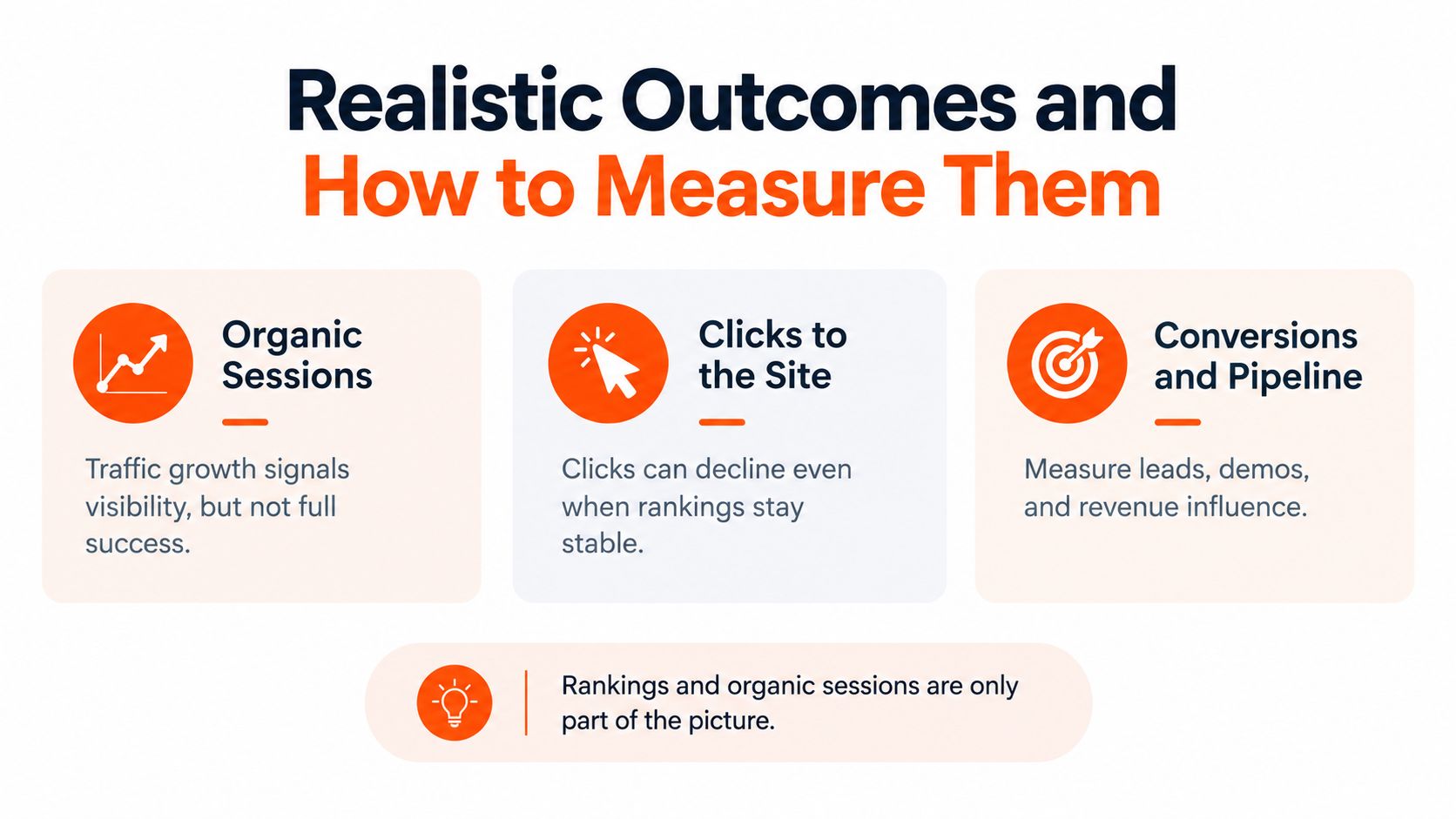
Many buyers expect a simple story. Rankings rise, clicks rise, leads follow, and everyone gets a tidy chart for the board meeting. Real search behaviour is messier, which is why rankings and sessions alone can make a healthy program look weak or a weak program look clever.
A 2024 analysis reported by Search Engine Land on zero-click search behaviour found that 58.5% of U.S. searches and 59.7% of EU searches ended without a click to an external website. Answers increasingly appear through snippets, panels, video, and other enhanced formats before a visitor reaches a company site.
Measuring More Than the Click
A stronger scorecard combines impressions, engaged sessions, assisted conversions, demo requests, and qualified pipeline. That mix shows whether content created visibility, held attention, and helped a buyer take a commercial step. Teams that want a deeper tracking setup can use resources on SEO measurement for SaaS marketing teams to connect search data with funnel actions.
The business case is broader than traffic. Content Marketing Institute content marketing statistics report that 87% of B2B marketers said content created brand awareness, 74% said it generated demand or leads, and 49% said it generated sales or revenue. Those outcomes need separate tracking, because awareness and revenue don't move in lockstep.
Consider an article targeting enterprise CRM migration checklist. It might attract ten visitors and produce three qualified meetings, while a funny listicle brings thousands of curious readers and no buyers. The quiet checklist page is doing the heavier commercial lifting.
Content in AI-Generated Answers
Buyers also research vendors inside tools such as ChatGPT, Perplexity, and Gemini. A 2025 B2B buyer content report from Redpoint Insights found that 50% of B2B buyers regularly use those tools and 58% use AI to summarise or compare vendor content. Evidence-rich, quotable pages with clear comparisons and expert input give AI systems something accurate to retrieve.
No provider can guarantee inclusion in an AI answer. A credible team sets a baseline first, tracks citations, branded searches, direct traffic, assisted pipeline, and qualified conversations, then reports what changed. That discipline connects naturally to a broader view of content marketing ROI for B2B companies, where revenue influence matters more than a single last click.
Comparing Vendor Process, Deliverables and Pricing
Two proposals can both promise SEO content and describe completely different work. One vendor sells finished articles. Another includes research, technical fixes, link outreach, editing, and reporting, so comparing price per article is like comparing a bicycle and a delivery van by counting wheels.
Buyers get a clearer view by scoring process, deliverables, and pricing separately. Teams comparing in-house hiring with external help can also compare SEO outsourcing options before deciding where specialist support fits.
A Simple Scoring Grid
Criterion | What a strong vendor shows | Red flag
Discovery and research | Buyer interviews, sales input, keyword intent, competitor gaps | Topic list built only from search volume
Roadmap and approval | Pillar map, briefs, calendar, clear approval steps | Articles appear without a documented plan
Writing and editing | Subject-matter input, named editors, revision process | Anonymous writers and no expert review
Technical and on-page work | Audit, internal links, headings, schema checks | Publishing without crawl or index checks
Links and distribution | Relevant outreach targets and promotion plan | Link quantity promised without quality criteria
Reporting | Leads, assisted conversions, pipeline influence, next actions | Rankings and sessions with no commercial context
Pricing | Retainer, per-piece, credit, or flat-fee terms stated plainly | Vague scope that changes after signing
Process reveals whether the vendor thinks before writing. Discovery should uncover ideal customers, sales objections, product strengths, and priority segments. Roadmap approval then gives the client a chance to reject topics that sound popular but attract the wrong reader.
Deliverables should be tangible enough to inspect. Useful examples include a keyword map, content calendar, article briefs, long-form drafts, on-page recommendations, link outreach records, and a monthly report with decisions. Published proof, such as B2B SEO content case studies, helps a buyer see how a provider connects output to outcomes.
Pricing Models in Plain Language
A monthly retainer suits steady publishing and ongoing optimisation. Per-piece pricing suits a defined batch, while credit-based work lets a team swap effort between articles, updates, and related assets. Flat fees can work for a fixed project, provided revisions, research depth, and reporting are spelled out.
ContentBuck provides one reference point for the same grid. Its SEO Content offering covers buyer-intent keyword research, pillar and cluster planning, human-written long-form articles, on-page optimisation, managed link building, and monthly reporting. Engagements run through monthly retainers or credit-based projects, with flat, no-contract plans, unlimited revisions, and a dedicated account manager.
The point isn't to crown a winner from a brochure. The point is to make every vendor answer the same questions, show sample deliverables, and explain pricing in language a finance lead can understand without a translator.
Buyer Checklist and Next Steps
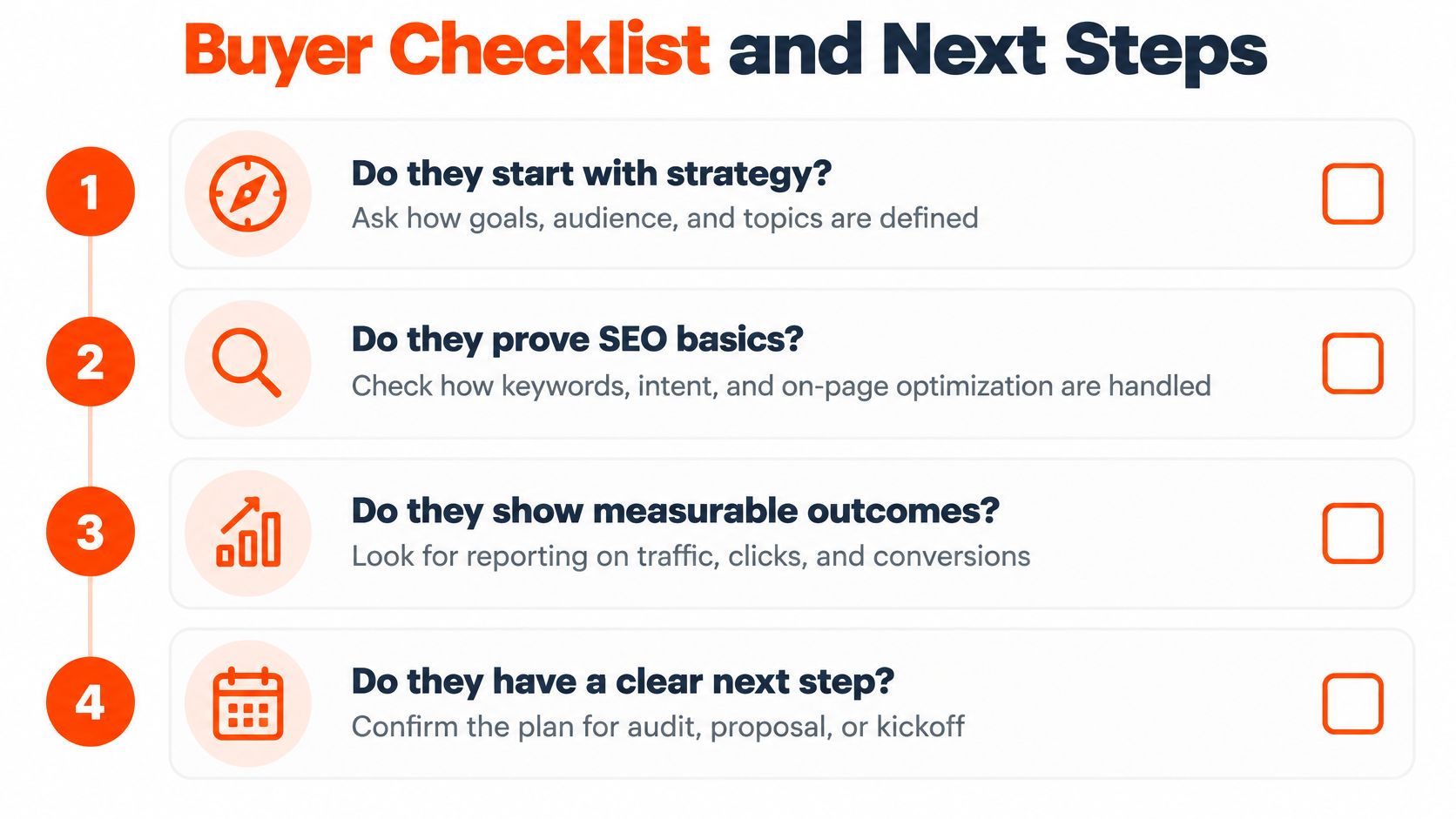
A sales call gets more useful when the buyer brings specific questions. Vague questions invite vague theatre, complete with dashboards, buzzwords, and a confident shrug. Specific questions force a provider to show how work starts, how quality is checked, and what happens when a page flops.
Questions to Ask Before Signing
Buyer intent first: Does research start with sales priorities and purchase-stage searches, or only broad traffic topics?
Sample roadmap: Can the provider show what a pillar, cluster, brief, and calendar look like before work begins?
Technical audit: Will crawlability, indexing, internal links, and sitemaps be checked before publishing scales up?
Reporting beyond traffic: Does the report include assisted conversions, qualified leads, and pipeline influence?
Schema and FAQs: How are Article, Organization, and FAQ markup selected, validated, and kept matched to visible content?
Underperformance plan: What gets refreshed, merged, rewritten, or retired when a page earns impressions but no action?
Buyers who are also weighing paid and organic support together may find it useful to compare SEM consulting services alongside content proposals. The comparison clarifies which problems need advertising expertise, which need editorial and technical SEO, and which need both.
Any vendor promising first place in search results on a fixed date is selling a unicorn with a spreadsheet.
A practical next step keeps risk low. Pick three priority pages linked to real buying problems, ask each shortlisted provider for a sample audit, and score the responses against the checklist. Clear thinking on three pages tells a buyer more than a glossy promise about fifty.
Frequently Asked Questions About SEO Content Marketing Services
How Soon Should Results Appear
Timelines depend on the starting site, competition, publishing quality, technical health, and the length of the B2B sales cycle. Early signals usually appear as impressions, indexation, and engagement before qualified pipeline can be judged fairly. A provider that gives one fixed date for every keyword is guessing in a confident voice.
A practical approach uses staged expectations. Buyers can review technical fixes and indexation first, then search visibility, then conversions and assisted opportunities. That order prevents a team from cancelling useful work because revenue didn't arrive before Google had even processed the pages.
Should a Vendor Interview Subject-Matter Experts
Yes, especially for complex B2B products. A product manager can explain implementation risk in one short interview better than a general writer can after reading five competitor blogs. Expert quotes, examples, and objections also make articles more useful for sales conversations.
The process doesn't need to become a burden. A provider can send focused questions, record a short call, and turn the transcript into article material and supporting video or social assets. Experts lend the knowledge, while writers handle structure and clarity.
Can a Provider Guarantee Rankings
No honest provider can guarantee a specific ranking. Competitors publish too, search results change, and Google controls its own systems. A credible vendor can commit to research quality, technical checks, publishing standards, reporting, and corrective action when pages underperform.
The same honesty applies to enhanced results. Google guidance on FAQ structured data explains that correctly marked-up FAQ pages may be eligible for enhanced presentation, but eligibility doesn't guarantee display. FAQ schema must match questions and answers visible on the page, so the FAQ should help visitors even if no rich result appears.
Does a Small Team Need a Full Program
Not always. A small team can start with a few buyer-intent pages, such as a comparison guide, an implementation checklist, and a pricing explainer tied to clear calls to action. That focused start tests research, writing quality, technical process, and reporting without funding a content factory.
Teams that want content judged by pipeline rather than pageviews can use ContentBuck for buyer-intent keyword research, long-form articles, on-page optimisation, link building, and monthly reporting tied to commercial outcomes. Visit ContentBuck to review the SEO content approach and choose a practical starting point built around priority buyer pages.
Parth Jasrapuria
Founder at ContentBuck
Building video systems for B2B businesses. Obsessed with YouTube growth, creative strategy, and organic SEO.