What Is Ad Creative? a Practical Guide for B2B Marketers
Parth Jasrapuria
Founder
A B2B marketer launches a carefully targeted ad, watches the right audience see it, then finds the results are flat. The natural reaction is to blame the media budget or ask for a new video. But the problem could be the message, the offer, the landing page, or the way success is measured. Knowing what ad creative really includes helps teams find the actual problem before they spend time and budget replacing the wrong thing.
What Ad Creative Really Means
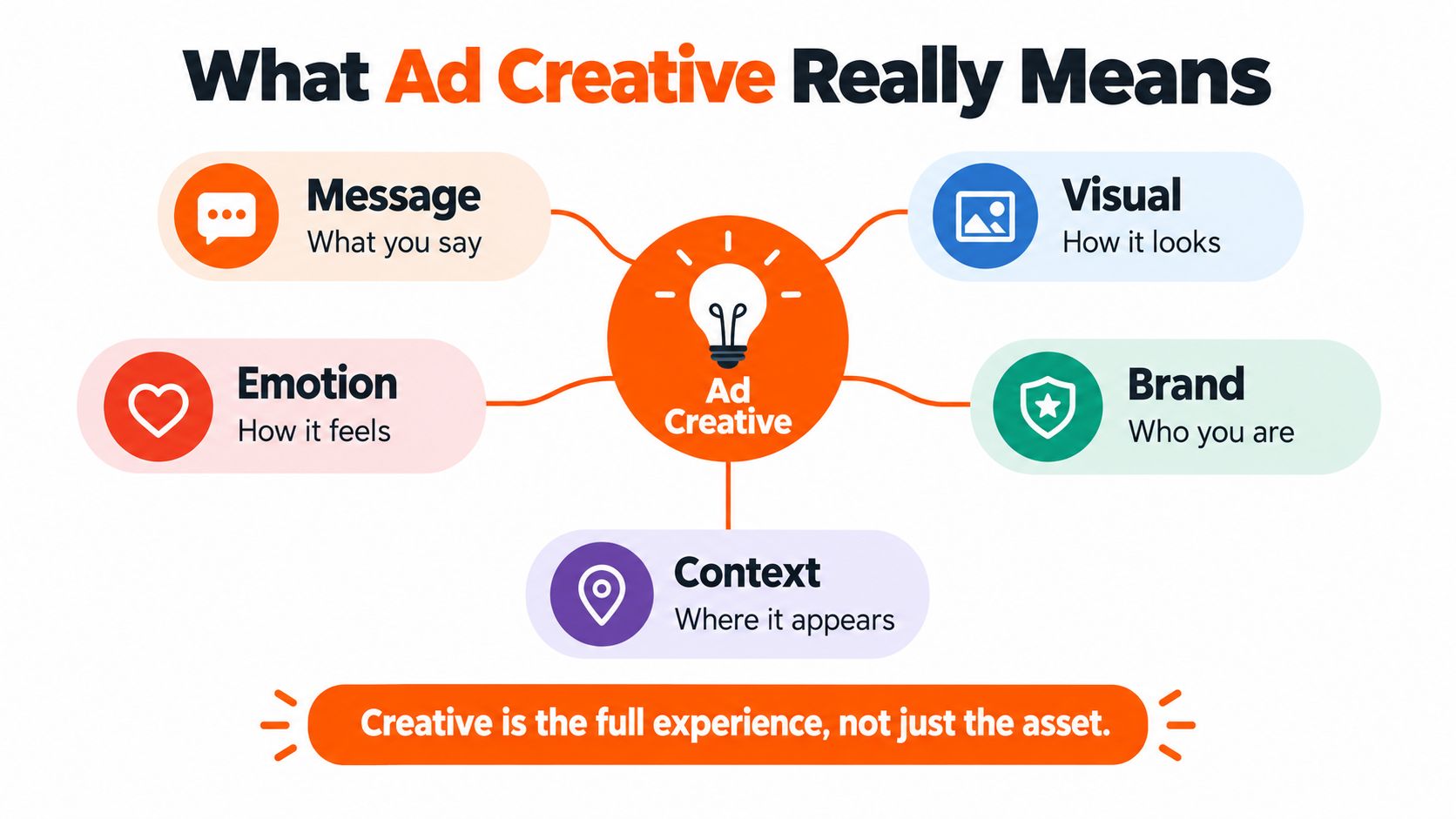
Ad creative is the complete persuasive package an audience sees or hears. It includes the idea, message, script, visuals, sound, format, branding, and call to action, not just the final video file or image. A product video can look polished and still fail if its opening gives busy buyers no reason to keep watching.
A useful distinction is that media determines who sees an ad and how often, while creative influences whether seeing it changes what someone thinks or does. A campaign might reach finance leaders through a relevant placement, for example, but its creative still needs to make a clear case for why those leaders should care.
Nielsen's analysis of Project Apollo, a cross-media advertising effectiveness initiative, found that 65% of the sales lift attributable to advertising came from the creative component (Nielsen's analysis of creative and advertising effectiveness). That finding puts creative in the category of business decisions, not decorative finishing touches. A strong visual identity matters, but the work also needs to explain value, earn attention, build credibility, and prompt action.
A simple example
Suppose a software company wants to reach operations leaders. One ad opens with a slow logo animation and the phrase “Creative solutions for modern business.” Another starts with a familiar frustration: approvals are scattered across email, and the team can't see what's waiting. The second version gives the audience a specific problem to recognize, before showing how the product helps.
The media placement could be identical in both cases. The difference is the creative: its opening, message, and demonstration. In one sentence, ad creative is the planned communication that turns an ad placement into a meaningful reason to pay attention and act.
The Anatomy of an Ad Creative
An ad isn't one indivisible asset. It's a set of components that work together, and each one can be adjusted and tested. A practical message structure starts with four questions: What problem does the audience face? What benefit does the product promise? What proof supports that promise? What should the audience do next?
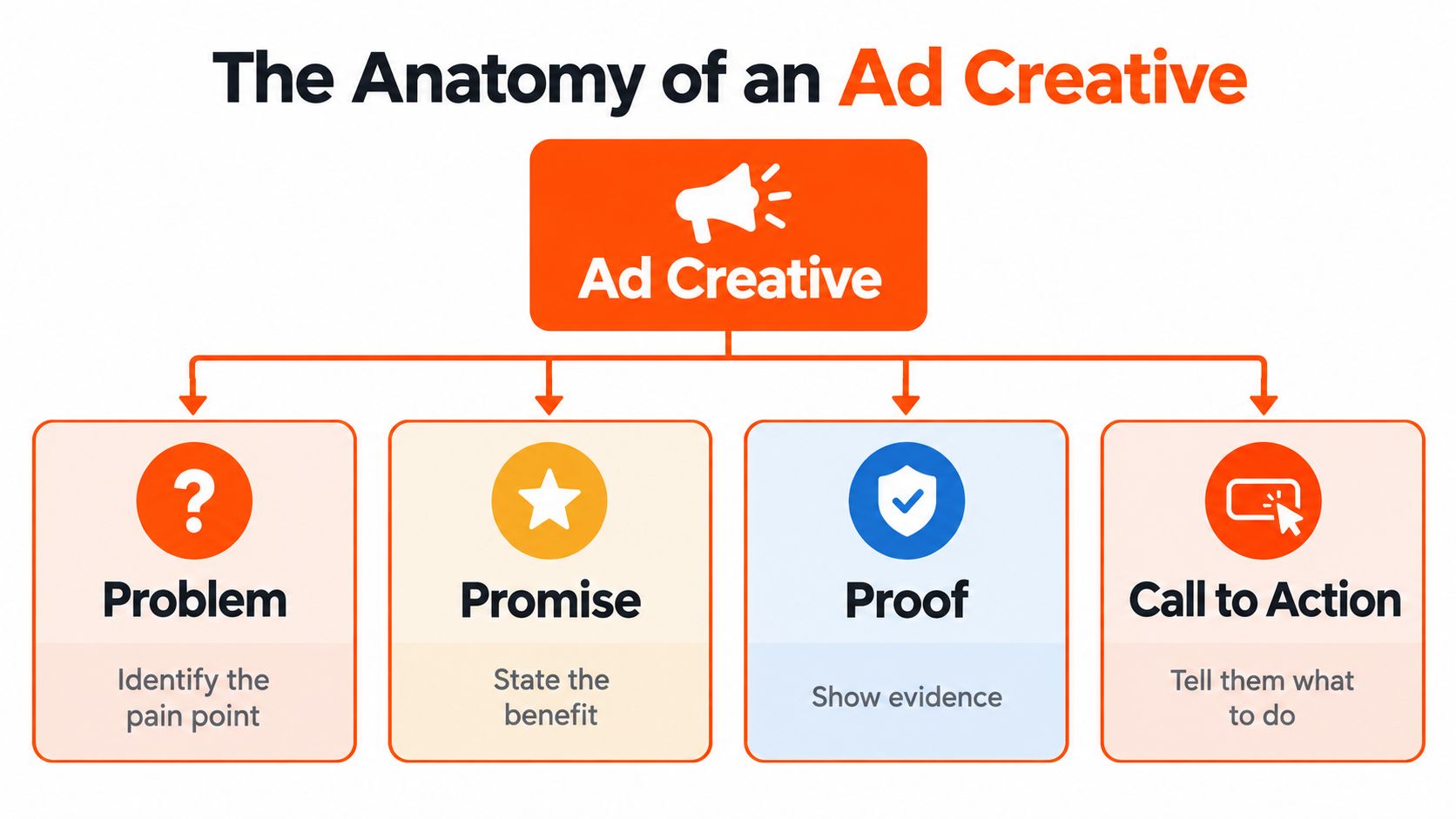
For example, a B2B software ad could introduce delays caused by manual invoice approvals, promise a clearer workflow, demonstrate how the product routes requests, and invite viewers to book a demo. Its opening hook, presenter, pacing, captions, logo placement, and CTA are all creative choices too. The landing page is part of the audience's overall experience, although it's useful to treat it as a separate test variable when diagnosing performance.
Google's responsive display system illustrates the modular idea. An advertiser can provide five headlines, five descriptions, several images, a logo, and a product video, and the system can combine assets and adjust how an ad appears across placements (Google Ads' overview of responsive display ads). A poor result might come from a headline-image pairing, rather than every ingredient in the campaign. That's a good reason to label assets by their hook, audience problem, visual treatment, speaker, and CTA.
A thumbnail can shape the first impression of a video, so it should support the same idea as the opening rather than promise something the ad doesn't deliver. Teams planning that element can use this practical guide to thumbnail design. For video that relies on music, the best licensed tracks for campaigns can help teams consider audio that fits the ad and its usage needs.
Practical rule: Change an identifiable ingredient, not the whole recipe, when a test is meant to explain what worked.
Video Ad Formats Across Channels
A video concept can travel across channels, but a single export won't automatically suit every placement. The IAB's digital in-stream guidance lists common maximum durations of 15 seconds and 30 seconds, depending on format, and recommends 16:9 for widescreen video. It also describes pre-roll, mid-roll, and post-roll placements, which appear before, during, or after video content (IAB digital in-stream video guidance).
Video ad format | Max duration | Aspect ratio | Placement
Short in-stream video | 15 seconds | 16:9 for widescreen | Pre-roll, mid-roll, or post-roll
Longer in-stream video | 30 seconds | 16:9 for widescreen | Pre-roll, mid-roll, or post-roll
The table is a planning reference, not a universal platform specification. Each placement can have its own rules, so production teams should check the destination's current requirements before exporting.
Sending one stretched orientation file everywhere is like wearing flippers to a business meeting: technically possible, visually unfortunate. A widescreen product demo may suit a desktop video player, while a phone-first placement may need a vertical version with larger captions and tighter framing. Marketers comparing YouTube formats can also consult Wideo insights on YouTube ad performance, then check the placement requirements for the campaign itself.
Plan for silent viewing and file limits
IAB display and mobile guidance allows an additional 1.1 MB for an auto-initiated 15-second video and 2.2 MB for an auto-initiated 30-second video in certain units. It recommends MP4 using H.264 for broad compatibility and says audio must be user-initiated, so ads shouldn't unexpectedly play sound (IAB display and mobile creative guidelines).
That makes captions and a clear opening frame practical necessities. A silent animation about automating invoice approvals should communicate its core point even when the viewer hasn't turned on sound. Teams planning a video before the content begins can also review the mechanics of pre-roll adverts.
How Creative Impacts CPC, CPL, and ROAS
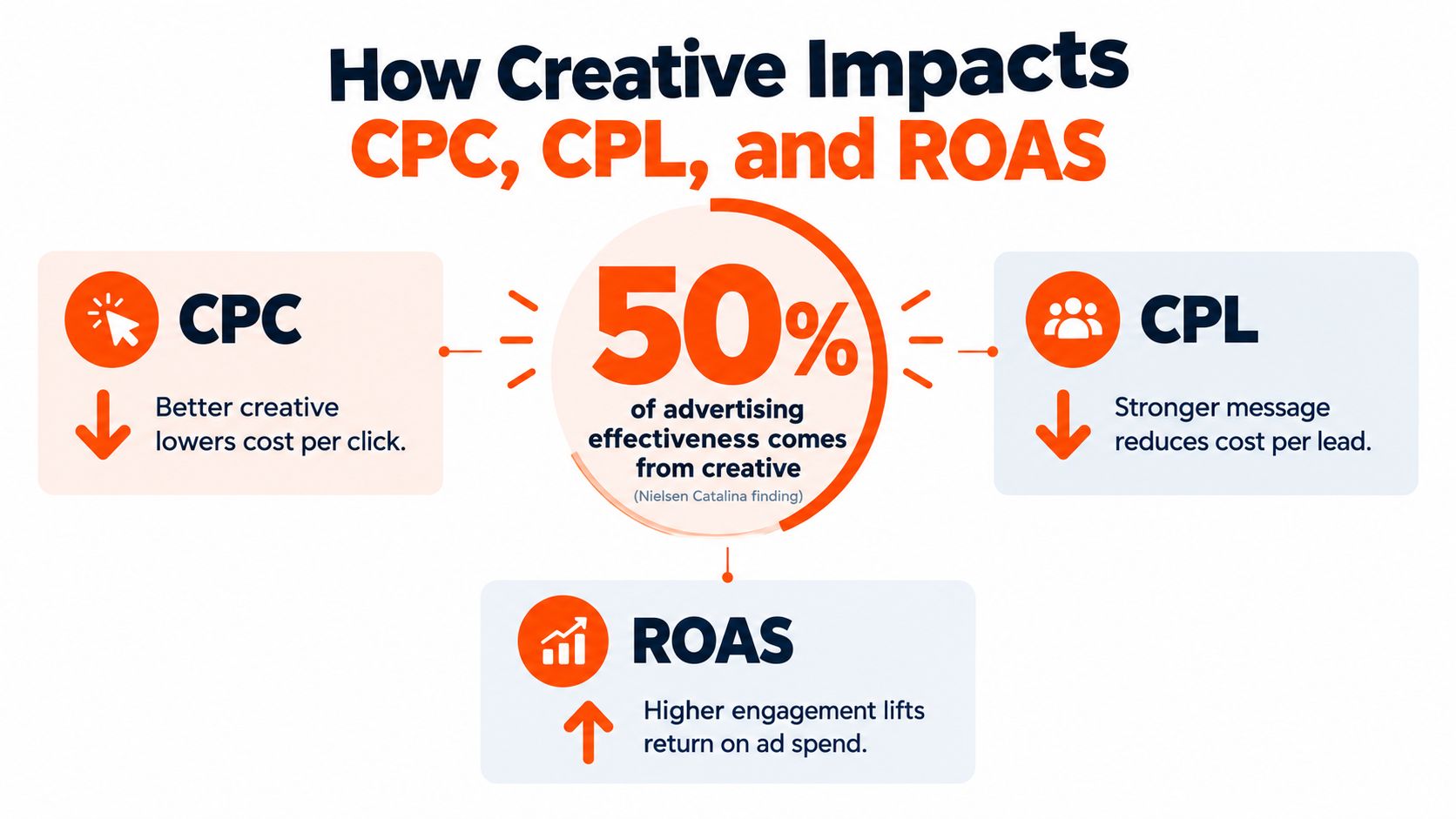
Creative affects whether an audience notices an ad, understands its value, and takes a useful next step. Nielsen Catalina research reported that almost 50% of advertising effectiveness was attributable to creative, with the remaining effect associated with media delivery (Nielsen Catalina findings on creative and media). This isn't a promise that any new video will reduce costs by a fixed amount. It's a reminder that media delivery alone can't rescue a message that leaves buyers confused.
A separate analysis of 175 campaigns reported that creatively awarded campaigns were, on average, at least 11 times more efficient than campaigns without awards, measured by business success relative to excess share of voice (Brandingmag's summary of creative effectiveness evidence). Awards aren't a substitute for business results, but the analysis reinforces the value of evaluating creative against outcomes rather than appearances alone.
Translate creative into B2B outcomes
A clearer problem statement may encourage more of the right prospects to click, which can influence cost per click (CPC). If those prospects are a better fit and continue to the next step, that may improve cost per lead (CPL). If qualified leads progress into opportunities, creative can contribute to return on ad spend (ROAS). These are possible pathways, not automatic results. The offer, audience, landing page, sales process, and measurement all matter.
Consider an agency targeting finance leaders. “Creative solutions” gives buyers little to connect with. An opening about invoice approvals getting lost in email is more specific, and a short product demonstration can show how the workflow changes. If clicks increase but qualified leads don't, the ad may be attracting curiosity without making the audience or value clear enough.
Measure the job the ad was hired to do. Views can describe attention, but qualified demos, conversion rate, CPL, and downstream revenue help show whether the campaign is attracting commercially relevant interest.
A company can use a relevant digital advertising example to compare how creative choices support the intended outcome. The useful question isn't whether an ad looks busy or polished. It's whether it helps the right buyer understand the offer and take a meaningful next step.
Creative Testing That Actually Works
A creative test should answer a question, not produce more ads. Google's experimentation framework supports measuring outcomes such as brand lift, click-through rate, conversion rate, cost per conversion, cost per view, and view rate (Google Ads guidance on campaign experiments). The right metric depends on the campaign's goal.
A controlled test compares a control and a treatment with comparable audiences, a stated hypothesis, and one clearly defined success metric. For example, a team might predict that opening with a product demonstration instead of a presenter will improve qualified demo requests. Keeping the audience and offer stable makes the result easier to interpret.
Build the test in manageable steps
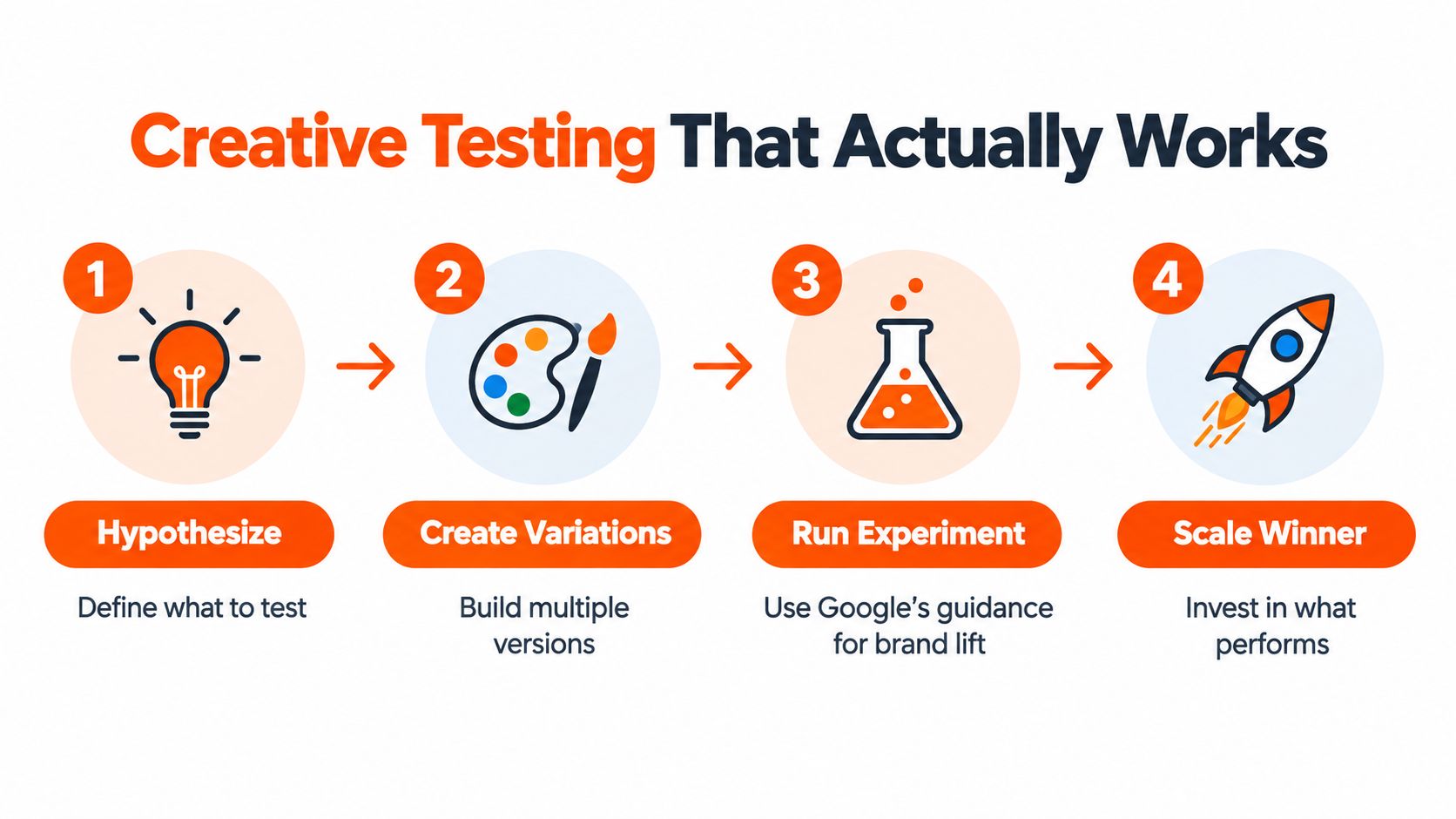
Write the hypothesis. Name the audience, the creative element being changed, and the outcome that would count as success.
Create focused variations. Produce several openings while keeping the offer and audience consistent. Then test framing, captions, proof, pacing, or CTA placement as separate questions.
Run the experiment. Compare versions under comparable conditions and use the success metric chosen before launch. Avoid changing the landing page or offer halfway through if the experiment is meant to isolate the ad.
Record the learning. Keep notes on what changed and what happened. If a video wins because a problem statement is clearer, that insight can guide future scripts.
Google's reported global YouTube experiments found 60% higher ad recall for stronger creative in upper-funnel tests and a 30% lower median cost per acquisition for the better-performing version in lower-funnel tests. One test of alternative text overlays produced 139% more conversions and 23% lower CPA (Google's guidance on improving video ad creative). Those results describe the reported experiments, not a guaranteed outcome for every B2B campaign.
Measurement matters too. If platform conversion tracking misses valuable actions, creative comparisons can become misleading. Teams reviewing their tracking approach can consult this CAPI setup guide for advertisers. The experiment still needs a clear objective and comparable conditions; better tracking can't turn a vague test into a useful one.
Creative Fatigue Myths and What to Refresh
Creative wear-out works a bit like a favorite song on the radio. Hearing it for the fiftieth time might bore you, or you might still sing along. Research suggests the first reaction is less automatic than marketers assume. Adworld's coverage of creative wear-out research reports both a 2025 study of 162 Irish TV campaigns showing no performance decline across campaign lifecycles ranging from under six weeks to more than three years, and separate controlled research with 8,000 TikTok users across six markets finding that ads with exceptionally early branding produced 48% less negative sentiment, 57% more happiness, and 19% less attention decay under heavy exposure than at first exposure.
An old ad is not automatically a tired ad. Clear branding, shown early, appears to protect an ad when people encounter it repeatedly.
That doesn't mean every ad should run forever. When performance weakens, teams can look across several signals rather than treating platform frequency as the full diagnosis:
Attention or click-through rate falls. The opening may no longer earn interest, or it may never have been strong.
Qualified-lead quality worsens. The ad may attract clicks that don't match the target buyer.
Cost per opportunity rises. The campaign may be paying more for commercially useful outcomes.
Effective frequency increases. This can be a clue, but it needs to be weighed alongside response and lead quality.
Preserve what works. Refresh the part that appears to be failing.
For a B2B team, that could mean keeping a proven value proposition while testing a different opening, demonstration, edit, presenter, format, or proof point. Swapping every asset on a fixed calendar is like repainting the whole house because one window sticks. A weak initial ad needs diagnosis. A strong ad may only need a more effective route into the same message.
Diagnosing an Underperforming Ad
When results flatten, the fastest route to a useful answer is to check the campaign in sequence. Starting with the video itself can lead a team to rewrite a script when the core issue is that the ad isn't reaching the intended audience.
Check delivery and audience quality. Confirm that the campaign is serving as intended and reaching relevant buyers. A creative can't persuade the people it never reaches.
Inspect attention signals. If the intended audience sees the ad but doesn't stop or continue watching, review the opening, first frame, and clarity of the problem.
Test comprehension and brand linkage. If people watch but don't connect the message with the company or product, examine whether the benefit, proof, and branding are easy to understand.
Follow the action downstream. Clicks without conversions can point to a mismatch between the ad, offer, and landing page. Leads that don't become opportunities may signal a fit or qualification problem rather than a video-editing problem.
For B2B campaigns, an immediate platform conversion isn't the only useful sign. Buying cycles can be long, so a creative may generate qualified engagement before a revenue outcome appears. Teams should agree on which early signals indicate progress and connect them to downstream results where measurement allows.
More variants aren't automatically better. Without a hypothesis, each new version can add noise, make results harder to explain, and weaken brand consistency. Industry reporting says 95% of surveyed marketers are testing AI for creative production, while 75% worry AI-generated work will make brands look and sound alike (Marketing Interactive's coverage of AI execution and fragmented ad technology). AI can help produce options, but the team still needs to decide which audience insight, message, and proof deserve to lead.
Frequently Asked Questions About Ad Creative
How often should ad creative be refreshed?
Refresh when attention, qualified engagement, or business outcomes weaken together, not just because an ad has reached an arbitrary age. Preserve effective brand and message elements while testing the part that appears to be underperforming.
Does creative testing require a large budget?
A useful test needs a clear comparison, not a large collection of unrelated versions. Start with a focused hypothesis and keep other campaign elements as consistent as practical.
How can creative success be measured beyond clicks?
Choose a metric tied to the campaign's purpose, such as qualified demos, conversion rate, cost per qualified action, or downstream revenue. Clicks show response, but they don't establish lead quality on their own.
Can AI replace human creative strategy?
AI can help generate or adapt assets, but people still need to define the buyer's problem, check brand fit, and interpret the test results. More output isn't the same as more learning.
ContentBuck plans and produces B2B video ads, including hooks, scripts, editing, captions, and platform-specific variations for paid campaigns. Visit ContentBuck to explore video-led production and creative testing support for B2B growth.
Parth Jasrapuria
Founder at ContentBuck
Building video systems for B2B businesses. Obsessed with YouTube growth, creative strategy, and organic SEO.