Ads vs Commercials: Which Works for B2B Marketers
Parth Jasrapuria
Founder
A founder asks for a commercial. The growth lead hears a TV spot. The designer hears a LinkedIn video. Sales just wants demo requests by Friday. Everyone leaves the same meeting with a different budget in mind, and nobody's wrong about the words. They're just using ads vs commercials to mean different jobs. That mix-up sounds harmless until money follows it. One team buys broad reach when it needs pipeline. Another buys cheap clicks when it needs people to remember a new name. The fix isn't a dictionary. It's picking the format by real attention, incremental lift, and the job it has to do this quarter.
Ads vs Commercials at a Glance
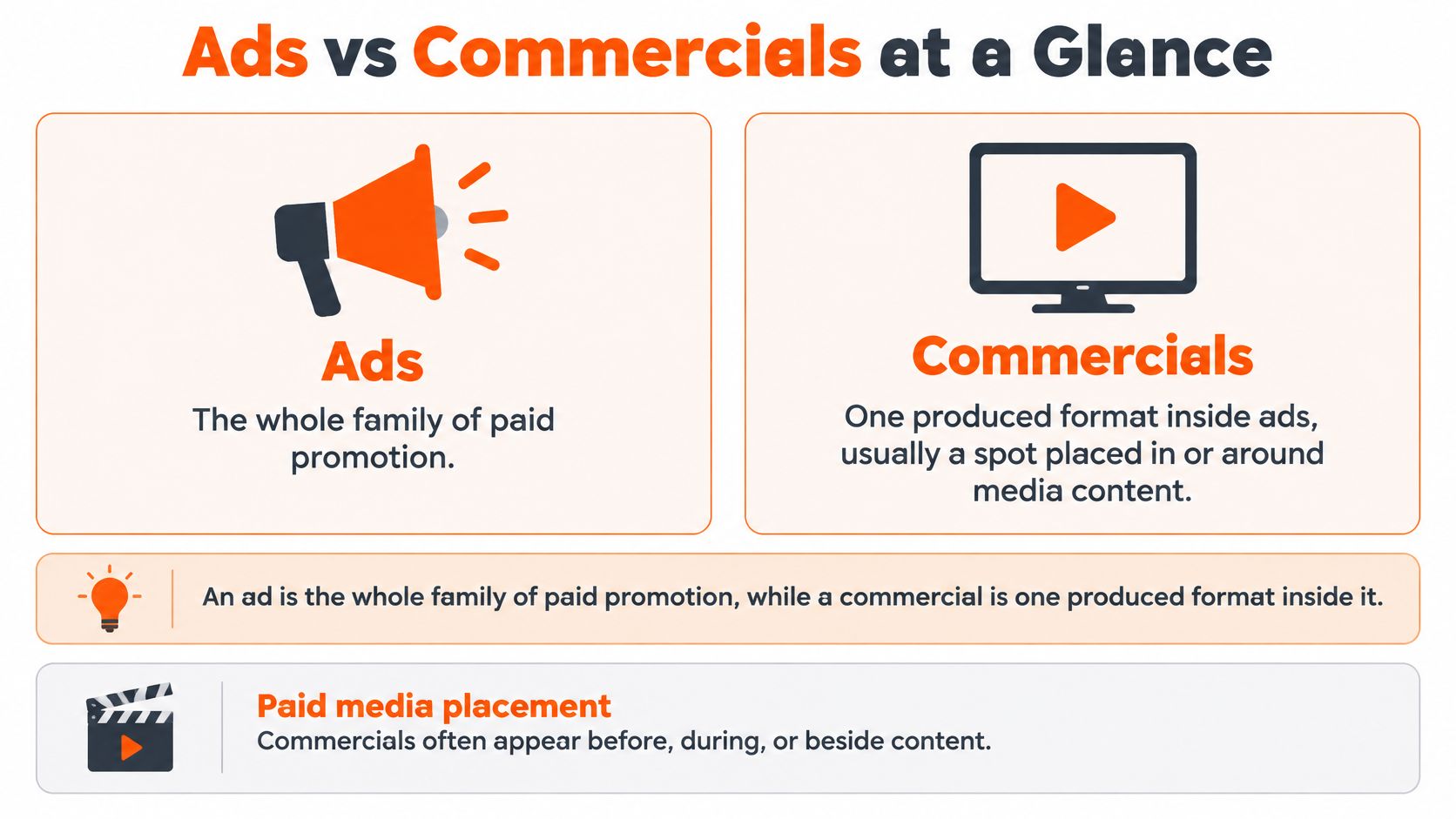
An ad is the entire category of paid promotion, while a commercial is one specific format within it, usually a spot placed in or around media content. An ad is defined by its paid promotional purpose. A commercial is defined by its creative convention and placement. Think sandwich. The bread is the ad, the paid placement that holds everything together. The filling is the commercial, the produced message people watch or hear. Or think zoo. An ad is the whole zoo, and a commercial is its loudest animal.
The Quick Comparison
Criteria | Ad | Commercial
Core meaning | Any paid promotional message | A produced spot, usually video or audio, placed in or around media content
Typical formats | Search text, display banner, social post, video, sponsored article | 6, 15 or 30-second video spot, radio spot, sponsored podcast read
Production effort | From minutes for a text post to weeks for video | Usually a full creative build with script, talent or animation
Main channels | Search, social, display, video platforms, print | TV, streaming, radio, pre-roll and mid-roll video
How success is judged | Clicks, conversions, cost per lead, lift tests | Reach, attention, brand recall, modeled lift
Best job | Capture active demand, retarget, test fast | Build memory and story at scale
A paid LinkedIn carousel is an ad, but almost nobody calls it a commercial. A 30-second TV spot is both. A 15-second YouTube pre-roll for a project tool is also both in everyday talk. The Interactive Advertising Bureau and PwC report on 2024 digital ad revenue put U.S. internet advertising revenue at $258.6 billion in 2024, a 14.9% year-over-year increase, which shows why so many commercials now live inside digital ad systems rather than only on broadcast TV.
Three Overlap Cases That Settle Most Arguments
YouTube pre-roll for a project tool: It's an ad because the placement is paid. It's a commercial because it's a produced video spot that interrupts content. Both labels fit.
Paid search text listing for the same tool: It's an ad only. Nobody calls a blue text link a commercial, not even after a long day.
Host-read sponsorship in a B2B podcast: It runs as an ad buy, but it works like a commercial in audio form. The host becomes the talent, the script becomes the spot.
Three questions sort any new case fast. What is it? A text link, a banner, or a produced spot. Where does it run? Inside search results, in a feed, or before and during content people chose to watch. Who pays for the attention, and how? Per click, per view, per episode, or per broadcast slot.
Choose the word by what a team is buying and how it will be judged, not by how the creative looks.
That rule matters in B2B because the buyer rarely clicks once and buys. A security lead sees a video, a finance manager searches the name later, and a champion books the demo next month. Calling everything a commercial makes teams expect story and scale. Calling everything an ad makes teams expect clicks by Tuesday. Neither expectation fits every format, and the mismatch is where budgets leak. The rows in the table, cost, channels, metrics, and goals, are where that leak shows up first.
Production Cost and Effort Side by Side
Use these numbers as rough, market-dependent planning ranges, not quotes. They help a team avoid the classic error of comparing a static post made before lunch with a broadcast spot that needs a crew, a location, and legal approval.
Asset | Typical time | Rough production cost | Where it usually runs
Static social ad built in-house | 1 to 3 hours | Staff time only | Social feeds, search display
15-second video cut from existing footage | 1 to 3 days | $500 to $3,000 | Paid social, YouTube
Animated explainer, 60 to 90 seconds | 2 to 4 weeks | $5,000 to $25,000 | Landing pages, paid video, sales emails
Live-action 30-second TV spot | 6 to 12 weeks | $50,000 to $300,000 or more | Broadcast, streaming, connected TV
The Hidden Cost Changes Sides
For TV, production can look scary, then the media buy walks in and makes it look small. Airtime, premium placement, and reach usually dwarf the cost of making the spot. Anyone scoping that route should check what TV ads cost to produce before treating the shoot budget as the whole budget.
Digital flips the problem. One asset is cheap, but it doesn't stay fresh. Ad fatigue pushes cost per click up when the same creative runs too long, so teams pay again and again in editing time. A SaaS team testing six hooks in a month may spend far less than one TV spot, yet it needs ten times more files, captions, sizes, and end cards. The invoice is smaller. The workload isn't.
Planning rule: Budget TV by media first and production second. Budget digital by refresh volume first and polish second.
That is why unlimited revisions and fast turnaround matter more for digital teams than a perfect final frame. A hook that fails on day two needs a replacement on day three, not an award ceremony. Teams comparing formats should read the breakdown of commercial video production steps and timelines to see where script, animation, and revisions consume time. The cheapest asset on the table can become the expensive one if nobody planned for version two, three, and four.
Where Each Format Runs and How Space Is Bought
Say a B2B team has one strong product video. Where it runs decides what it costs, how long it can be, and whether anyone can skip it. The file doesn't change. The buying rules change everything around it.
Channel | How space is bought | Typical shape
Linear TV | Upfronts or spot buys, negotiated per slot | 30-second spot in a program break
Streaming and connected TV | Targeted placements around content | Pre-roll, mid-roll, post-roll
YouTube | Auction, usually per view or per click | Skippable in-stream video
LinkedIn | Auction by job title, company size, account list | Sponsored video or single image
Paid search | Auction per click | Text ad
Podcasts | Flat fee per episode | Host-read segment
Radio | Station rate card | Audio spot
Length Follows the Placement
In digital video, the IAB digital video ad format guidelines describe standard linear ad lengths as 6, 15, or 30 seconds, appearing as pre-roll, mid-roll, or post-roll. A 15-second software demo before a YouTube tutorial is both an ad and, in everyday language, a commercial. A banner, sponsored article, or search result is an ad without that spot-like feel.
That explains the re-edit problem. A clip built for a 30-second TV break often opens too slowly for social, where the skip or scroll decision happens almost at once. It usually needs a shorter cut, a faster product shot, and a new first line. Same story, different doorbell.
LinkedIn adds another wrinkle. Many viewers watch with sound off between meetings, so captions and an early product shot matter more than a clever voiceover they will never hear. Targeting data also brings duties that broadcast never had, which is why teams should understand privacy across the advertising lifecycle before building account lists and retargeting pools.
The channel decides the bill and the rules. The creative decides the story.
Podcasts and radio prove the point from the audio side. There's no picture to rescue a vague claim, so the offer, the name, and the next step have to land by ear alone. Paid search goes further. It strips away story almost completely and sells intent by the click. A team that wants memory shouldn't judge search like a commercial, and a team that wants demos shouldn't judge a streaming spot like search.
Metrics That Judge Each Format Fairly
Gross impressions tell a team an ad could be seen. They don't tell anyone that a human looked, understood, or cared. That's the favourite number to challenge first, because it makes weak campaigns look busy and busy campaigns look effective.
Metric | What it tells you | Works best for | Main trap
Cost per click | Price of each visit | Paid search and social | Ignores buying readiness
Cost per lead | Price of each form fill or demo request | B2B digital campaigns | Cheap leads can be poor leads
Viewability | Video visible on screen for at least 2 continuous seconds | Digital video | Visible does not mean watched
Completion rate | Share of viewers who watch to the end | Videos of the same length | Short cuts score high by default
Attention time | Seconds of real looking, about 13.8 per 30-second TV ad among viewers who look up | TV commercials | Based on panel estimates
Brand lift | Change in recall, awareness and consideration against a control group | Both formats, with test design | Needs enough volume to be reliable
Branded search growth | More searches for your name after a flight | Commercials and brand campaigns | Hard to attribute alone
Attention Is Stricter Than Delivery
The WARC marketing effectiveness glossary reports TVision data showing 74% of 30-second television ads have an opportunity to be seen, but only 43% are looked at, and viewers who look up give the average 30-second TV ad 13.8 seconds of genuine attention. WARC also defines video viewability as at least 50% of the ad being visible for a minimum of two continuous seconds. Delivered, viewable, and watched are three different parties. Only one of them brings snacks.
Cost per click shows the price of a visit, not readiness to buy. Cost per lead shows the price of a demo request, but a cheap lead from the wrong company is just a polite expense. Completion rate needs a fair fight, so compare 15-second cuts with 15-second cuts, not with 6-second teasers that finish before a viewer finds the skip button.
Brand lift is fairer for commercials because it compares people exposed to the ad with a control group on recall, awareness, and consideration. It needs enough volume to mean anything, and teams that want that discipline can evaluate campaign lift with holdouts rather than trusting last-click reports. Branded search growth often reveals commercial effects those reports miss, especially when buyers search a name days later. Clear thinking about what ad creative includes and how each element gets judged keeps teams from blaming the channel for a weak hook, or praising the hook for lucky placement.
Which Format Fits Your B2B Goal
Start with digital ads when the goal is measurable and close, such as pipeline this quarter. Feedback arrives within days, bad hooks get retired fast, and budget follows the variants that produce qualified actions. Use commercial-style video when the goal is brand memory in a category where buyers spend time on streaming or connected TV, then pair it with search follow-up so interested people find a clear next step.

Goal | Lead with | Why it works | Watch for
Fill pipeline this quarter | Digital ads with lead forms | Results visible within days | Creative fatigue after a few weeks
Explain a complex product | Animated explainer used as paid video and on landing pages | Better understanding before the demo call | Keep paid cuts under 90 seconds
Build category awareness | Video commercials on streaming or connected TV, with search follow-up | Story and reach across the buying group | Hard to prove lift without a control group
Reach a named account list | Targeted LinkedIn video ads | Reaches job titles at target companies | Higher cost per impression, needs frequency caps
Two Goals, Two Different Buys
Say a cybersecurity firm wants 40 demo requests from a named account list. Targeted LinkedIn video fits because job title and company targeting keep spend near the accounts sales wants. A broad TV spot would be a very expensive way to wave at everyone else.
Say a payroll software brand wants category awareness before a launch. Streaming spots can build the story across the buying group, while branded search shows whether more people look for the name afterward. The Dentsu global ad spend forecast for June 2025 forecasts global connected-TV ad spending to grow 10.9% in 2025 while total television spending, including broadcast, declines 1.8%. Budgets are moving toward addressable TV-style placements, so most B2B teams should plan a combination rather than betting the quarter on one format.
The middle path deserves respect. An animated explainer used as paid video and as a landing page clip helps when a product is hard to grasp, because comprehension often lifts conversion before the demo call. It won't create mass fame, and it shouldn't pretend to. A commercial without a measurement plan is an expensive poster.
What a Wrong Pick Costs B2B Teams
Say a SaaS team buys a TV spot to fill pipeline this quarter. It gets brand memory, internal applause, and almost no demo requests. The media reached plenty of people outside the target account list, so sales still starts the quarter hungry. The creative didn't fail. The job description did.
Now flip it. A payroll brand runs only search and social clicks to build category awareness before launch. It harvests cheap clicks from people who already knew the name, while the wider market never hears the story. Reports look efficient. The launch still feels invisible. Cheap attention from the already convinced is not reach, it's a reunion.
Three Signs the Pick Is Wrong
No control group: Nobody can separate campaign effect from normal demand.
No lead-quality metric: Form fills get counted before anyone checks company fit or buying role.
Budget sized by impressions alone: Delivery gets funded, while attention and downstream actions get ignored.
TV makes the mistake expensive because the media buy usually carries the biggest bill, and plenty of delivered spots never earn real looking. Digital makes the mistake sneaky because production starts cheap, then stale creative lets cost per click creep up week after week. Either way, a commercial without a measurement plan is an expensive poster, just with better lighting.
Test Your Format Before You Commit the Budget
Testing beats debating. It's also cheaper than arguing in a meeting for three weeks and calling that research.
A Simple Test Loop
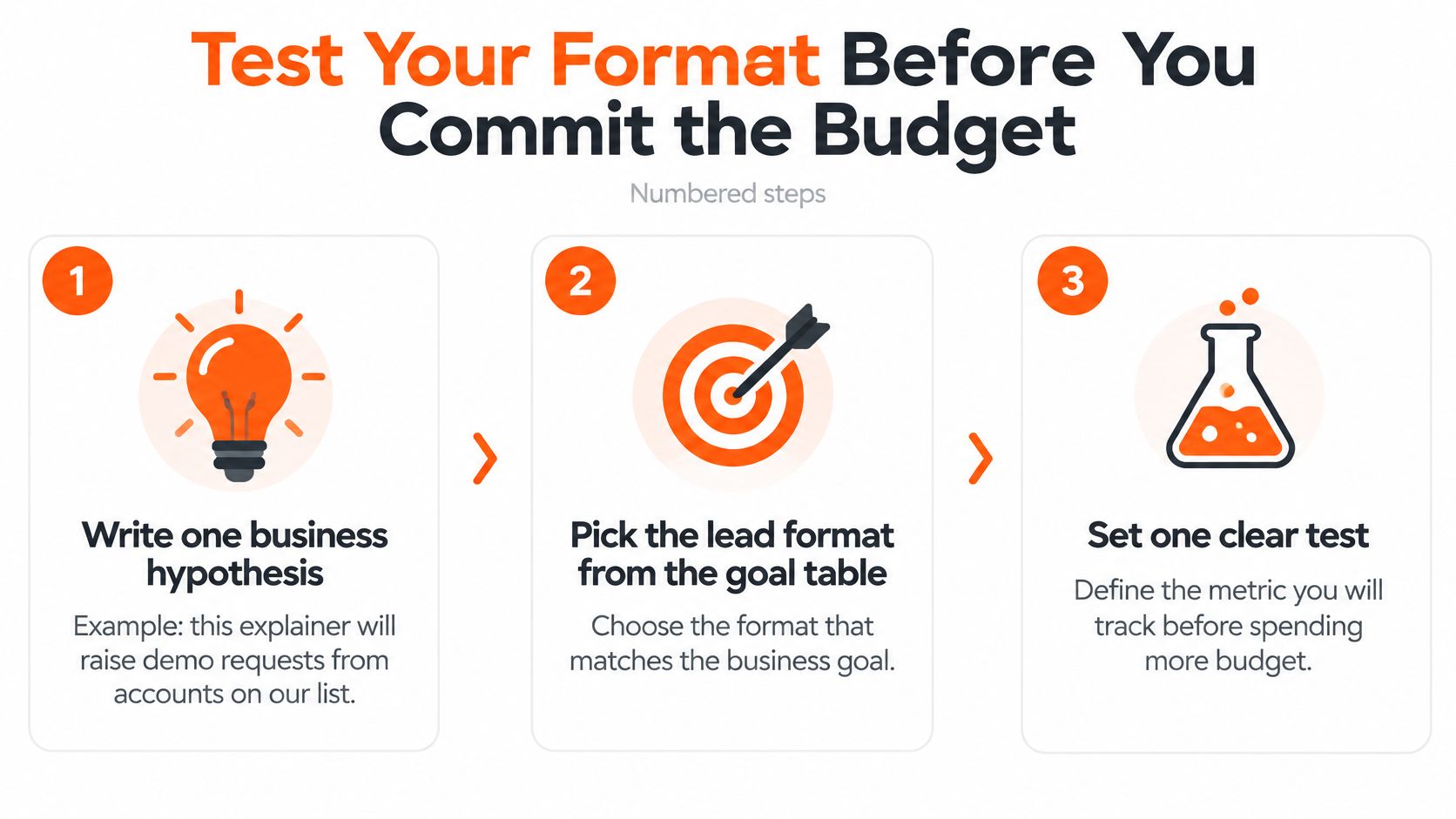
Write one business hypothesis. For example, this explainer will raise demo requests from accounts on the target list. One sentence keeps the test honest.
Pick the lead format from the goal table. Pipeline, explanation, awareness, and named accounts each point to a different starting format.
Set one primary metric and a control group. Use a holdout where volume allows, so lift means more than a good feeling.
Produce three to five variants. Change only the hook, the first three seconds, or the aspect ratio. Changing everything at once teaches nothing. Teams without an in-house editor often outsource this loop, and ContentBuck offers Unlimited Ad Editing with ongoing ad variants, hooks and scripts, 24-hour delivery per request, and a bi-weekly creative refresh.
Run each variant for two to four weeks at equal budget. Equal spend makes the comparison fair enough to act on.
Check viewability, completion, and lead quality. Cost per click alone can crown the wrong winner, so use the practical ad creative testing framework for hooks and variants to judge the full stack.
Scale the winner and retire the rest. Keep the learning, cut the sentimental attachments.
Small tests feel slower for one week. They save a quarter of confident spending in the wrong channel.
Frequently Asked Questions About Ads and Commercials
Do Commercials Need Disclosure When They Look Like Content
Yes. The FTC native advertising guide for businesses requires advertising to be identifiable when it could otherwise look independent or editorial, with disclosures that are clear and prominent, use understandable language, appear as close as possible to the ad, and, for video, remain on screen long enough to be noticed, read, and understood. Say a sponsored "best project-management tools" video features the company that paid for it. It needs a visible Sponsored or Advertisement label. A commercial can wear casual clothes online, but it still has to introduce itself clearly. Teams should also add FAQPage schema to pages like this one so search engines can show direct answers, and use clear keywords such as ads vs commercials where they fit naturally.
Is a TV Commercial Cheaper Than Digital for B2B
Usually not per target account. Broad reach carries a large media cost, and much of that reach lands outside the companies a B2B seller can serve. Digital costs more per impression on some platforms, but targeting by account, role, and intent wastes less of the buy.
Can a TV Spot Be Cut for LinkedIn
Often yes, but not by just uploading the same file and hoping for applause. Reshape the hook so the product and problem appear early, tighten the opening, and add captions for sound-off viewing. A vertical or square version may also be needed. The story can travel. The first three seconds usually need a new passport.
Ready to turn the ads vs commercials decision into tested video that fills pipeline instead of meetings? ContentBuck plans, scripts, and edits B2B ad creative, animated explainers, and ongoing variants built for LinkedIn, YouTube, and streaming, so bring one goal and one rough idea and get a practical production plan.
Parth Jasrapuria
Founder at ContentBuck
Building video systems for B2B businesses. Obsessed with YouTube growth, creative strategy, and organic SEO.