Why Your B2B Blog Gets Traffic but No Leads: 2026 Fixes
Parth Jasrapuria
Founder
The marketing dashboard looks cheerful. Organic visits are climbing, the latest article ranks, and someone has added a green arrow to the monthly report. Meanwhile, the sales inbox contains a newsletter, a vendor pitch, and absolutely no reason to celebrate.
Understanding why your B2B blog gets traffic but no leads starts with separating attention, buying readiness, and measurable action. Some readers aren't potential customers. Others are potential customers who can't find a sensible next step. And some are building a case for buying, without giving analytics the satisfaction of taking credit.
Telling Traffic Problems From Lead Problems
A traffic problem means the wrong readers arrive. A lead problem means suitable readers arrive, but something breaks between interest and inquiry. Both produce the same awkward pipeline meeting, but they need different repairs.
A software company attracting students through a glossary doesn't need a brighter consultation button. A company attracting implementation searches to a broken contact form doesn't need another glossary.
Blog symptoms, likely causes and first checks
Symptom | Likely cause | First check
Thousands of sessions, almost no form fills | Readers are researching, not buying | Compare sessions with lead events by article stage
High scroll depth, zero completed forms | Analytics counts scrolling, not lead submissions | Confirm a lead event fires on the thank-you page
Visits from students and job seekers | Keyword targets general learners | Check job titles and company size in analytics where available, then validate against CRM records
Many Book a Demo clicks, few submissions | Form is too long or the offer is too high-commitment | Count form starts against completions
Good engagement but sales says leads are weak | Ideal buyers never reach the page or the offer | Ask recent leads how they first heard of the business
Job titles and company size aren't automatically available in standard Google Analytics reports. Teams should use consented lead information rather than assume anonymous visitors come with business cards attached.
The Content Marketing Institute's 2025 B2B benchmark found that 87% of marketers said content helped create brand awareness, 74% said it generated demand or leads, 62% said it nurtured subscribers, audiences, or leads, and 49% said it helped generate sales or revenue. These aren't stages of a measured conversion funnel, but they illustrate the difference between attracting attention and supporting commercial outcomes.
Diagnostic rule: More water won't fix a leaky bucket. More visits won't fix a broken buying path.
For agency teams connecting search visibility to inquiries, LLMrefs' practical lead generation strategies for agencies provides a useful companion resource.
A practical 30-day self-check records sessions, form starts, completed forms, and sales conversations. The smallest number identifies the outcome needing attention; the drop immediately before it helps locate the actual problem.
Matching Each Article to the Right Buyer Stage
A bookshop browser doesn't expect a sales contract at the door. Likewise, someone learning a business concept doesn't necessarily want a product evaluation call before understanding the problem.
The useful distinction is between learners, comparers, and buyers. Each needs a different next step, not a different shade of the same demo button.
Give each search a suitable offer
Reader stage | Example keyword | Suitable next step
Learner | What is customer-data governance? | Diagnostic checklist, benchmark, or short explainer
Comparer | Best customer-data governance tools for B2B teams | Comparison guide with a customer story and case link
Buyer | Customer-data governance implementation cost | Consultation or product evaluation
Say a software team publishes an introductory governance article. Students, analysts, consultants, and employees researching an internal problem all arrive. A generic demo request treats this mixed audience as though everyone already has budget approval and a procurement spreadsheet.
The MakeAutomation guide to B2B lead-generation landing pages describes this practical issue as a mismatch between visitor intent and the offer. The solution is to classify keyword groups by buying stage and give each group a suitable action.
Build a route beyond the answer
A learner's checklist can reveal whether the company has a governance problem. A comparison page can explain trade-offs between approaches. An implementation page can address migration, integrations, and responsibilities before a sales conversation.
The team should give these offers distinct conversion events, so checklist requests don't become indistinguishable from consultations. Otherwise, a large pile of educational downloads can look suspiciously like sales demand.
ContentBuck's SEO content writing service produces buyer-intent articles, which makes the search-to-offer relationship part of the content decision rather than a button added at the end.
Every informational article should link to a relevant comparison page and a service page. A useful answer shouldn't become a commercial dead end.
Links should explain their destination. Compare governance platforms is more helpful than the internet's exhausted little signpost, learn more.
How to Track Real Leads Instead of Pageviews
Scrolling is window-shopping. A completed inquiry is closer to putting an item in the basket, although sales still needs to establish whether that item belongs there.
Google Analytics' key-event guidance distinguishes general engagement from meaningful business actions such as a completed lead form. A button click isn't a submitted inquiry, and a submitted inquiry isn't automatically a qualified opportunity.
The visual below summarises the measurement path.
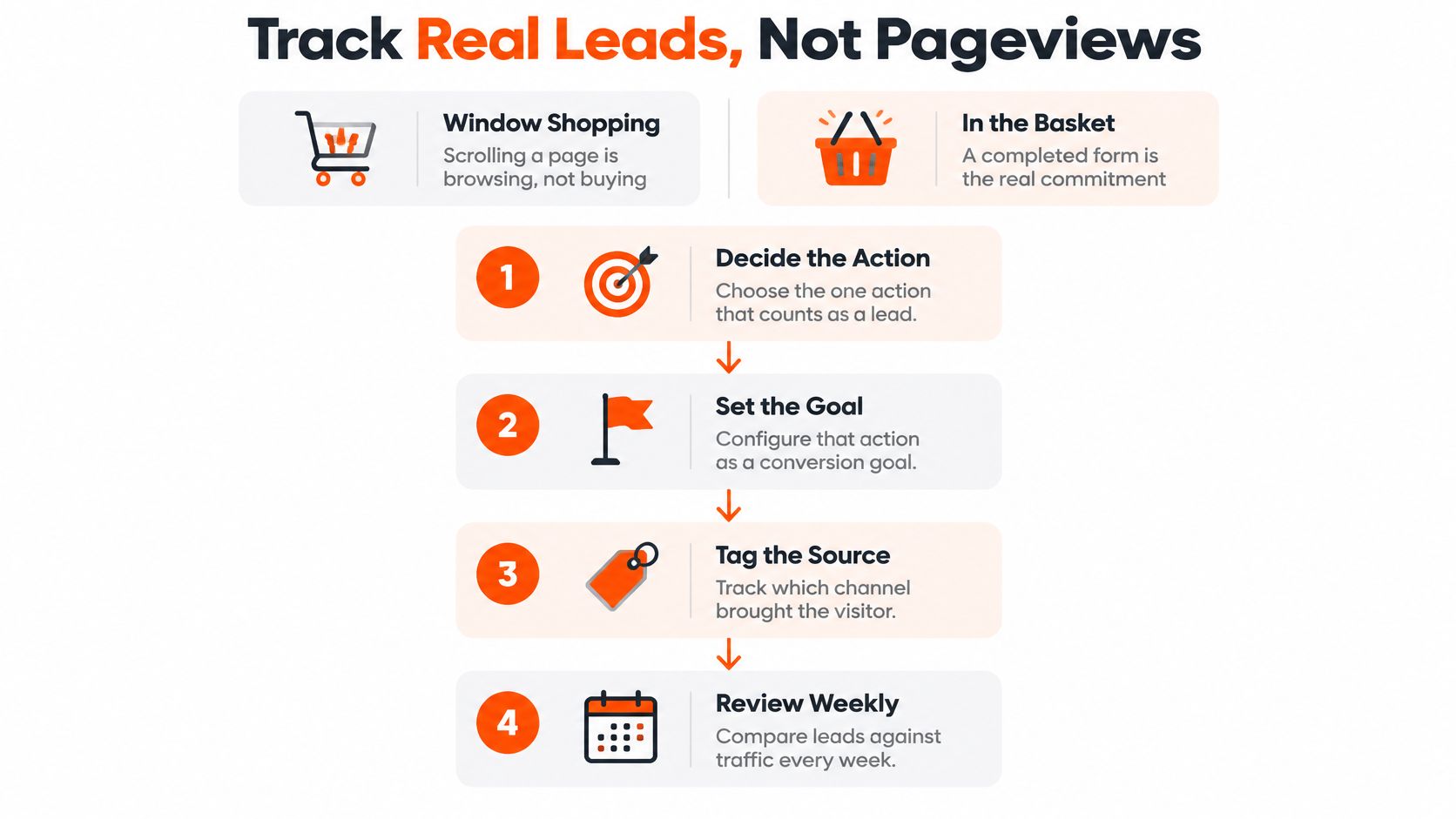
Configure the action that actually happened
Define a lead. Choose a successful form submission or a genuine confirmation-page visit. This prevents ordinary reading activity from inflating the lead count.
Name events by action, such as lead_form_submit for a verified submission or generate_lead for a confirmation-page method. Names should describe what happened so reports remain understandable.
Separate starts from completions. Record when someone begins a form and when the submission succeeds. The gap helps reveal friction rather than merely weak interest.
Give newsletter, checklist, and consultation offers distinct identifiers or events. This keeps low-commitment subscriptions separate from sales inquiries.
Mark appropriate lead events as key events. Preserve the form name, offer, and landing-page context so each inquiry can be connected to its origin.
Report completed leads beside article sessions each month. Add CRM qualification and sales outcomes so the team can distinguish activity from useful demand.
Google's event-creation documentation explains submission-based and confirmation-page methods. Teams should choose a consistent implementation and prevent duplicate counting when both methods detect the same inquiry.
Read the funnel honestly
Consider a hypothetical article with 2,000 visits, 300 consultation-button clicks, 40 form starts, and 8 completed forms. The inquiry count is eight, not the much more photogenic button-click total.
For teams querying reports through an assistant, NotFair's guide to connect Claude to Google Analytics is a relevant implementation resource. Reporting access still depends on clean event definitions.
The embedded video provides an additional viewing option.
Connecting these actions to commercial outcomes also supports B2B content marketing ROI measurement. A final test should submit the form, confirm delivery to the CRM, and check GA4 DebugView or Realtime shortly afterward; standard reports can take longer to update.
Forms and Calls to Action That Do Not Scare Buyers Off
A long lead form resembles a restaurant that hands over a novel before accepting a sandwich order. The visitor wanted something useful, not an administrative side quest.
The FormBeam lead-capture optimisation guide summarises benchmarks indicating that each additional field reduces conversion by approximately 4.1% on average, while B2B forms with more than five fields can show roughly 30% lower conversion than shorter alternatives. These are directional benchmarks, not a guaranteed forecast for a particular form.
Ask only what the next step needs
Progressive profiling means collecting information gradually. An initial consultation request might need work email, name, company, and a relevant qualifier; project details can follow after the prospect receives value or begins a conversation.
Not every offer needs even that much. A downloadable checklist shouldn't require the same information as a technical implementation assessment.
YouTube acquisition article: Offer a channel audit or content roadmap.
Ad-fatigue article: Offer a creative testing plan.
Implementation article: Offer a scoped conversation about requirements and constraints.
The promise should remain consistent from button to form to confirmation message. An audit button that opens a generic contact page creates an unnecessary guessing game.
Remove friction without removing qualification
Kiwiform's logic-driven form builder comparison is useful when evaluating conditional questions, where later fields appear only when an earlier answer makes them relevant. Teams should also test validation messages, keyboard behaviour, and submission on a phone.
A conversion-focused website design approach connects the offer, page layout, form, and follow-up rather than treating them as unrelated decorations.
Form test: List each CTA, write its promise beside it, and remove any field that isn't needed to deliver that promise.
Judge the result by qualified-lead rate, meeting rate, and pipeline per visitor. A shorter form that produces more spam isn't an improvement, just a busier inbox.
Writing for Scanners and AI Answer Engines
Readers often inspect a page before deciding whether it deserves careful attention. In historical web-reading tests published in 1997, Nielsen Norman Group found that 79% of tested users scanned new pages, while 16% read word by word.
That finding isn't a current B2B conversion benchmark. It is a useful reminder that headings, short paragraphs, and visible evidence need to communicate the argument without requiring a reading retreat.
The image reinforces that emphasis on visible takeaways.

Make the useful parts easy to find
Answer early: A suitable opening might explain that missing lead tracking can make working articles appear ineffective.
Name the reader: For example, the guidance applies to SaaS teams selling complex subscriptions.
Show a measurable outcome: Use a verified result, or clearly label a worked example as hypothetical.
Explain the process: Describe checking submissions, validating delivery, and reviewing qualification.
Include a concrete example: Show how a checklist offer supports an implementation article.
Answer objections: A short FAQ can explain whether a technical consultation requires preparation.
Give answer engines something distinctive
Forrester's 2025 buyer research reported that 94% of buyers used generative AI or conversational search. Some buyers may encounter a brand through a summary without visiting its website.
Original examples, first-party evidence, transparent comparisons, and detailed implementation guidance give publishers something distinctive to contribute. They aren't impossible to summarise, but they provide a reason to cite the source and investigate further.
Arriving readers still need a useful diagnostic, calculator, or demonstration. Teams should review branded searches, return visits, and self-reported discovery alongside submissions, rather than treating clicks as the entire story.
Choosing Between In-House, Freelance and Outsourced Video Workflows
Video editing outsourcing starts with a brief, not a folder called final-final-final. The team names the article, buyer stage, intended audience, and action the video should support.
Next come the raw footage, script, brand files, and delivery requirements. The editor produces a first cut, the team consolidates feedback into agreed revision rounds, and the editor exports the approved formats.
Video workflow options for B2B blog content
Option | Best for | Main trade-off
In-house editor | Steady monthly video volume | Salary cost and a single-person bottleneck
Freelance editor | Small batches and one-off explainers | Availability and uneven quality
Outsourced studio or agency | Regular output across several formats | Less direct control and a handoff to manage
Hybrid with in-house strategy and outsourced editing | Speed without losing message control | Coordination effort at each handoff
Keep message ownership clear
In a hypothetical SaaS workflow, the strategist writes a three-minute explainer for each buyer-stage article. The strategist owns the buyer question, claims, and CTA; the editor owns pacing, captions, sound, and the cut.
A hybrid arrangement can reduce production delays when the team supplies complete inputs and consolidated feedback. It doesn't remove the need for someone inside the business to approve technical accuracy.
Before selecting a workflow, the team should:
Review matching samples: Evaluate work in the intended format, not an unrelated cinematic showreel.
Agree on delivery: Record turnaround expectations and revision rounds.
Clarify ownership: Establish access to source files, graphics, and final exports.
Run a pilot: Test the brief and review process before committing to a longer engagement.
The best arrangement is the one the team can operate consistently without turning every explainer into a miniature film festival.
Real Cases Where Traffic Became Pipeline
ContentBuck published 12 articles in 3 months targeting the searches of a B2B operations software company's buyers, taking the company from zero to 34,000 monthly visitors. The commercial context matters alongside that visibility.
Tom from OpsGrid described the change:
“We were completely invisible on Google. ContentBuck changed that in 3 months. We are now getting real inbound demo requests from people who found us through articles. That has never happened before.”
Separately, a ContentBuck project management SaaS video titled How We Built a $2M Inbound Pipeline Using YouTube generated 180+ inbound leads. Those results don't establish that every visit or video view becomes an inquiry.
Hypothetical applications
Operations software scenario: Before, every educational article ends with the same demo button. The team introduces stage-matched offers and comparison links, then discovers which articles generate completed inquiries and qualified conversations.
Project management SaaS scenario: Before, a how-to video earns views without identifiable demand. The team adds a checklist tied to the demonstrated workflow and measures completed checklist requests by video.
These scenarios illustrate possible implementation choices, not additional claims about those customer projects. Any organisation turning them into its own case study should replace the illustrative details with its actual records.
The shared lesson is specific buyer question, relevant next step, verified business outcome. Traffic earns attention; evidence of inquiries and sales progression establishes commercial value.
Common Questions About Blog Traffic and Leads
Questions teams ask before changing the blog
Is a small number of visits enough to judge an article?
A few hundred monthly visits can reveal a lead signal, but a small sample can also mislead. A practical review window is at least 60 days, treated as a working checkpoint rather than a universal benchmark; a specialist integration article may matter even with modest reach.
How long before a new article starts producing leads?
Search content needs time to earn visibility, and ranking doesn't guarantee inquiries. ContentBuck states that its SEO content takes 60–90 days to start ranking, so an urgent pipeline gap needs other acquisition activity alongside publishing.
Should the Book a Demo button disappear?
It belongs on high-intent pages, including implementation and evaluation content. An introductory article can retain access to a demo while making a checklist or explainer the more suitable primary offer.
Do AI answer engines make blogs pointless?
They change where buyers first encounter information, not whether credible explanations matter. For example, an answer engine may introduce a vendor, while its implementation guide helps the buying team evaluate fit.
For publication, Article schema should describe the page accurately, and any FAQPage schema should match the visible questions and answers. Structured markup isn't a promise of enhanced search display, and keywords should describe genuine reader questions rather than decorate the page.
Pick One Lead Gap to Fix This Week
The team should select a single article, verify its lead event, and record the change being tested. A full-site makeover isn't required before a useful experiment can begin.
High sessions, weak completions: Check measurement and form delivery first.
Wrong audience: Rework the search-stage match and relevant internal paths.
Suitable readers, little action: Improve the visible evidence and CTA promise.
Run a controlled test
A 30-day test can compare a single change against the recorded baseline, with traffic mix and sample size noted before drawing conclusions. The earlier funnel check identifies where attention is most useful, not merely which dashboard number looks disappointing.
Buying committees also need time and different evidence. As Marketing Dive's discussion of B2B buying groups explains, a reader may share material with colleagues rather than immediately submit an inquiry.
ContentBuck's monthly reports track lead volume, proposal requests, win rates, and client value. That is the useful direction: an article, a focused change, and a business outcome worth measuring.
ContentBuck plans and produces B2B video-led acquisition systems, including buyer-intent SEO content, explainers, and YouTube content. Teams ready to connect article traffic with relevant offers and measurable inquiries can visit ContentBuck to discuss the gap between the content buyers consume and the next step they take.
Parth Jasrapuria
Founder at ContentBuck
Building video systems for B2B businesses. Obsessed with YouTube growth, creative strategy, and organic SEO.