YouTube Management Agency: What It Does and How to Choose
Parth Jasrapuria
Founder
A SaaS founder finally publishes a product video after months of delays. Say it gets 200 views, no obvious demo requests, and a polite thumbs-up from someone in accounting. The algorithm gets blamed, while the next recording sits untouched in a shared folder.
A YouTube management agency should fix the operating problem behind that scene, not just make the next video look nicer. For B2B companies, the job is to build a repeatable publishing system that connects buyer questions, useful videos, qualified attention, and commercial results.
What a YouTube Management Agency Actually Does
A YouTube management agency acts as a pit crew for the channel. The expert still drives, bringing product knowledge and a point of view. The crew handles the tyres, fuel, timing, and checks that stop the whole operation from becoming an expensive parking exercise.
In plain English, the agency plans the channel, helps make the videos, packages them so relevant people click, repurposes the material, and measures what happens next. Monetization support belongs in that job too, although platform advertising revenue and B2B sales revenue need separate reporting.
Core services a YouTube management agency covers
Service | What the agency handles | Typical output
Channel strategy | Audience research, topic roadmap, keyword plan | Quarterly roadmap and monthly strategy review
Scripting and production | Scripts, filming or screen recording, voiceover | Finished long-form episodes
Editing and captions | Cuts, pacing, b-roll, subtitles | Upload-ready video files
Thumbnails and titles | Packaging ideas and variant design | Thumbnail and title options to test
Search optimization | Keyword research, chapters, descriptions | SEO-ready upload page
Repurposing | Shorts, clips, podcast cuts, vertical versions | A scoped package of 3–7 short clips per long video or episode
Analytics and reporting | Dashboards and monthly review | Monthly performance report
Monetization support | Eligibility checks, policy review, milestone tracking | Clear milestone plan and account checklist
That clip count is a proposed deliverable, not an industry guarantee. Scope varies by agency, so proposals need checking against every row, including who records, approves, uploads, and maintains tracking.
ContentBuck's YouTube Growth, Podcast Video Agency, and SEO Content services illustrate a bundled approach. A company can connect video publishing with podcast distribution and written buyer education instead of managing disconnected suppliers.
Practical rule: Buy responsibility for a workflow, not a mysterious monthly quantity of “content.”
Production ownership doesn't have to be all or nothing. Nereo's guide to outsourcing AI video versus in-house production offers useful context for deciding which tasks stay internal and which need outside support.
According to Wyzowl data reported by HubSpot, 55% of businesses produced videos in-house, 14% outsourced production, and 31% used both approaches in 2025. A mixed model is normal; the useful starting exercise is to mark which table rows the existing team already covers reliably.
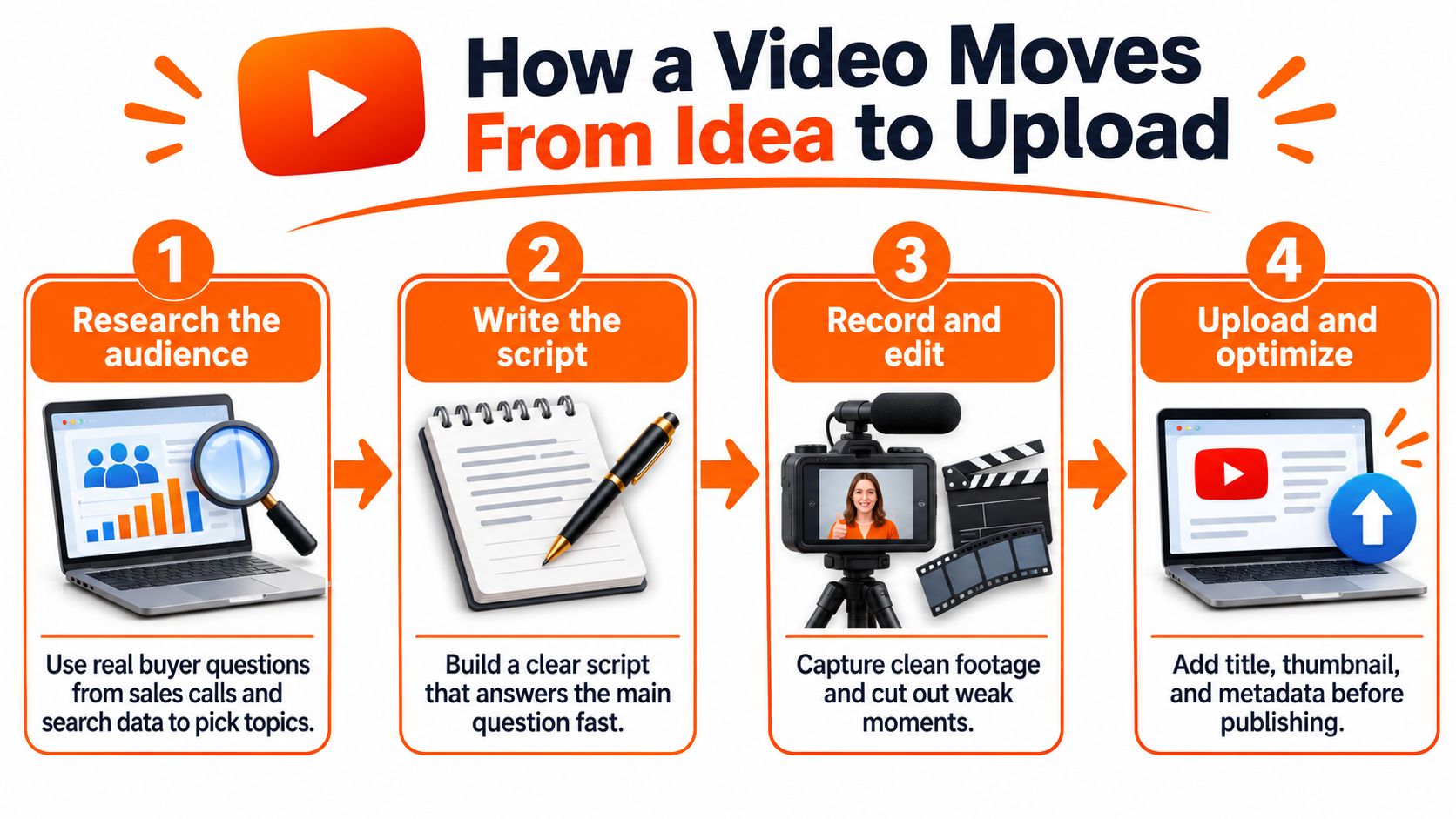
How a Video Moves From Idea to Upload
Good production works like a restaurant kitchen. The chef decides what the dish should taste like; the prep team chops the onions. Asking the subject-matter expert to handle every production task is how a useful explanation becomes a calendar invitation nobody accepts.
The repeatable production workflow
Research the audience and choose the question. Pull objections from sales-call transcripts, support tickets, and search queries. A topic such as payroll migration risks gives the script a clearer purpose than another general company update.
Start with the answer, then build the script around it. The opening should establish the problem, promised outcome, and reason to keep watching before company introductions take over.
Record the expert or product demonstration. Use a clean microphone, stable framing, and a screen recording that hides customer information. Accurate audio and a readable interface matter more than decorative office footage.
Edit for understanding rather than constant motion. Remove repeated explanations, add captions, and use chapters to separate meaningful tasks; a zoom effect can't rescue an unclear sentence.
Develop title and thumbnail options before upload. Check whether the promise makes sense without the script beside it. If nobody can summarize the value clearly, the topic may need tightening before editing finishes.
Prepare the upload page and schedule publication. Add a useful description, relevant terminology, chapters, and a destination that matches the topic, such as a migration checklist rather than an unrelated homepage.
Feed the review into the next script. At the monthly strategy review, inspect where viewers arrived, where they left, and whether relevant visitors took action. Assign an owner to each change so the same weak introduction doesn't return wearing a different shirt.
The production flow can be summarized visually:
ContentBuck's YouTube Growth plan includes four long-form videos per month, each with a full agency-written script. The client provides expert input, shows up, and approves, while the team handles scripting, editing, SEO optimization, thumbnails, and distribution.
Where AI should stop
AI can help summarize research, clean transcripts, prepare rough cuts, generate captions, and create format versions. Expert claims, customer evidence, permissions, and final narrative judgment should stay human. An editor should verify each factual statement against its original source, not against another AI summary.
YouTube's AI guidance says AI-enhanced storytelling can remain monetizable, realistic altered or synthetic content may require disclosure, and disclosure alone doesn't reduce reach or monetization eligibility.
The YouTube video production guide provides additional context for coordinating those handoffs. The important boundary is simple: automation can prepare material, but a named person must approve what the company publishes.
Packaging and Retention That Keep Viewers Watching
A useful video still needs a clear reason to click. Packaging works like a shop window: the display attracts attention, the experience inside keeps someone interested, and the value determines whether that person returns.
YouTube's performance guidance describes those stages as appeal, engagement, and satisfaction. Appeal concerns whether viewers choose to watch, engagement concerns whether they continue, and satisfaction concerns whether they enjoyed the experience.
Diagnose the stage that failed
Stage | What the agency examines | Practical response
Appeal | Impressions-to-views conversion by traffic source | Test a clearer promise or more readable thumbnail
Engagement | Early exits, skips, and strong retention segments | Remove delay and bring useful material forward
Satisfaction | Repeat viewing, post-watch behavior, and qualitative feedback | Check whether the video delivered the promised value
A high click-through rate isn't a complete victory. If the thumbnail promises a product comparison but the video opens with a sales pitch, viewers may leave quickly. Winning the click through a misleading promise can undermine the viewing experience and subsequent distribution.
For stronger opening ideas, Social Media Scheduler's hook ideas for social media managers can help generate alternatives. Those ideas still need adapting to a B2B buyer's actual question rather than copying consumer-style suspense.
A payroll tutorial with an avoidable problem
Suppose a payroll software company publishes a 12-minute tutorial, but viewers leave during the first 45 seconds because the presenter starts with company history. A sensible test would move the actual demonstration to second 10, remove the corporate introduction, and explain necessary context during the task.
Those timings describe a hypothetical edit, not a universal benchmark. The retention curve should determine whether the change helped.
A buyer looking for a payroll fix shouldn't have to attend the company's origin story first.
The agency should connect packaging versions with retention and conversion records, using the reporting fields in the measurement framework below. The guide to YouTube thumbnail design can support that packaging work.
SEO metadata supports discovery; it doesn't replace viewer value. Recommendations match content to viewers in context, not to a magic video length that every channel must obey.
Turning One Long Video Into Many Assets
Suppose a project management SaaS company records a 45-minute customer webinar about fixing unreliable project handoffs. Instead of uploading the recording and declaring victory, the team designs a small distribution package around its strongest explanations.
The job resembles cutting a useful ingredient for different dishes. The original material stays recognizable, but each serving needs preparation for its destination.
A shared review helps the team choose moments that stand alone:

Extract complete ideas, not random highlights
For this hypothetical webinar, a package of three to seven clips could address a customer objection, a workflow demonstration, a useful claim, and a clearly explained outcome. Each clip needs enough context to make sense without the full recording.
Give each derivative its own opening, captions, aspect ratio, thumbnail or cover treatment, and call to action. Vertical versions suit Shorts and Reels; square or widescreen versions can suit LinkedIn placements. The long-form version should retain chapters, searchable terminology, and relevant conversion paths.
Wistia research cited by Demand Gen Report found approximately 23% click-through rates for 30–60-minute videos, compared with roughly 1% for videos shorter than one minute. Those figures describe Wistia-hosted video, not YouTube benchmarks; they support testing useful depth, not making every explanation longer.
The embedded video offers another long-form asset to consider through that repurposing lens:
Prepare every destination
The Podcast Video Agency service provides 3–7 short clips per podcast episode, thumbnail design, and SEO show notes. That approach preserves the full conversation while creating separate entry points for buyers who aren't ready to watch an entire episode.
A practical video content distribution plan should assign the following fields before clips reach the publishing queue:
Hook: The specific problem or useful claim.
Aspect ratio: The version required by the placement.
Caption: Readable subtitles and accompanying post copy.
Thumbnail: A clear visual promise where supported.
Call to action: The relevant next step.
Destination page: The exact resource, demonstration, or booking page.
Measuring YouTube Results That Reach Revenue
Subscribers and views don't establish whether YouTube influenced qualified pipeline. B2B buyers can watch anonymously, return through branded search, and book a meeting through another channel. Treating the final click as the whole journey is like crediting the cashier for every decision made during a shopping trip.
Directive's B2B YouTube guide reports that 61% of B2B buyers prefer a largely rep-free buying experience, while 73% avoid suppliers that send irrelevant outreach. Useful self-serve video should therefore be measured as buyer education as well as direct response.
Metrics by asset role for B2B YouTube reporting
Metric | Asset it judges | What it tells the business
Qualified watch time | Long-form videos | Whether relevant viewers stay for real value
Returning viewers | Long-form videos | Whether the channel builds a following
Assisted conversions | Long-form videos | Whether YouTube helped a deal without being the last click
Meeting starts | Long-form videos | Calls that began after a recorded YouTube touch
Hold rate | Short clips | Share of viewers who stay past the opening seconds
Profile and channel visits | Short clips | Interest beyond an individual clip
Traffic contribution | Short clips | Website or booking-page visits attributable to clips
Qualified watch time needs an agreed definition. YouTube Analytics can't verify that every viewer matches the ideal customer profile, so teams should distinguish topic relevance and observable audience signals from confirmed account identity.
Connect the channel to the CRM
Use unique UTMs for video destinations and preserve those values on form submissions. Add CRM campaign membership, lawful video-engaged account audiences where available, post-view surveys, and sales feedback. Lift tests can strengthen evidence when the audience size and test design support a meaningful comparison.
For each production cycle, record:
Packaging and source: Title and thumbnail version, traffic source, and click-through context.
Viewing behavior: First-30-second retention, average percentage viewed, and end-screen clicks.
Commercial action: Qualified conversion events, meeting starts, proposal requests, and opportunity association.
Suppose a financial services firm notices shorter sales calls among accounts that watched several educational videos. That suggests influence, but those accounts may already have been better informed or more motivated. Correlation isn't proof that the videos caused the difference.
A channel with few direct leads may still help existing opportunities progress or reduce repetitive sales education.
The monthly performance review should cover watch time, search rankings, and lead submissions and proposal requests attributed to YouTube content. Reports should label attribution methods rather than presenting every associated opportunity as revenue caused by video.
During the opening week, establish UTMs, form-source capture, CRM campaign rules, conversion events, and a baseline. YouTube Analytics alone can't prove account-level buying intent, offline influence, or incremental revenue.
Monetization Milestones to Plan Around
A viral Short can contribute zero hours toward the long-form watch-hour requirement when watched in the Shorts Feed, according to YouTube's Partner Program guidance. That's an impressive way to run in place if the team is watching the wrong dashboard.
Monetization works like separate lanes at a checkpoint. Early feature access and advertising revenue have different entry requirements; reaching one doesn't mean the other gate opens automatically.
YouTube Partner Program thresholds to plan around
The same YouTube guidance sets out these eligibility routes:
Track | Subscribers | Public uploads in 90 days | Watch hours or Shorts views | What it unlocks
Expanded Partner Program | 500 | 3 valid public uploads | 3,000 qualified public watch hours in 12 months or 3 million qualified public Shorts views in 90 days | Features such as fan funding in eligible markets
Ad revenue route | 1,000 | No separate upload minimum stated for this route | 4,000 qualified public watch hours in 12 months or 10 million qualified public Shorts views in 90 days | Ad and YouTube Premium revenue sharing
Shorts Feed watch time | Not a separate eligibility route | Not a separate upload requirement | Not counted toward the 4,000-hour requirement | Qualified Shorts views contribute to the Shorts route
Suppose a cybersecurity consultancy has 600 subscribers. It may qualify for the expanded program if it meets the other conditions, but its founder shouldn't hear that the ad-money truck has arrived.
Turn eligibility into an onboarding checklist
The agency should check the account before building a monetization forecast:
Policy compliance: Review content against monetization policies and confirm there are no active Community Guidelines strikes.
Regional eligibility: Confirm the program is available in the channel's country or region.
Account security: Enable two-step verification and obtain advanced-features access.
Payment setup: Connect an AdSense for YouTube account.
Reporting: Keep expanded-program eligibility separate from advertising-revenue eligibility.
A hypothetical set of three Shorts can support discovery while the original long video contributes eligible public watch hours. Combining those activities into a single progress total would hide which requirement the channel is approaching.
Thresholds and availability can change. The agency should check the current help pages before making any commitment, and remember that meeting numerical thresholds doesn't replace policy review.
Choosing a B2B Partner and Starting a Six-Month Test
ContentBuck's founder believes most video agencies were built for consumer brands, and that consumer-style video doesn't work when the customer is a CFO or Head of Operations. The useful selection principle is narrower than rejecting all consumer techniques: a B2B partner must understand buyers, not just viewers.
Selecting that partner resembles hiring a specialist mechanic. A polished workshop matters less than whether the team can diagnose the particular engine in front of it. A portfolio full of lifestyle videos doesn't automatically demonstrate skill at explaining enterprise procurement or technical implementation.
B2B YouTube partner checklist
Criterion | Good sign | Red flag
B2B focus | Case studies from SaaS, IT services, or professional services | Portfolio limited to lifestyle or consumer vlogs
Measurement | Reports meetings, proposals, and pipeline influence | Reports subscribers and views only
Timeline | Sets a three to six month expectation with milestones | Promises leads within a week
Repurposing | Plans clips and captions alongside long videos | Delivers long videos with no derivative plan
Ownership | Named account manager and dedicated editor | Rotating freelancers with no single owner
Process | Written approval points and a shared project board | Client must script, film, and edit everything
The company states that YouTube is a three to six month investment and isn't suited to clients who need leads within a week. That's a planning expectation, not a guaranteed date for results.
A named account manager should own communication, while a dedicated editor maintains production continuity. Approvals belong on a shared project board with clear statuses, deadlines, and responsibility. Otherwise, the founder becomes the project-management software, usually with worse notifications.
Define the test before signing
Start with a Free YouTube Audit, which the company offers and which prospective clients can also request from other providers. The useful output is a diagnosis: audience fit, topic gaps, packaging weaknesses, retention problems, and tracking requirements.
A six-month test should specify what happens before anyone debates whether the channel is working:
Before launch: Agree on qualified watch time, meeting starts, and assisted conversions as the core evaluation metrics. Record the baseline and attribution limitations.
During production: Publish on the agreed schedule, document approvals, and log changes to topics and packaging.
At month three: Review whether the audience, viewing behavior, and commercial signals justify continuing the current approach or changing it.
At month six: Decide whether to continue, narrow the topic strategy, adjust production volume, or stop.
These are proposed review points, not performance promises. Low output caused by approval delays needs a different response from consistent publishing that attracts the wrong audience.
The strongest candidate should be able to explain a sample script, reporting template, and production handoff in plain language. Confidential client information isn't necessary to demonstrate a clear process.
A practical shortlist contains two or three partners scored against the same checklist. The publisher is one option, not the only one; the best fit is the team whose answers match the buyer, available expert time, and measurement requirements.
Frequently Asked Questions
What does a YouTube management agency cost?
Pricing depends on production scope, publishing volume, and responsibility. Comparable quotes need line-by-line services, outputs, and monthly deliverables, not just a headline fee.
How long until results show?
The publisher recommends planning for a three to six month investment. Promises of leads within a week aren't a sound basis for choosing an organic channel partner.
Is an in-house video team still necessary?
A full internal production team isn't essential when the agency owns execution. Internal experts still need to supply accurate knowledge, permissions, and approvals.
Will AI-assisted videos hurt monetization?
AI assistance doesn't automatically make a video ineligible for monetization. Realistic synthetic material may require disclosure, and the finished content still needs policy and editorial review.
How many subscribers are needed for ad revenue?
Subscriber count alone doesn't establish advertising-revenue eligibility. The channel must also satisfy the relevant viewing threshold and account requirements.
What should a Free YouTube Audit include?
An audit should review audience fit, topics, packaging, retention, and conversion tracking. Its recommendations should identify practical fixes and explain how pipeline influence will be evaluated.
ContentBuck offers a Free YouTube Audit alongside B2B YouTube Growth, scripting, editing, and repurposing services. Marketing teams can visit ContentBuck to request an audit and discuss a publishing system tied to buyer education, qualified meetings, and measurable pipeline influence.
Parth Jasrapuria
Founder at ContentBuck
Building video systems for B2B businesses. Obsessed with YouTube growth, creative strategy, and organic SEO.