YouTube Advertising Videos That Actually Convert
Parth Jasrapuria
Founder
YouTube ads could reach approximately 2.53 billion users worldwide in January 2025, representing about 45.5% of internet users, according to DataReportal's YouTube advertising data. That doesn't mean every reachable user watches every campaign, or that a software buyer will sprint from a pre-roll ad to a signed contract. It does mean YouTube advertising videos deserve a place in serious B2B planning.
The useful question isn't whether YouTube has reach. It's whether the script, edit, targeting, landing page, and CRM are designed as one system. A polished video that earns cheap views but no sales conversations is still an expensive screensaver.
Why YouTube Advertising Videos Belong in Your B2B Mix
India leads YouTube's national advertising reach with roughly 491 million reachable users, followed by the United States at about 253 million, Brazil at 144 million, and Indonesia at 143 million, according to the DataReportal data cited earlier. These figures describe addressable ad reach, not verified monthly active users. Use them as planning inputs, not as a literal audience census.
That scale gives B2B marketers room to build familiarity before a buying committee starts searching for vendors. A cloud-security company entering several markets can explain the category early, then support active demand with search, sales outreach, and market-specific landing pages. An account-based marketing team can introduce a product to target accounts on YouTube, use LinkedIn for job-title precision, and use Meta for retargeting and creative repetition.
The practical advantage is video's ability to carry the explanation. A product can show the workflow, demonstrate the interface, and make an unfamiliar problem easier to recognize. Those creative choices also determine what the CRM can measure later, from account engagement to qualified conversations.
Who should buy a YouTube slot
YouTube fits products that need to be shown, explained, or made familiar before a buyer requests contact. Strong use cases include:
Problem recognition: A finance leader sees how manual reporting creates avoidable work.
Category education: An animated example makes a new software category easier to understand.
Buying-committee reinforcement: A technical evaluator, finance owner, and executive encounter different cuts of the same message.
Global demand generation: Localized voiceovers, subtitles, and landing pages support several markets without rebuilding the campaign from scratch.
LinkedIn retains an advantage when the brief depends on narrow professional filters, such as a specific seniority level or function. YouTube becomes a poor fit when the creative has no visual demonstration, no memorable argument, and no plan beyond collecting views. A polished brand film can look excellent in a boardroom while giving a buyer nothing useful to remember or act on.
YouTube has developed from a basic placement channel into a creator-supported video system with measurable distribution. The documented history of YouTube advertising traces early advertising activity to a February 2006 promotion, the YouTube Partner Program to late 2007, and broader adoption of skippable TrueView advertising in December 2010. That history helps explain the current mix of auction targeting, creator distribution, skippability, and engagement signals.
The billing rule that shapes the opening
For skippable in-stream ads, Google counts a billable view when someone watches 30 seconds, watches the entire ad if it is shorter, or interacts with an interactive element, according to Google Ads' video-view guidance. In-feed ads use a 10-second watch threshold or a thumbnail click. Shorts ads use a 10-second watch threshold or a CTA click.
The skip option appears after five seconds, making the opening a commercial test rather than a decorative introduction. A generic logo animation can disappear before the viewer understands the offer. “Your sales team is losing leads in three places” gives the audience a concrete reason to continue.
Bumpers and non-skippable ads do not qualify for TrueView views, so their billing mechanics should not be compared directly with skippable campaigns. Procurement should define whether the campaign is paying for impressions, views, clicks, qualified leads, or pipeline. The script should reflect that decision. A view campaign can tolerate a broader opening, while a pipeline campaign needs a clear problem, proof, and next action.
Teams can use a reporting platform such as PostPulse YouTube platform integration to bring channel and campaign information into a broader operating view. For paid distribution tactics, see ContentBuck's guide to paid YouTube promotion. The operating goal is simple: connect exposure with account engagement, conversion quality, and sales follow-up.
Picking the Right Format for Each Funnel Stage
A useful format mix gives every ad a job. Shorts can make a problem recognizable, skippable in-stream can explain the product, non-skippable placements can deliver a compact proof point, and bumpers can remind an already-aware account why the brand belongs on the shortlist.
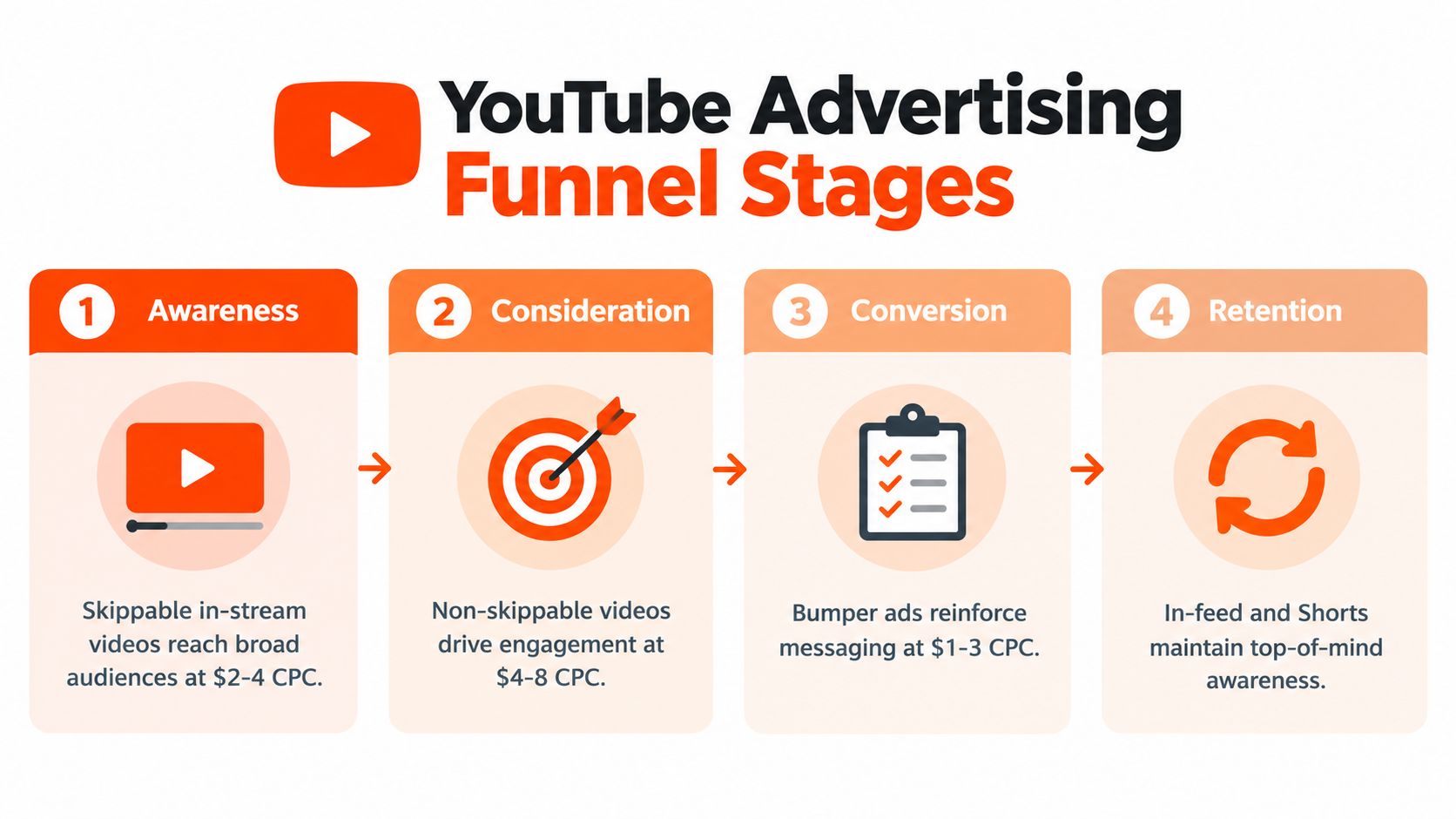
Skippable in-stream suits broad awareness and consideration. A workflow software company can lead with a recognizable operational problem, show the interface, and offer a guide. The viewer can skip, which makes the creative earn attention rather than assume it.
Non-skippable in-stream works for a short, tightly controlled message where every exposed viewer receives the same sequence. It's useful for a product launch or a concise trust statement, but weak scripts become especially painful when nobody can leave.
Bumper ads are reminders, not miniature product demos. A six-second message such as “Still reconciling reports manually? See the automated workflow” can reinforce an earlier explainer during retargeting. Asking a bumper to explain enterprise software is like asking a sticky note to host a workshop.
In-feed video ads belong near active discovery. A strong thumbnail and a useful promise can attract people already browsing related content. Shorts fit quick problem recognition, mobile-first retargeting, and sequential messages, but a vertical clip shouldn't carry the full burden of technical education.
Shorts inventory has grown in importance, yet a lower-cost reach opportunity doesn't automatically produce better pipeline. A vertical hook may attract attention while failing to establish credibility for a complex purchase. The sensible answer is a sequence, not a format loyalty oath.
Creative Strategy Using Google's ABCD Framework
Google's ABCD framework gives B2B producers a practical quality check: attention, branding, connection, and direction. Use each element as a decision gate before approving a concept or spending on distribution.
Attention: Does the opening identify a problem, audience, tension, or unexpected visual?
Branding: Can viewers recognize the company early enough for attribution to survive a skip?
Connection: Does the story show a human consequence, a concrete workflow, or a credible product outcome?
Direction: Does the viewer know the single next action?
Google's analysis of 778 YouTube videos and 73 creative attributes found that 13 principles accounted for approximately 80% of sales impact. It also associated execution that improved from poor to optimal with as much as a 1.7× increase in ROI, as reported in Google's YouTube creative effectiveness analysis. Ads with a clear path to purchase produced an average 5.7% ROI improvement, although only 27% of campaigns included one.
A SaaS explainer that starts with four seconds of music, a logo, and a slow office shot may look polished, yet it gives viewers little reason to stay or act. A stronger version opens with a finance manager switching between three spreadsheets, names the brand before the skip point, shows the automated workflow, and ends with one invitation to book a demo.
Practical rule: If an editor can remove the brand, problem, or next action without changing the story, the script has not done its job.
Score each ABCD element as weak, usable, or strong. Require one revision for every weak mark, then check whether the change affects the landing page, audience, or CRM event you plan to measure. Creative and media decisions should stay connected from the brief through pipeline reporting. Teams that need a broader planning model can use ContentBuck's ad creative strategy guide. A commercial can look excellent in a boardroom and still waste budget if viewers cannot tell what it sells.
Scripting Hooks, Bodies, and Calls to Action That Scale
A scalable B2B script has four movements: hook, relevance, proof, and direction. The hook earns the next few seconds. Relevance tells the right buyer why the problem matters. Proof makes the claim believable. The CTA gives the viewer one sensible next action.
A SaaS demo ad might begin: “Your sales team isn't losing leads in one place. It's losing them during handoffs.” The body shows a lead moving from form submission to owner assignment, then displays the product outcome. The CTA asks the viewer to book a demo, not to “learn more,” “follow the journey,” and “reimagine growth” in one breath.
An agency credibility ad needs a different proof mechanism. It can open with a producer holding a messy client brief, cut to the cleaned script and multiple edits, then explain how one source interview becomes ads for several placements. The CTA can invite a production consultation because the viewer is buying capability and reliability, not a software trial.
A thought-leadership retargeting ad can be calmer. It might open with a disputed assumption, add one useful explanation from a longer interview, and direct an already-engaged viewer to a detailed guide. The CTA belongs later because the audience has more context.
One source recording can support three cuts:
Short hook cut: One sharp problem statement and one visual proof point.
Mid-length proof cut: The problem, workflow, and outcome.
Longer explainer: Context, objections, demonstration, and a direct CTA.
The funniest hook mistakes often sound like this: “Welcome to our company overview,” “In today's rapidly changing world,” and “We're excited to announce.” None of these lines is illegal. They're excellent ways to give the skip button a promotion.
A useful brief states the audience, opening line, proof asset, desired action, and one thing the editor must never bury.
Specs, Files, and Creative QA That Save Disapprovals
Production errors rarely look dramatic. A hidden CTA, unreadable captions, or a badly cropped face can weaken a campaign long before a platform warning appears.
Google accepts practical targets for horizontal, vertical, and square video. The Google Ads video asset specifications recommend 1920 × 1080 for horizontal video, 1080 × 1920 for vertical video, and 1080 × 1080 for square video. 720p versions are accepted, the maximum file size is 256 GB, and Google recommends MPEG-2 or MPEG-4 files, while MP4, MOV, AVI, WebM, ProRes, and HEVC may also be accepted.
Format | Resolution | Aspect Ratio | Max File Size
Horizontal | 1920 × 1080 | 16:9 | 256 GB
Vertical | 1080 × 1920 | 9:16 | 256 GB
Square | 1080 × 1080 | 1:1 | 256 GB
A safe production workflow keeps the subject, headline, and CTA inside a central area that survives cropping. Teams preparing reframing horizontal footage for Shorts should treat vertical editing as a composition task, not a crop button with a marketing degree.
The pre-flight pass
Audio: Check that dialogue is clear, music sits underneath the voice, and the opening doesn't arrive at a whisper.
Captions: Review spelling, timing, contrast, and mobile readability. Captions shouldn't cover product controls or the CTA.
Branding: Show the brand naturally before the viewer can skip, without turning the first seconds into a logo ceremony.
End-screen: Confirm the URL, button language, offer, and legal text match the landing page.
Safety: Review claims, customer permissions, music licensing, stock footage, and category restrictions before upload.
Variants: Export horizontal, vertical, and square cuts from a deliberate edit, not from an emergency resize.
A Testing Framework That Actually Moves the Needle
A stronger view rate can still produce weaker pipeline. B2B teams lose that distinction when they change the hook, audience, bid strategy, landing page, offer, and CTA in one launch, then label the result a test. That is a creative lottery with a spreadsheet attached.
Treat each creative decision as a measurement decision. Hold the audience, placement, bid strategy, and landing page steady while testing one major variable. Start with the first five seconds, then examine proof, offer framing, and CTA. The Google creative study cited in the ABCD section also associates humour with the highest average ROI impact in the study at 6.9%, while humour appeared in only 10% of campaigns. The practical lesson is not to force jokes into every cybersecurity ad. Underused devices deserve controlled tests when they suit the buying context and brand.
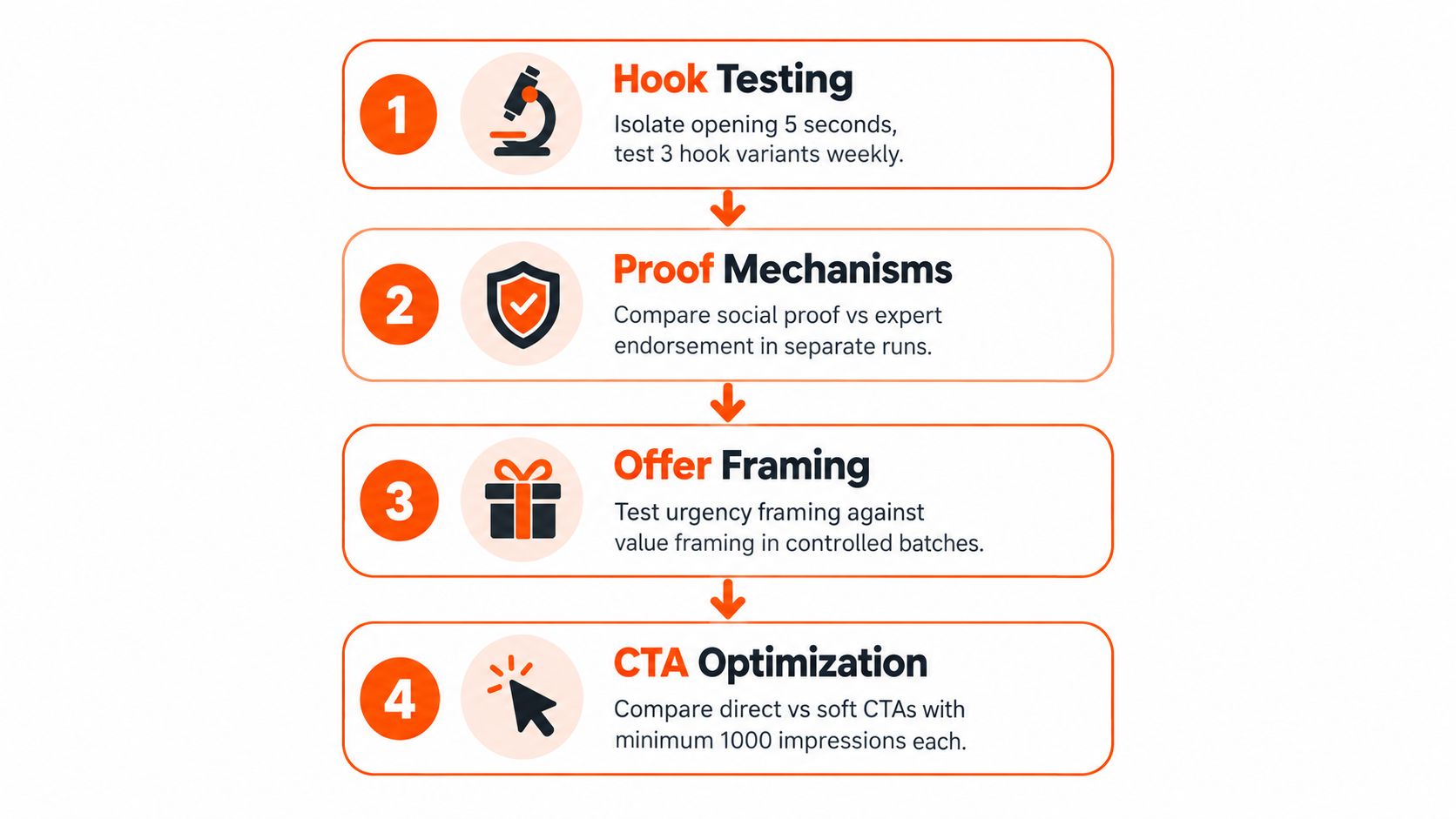
A useful test sheet separates the variables:
Hook: Compare a cost problem with a workflow problem.
Proof: Compare a product demonstration with customer evidence.
Offer: Compare a diagnostic asset with a demo invitation.
CTA: Compare a direct booking request with a lower-friction guide download.
The testing visual suggests three hook variants weekly and a minimum of 1,000 impressions per CTA variant. Treat those as operating rules, not statistical guarantees. Before launch, set the confidence threshold, conversion volume, sales-cycle length, and stopping rule your team will use.
A cut with stronger view rate and more completed views may still lose to one that generates fewer views but more qualified form submissions. The latter can be the commercial winner. Google's support material gives 10–15% as an average in-stream view-rate range across industries and explains that targeting, placement, creative, and format affect performance, as described in Google's view-rate guidance. View rate is an early diagnostic, not a pipeline verdict.
For a practical operating model, use ContentBuck's ad creative testing guide. Promote the variant that helps qualified accounts progress through the CRM, even when another version makes the platform dashboard look better.
Measuring Pipeline, Not Just Views
A view is an exposure event with a definition. It isn't a sales opportunity, and it certainly isn't revenue.
The measurement plan should separate exposure, view, engagement, conversion, opportunity creation, and revenue. For skippable in-stream ads, a click can create both a click and a view. TrueView views shouldn't be compared directly with bumper or non-skippable formats because those formats don't use the same view definition.
Build the CRM connection first
Every creative needs a unique campaign or asset identifier that follows the viewer to the landing page and into the CRM. The reporting chain should show:
Account exposure: Which target companies received impressions or meaningful views?
Qualified engagement: Which accounts clicked, watched deeper content, or returned to the site?
Sales acceptance: Which leads became sales-accepted conversations?
Pipeline: Which opportunities were sourced by YouTube, and which were influenced by it?
Revenue: Which closed deals include YouTube in the documented journey?
“Sourced” and “influenced” shouldn't be merged. A YouTube ad that introduces a company before an organic search conversion may have influenced the deal without being the final click. A platform-reported view-through conversion can be useful for diagnosis, but it doesn't prove that the ad caused the purchase.
Customer-source surveys add a simple human check. A form can ask, “How did you first hear about the company?” Sales representatives can ask the same question during discovery. The answers won't replace attribution, but they can reveal dark exposure that analytics misses.
Use lift studies when clicks understate the job
Google describes Brand Lift as a free measurement tool for video campaigns that compares people exposed to an ad with a randomized control group. It can evaluate ad recall, brand awareness, brand association, consideration, favorability, and purchase intent, with measures including absolute lift, relative lift, headroom lift, baseline positive-response rate, exposed positive-response rate, lifted users, and cost per lifted user, according to Google's Brand Lift documentation.
That matters for a SaaS company running category education. A video may generate few immediate demo clicks while improving recognition and consideration among exposed viewers. Brand Lift doesn't turn every soft signal into pipeline, but it can show whether upper-funnel creative is doing the job assigned to it.
Holdout testing supplies another layer. A marketer can exclude a comparable audience or geography from the campaign, then compare qualified account engagement, opportunity creation, and revenue progression against the exposed group. The comparison needs clean setup and enough time for the B2B sales cycle. It should also account for other campaigns that may reach the same accounts.
Repurpose one interview without exhausting the team
A sales interview, founder podcast, or product demonstration can produce a useful sequence:
Three-second hooks: Several problem statements built around different buyer pains.
Fifteen-second proof cuts: One demonstration, objection response, or customer observation.
Thirty-second problem-solution ads: A complete narrative with brand and CTA.
A bumper: One memorable reminder for retargeting.
The production team can publish the short hook for recognition, use the proof cut for engaged viewers, and reserve the fuller explanation for people who need context. Creative refreshes should follow performance signals, but not every weak result requires a new production day. Often the issue is a buried brand, an unclear offer, or a CTA aimed at the wrong buying stage.
Boardroom test: If the report can't show how YouTube exposure relates to qualified accounts and opportunity progression, it's a media report, not a pipeline report.
FAQs
Are YouTube advertising videos suitable for complex B2B products?
Yes, when the campaign uses sequencing. Short creative can identify the problem, while longer in-stream assets demonstrate the workflow and address objections. A single short ad shouldn't be forced to explain an enterprise product, prove trust, and close a deal before the viewer finds the remote.
What should the first five seconds contain?
The opening should establish audience relevance, problem tension, or a compelling visual. It should also introduce the brand early enough that attribution survives a skip. A logo-only opening usually asks the viewer to care before giving a reason.
Should a B2B campaign optimize for views or leads?
Views help diagnose attention, but qualified leads and pipeline should decide the commercial winner. Google's view-rate guidance identifies 10–15% as an average in-stream range across industries, while noting that results vary by campaign conditions, so the figure is directional rather than a success target.
How should teams use Shorts for B2B?
Use Shorts for fast problem recognition, retargeting reminders, and sequential messages. Use longer in-stream or explainer assets when the buyer needs technical detail, proof, or a clearer product demonstration. Lower-cost reach doesn't automatically equal better opportunity quality.
What should a YouTube video ad brief include?
The brief should name the target buyer, funnel stage, opening hook, proof mechanism, brand moment, CTA, landing page, required aspect ratios, tracking identifier, and success metric. It should also state what the editor must not hide behind captions, interface controls, or an overenthusiastic transition.
ContentBuck produces B2B YouTube advertising videos with hook writing, full ad scripts, editing, captions, platform-ready formats, and ongoing creative variants. Teams that want the video tied to distribution and CRM outcomes can visit ContentBuck and discuss the next campaign.
Parth Jasrapuria
Founder at ContentBuck
Building video systems for B2B businesses. Obsessed with YouTube growth, creative strategy, and organic SEO.